Chapter 2: Syntax and Semantics of Propositional Logic
 Studied by 0 people
 Call Kai
 Learn
Learn Practice Test
 Spaced Repetition
 Match
Match Flashcards
 Knowt Play
1/13

There's no tags or description
Looks like no tags are added yet.
Name | Mastery | Learn | Test | Matching | Spaced |
|---|
No study sessions yet.
14 Terms
Sentence letters are…
P, Q, R, P₁, Q₁, R₁, P₂, Q₂, R₂ and so on
Sentences of 𝐿₁ are…
All sentence letters,
If Φ and Ψ are, then ¬Φ, (Φ ∧ Ψ), (Φ ∨ Ψ), (Φ → Ψ) and (Φ ↔ Ψ) are too,
Nothing else.
Bracketing convention 1
The outer brackets may be omitted from a sentence that is not part of another sentence.
Bracketing convention 2
The inner set of brackets may be omitted from a sentence of the form ((φ∧ψ) ∧χ) and analgously for ∨.
Bracketing convention 3
Suppose ⬦∈{∧, ∨}and ⚬∈{→, ↔}. Then if (φ⚬(ψ⬦χ)) or ((φ⬦ψ)⚬χ) occurs as part of the sentence that is to be abbreviated, the inner set of brackets may be omitted.
An 𝐿₁-structure is…
an assignment of exactly one truth-value (T or F) to every sentence letter of 𝐿₁.
Truth in an 𝐿₁-structure.
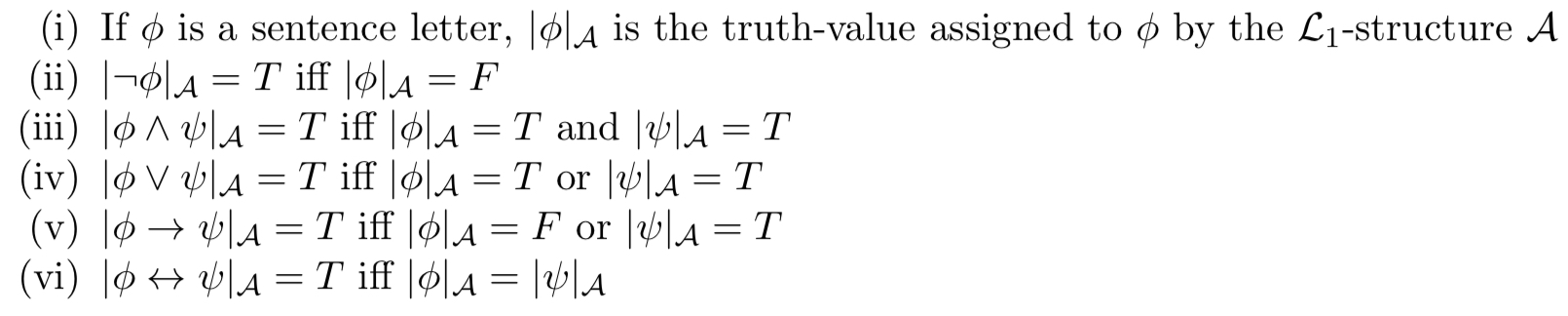
Truth tables for each logical connective
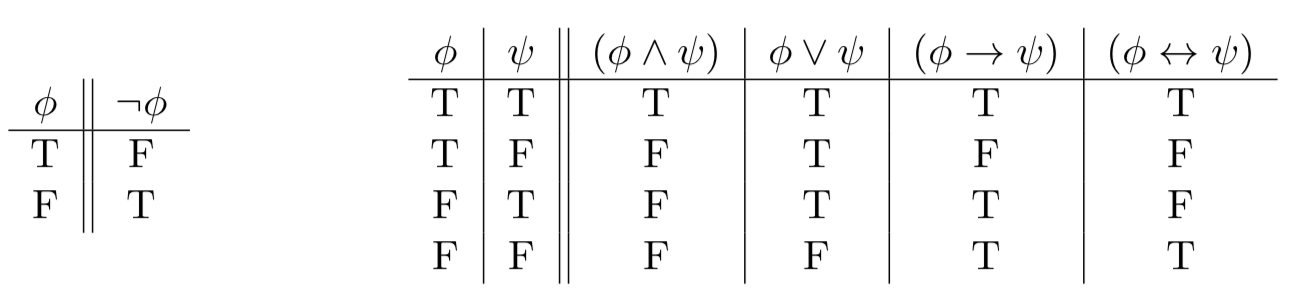
A sentence Φ of 𝐿₁ is logically true iff…
Φ is true in all 𝐿₁-structures.
Any sentence Φ of 𝐿₁ is a contradiction iff…
Φ is not true in any 𝐿₁-structure.
A sentence Φ and a sentence Ψ are logically equivalent iff…
Φ and Ψ are true in exactly the same 𝐿₁-structures.
Logical Validity
Let Γ be a set of sentences of 𝐿₁ and Φ a sentence of 𝐿₁. The argument with all sentences in Γ as premisses and Φ as conclusion is valid if and only if there is no 𝐿₁-structure in which all sentences in Γ are true and Φ is false.
An 𝐿₁-structure is a counterexample…
to the argument with Γ as the set of premisses and Φ as conclusion if and only if |Ψ|A = T for all Ψ ∈ Γ and |Φ|A = F. Therefore, an argument in 𝐿₁ is valid if and only if it does not have a counterexample.
A set Γ of 𝐿₁-structures is semantically consistent iff…
there is an 𝐿₁-structure A such that |Φ|A = T for all sentences Φ of Γ.