BIOL 155 (L1)
 Call Kai
 Learn
Learn Practice Test
 Spaced Repetition
 Match
Match Flashcards
 Knowt Play
1/34

Earn XP
Description and Tags
Lecture 1
Name | Mastery | Learn | Test | Matching | Spaced | Call with Kai | Chat |
|---|
No analytics yet
Send a link to your students to track their progress
35 Terms
homeostasis
Maintain a stable internal environment by regulating variables around their set points.
mechanism for maintaining homeostasis & components
negative feedback; sensor → integrator → effector
sensor: detects change
integrator: compares change to set point and determines what needs to be done, sending the command to effector
effector: returns the change to set point
allostasis
anticipate future physiological demands by changing set point or behaviour before demand occurs.
behavioural allostasis
conscious performance of behaviours that anticipate future physiological demands (feed forward)
physiological allostasis
automatic physiological change in set point that anticipates future physiological demands (feed forward)
which ions are common in extracellular fluid?
Na+, Cl-, Ca2+
which ions are common in intracellular fluids (aka cytosol)?
K+, large anions
(SO1) name the 4 main types of tissue and give examples of where in the body each is likely to be found (or classify a tissue in an organ diagram based on these 4 types)
Epithelial tissue
Covers exposed surfaces & provides physical protection
Lines internal passages and chambers
Forms secretory glands
Sensory reception
Control permeability
Where: skin, digestive tract, respiratory system, urinary & reproductive tract
Connective tissue
Fills internal spaces
Provides structural support
Stores energy
Where: dermis, bones, cartilage, forms tendons (attaching muscle to bone)
Muscle
Contracts to produce movement
Types:
Skeletal
Where: attached to bones via tendons, diaphragm, biceps
is under voluntary control
Cardiac
Where: exclusively in heart walls
Smooth muscle
Where: walls of hollow visceral organs (e.g. stomach, intestines, bladder, uterus)
responsible for involuntary contractions that push materials through internal passageways
Nervous
Sends and receives information from electrical impulses
Where: brain, spinal cord, nerves, ganglia
(SO2) Describe or identify the shared features of epithelial tissue, including glands, such as cellular polarity, intercell junctions, and the basement membrane
Functions: provide physical protection, control permeability, provide sensation, produce specialized secretions
Cellular polarity/polarization of epithelial cells: apical surface & basolateral surface
(SO3) Classify an example epithelial tissue based on key structural or physiological features (simple/stratified, squamous/cuboidal/columnar, leaky/tight)
Leaky tight junctions - allow paracellular transport of water and solutes
Tight tight junctions - do not allow paracellular transport
Different types of epithelial tissue have different cellular and tissue structures specialized for different functions
Simple epithelia: one layer
Stratified epithelia: multiple layers
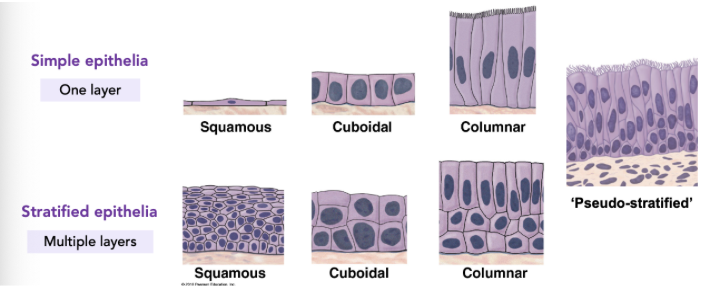
(SO4) Explain the basic definition of connective tissue and classify whether a tissue is a connective tissue or not based on a description. List the branches of connective tissue and examples, and functions of connective tissue.
Connective tissue = presence of extracellular protein fibres and cells suspended within a ground substance (matrix), but can fulfill many functions
Branches:
Connective tissue proper
Loose
Areolar tissue
Adipose tissue
Reticular tissue
Dense
Dense regular
Dense irregular
Elastic
Fluid connective tissues
Blood
Lymph
Supporting connective tissues
Cartilage
Hyaline cartilage
Elastic cartilage
Fibrocartilage
Bone
Functions:
Establish a structural framework for the body
Transport fluids & dissolved materials
Protect delicate organs
Support, surround, and connect other types of tissue
Store energy
Defend body from invasive microorganisms
(SO5) Compare and contrast the structure and general functions of loose & dense connective tissue proper.
Connective tissue proper types → LOOSE & DENSE
Loose connective tissue
Lower density of extracellular fibers
Greater diversity of cell types
Ex. areolar tissue
Dense connective tissue
Higher density of extracellular fibres
Fewer diversity of cell types
Ex. tendon
Connective tissue proper contains extracellular fibres (elastin fibres & collagen fibres)
Elastin fibers
Stretch & recoil
Collagen fibers
High tensile strength (strong but not stretchy)
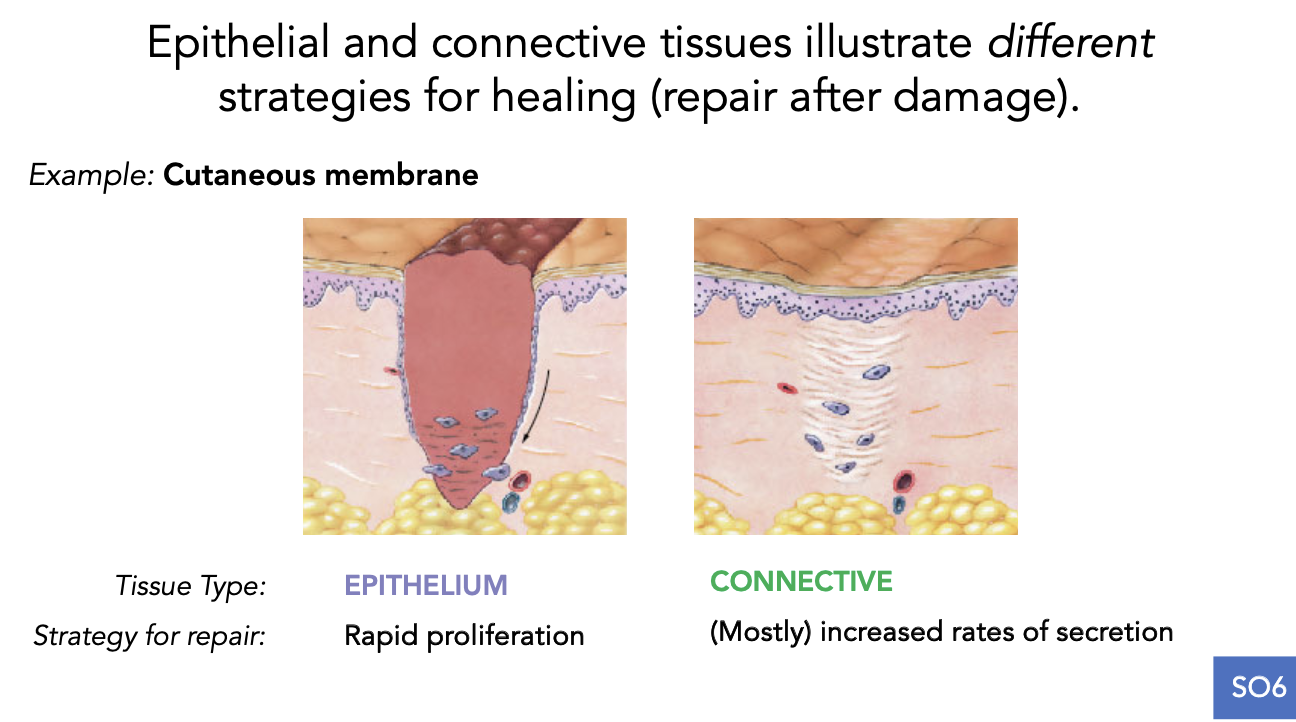
(SO6) Describe the key features of tissue repair in proper connective tissue, and predict consequences for the organism if a component of the repair process is disrupted
Epithelial & connective tissues illustrate different strategies for healing (repair & damage)
Tissue type: strategy for repair
Epithelium: rapid proliferation
Connective: increased rates of secretion
General set of defence mechanisms are activated when a connective tissue is injured
Clot - forms out of blood tissue
Scar - forms when a dense web of collagen fibres is secreted at the injury site
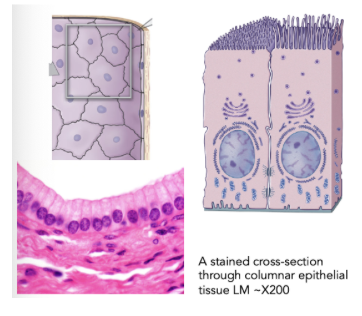
what tissue type
epithelial
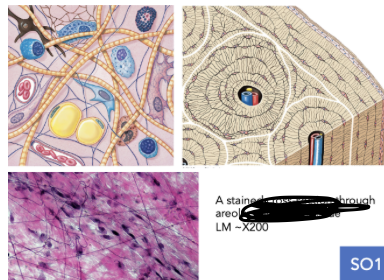
what tissue type
connective
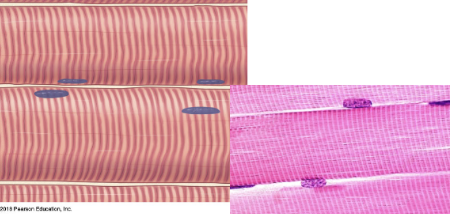
what main tissue type AND specific type?
muscle tissue
skeletal muscle cross section
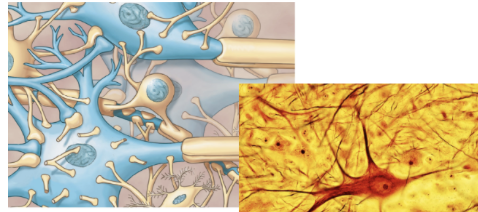
tissue type?
nervous tissue
What do muscle and nervous tissue contain and why? Provide specific examples.
Contain highly specialized cells adapted for specific physiological roles
Muscle tissue: Contract + produce mechanical force
Nervous tissue: Send + receive information in form of electrochemical signals
Which tissue types are more diverse in their functions, specializations, and location?
Epithelial & connective tissues
What’s epithelium? What are the branches of epithelial tissue?
Epithelium = sheet of connected epithelial cells to a basement membrane
Epithelial tissue includes:
Epithalila
Glands
Exocrine glands
Endocrine glands
In what ways are the cells in an epithelium bound to each other? List the intercellular connections and basement membrane connections.
Intercellular:
Tight junctions
Adhesion belt
Gap junctions
Desmosomes
Basement membrane:
Basal lamina
Reticular lamina
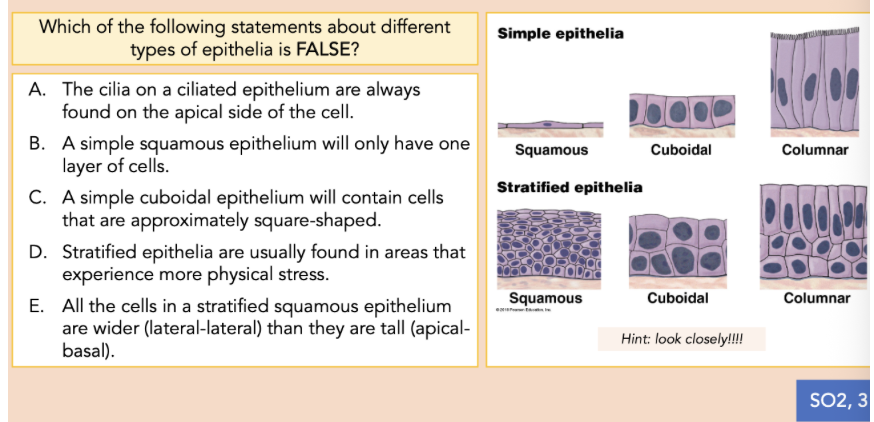
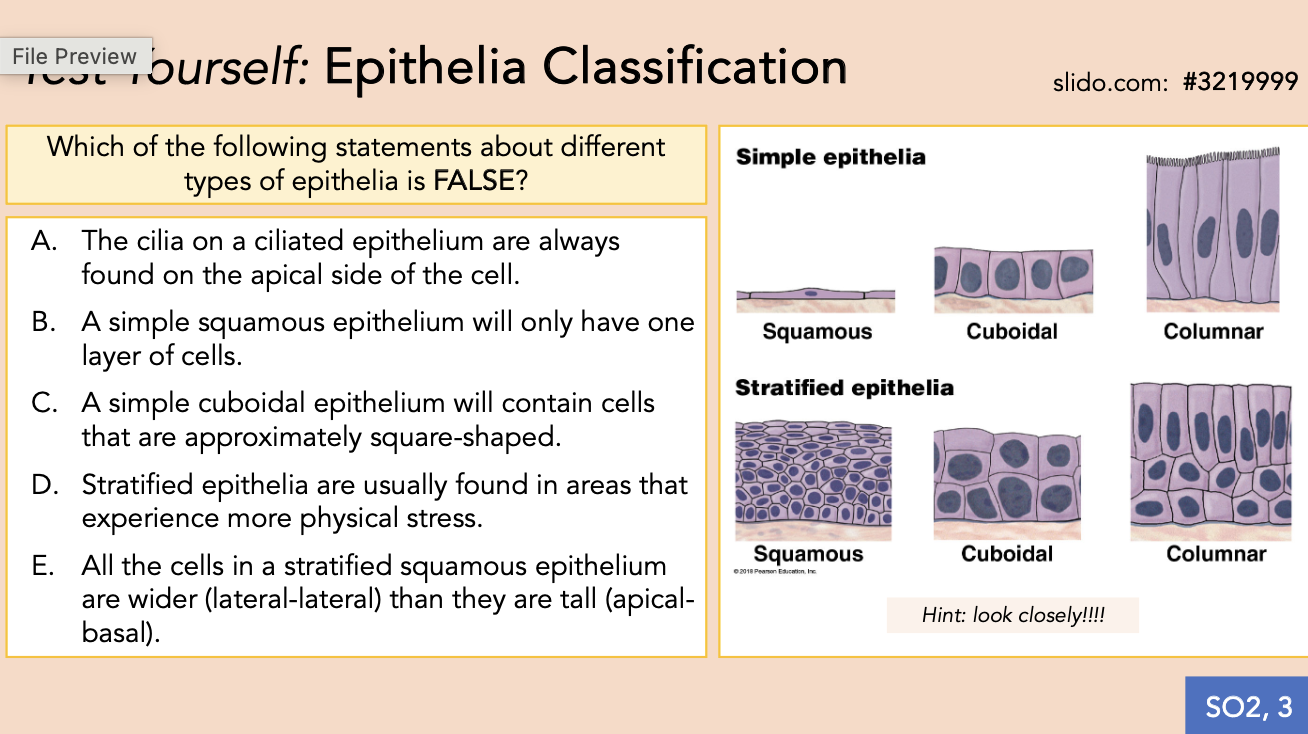
A - T: Cilia on a ciliated epithelium are always found on the apical side of the cell
B - T; A simple squamous epithelium will only have one layer of cells
C - T: Simple cuboidal epithelium will contain cells that are approx. square-shaped
D - T: Stratified epithelium are usually found in areas that experience more physical stress
E - F: All cells in a stratified squamous epithelium are wider (lateral-lateral) than they are tall (apical-basal)
List the different cell types can be found in loose connective tissues
Wandering cells
move into/through tissue depending on physiological demands
Fixed cells
remain permanently in the tissue
Mesenchymal cells
stem cells that can divide to replace damaged cells (fibroblasts)
Fibroblasts
secrete the proteins of the extracellular matric
Fibrocytes
maintain the proteins of the extracellular matrix
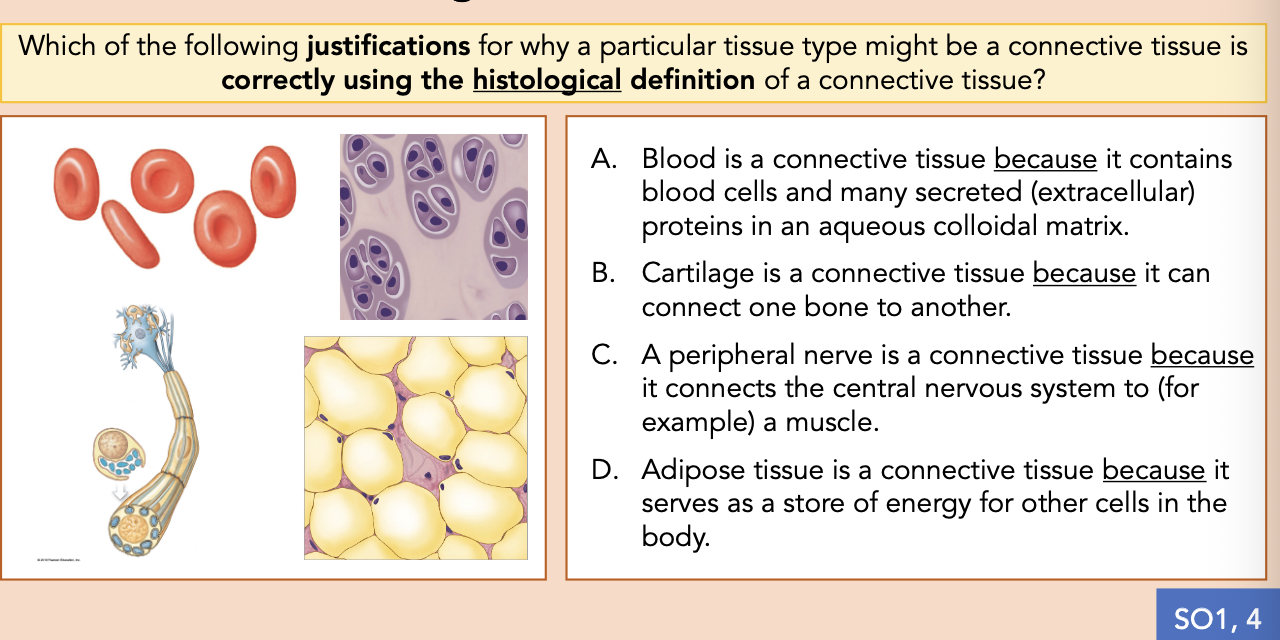
fix from iPad later
epithelial cells are ___________, but connective cells are _____________
connected by tight junctions
suspended in extracellular matrix