Chapter 11 flashcards
 Call Kai
 Learn
Learn Practice Test
 Spaced Repetition
 Match
Match Flashcards
 Knowt Play
1/146

Earn XP
Description and Tags
A & P 1
Name | Mastery | Learn | Test | Matching | Spaced | Call with Kai | Chat |
|---|
No analytics yet
Send a link to your students to track their progress
147 Terms
What are the three major functions of the nervous system?
Sensory input, integration brain, and motor output
What does the sensory input do for the nervous system?
detach stimulus
What does the motor output do for the nervous system?
Carries instructions from the brain to the muscles
What best represents the integration function of the nervous system?
Deciding to slow down and pull your car over
What is the overall function of the central nervous system (CNS)
Integrating and controlling center of the nervous system
What is the overall function of the peripheral nervous system (PNS)
Communication lines that link all parts
What makes up the CNS
Brain and spinal cord
What makes up the PNS
Cranial nerves, spinal nerves, and ganglia
The PNS has two different divisions, what are they?
Afferent- sensory, Efferent- motor
The motor (efferent) has two different parts, what are they?
Somatic and Autonomic
Somatic nervous system
Voluntary control and skeletal muscles
Autonomic nervous system
Involuntary control and visceral (organ)
True or False- The somatic nervous system conducts impulses from the CNS to cardiac muscle, smooth muscle, and glands
FALSE - autonomic
True or False- The sensory (afferent) division of the PNS conducts impulses from receptors to the CNS
True
True or False- The sympathetic division of the ANS mobilizes body systems during activity
True
True or False- Visceral motor nerve fibers conduct impulses from the CNS to the skeletal muscles
FALSE- Somatic
True or False- The autonomic nervous system is also called the voluntary system
FALSE- somatic
Ependymal cells
Line cerebrospinal fluid-filled CNS cavaties
Schwann cells
Form myelin sheaths around PNS nerve fibers
Oligodendrocytes
Form myelin sheaths around CNS nerve fibers
Astrocytes
Assist in exchanges between blood capillaries and CNS neurons
Microglial cells
Defensive cells in the CNS
Satellite cells
Surround and support neuron cell bodies in the PNS
What describes neurons?
Structural units of the nervous system and specialized to generate and transmit electrical signals
In addition to being excitable cells, list three other special characteristics of neurons
Ingenuity, amitotic, and high metabolic rate
Also called the soma
cell body
Most responsible for receiving info from other neurons
dendrites
The major biosynthetic center of the neuron
Cell body
Generates nerve impulses and transmits them
axon
contains neurofibrils and a spherical nucleus
cell body
The conducting region of the neuron
axon
any long axon is also called a …
nerve fiber
Axon terminals, the … region of the neuron, release … that either excite or inhibit other neurons or effector cells
secretary, neurotransmitter
In motor neurons, the nerve impulse is generated at the …. of the axon
initial segment
ganglion
cluster of neuron cell bodies in the PNS
tract
bundle of axons in the CNS
nerve
bundle of axons in the PNS
nucleus
cluster of neuron cell bodies in the CNS
What is the myelin sheath
fatty insulation
How is the myelin sheath formed in the PNS
Schwann cells
How is the myelin sheath formed in the CNS
Oligodendrocytes
What is the function of the myelin sheath
protects and electrically insulates as well as speed of action potential
What is the structural classification of neurons based on
The number of processes extending from their cell body
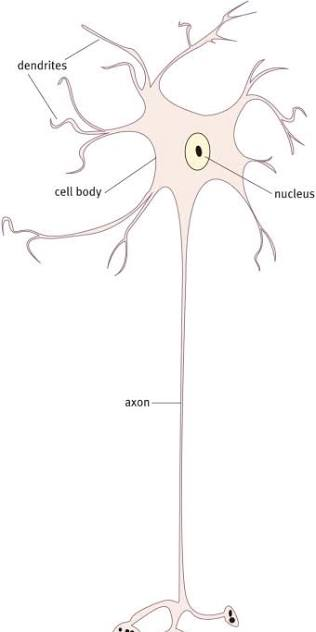
what type of neuron is shown
unipolar neuron
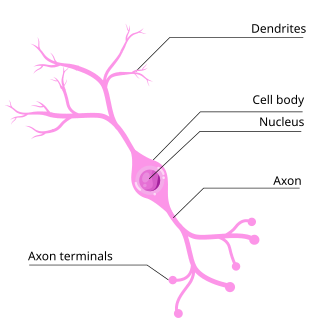
What type of neuron is shown
bipolar neuron
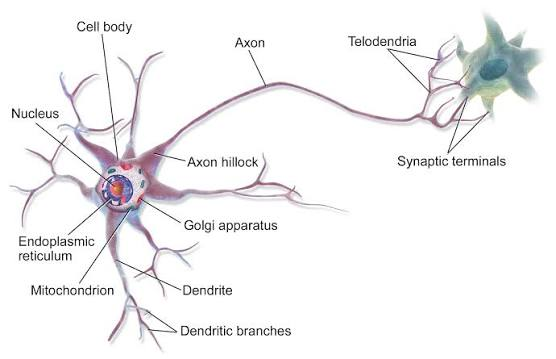
what type of neuron is shown
multipolar
what is the functional classification of neurons based on
the direction the nerve impulse travels
transmit impulses from receptors in the skin or internal organs toward the CNS
sensory neurons
shuttle signals through CNS pathways where integration occurs
interneurons
transmit impulses away from the CNS to the effectors of the body
motor neurons
also called association neurons
interneurons
also called afferent neurons
sensory neurons
also called efferent neurons
motor neurons
virtually all are unipolar
sensory neurons
all are multipolar
motor neurons
make up over 99% of the neurons of the body; almost all are multipolar
interneurons
voltage
the measure of potential energy generated by separated electrical charges
current
the flow of electrical charge from one point to another
resistance
the hindrance to charge flow provided by substances through which the current must pass
In the body, the charge separation across the plasma membrane creates a …. across the membrane
potential
In the body, electrical currents reflect the flow of … across the plasma membrane
ions
In the body, the plasma membrane provides … to the flow of current across the membrane
resistance
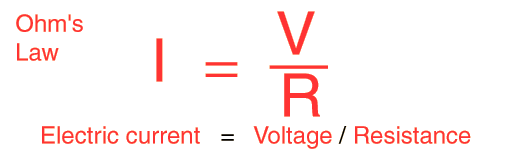
Ohm’s law
current is (directly or inversely) proportional to voltage
directly
An increase in voltage will (increase or decrease) the current
increase
Current is (directly or inversely) proportional to resistance
inversely
An increase in resistance will (increase or decrease) the current
decrease
what type of membrane ion channel opens when a particular neurotransmitter binds to it
chemically gated channel
what type of membrane ion channel opens and closes in response to changes in the membrane potential
voltage-gated channel
what are the two components that make up the electrochemical gradient
concentration and electrical
describe the component, concentration, in the electrochemical gradient
ions move down
describe the component, electrical, in the electrochemical gradient
ions move towards the area of opposite charge
resting membrane potential
voltage across the plasma membrane. -50 to -90 mV
When a voltmeter shows a value of -70 mV when measuring the resting membrane potential along the axon of a neuron, what does the minus sign mean
Inside plasma membrane is negatively charged relative to outside
The major cation in the extracellular fluid is (Na + or K +)
Na+
The major cation in the intracellular fluid is (Na+ or K+)
K+
The plasma membrane has more leakage channels for (Na+ or K+)
K+
The greater (inward or outward) diffusion of K+ than (inward or outward) diffusion of Na+ makes the voltage on the cytoplasmic side of the plasma membrane potential more (positive or negative)
outward, inward, negative
explain how the actions of the sodium-potassium pump stabilize the resting membrane potential
the RMP would not stabilize
A stimulus causes the membrane potential to change from -70 mV to -65 mV. Does this change represent depolarization or hyper polarization of the membrane?
moves closer to 0 (less negative) depolarization
what are graded potentials
small changes in neuron membrane potential
why are graded potentials important
they help determine whether an action potential will occur
what makes graded potentials “graded”
size varies depend on strength of stimulus
why are graded potentials brief, short distance signals
they weaken with distance
which type of graded potential is produced in a neuron that is stimulated bby neurotransmitter released by another neuron
postsynaptic potential
which typpe of graded potential triggers and action potential in a skeletal muscle cell
end plate potential
graded potential or action potential- always the same amplitude
action
graded potential or action potential- short distance communication only
graded
graded potential or action potential- occurs along the axon
action
graded potential or action potential- involves voltage-gated channels
action
graded potential or action potential- an all or nothing phenomenon
action
graded potential or action potential- occurs at the dendrites and cell body
graded
graded potential or action potential- long distance communication
action
graded potential or action potential- decays with distance traveled
graded
which type of graded potential (depolarizing or hyper polarizing) makes and action potential more likely
depolarizing
in a typical multipolar neuron, where does the transition from local graded potential to a long distance action potential occur
initial segment of axon
what is the term for the voltage at which an axon “fires” an action potential
threshold
state of voltage-gated Na+ channels- resting state
closed
state of voltage gated Na+ channels- depolarization
open
state of voltage gated Na+ channels- repolarization
closed