Biochem Quiz 7
 Call Kai
 Learn
Learn Practice Test
 Spaced Repetition
 Match
Match Flashcards
 Knowt Play
1/22

There's no tags or description
Looks like no tags are added yet.
Name | Mastery | Learn | Test | Matching | Spaced | Call with Kai | Chat |
|---|
No analytics yet
Send a link to your students to track their progress
23 Terms
Fats From Diet (Seven Steps)
Fats ingested in the diet
Bile salts emulsify dietary fats in small intestine
Lipases degrade TAGs
FFAs taken up by intestinal mucosa and converted to TAGs
TAGs incorporated into chylomicrons
Chylomicrons move through bloodstream and target tissues
Lipoprotein lipases interact with chylomicrons and convert TAGs to FFAs
Stored Fats (Steps 1 and 2)
Adipocytes with oil droplets are 90% TAGs
Lipolysis initiated when glucagon binds to Gs-coupled GPCR in adipocytes
Stored Fats Step Three
a. Triacylglycerol → Diacylglycerol and FFA via ATGL
b. Diacylglycerol → Monacylglycerol and FFA via HSL
c. Monacylglycerol → glycerol and FFA via MGL
FF
Serum Albumin transports FA through blood
FFA Activation and Transport Step 2
FA transported into cell via facilitated diffusion transporter
FFA Activation and Transport Step 3
FA → Fatty Acyl CoA via Fatty CoA Synthetase
FFA Activation and Transport Step 4
Fatty Acy CoA + Carnitine → Fatty Acyl Carnitine via CPT1
FFA Activation and Transport Step 5
Fatty Acyl Carnitine transported into mitochondria
FFA Activation and Transport Step 6
Fatty Acyl Carnitine → Fatty Acyl CoA via CPT2 in mitochondria
Beta Oxidation Step 1
Oxidation of aplha-beta bond
Enzyme: Acyl CoA Dehydrogenase
FAD reduced to FADH2
FADH2 goes to ETC
Beta Oxidation Step 2
Hydration
Enzyme: Enoyl CoA Hydratase
Hydroxyl group on beta carbon
Beta Oxidation Step 3
Oxidation
Enzyme: Beta-Hydroxylacyl CoA Dehydrogenase
NAD+ reduced to NADH
NADH to ETC
Beta carbon is a carbonyl group now
Beta Oxidation Step 4
Cleavage
Enzyme: Acyl CoA Acetyltransferase (thiolase)
Adding coASH
Release of acetyl coA (2 carbons)
Original Beta carbon now carbon #1 (carbonyl carbon)
Three Ketone Bodies
Acetone
Acetoacetate
Beta-Hydroxybutarate
When does the body make ketone bodies and why?
In liver
Used by extra-hepatic tissue
After B-oxidation liver cannot use acetyl coA
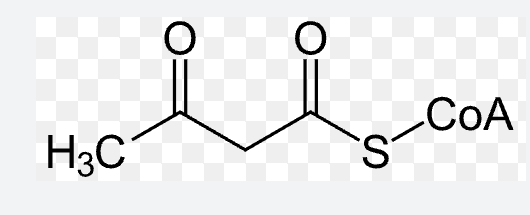
Step 1 Ketogenesis
Reactant: 2 Acetyl CoA
Enzyme: Thiolase
Product: Acetoacetyl CoA
Step 2 Ketogenesis
Reactant: Acetoacetyl CoA
Enzyme: HMG-CoA Synthase
Product: HMG-CoA
Add third acetyl CoA
Step 3 Ketogenesis
Reactant: HMG-CoA
Enzyme: HMG-CoA Lyase
Product: Acetoacetate
One acetyl CoA leaves
Step 4 Ketogenesis - To create Acetone
Reactant: HMG-CoA
Enzyme: Acetoacetate Dehydrogenase
Acetone
Decarboxylation
Released via exhalation
Step 4 Ketogenesis - To create B-Hydroxybutyrate Dehydrogenase
Reactant: Acetoacetate
Enzyme: B-Hydroxybutyrate Dehydrogenase
Product: B-Hydroxybutarate
NADH oxidized to NAD+
Ketone Oxidation Step 1
Reactant: B-Hydroxybutyrate
Enzyme: B-Hydroxybutyrate Dehydrogenase
Product: Acetoacetate
NAD+ reduced to NADH
Ketone Oxidation Step 2
Reactant: Acetoacetate
Enzyme: B-Ketoacyl CoA Transferase
Succinyl CoA to Succinate
Product: Acetoacetyl CoA
Ketone Oxidation Step 3
Reactant: Acetoacetyl CoA
Enzyme: Thiolase
Product: 2 acetyl CoAs
Addition of CoASH