619 GLA 8/12 Lipid Metabolism
 Call Kai
 Learn
Learn Practice Test
 Spaced Repetition
 Match
Match Flashcards
 Knowt Play
1/67

There's no tags or description
Looks like no tags are added yet.
Name | Mastery | Learn | Test | Matching | Spaced | Call with Kai | Chat |
|---|
No analytics yet
Send a link to your students to track their progress
68 Terms
Where and in what state does fatty acid synthesis occur in?
it occurs in the liver in the fed state
Fatty Acid Synthesis (simple)
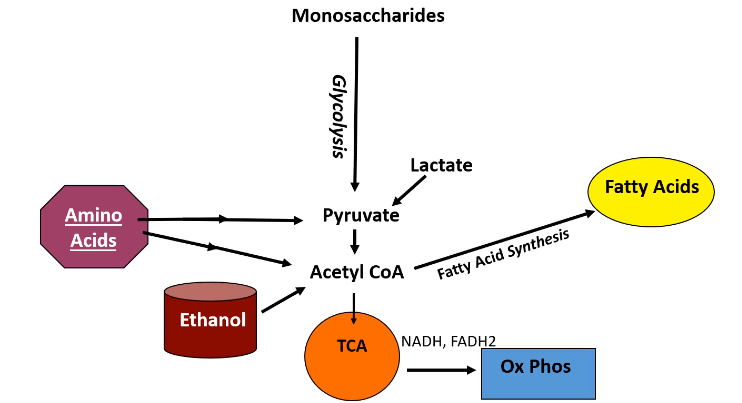
conversion of acetyl CoA to fatty acids
monosaccharides, ethanol, and most amino acids are all potential carbon sources
What are the sources of carbs for fatty acid synthesis?
excess dietary carbs are the primary source, excess dietary proteins can also contribute
What other cycle is fatty acid synthesis dependent on?
TCA Cycle
Linkage of Fatty Acid Synthesis to TCA Cycle
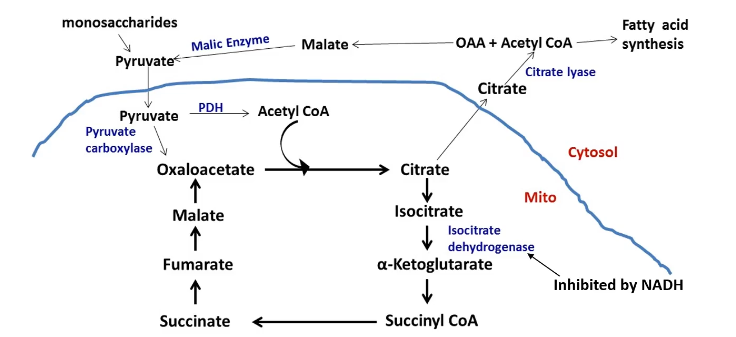
fatty acid synthesis occurs in the cytosol, but acetyl CoA is produced in the mitochondria and can’t pass membranes
citrate shuttles the excess acetyl CoA to the cytosol
Cytosol
location of fatty acid synthesis
Citrate
shuttle that transports acetyl CoA to cytosol for fatty acid synthesis
Isocitrate Dehydrogenase
controls the extent to which citrate leaves the mitochondria when transporting acetyl CoA to the cytosol
Isocitrate Dehydrogenas Inhibitors
ATP and NADH
Isocitrate Dehydrogenase Activators
ADP and Ca+2
Pyruvate Carboxylase
converts pyruvate → oxaloacetate
replenishes the TCA cycle intermediates that are lost to fatty acid synthesis so the cells ability to make ATP is not compromised
Diagram of Where Fatty Acid Synthesis Is
TCA Cycle Linkage to Fatty Acid Synthesis Diagram
Where does beta-oxidation occur?
it occurs in the mitochondria
Why is it important for beta-oxidation and fatty acid synthesis to be in different parts of the cell?
it prevents the fatty acids synthesized from immediately being broken down by beta-oxidation and vice versa
Citrate Lyase
converts citrate carrying acetyl CoA into acetyl CoA in cytosol
Oxaloacetate
element of TCA cycle that needs to be replenished by puruvate carboxylase
NADPH
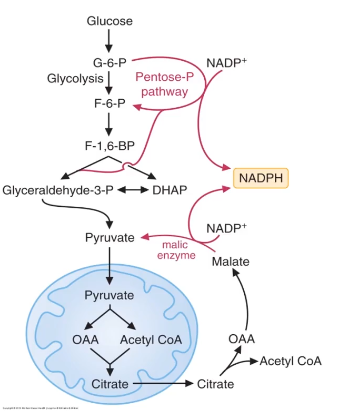
synthesized from pentose phoaphate pathway, required for fatty acid synthesis
Glucose-6-Phosphate Dehydrogenase
enzyme is pentose phosphate pathway that generates NADPH
Preperatory Phase of Fatty Acid Synthesis
NADPH generation in the pentose phosphate pathway by the enzyme glucose-6-phosphatedehydrogenase
expression of malic enzyme in the liver to generate NADPHby converting malate → pyruvate
NADPH Synthesis for Fatty Acid Synthesis Diagram
3 Simple Steps of Fatty Acid Synthesis
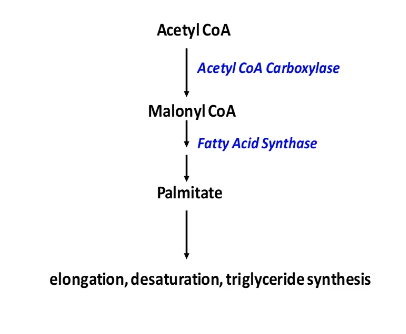
acetyl CoA is converted to malonyl Coa by acetyl CoA carboxylase
malonyl CoA is converted to palmitate by fatty acid synthase
elongation, desaturation, and triglyceride synthesis occur
Fatty Acid Synthase
converts malonyl CoA to palmitate in fatty acid synthesis, requires biotin
Acetyl CoA Carboxylase
converts acetyl CoA to malonyl CoA in fatty acid synthesis, highly regulated step of fatty acid synthesis, requires biotin
Acetyl CoA Carboxylase Stimulants
insulin, citrate, and a high calorie diet
Acetyl CoA Carboxylase Repressors
palmitoyl CoA and AMP
Palmitate
16 carbons, initial product of fatty acid synthesis that is then changed
Fatty Acid Synthesis Diagram
What cofactor do all carboxylase enzymes require?
biotin
Biotin
cofator of carboxylase enzymes, found in many foods and can be synthesized by some intestinal bacteria so deficiency is very rare
What can cause biotin deficiency (rare)?
antibiotic use and excessive raw egg consumption
Biotin Deficiency Clinical Presentation
mental status changes, dermatitis, and alopecia
How do eggs cause biotin deficiency?
they contain the protein avidin which binds to biotin and inhibits its absorption
When is fuel storage regulated to occur in?
the fed state
What enzymes are more active for fatty acid synthesis when the insulin/glucagon ratio is high?
g6pd, citrate lyase, malic enzyme, acetyl CoA carboxylase, fatty acid synthase
What three regulated glycolytic enzymes in the liver are more active when the insulin/glucagon ratio is high?
glucokinase
pfk-1
pyruvate kinase
Malonyl CoA
part of fatty acid synthesis pathway, inhibits beta-oxidation to prevent a futile cycle
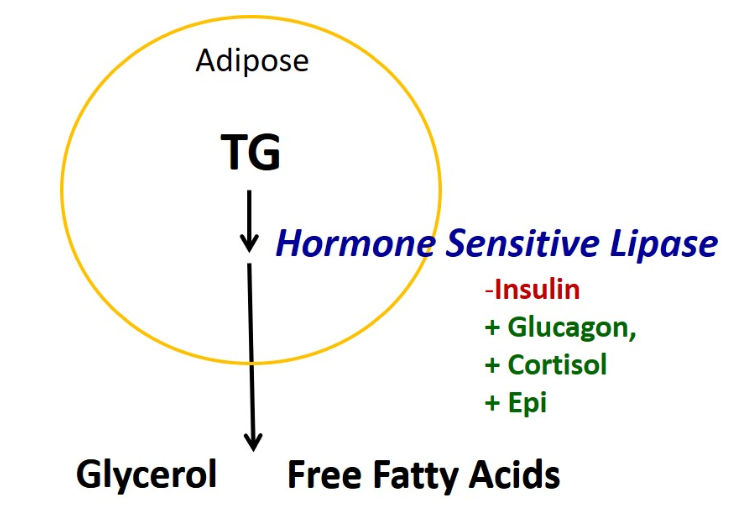
Lipolysis Diagram
Beta-Oxidation
breakdown of fatty acids to form glucose
When does beta-oxidation of lipids occur?
fasted state
When does beta-oxidation of muscle occur?
fed and fasted state
Fatty Acid Catabolism (Beta-Oxidation) Depends Partially on FA Chain Length and Structure
very long chains (>20C), long chains (12-20C), medium chains (6-12C), short chains (4C)
branched or unbranched
saturated or unsaturated
What is the structure of most FAs released from adipose and ingested?
long-chain unbranched
Where does beta-oxidation occur?
mitochondria
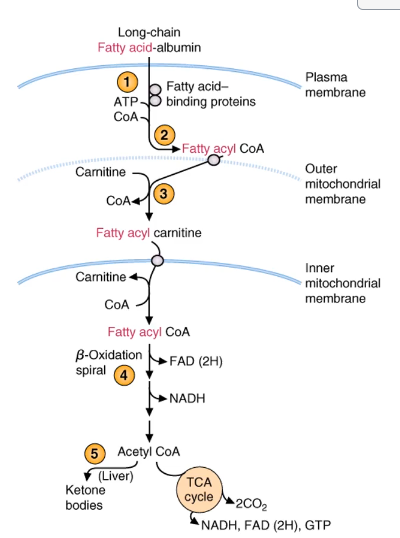
Beta-Oxidation Diagram
What types of tissues can get energy from fatty acids?
only aerobic tissues can get energy from fatty acids
Beta-Oxidation Basics
fatty acyl-CoA synthase “activates” the fatty acids
carnitine facilitates transport across the mitochondrial membrane
the beta-oxidation spiral slowly cuts it up more and more to produce NADH, FADH2, and acetyl CoA so the TCA cycle and oxidative phosphorylation must be active in order to generate ATP from fatty acids
3 Products of Beta-Oxidation
acetyl CoA, NADH, FADH2
Carnitine
a necessary cofactor for transport of most fatty acids to the mitochondria
Diagram of Transfering Acetyl CoA into the Mitochondrial Matrix
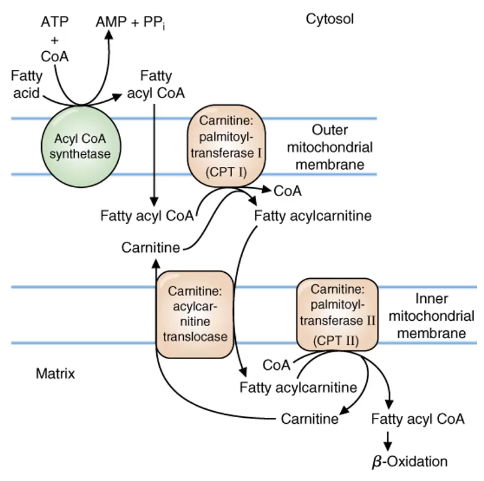
4 Steps of Transferring Acetyl CoA into the Mitochondrial Matrix
carnitine palmitoyl transferase 1 (CPT1) transfers the fatty acid from CoA to carnitine forming acylcarnitine
the acylcarnitine is translocated across the inner membrane and CPT II transfers the fatty acid back to CoA (takes off carnitine)
carnitine is shuttled back across the inner membrane
acyl CoA is in the mitochondrial matrix for beta-oxidation
Carnitine Palmitoyl Transferase 1 (CPT1)
in the outer mitochondrial membrane, transfers the fatty acid from fatty acid CoA to carnitine forming an acylcarnitine
CPT II
in the inner mitochondrial membrane, converts acylcarnitine to acetyl CoA in mitochondrial matrix
What does CPTII Deficiency Cause
acylcarnitine build up in the inner mitochondrial space
Beta-Oxidation Spiral
breakdown of acetyl CoA in the mitochondrial matrix, acyl-CoA dehydrogenases are involved
Acyl-CoA Dehydrogenases (CADs)
key enzymes in spiral of beta-oxidation, catalyze the first step in each beta-ox cycle
transform palmitoyl CoA → 7 acetyl CoA
How are Acyl-CoA Dehydrogenases classified?
they are classified based on their substrate specificity
Two Types of Acyl-CoA Dehydrogenases
long-chain acyl-CoA dehydrogenase (LCAD)
medium-chain acyl-dehydrogenase (MCAD)
CAD Deficiency
leads to an inability to complete beta-oxidation
Will acylcarnatines accumulate in patients with MCAD or LCAD deficiencies?
yes, because even though CPTII is still able to take off the caratine, there is a backup of the fatty acids in the matrix, which limits CPTII activity
Do hormones regulate beta-oxidation?
no, hormones do not directly regulate beat-oxidation
What is the key factor to determining the rate of beta-oxidation?
substrate availability (substrate is fatty acids)
What inhibits beta-oxidation?
it is inhibited by malonyl CoA which blocks CPTI to ensure that newly synthesized fatty acids are not transported to the mitochondria for beta oxidation
Hormone Sensitive Lipase
controls the availability of substrate (fatty acids) for beta oxidiation in the fasted state
Systemic Primary Carnitine Deficiency
an inherited disorder caused by a mutation in the protein that transports carnitine into cells
Carnitine Importance
without carnitine, fatty acids cannot enter the mitochondria and acumulate causing cell damage
2 Other Pathways of Fatty Acid Oxidation
peroxisome (long-chain fatty acids)
omega oxidation
Omega Oxidation
in the ER, generates dicarboxylic acids which may be detected in blood and urine in patients with impaired beta-oxidation