Microbiology: Module 7
 Call Kai
 Learn
Learn Practice Test
 Spaced Repetition
 Match
Match Flashcards
 Knowt Play
1/68

There's no tags or description
Looks like no tags are added yet.
Name | Mastery | Learn | Test | Matching | Spaced | Call with Kai | Chat |
|---|
No analytics yet
Send a link to your students to track their progress
69 Terms
Capsid
the protein coat that protects the nucleic acid of the virus is called the
Bacteriophages
Viruses that infect bacteria are called
Lytic
In the ____ cycle, all infected cells are eventually killed by breaking open to release virus particles
sometimes convert their genome to DNA for replication
RNA Viruses
Nucleus
The genome of influenza virus is replicated in the host cell’s ____
Plaque
A zone of clearing on a lawn of bacteria due to viral infection is called
Virion
is a complete, fully developed infectious viral particle
Prion
An infectious protein is called a
No. They are not considered alive because they are acellular and cannot reproduce on their own.
Are viruses considered living organisms?
Acellular (they are not made of cells)
Are viruses cellular or acellular?
No. They require a host cell to propagate (replicate)
Can viruses reproduce independently?
Genome and capsid
What are the two essential components found in all viruses?
DNA or RNA
What can a viral genome consist of?
No. Some viruses are enveloped, while others are naked (non-enveloped)
Do all viruses have an envelope?
enveloped virus
A virus surrounded by a lipid envelope outside the capsid.
naked virus
A virus that lacks a lipid envelope and consists only of a genome and capsid
No. Some viruses have complex structures
Are all viruses the same shape?
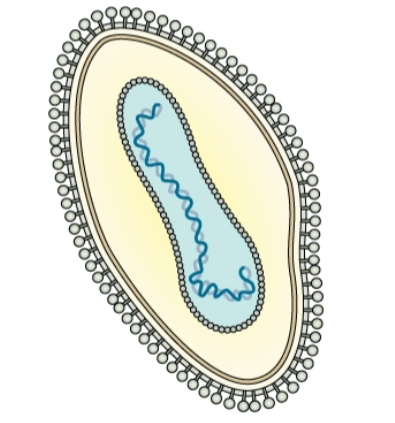
Complex (ex: bacteriophage)
What capsid shape is this?
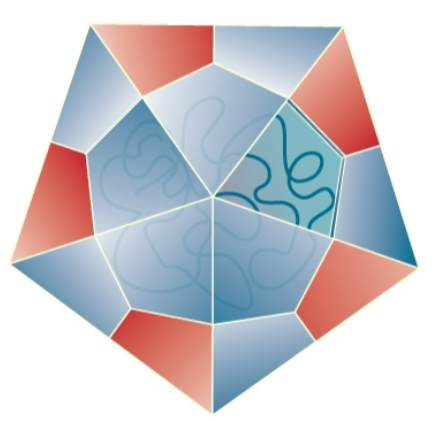
Icosahedral (ex: Rhinovirus)
What capsid shape is this?
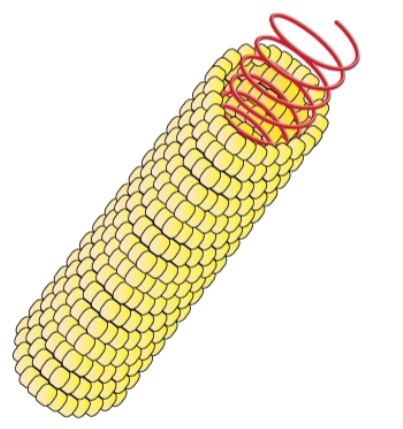
Helical (Tobacco mosaic virus)
What capsid shape is this?
Genome
Capsid
No lipid envelope
Naked virus
Genome
Capsid
Lipid envelope
Glycoprotein spikes
Enveloped virus
Enveloped viruses
Which viruses have a lipid membrane?
Help the virus attach to host cells.
What is the function of glycoprotein spikes?
Capsid
Which part contains the viral genome?
Tail fibers
Which structure attaches to the bacterial cell?
Injects viral DNA into the bacterium
What is the function of the sheath?
Lytic cycle and lysogenic cycle
What are the two main viral life cycles?
Lytic cycle.
Which viral cycle immediately kills the host cell?
Attachment → Penetration → Biosynthesis → Assembly → Release (lysis)
What are the five steps of the lytic cycle?
The virus binds to specific receptors on the host cell.
What happens during attachment? (lytic)
They can only bind to cells with the correct receptors
Why can't viruses infect every cell? (lytic)
Viral nucleic acid enters the host cell.
What happens during penetration? (lytic)
Only the viral DNA (or RNA); the capsid remains outside
In bacteriophages, what enters the host cell? (lytic)
The virus takes over the host's machinery to make viral DNA and viral proteins
What happens during biosynthesis? (lytic)
Viral genomes and capsid proteins assemble into complete viruses
What happens during assembly? (lytic)
The host cell lyses (bursts open).
How are viruses released? (lytic)
It dies.
What happens to the host cell during the lytic cycle?
Viral DNA integrates into the host chromosome
What happens after penetration? (lysogenic)
A prophage
What is viral DNA called after integrating into bacterial DNA? (lysogenic)
It is copied every time the bacterial chromosome replicates.
What happens while the prophage is integrated? (lysogenic)
No
Are new viruses produced immediately during the lysogenic cycle?
induction
The prophage leaves the bacterial chromosome and enters the lytic cycle. (lysogenic)
Stress such as UV light, radiation, or chemicals
What can trigger induction? (lysogenic)
prophage
Viral DNA integrated into a bacterial chromosome. (lysogenic)
The prophage is copied along with the bacterial DNA
During lysogeny, what happens when the bacterium divides?
Lytic
Which cycle immediately produces new viruses?
Lysogenic
Which cycle allows the virus to remain dormant?
Lysogenic
Which cycle contains a prophage?
Lysogenic
Which cycle can switch into the lytic cycle?
Double-stranded DNA
Can generally use host proteins for replication
Single-stranded DNA
Needs some host proteins for replication
Uses virus-specific DNA-dependent DNA polymerase
Double-stranded RNA
Uses virus-specific RNA-dependent RNA polymerase
Brings replication proteins into the cell with the genome
Single-stranded (+) RNA
Can act as mRNA immediately upon entering the cell
Uses virus-specific RNA-dependent RNA polymerase for replication
Brings replication proteins into the cell with the genome
Single-stranded (-) RNA
Uses virus-specific RNA-dependent RNA polymerase for replication
Brings replication proteins into the cell with the genome
Retroviruses
Enters cell as RNA, converted to DNA
Uses Reverse transcriptase
Brings replication proteins into the cell with the genome
prion
An acellular, infectious, misfolded protein.
no
Do prions contain DNA or RNA?
It causes normal proteins of the same type to misfold
What makes a prion infectious?
The normal protein misfolds and becomes another prion.
What happens when a normal protein contacts a prion?
By converting normal proteins into misfolded prion proteins
How do prions spread within the body?
They damage or kill affected cells.
What do prions do to cells?
Through genetic mutations passed down in families
How can prion diseases be inherited?
Misfolded proteins accumulate, disrupting normal cell function and causing cell death
Why are prions harmful?
By consuming contaminated food or exposure to infectious prions
How can prion diseases be acquired?
yes
Can prions be both inherited and infectious?
They are extremely resistant to destruction.
Why are prions difficult to eliminate?
No
Is normal cooking enough to destroy prions?
Prions are highly resistant to heat and standard cooking methods
Why doesn't cooking make prion-contaminated food safe?