Abraham Maslow - Dominance/Security and Self- Actualization
 Call Kai
 Learn
Learn Practice Test
 Spaced Repetition
 Match
Match Flashcards
 Knowt Play
1/23

There's no tags or description
Looks like no tags are added yet.
Name | Mastery | Learn | Test | Matching | Spaced | Call with Kai | Chat |
|---|
No analytics yet
Send a link to your students to track their progress
24 Terms
Maslow: Early Influences
Personal
Parental Influences
Parents uneducated
Dad: loved whiskey, women, and fighting
Abraham “unloved and unlovable”
Mom: Not nice
Abusive: Killed kittens
“God will strike you dead”
» Lead to scientific testing
Antisemitism
Led to few friends
Joined a gang
LACK OF CONFIDENCE
Wanted to go to Cornell, but lacked confidence to apply
Went to City College and did poorly
Finally went to University of Wisconsin and found love of psychology
Education
Experimental Psychology: Worked with Harlow working with Monkeys
“Dominance Feeling”
Saw that dominance was less due to physical force, but came from within
Studied this in humans via conversational probing
Intense interview
High dominance (or security): Less religious, extroverted, and unconventional
Low dominance: Anxious, jealous, and easily embarrassed
Job
Got a job at Brooklyn College and worked with two important people in his life
Max Wertheimer (Psychologist)
Ruth Benedict (Anthropologist)
Key Ideas
Motivational factors underlie personality
Refers to how people are propelled towards goals
Goes beyond physiological drives (from hunger to security, esteem)
Sought by all humans
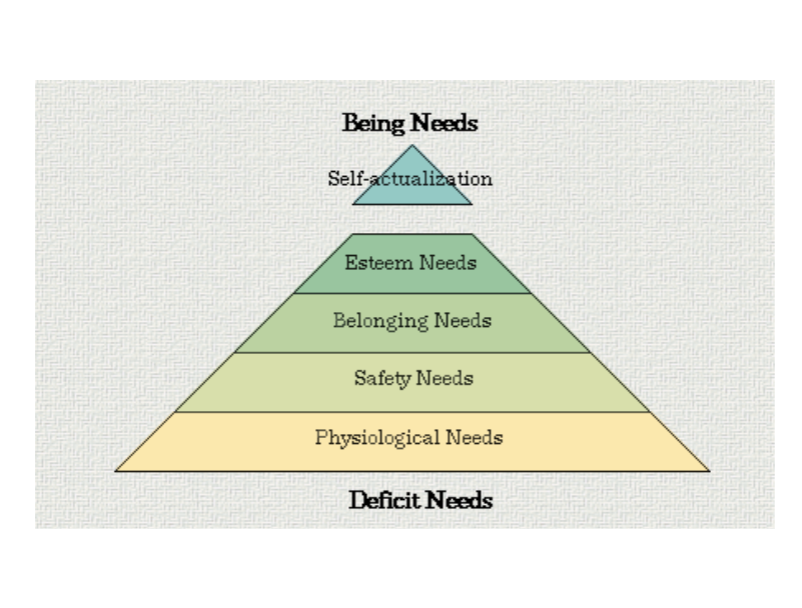
Hierarchy of Needs
Physiological
Safety
Belongingness and love
Esteem
Self-Actualization
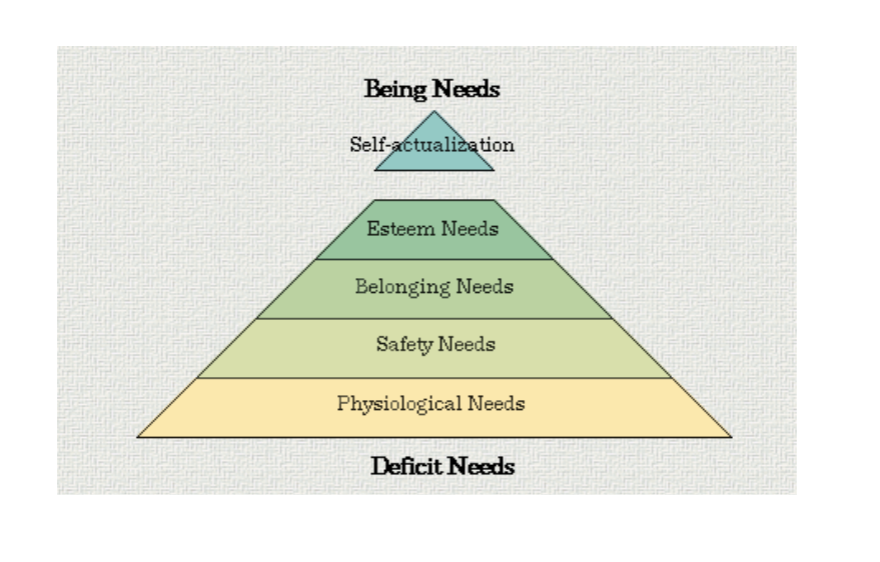
Physiological Needs
The lowest level of the hierarchy
Food, water, sleep, and sex
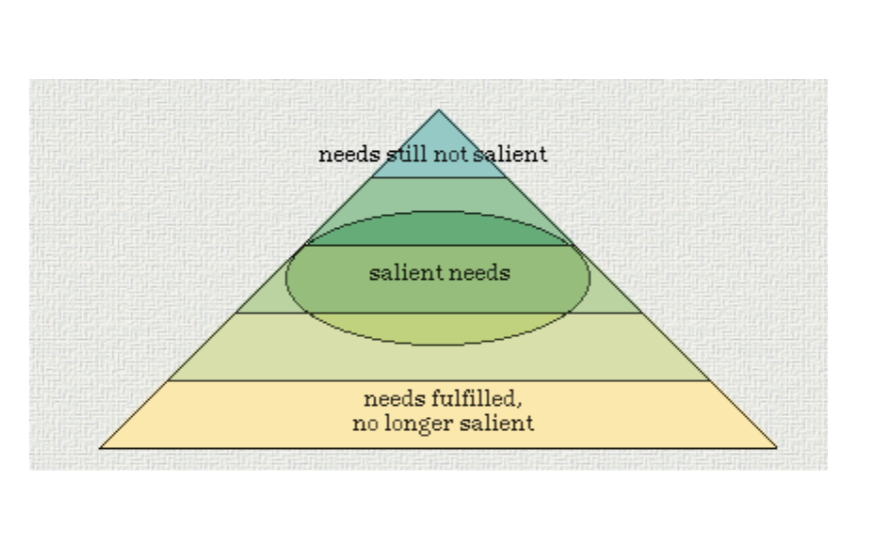
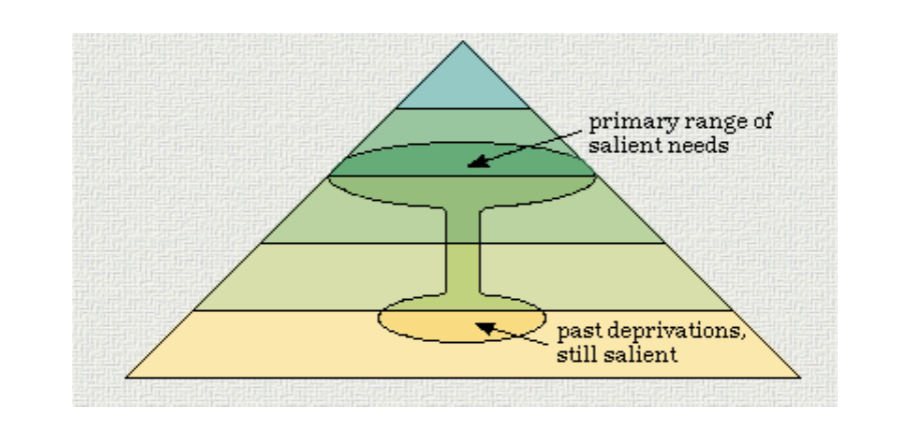
Needs that are dominant at a particular time are known as prepotent needs
Sleep or thirst may be prepotent but after drinking/sleeping, they are no longer . . .
Safety Needs
Safe situations
Infants/children like “known situations”
Cry under novel situations (loud noises, strange animals, parental quarrels, etc)
War, disease, natural catastrophes, crime waves, etc. all bring about safety needs
OCD often represents a need for order, to maintain the “known,” or safety
Maximize safety at expense of higher-order needs
Belongingness and Love Needs
Need to give AND receive love, both in one’s community (belongingness) as well as with individuals (love)
According to Maslow, this is the most frequent source of maladjustment
Sex is represented here as well as in physiological needs
Esteem Needs
Need for self-respect as well as the respect of others
Must be based on truths about ourselves, not fabrications
If these needs are not met, then we feel inferior
Self-Actualization
D-Needs (Deficit Needs)
B-Needs (Being-Needs) for self actualization
B-Values or “metamotives”
D-Needs/B-Needs
D-Needs (Deficit Needs)
First 4 require fulfillment of needs to avoid physical or psychological illness
B-Needs (Being-Needs) for self-actualization
Must achieve partial satisfaction of all needs:
Spontaneous
Hard-working
Ethical, with strong values
Independent
Have deep relationships
B-Values or “metamotives”
For people who attain self-actualization
B-values are cognitive needs to know, explain, understand, and satisfy big constructs
Truth, godliness, justice, playfulness
“What a man can be, he must be. This need we may call self-actualization”
D-Needs/B-Needs
We experience things differently based on where we are in the hierarchy
Love
D-Needs
Often experience jealousy and anxiety
B-Needs
Nonpossessive and completely enjoyable
Peak Experiences
More likely in self-actualizers
Intense and mystical experiences
Feel powerful and get lost in a sense of time
Experience a sense of wonderment, awe, and deep thought
After-Effects of peak experiences
Change a person’s view:
of themselves in a healthy direction – more positive, secure, and confident
of other people and their relationships to them . . . But always in a more realistic way
of the world, usually by seeing worldwide problems more realistically
Releases them for greater creativity, spontaneity, and expressiveness
Remembers experience very positively; wants to repeat it over and over again
More likely to view life as worthwhile
Beauty, excitement, honesty, goodness, truth, and meaningfulness DO exist!
Self-Actualization
Took notes on his two role-models (Wertheimer and Benedict)
“I realized in one wonderful moment that their two patterns could be generalized. I was talking about a kind of person, not about 2 non-comparable individuals. There was wonderful excitement in this. I tried to see whether this pattern could be found elsewhere, and I did in one person after another.”
Started “Good Human Being” notebook
Started collecting data at Brooklyn College (appearance, security score, Rorschach, intense interview):
By 1945, he had developed a list of characteristics of self-actualized people . . .
Characteristics of Self-Actualized Individuals
Clear perceptions of reality
Acceptance of self, others, and reality
Spontaneous and natural
Problem-focused; have a mission
Independent thinking
Creative
Have “peak experiences”
Feels kinship with society
Deep, but few, relationships
Strong and clear ethics
Unhostile sense of humor
Resists cultural molding
Self Actualized Persons: Imperfections
Unexpectedly ruthless with honesty
Occasionally absent-minded
Overkind to a fault
Boring or lacking in humor
Anxious at times
Examples of Self-Actualized Persons
Max Wertheimer
Ruth Benedict
Eleanor Roosevelt
George Washington Carver
Measurement and Research on Self-Actualization
Maslow did not develop a formal assessment of his theoretical concepts
Measurement was mostly based on observation and one-on-one interviews
Conversational probing
Shostrom developed the Personal Orientation Inventory
150 question inventory
Two primary scores
Inner-Directed Supports
D-Needs
Time Competence
B-Needs
Independent, having a mission, new conceptualizations of the world
Research: Pro-Maslow
Graham and Balloun surveyed a cross-section of a community
Higher needs were judged as less satisfied relative to lower needs
For all ages, self-actualization increased with age (except for oldest cohort)
Research: Con-Maslow
Coles
Persons in dire economic situations seem to often function at higher levels of the hierarchy
Nazi concentration camps
Sense of purpose, community, ethics
People commit suicide
Soldiers die for political reasons
Applications of Maslow’s Theory
Growth Centers
Work
Religion
Applications of Maslow’s Theory: Growth Centers
Esalen Institute in Big Sur, California
Strove to provide D-needs
The opportunity for B-Needs
Explored ethics, creativity, hard-work, problem-solving, and the community
Applications of Maslow’s Theory: Work
Corporate leaders, as found by I/O psychologists, rank higher on hierarchy
Confound: Age and $$$
Applications of Maslow’s Theory: Religion
Opposed to dogmatic views
Must be true to oneself and explore own ethics