Unit 8.1: Antimicrobial Substances
 Call Kai
 Learn
Learn Practice Test
 Spaced Repetition
 Match
Match Flashcards
 Knowt Play
1/14

There's no tags or description
Looks like no tags are added yet.
Name | Mastery | Learn | Test | Matching | Spaced | Call with Kai | Chat |
|---|
No analytics yet
Send a link to your students to track their progress
15 Terms
What are the four Antimicrobial substances?
The complement system
Interferons
Iron-binding proteins
Antimicrobial peptides
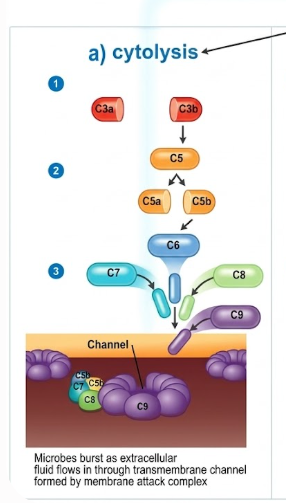
What is Cytolysis?
Cytolysis is when complement proteins form a membrane attack complex (MAC) which creates holes in the pathogens membrane
Which specific bacteria can evade Cytolysis / MAC
Gram positive bacteria
Bacterial capsules
Some gram-negative bacteria
Some gram negative and positive bacteria can release an enzyme that breaks down C5a
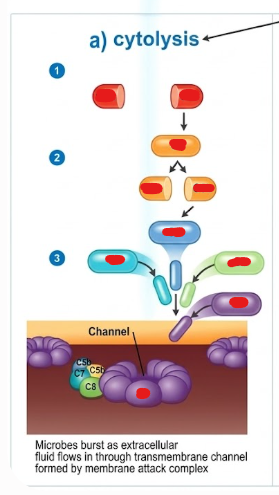
Complement system - Cytolysis Process
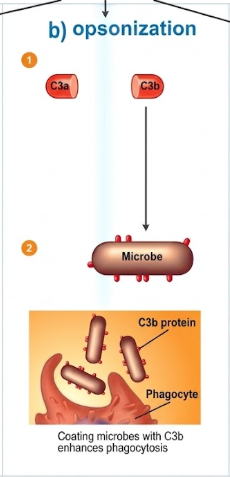
What is opsonization?
Opsonization is when a pathogen is coated with C3b proteins or antibodies, making them more identifiable
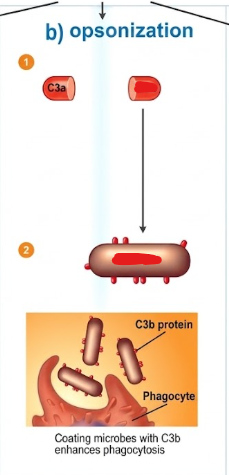
Complement system - Opsonization process
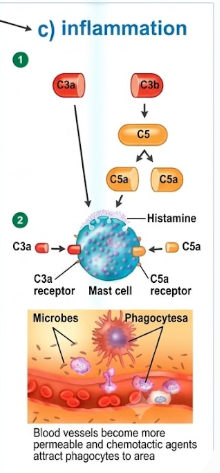
Complement system - Inflammation process
What are the two types of Interferons?
Gamma interferon
Alpha and beta interferon
What is Gamma interferon’s function?
Gamma interferons activate immune cells
What are Alpha and beta interferon’s functions?
Signals neighboring cells to destroy RNA and reduce protein synthesis
Signals neighboring infected cells to undergo apoptosis
What are the four proteins in the human body that bind to iron and their locations?
Lactoferrin: in tears
Transferrin: blood and tissue fluids
Ferritin: liver, red bone barrow
Hemoglobin: red blood cells
What do Antimicrobial peptides do?
Antimicrobial peptides kill bacteria, viruses, and fungi
What are the Antimicrobial peptides’ modes of action?
Modes of action: form pores in plasma membrane, inhibit cell wall synthesis, destroy DNA/RNA
What are some examples of Antimicrobial peptides?
Defensins
Dermcidin
Bacteriocin