Integration of Diagnostic Imaging into PT Practice
 Call Kai
 Learn
Learn Practice Test
 Spaced Repetition
 Match
Match Flashcards
 Knowt Play
1/46

There's no tags or description
Looks like no tags are added yet.
Name | Mastery | Learn | Test | Matching | Spaced | Call with Kai | Chat |
|---|
No analytics yet
Send a link to your students to track their progress
47 Terms
Primary care physicians that can order diagnostic imaging:
All of the above
Which of the following is a possible point of access to diagnostic imaging for a physical therapist?
Direct referral of the patient to radiology
According to the Pittsburgh Decision Rules, which age groups meet the age criterion for knee radiographs following blunt trauma or a fall?
Younger than 12 or older than 50
According to the Pittsburgh Decision Rules, how many weight-bearing steps must a patient be unable to take to meet the criterion for knee radiographs?
4 Steps
According to the Ottawa Knee Rules, what age automatically meets a criterion for knee radiographs?
> 55 years
Which of the following is ALSO a criterion for knee radiographs under the Ottawa Knee Rules?
Tenderness at the head of the fibula
According to the Ottawa Ankle Rules, tenderness at which location is an indication for ankle radiographs?
Posterior edge or tip of the lateral or medial malleolus
According to the Ottawa Foot Rules, where must there be bone tenderness to indicate the need for a foot X-ray?
Base of the 5th metatarsal or navicular bone
Inability to bear weight both immediately after the injury and in the emergency department is a criterion for ordering radiographs after ankle or foot trauma.
True
Which of the following is considered a high-risk criterion for cervical spine injury?
Age 65 years or older
Paresthesias in the extremities are considered a high-risk criterion
True
Which of the following is NOT considered a dangerous mechanism of injury under the high-risk criteria?
Ambulatory at any time
Which substance appears the darkest/blackest on a radiograph?
Air
Which substance appears the whitest on a radiograph?
Metal
Put the following in order from darkest to lightest on a radiograph.
Air → Fat → Water → Bone → Metal
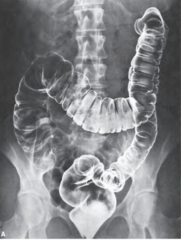
What type of diagnostic image is shown?
Dual-contrast radiograph
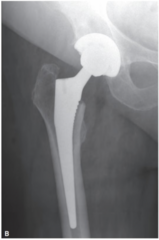
Why do the prosthetic components of this joint replacement appear solid white on the radiograph?
Heavy metals absorb nearly all of the X-rays
What phrase did the professor strongly emphasize when discussing radiographic views?
"One View Is No View"
What are the most common projections used in routine radiographic examinations of the appendicular skeleton and spine?
AP, lateral, and oblique
What is the minimum number of radiographs generally needed in diagnostic radiology?
Two
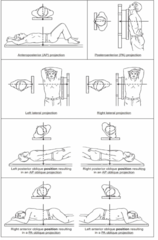
What is the primary purpose of routine radiographs?
To provide a basic assessment and screen for pathologies
If a routine radiographic examination confirms the suspected clinical diagnosis, the result is considered:
Positive
What type of diagnostic image is shown?
Tomogram

What type of diagnostic image is shown?
CT Scan
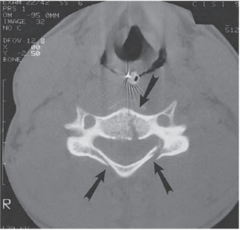
What type of diagnostic image is shown?
PET Scan

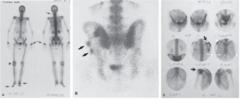
What type of diagnostic image is shown?
Bone Scan
What type of diagnostic image is shown?
MRI

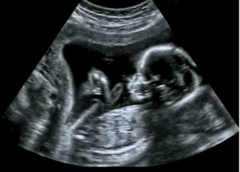
What type of diagnostic image is shown?
Ultrasonography
Why is fluoroscopy used during a provocation discography?
To guide the needle into the intervertebral disk

What procedure is shown in this image?
Percutaneous vertebroplasty

What procedure is shown in this image?
Intradiscal electrothermal therapy (IDET)
What do the "ABC's" of radiographic evaluation stand for?
Alignment, Bone density, Cartilage spaces, Soft tissues
When evaluating Alignment (A), what should you assess?
General Skeletal Architecture
When evaluating Bone (B), what should you assess?
Local bone density changes
When evaluating Cartilage (C), what should you assess?
Joint space, subchondral bone, and epiphyseal plates
When evaluating soft tissues (S), what should you assess?
Muscles, fat pads, joint capsules, periosteum
Which of the following is NOT one of the major categories of skeletal pathology?
Cardiovascular
Which of the following IS a category of skeletal pathology?
Neoplastic
Which of the following is NOT a tissue type listed in the classification table?
Muscle
Which group contains ONLY tissue types listed in the table?
Bone, marrow, cartilage, nerves
Which of the following IS listed as a tissue type?
Fat
What is the FIRST section of a radiologic report?
Heading
What is the SECOND section of a radiologic report?
Clinical Information
What is the THIRD section of a radiologic report?
Findings
What is the FOURTH section of a radiologic report?
Conclusions
What is the FIFTH section of a radiologic report?
Recommendations
What is the SIXTH and final section of a radiologic report?
Signature