FDNMANP - Chapter 3
 Call Kai
 Learn
Learn Practice Test
 Spaced Repetition
 Match
Match Flashcards
 Knowt Play
1/28

Earn XP
Description and Tags
Name | Mastery | Learn | Test | Matching | Spaced | Call with Kai | Chat |
|---|
No analytics yet
Send a link to your students to track their progress
29 Terms
Capitalism
rewarding entrepreneurs for combining resources in ways that create valued goods and services
Capitalism in FBL
Documentational Capitalism: emphasis on detailed written contracts, public financial reports, management rights, short-term maximization of financial performance
Capitalism in TBL
Hybrid: emphasis on relational contracts, long-term reputation and maximization of firm financial performance, costs of neglecting employee rights, needs of key stakeholders
Relational Capitalism
emphasis on relational contracts, long-term reputation and financial firm performance, employee rights, the needs of all stakeholder groups (SET)
Economics
how goods & services are produced, distributed, and consumed
Acquisitive Economics
refers to the management of property and wealth to maximize the short-term monetary value for owners (FBL)
Sustenance Economics
refers to managing property and wealth to increase the long-term overall well-being for owners, members, and other stakeholders (SET)
Simple Model of the Economy
People —> (provides labor) —> Clan
Clan —> (receives goods and services) —> People
Simple Monetized Economy
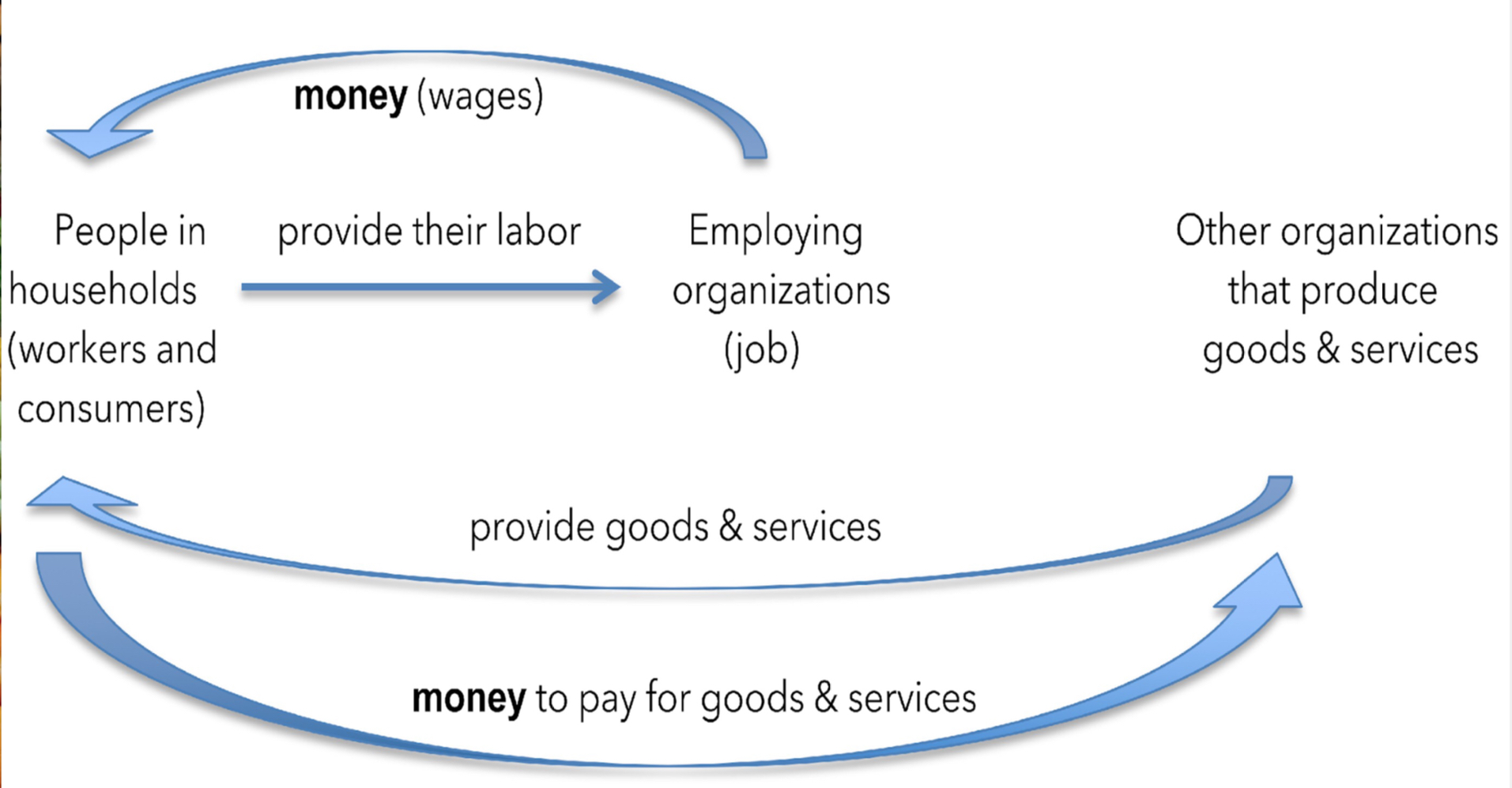
Simple Corporate Economy
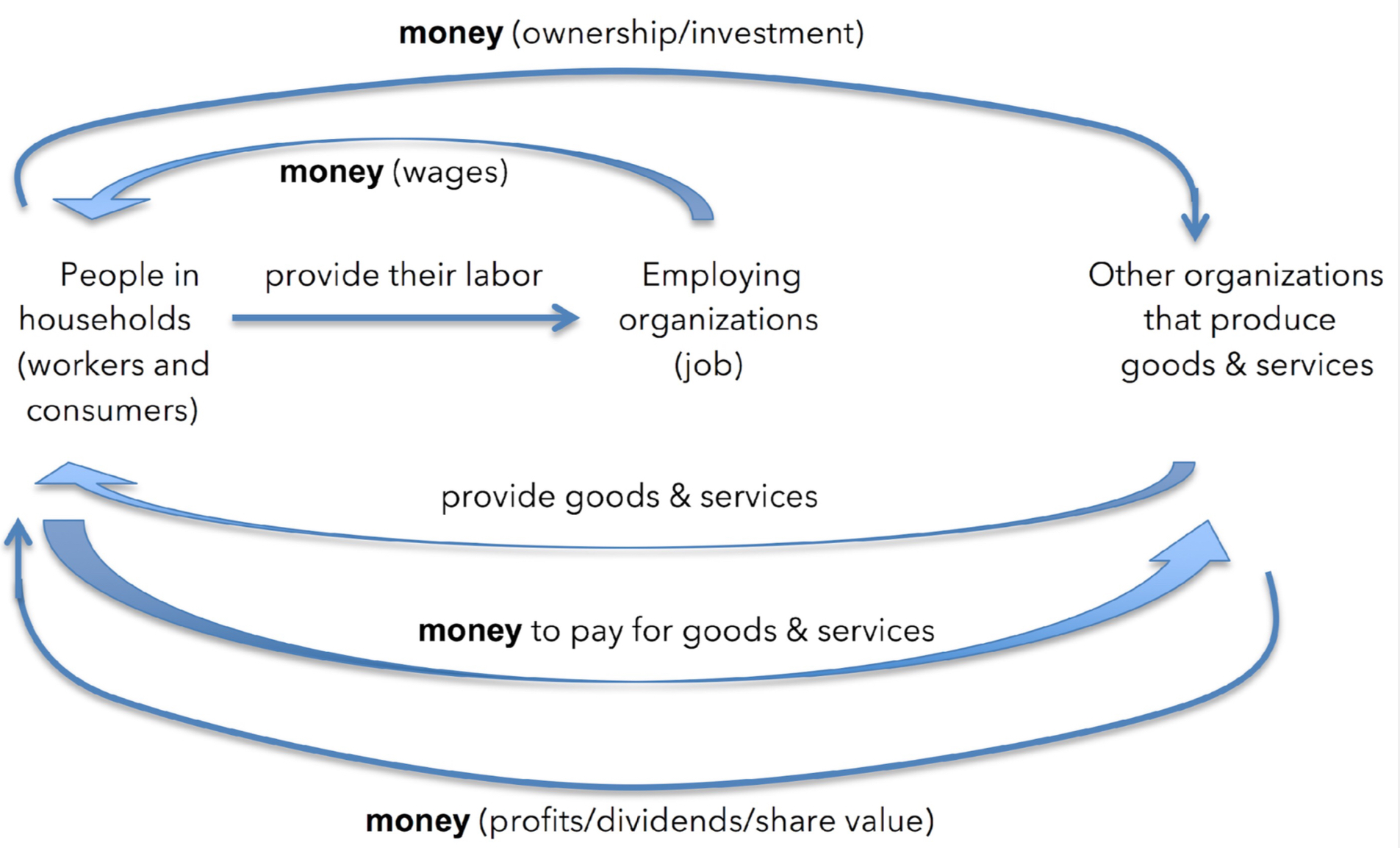
Economic well-being involves creating:
jobs, goods and services, profits
Jobs in High-Income Setting (FBL)
More jobs being created now than ever before
Jobs in High-Income Setting (TBL)
Concern that low quality of jobs or pay will decrease performance
Jobs in High-Income Setting (SET)
Concern that low quality jobs or pay decreases quality of life
Living Wage
earnings are adequate pay for the basic amenities of life (adequate housing, food, clothing, education, and health care)
Goods & Services in High-Income Setting (FBL)
GDP is increasing
Gross Domestic Product (GDP)
measures the total financial value of all the goods and services produced within a country
Goods & Services in High-Income Setting (TBL)
Produce goods and services that increase profits and decrease negative social and ecological externalities (e.g., solar power)
Goods & Services in High-Income Setting (SET)
Don’t produce more goods than the planet can sustain
Profits in High-Income Setting (FBL)
Corporate profits steadily increasing
Profits in High-Income Setting (TBL)
Can grow profits by reducing negative social and ecological externalities (e.g., less packaging, LED lighting)
Profits in High-Income Setting (SET)
enhance the Genuine Progress Indicator (e.g., promote income equality, reduce crime, reduce pollution, enhance leisure time)
Genuine Progress Indicator (GPI) measures quality of life based on:
Income distribution: GPI increases when relatively poor people receive a larger portion of national income, and decreases when their share declines
Crime: Unlike GDP, which grows with costs of crime (e.g., legal costs, property damage, and healthcare), GPI subtracts these costs
Resource depletion: Unlike GDP, which ignores externalities like the depletion and degradation of forests etc., GPI treats these as costs
Pollution: Unlike GDP, which often double-counts pollution (first for the costs incurred in creating pollution, and second for the costs of cleaning up pollution), GPI subtracts costs of water and air pollution based on their damage to the environment and human health
Long-term environmental damage: GPI recognizes the negative financial externalities associated with carbon emissions Leisure time: GPI goes up with increases in leisure time, and down with decrease
Leisure time: GPI goes up with increases in leisure time, and down with decreases
Jobs in Global Setting (FBL)
Associated with globalization, free trade, and “a rising tide raises all boats”
Jobs in Global Setting (TBL)
People want secure jobs to provide families with food, clothing and education; providing such jobs can increase profits
Jobs in Global Setting (SET)
Promotes creating of jobs based on fair trade principles which seek to ensure that workers in low-income countries are paid a fair price for the products they produce
Goods & Services in Global Setting (FBL)
International trade can help people in low-income countries. Free trade reduces subsidies, tariffs, and quotas
Promote free flow of money
Goods & Services in Global Setting (TBL)
Businesses should increase their sales by targeting the “Base of the Pyramid” (BoP) thus enable BoP to participate in the global economy
Promote initiatives (like the UN Global Compact), which help firms to increase profits responsibly
Goods & Services in Global Setting (SET)
Permit low-income countries to use tariffs/subsidies/quotas to strengthen their local economies
Challenges practices that increase income disparity such as derivatives trading; rather, supports initiatives (like the Tobin Tax and Socially Responsible Investing)