MBB222 - Lecture 32: Protein synthesis (pt.2)
 Call Kai
 Learn
Learn Practice Test
 Spaced Repetition
 Match
Match Flashcards
 Knowt Play
1/16

There's no tags or description
Looks like no tags are added yet.
Name | Mastery | Learn | Test | Matching | Spaced | Call with Kai | Chat |
|---|
No analytics yet
Send a link to your students to track their progress
17 Terms
what are the steps in the formation of the prokaryotic translation initiation complex (3 steps)
GTP, IF1, IF2, IF3 → bind to the 30S ribosomal subunit
mRNA and fMet-tRNAi met binds to the complex with the Shine-Dalgarno sequence of mRNA aligning with complementary sequences in the 16S rRNA in the 30S ribosomal subunit → IF3 is released
hydrolysis of GTP facilitates binding of the 50S ribosomal subunit - release of IF1 and IF2 forms the function 70S ribosomal initiation complex
list the 6 steps for translational elongation
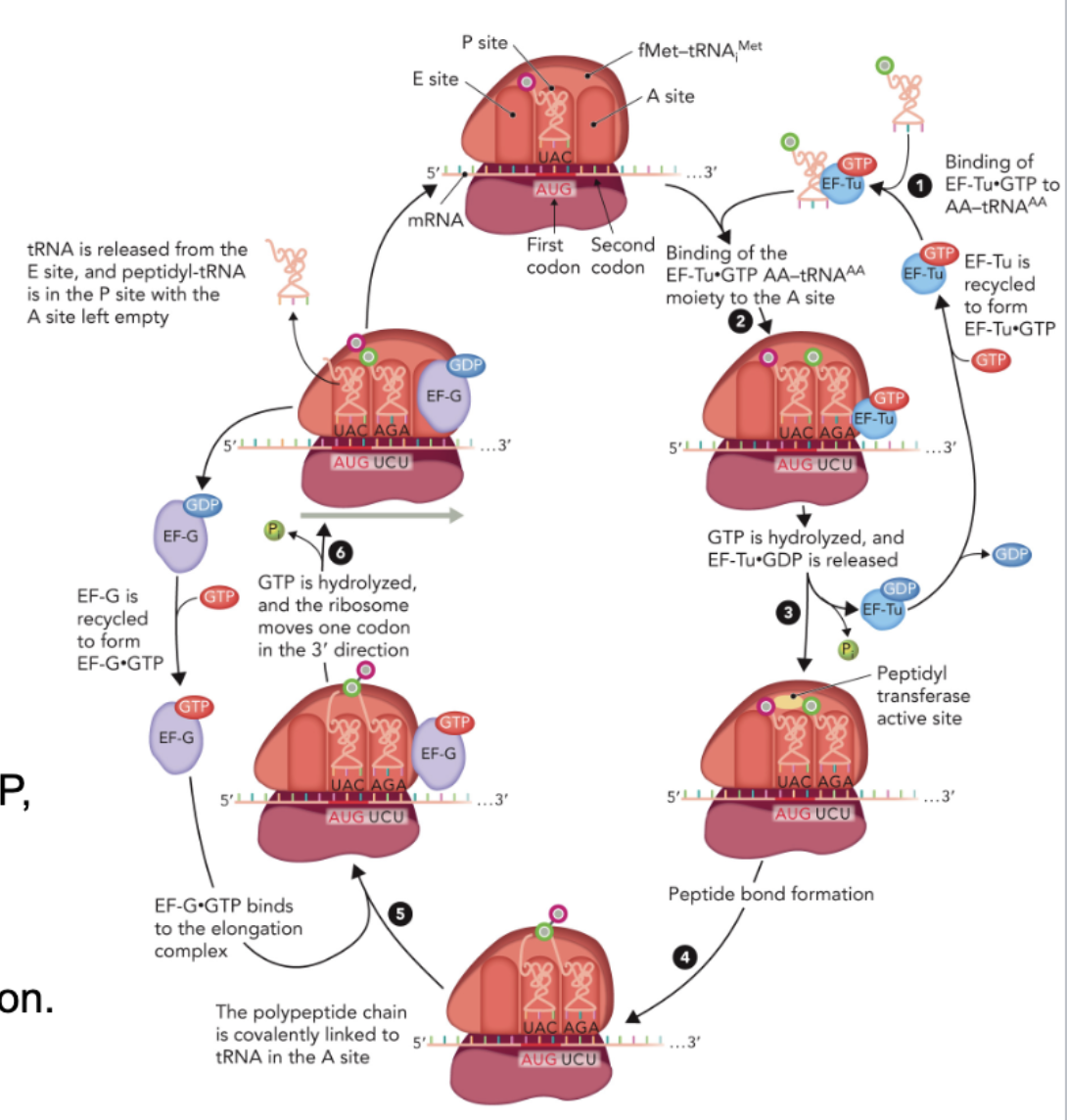
what does the 6 step elongation cycle require
requires the hydrolysis of 2 GTP
one used to promote binding of the AA-tRNAAA to the A site
one to facilitate translocation of the ribosome in the 3’ direction
the peptidyl transferase reaction is catalyzed by what
the ribozyme activity of the 23S rRNA in the large ribosomal subunit
what is the peptidyl transferase reaction
nucleophilic amino group of amino acid bound to the 3’ terminus of A-site tRNA → attacks the carbonyl carbon in the ester bond
rearrangement of the tetrahedral intermediate results in transfer of the formerly P-site amino acid ( or polypeptide) to the amino acid on the A site that is bound to tRNA
which direction does ribosome “track” along the mRNA
5’ → 3’ direction - synthesizing proteins in the N→ C terminal direction
what are the binding sites for tRNA
A- / P- / E-sites → span in both large and small ribosomal subunit
how do new polypeptides exit from the ribosome
newly-synthesized polypeptide exits through a hydrophobic tunnel in the 50S subunit at the site of peptide bond formation
what happens during the termination of translation
release factors (RF) bind to the stop codon and lead to release of the polypeptide chain
can occur 2 ways:
binding of the release factor protein (RF2) to the stop codon in mRNA leads to GTP hydrolysis → releases all bound translational components
molecular structure of the 70S bacterial ribosome with tRNA molecules in the E and P sites + RF2 in the A site + short mRNA substrate that has the stop codon
what are the differences between prokaryotic and eukaryotic translation initiation complexes
eukaryotic lack a specific ribosome binding site in the mRNA + has a greater number of eukaryotic initiation factors (eIFs) required
what are examples of 4 antibiotics that inhibit bacterial protein synthesis at specific steps
chloramphenicol → binds to the 50S subunit and prevent peptide bond formation
Erythromycin → binds to the 50S subunit and prevents translocation
Tetracyclines → prevents tRNA binding to the A site in the ribosome
Streptomycin → alters the structure of the 30S subunit - causes errors in translation
what are polyribosomes/polysomes
group of multiple ribosomes attached to a single mRNA molecule
where are proteins made on
polyribosomes/polysomes
how can multiple synthesis occur on a single mRNA
through polysome formation - multiple ribosomes translate the same strand simultaneously
what is co translational folding of proteins
the process where a protein starts to fold into its active 3D shape while it is still being made by a ribosome
why do some proteins need to be post translationally modified
in order to adopt their biologically active form
what is proteasome - what does it do
an ATP dependent protease complex that rapidly destroys misfolded proteins
proteins with exposed hydrophobic regions → marked for destruction by covalent binding of multiple copies of a protein (ubiquitin)
protein marker allows them to be recognized by proteasome
misfolded proteins are bound by proteosome → unfolded → degraded into short peptides