Histo 12 Module 2 Quiz 2 (US Occupation & Road to Inderpendence)
 Call Kai
 Learn
Learn Practice Test
 Spaced Repetition
 Match
Match Flashcards
 Knowt Play
1/19

There's no tags or description
Looks like no tags are added yet.
Name | Mastery | Learn | Test | Matching | Spaced | Call with Kai | Chat |
|---|
No analytics yet
Send a link to your students to track their progress
20 Terms
Chronological Order of Events
Philippine Organic Act (Cooper Act), July 1, 1902
First Philippine Assembly, October 16, 1907
Jones Law (August 29, 1916)
Osmeña-Quezon Rivalry,1922
OsRox Mission, 1931
Hare-Hawes Cutting Act (passed on Jan 13, 1933 & enacted on Jan 17, 1933)
Tydings McDuffie Act, March 24, 1934
National Defense Act, December 21, 1935
Benevolent Assimilation
Dec 21, 1898
Proclamation by President William McKinley
Document from the US stating that they would colonize the PH and bring forth civilization to the country (to come as friends, but really they wanted to expand military reach)
American generals in the PH didn’t want it to be published because magagalit si Aguinaldo
But it was published by General Miller and it reached Luna, editor of La Independencia
Luna led the attack on this proclamation saying it was to quiet the people and subterfuge (a deceptive trick used to hide something, used to escape or get away with something)
• Aguinaldo’s rection: he realized that the US were not friends, he publicly denounced the proclamation
The Whiteman’s Burden
Published in Judge Magazine on April 1, 1899 inspired by Rudyard Kipling's poem, “The White Man's Burden”
Depicts John Bull (Great Britain) and Uncle Sam (United States) carrying colonized people toward "Civilization"
Reflects the belief that Western nations had a moral duty to civilize non-Western peoples through colonial rule
Justified American imperialism and the annexation of the Philippines after the Spanish–American War
Philippine Organic Act of 1902 / Cooper Act
By Henry A. Cooper
Also known as the Philippine Bill of 1902 or the Cooper Act
A law for the Insular Government (American colonial government) that was enacted by the United States Congress on July 1, 1902
Provided the creation of the Philippine Assembly, with members to be elected by Filipino males (women did not have the right to vote until after the 1937 suffrage plebiscite)
The approval of the act coincided with the official end of the Philippine–American War
First Philippine Assembly
Established under the Philippine Organic Act of 1902
Inaugurated on October 16, 1907
The first Philippine Assembly elections were held on July 30, 1907
Also the first nationwide election in Philippine history
Key officials included:
Sergio Osmeña – Speaker of the Assembly
Manuel L. Quezon – Majority Leader
Vicente Singson – Minority Leader
Served as the lower house of the Philippine Legislature from 1907 to 1916
It was the first national legislative body elected by the Filipino people
Marked the beginning of Filipino participation in national self-government
Together with the appointed Philippine Commission (Upper House), it formed a bicameral legislature (legislative department is divided into lower and upper houses)
What was the format of Philippine government?
Bicameral Legislature
First Philippine Assembly served as the lower house of Philippine Legislature
The Philippine Commission served as the upper house
Political Parties
The Federalista Party advocated for U.S. statehood
In 1905, it became the National Progressive Party and shifted to supporting independence
The Nacionalista Party was founded in 1907 as a Filipino nationalist party advocating independence
The Nacionalista Party became the dominant political party in the Philippines
It led the country under President Manuel L. Quezon, Sergio Osmeña, Ramon Magsaysay, Carlos P. Garcia, and Ferdinand Marcos
1916 Jones Law / Philippine Autonomy Act
to help expand the Filipino self-government, increasing Filipino participation in government, the Philippine Assembly became the House of Representatives
The first formal and official declaration of the United States Federal Government's commitment to grant independence to the Philippines
Had certain privileges reserved to the United States to protect its sovereign rights and interests, in preparation for the grant of independence
Stated the grant of independence would come only "as soon as a stable government can be established", which was to be determined by the U.S Government itself
Established the first fully elected Philippine Legislature, replacing the Philippine Commission with an elected Senate
In 1916, it renamed the Assembly as the House of Representatives of the Philippines
Increased Filipino participation in government and legislative autonomy
Quezon vs Osmeña
In 1922, Manuel L. Quezon announced a political split with Sergio Osmeña
Two factions emerged:
Unipersonalistas led by Osmeña
Colectivistas led by Quezon
Despite the division, both groups remained under the Nacionalista Party
Each faction fielded its own slate of candidates in the 1922 Senate elections
After the elections, Quezon became Senate President, while Osmeña became Senate President Pro Tempore
Reconciled to lead the OsRox Mission
OsRox Mission 1931 Leading to 6. Hare Hawes Cutting Act
The two leaders of the OsRox Mission were Sergio Osmeña and Manuel Roxas
The goal was to persuade the U.S. Congress to pass a law granting Philippine independence
The Osrox Mission eventually secured the Hare Haws Cutting Act
Want representation in executive branch
Want a specific date for independence, which was not stated in the Jones Law
• ⁃ Independence in 10 years
On January 13, 1933, the Hare-Hawes-Cutting Act became the first measure passed by the United States House of Representatives
On January 17, 1933, the U.S. Senate approved the bill
It promised Philippine independence after a 10-year transition period; however:
Reserved several military and naval bases for the United States
Imposed tariffs and quotas on Philippine exports
Tydings McDuffie Act / Philippine Independence Act
On March 24, 1934, it was signed into law by Franklin D. Roosevelt
Manuel L. Quezon travelled to the U.S. opposing the Hare-Hawes Act
Advocated for the passage of the Tydings-McDuffie Act, which eliminated objectionable provisions of the Hare-Hawes-Cutting Act
The Philippine Senate supported the bill and won the support of Roosevelt
Established another 10-year transition period leading to Philippine independence
Authorized the drafting of the 1935 Constitution and the establishment of the Philippine Commonwealth
Was basically a copy of the hare hawes cutting act, because the US was still under the great depression
National Defense Act (Common Wealth Act No.1)
Enacted on December 21, 1935
Established the Philippine national defense system aimed to create a citizen army capable of defending the country
Manuel L. Quezon sought Douglas MacArthur to organize the Philippine military
Appointed him as Field Marshal of the Philippine Army
Developed defense plans, military organization, and training program
Pensionado Act
The word pensionado originated with the Spanish language, meaning to receive a pension from the government
Started in 1903 with a purpose to "educate and bind current and future Filipino leaders to the American colonial administration”
Filipinos (mostly males) sponsored by the act were able to continue their education abroad and learn about American culture
Pensionados
The United States government agreed to having Filipinos in the United States acquire knowledge on Western culture and civilization and return to the Philippines
what was the impact of Education
Education became a very important issue for the United States colonial government
It allowed it to spread their cultural values, particularly the English language and American history, to the Filipino people
Led to forming of a national identity and Filipino nationalism
Higher Education
It was provided by the establishment of the state-supported University of the Philippines in 1908
Used Spanish as a medium of instruction, but pressure of competition forced them to abandon Spanish in favor of English
English as Primary Language
The graduates of the previously mentioned school were greatly handicapped in government examinations, which were conducted in English
English to be the language of instruction in all schools, colleges and universities,
Explains why English is understood throughout the Philippines
Resulted in an increase of Filipino literacy
Thomasites
The first public school teachers were American soldiers who were replaced by Thomasites
American teachers who came to the Philippines on board the S.S. Thomas
From 1913-1914, Filipino students who showed aptitudes in some branches of learning were sent to the United States as pensionados
Important Women during American Period and Commonwealth
Encarnación Alzona
Pioneering Filipino historian, educator, and suffragist
First Filipino woman to earn a Ph.D. (Columbia University, 1923).
First Filipina Politicians
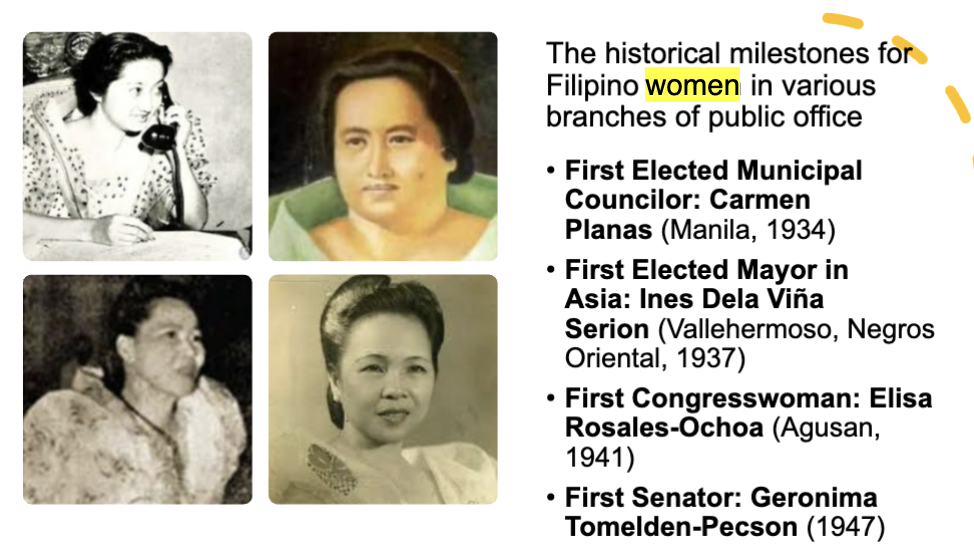
Agricultural Issues and Developments
Free Trade: The Sugar Problem
Two problems confronted the country:
Find the means for the preservation of the sugar industry after all the privileges that it now enjoys have terminated
Find the means of distributing the profits of the industry more equitably, as between the sugar central and the landowner on the one hand, and the sugar planter and the laborers, on the other
Farmer’s Rights and Earning
Rice Share Tenancy Act
(aimed for 5050 split of crop shares between land owner and farmer)
10% increase in interest in agricultural years
safeguards against arbitrary “abuse” by landlords
Treaty of Paris (selling of the PH)
Dec 10, 1898, happening in the background
The Spanish wanted a dignified exit from the Philippines, Spain was bankrupt because of the wars
US offered 20 mil USD to pay for the PH
Spain would offer multiple latin American countries and the PH to Spain
• ⁃ There was no Filipino signature or person at the meeting
Malolos Congres
Based on the on the decrees from June 18 and 23, 1898, Aguinaldo summoned the Revolutionary Congress at Barasoain, Malolos
Sept 4: he appointed 50 delegates
Sept 10: became 10
Number of delegates in congress fluctuated at times
There was now an executive and congress
What to do:
Ratify Declaration of Independence
• 2. To write a constitution
Headed by Pedro Paterno
San Juan bridge incident
Feb 4 1899
William Grayson shoots 2 unarmed Filipino soldiers trying to cross into an American-held sector near the San Juan Bridge
Filipinos didn’t speak English
“Halt!” Said the Americans, but they couldn’t understand so they proceeded.
After the shots, Filipinos began firing
• ⁃ Led to Battle of Manila
Philippine-American War (2 phases)
Two phases:
Feb-Nov 1899: Aguinaldo attempts to fight a traditional war with a pre-mature army. Failed against American veterans
Nov 1899-Spring 1902: shift to guerrilla-style war, in 1901 Aguinaldo was captured
Resistance maintained until 1903 and 1913 for different groups