Female Reproductive
 Call Kai
 Learn
Learn Practice Test
 Spaced Repetition
 Match
Match Flashcards
 Knowt Play
1/115

Earn XP
Description and Tags
Lec 23
Name | Mastery | Learn | Test | Matching | Spaced | Call with Kai | Chat |
|---|
No analytics yet
Send a link to your students to track their progress
116 Terms
What are the 3 primary functions of
the female reproductive system?
1. Produces gametes (ova)
2. Prepares to support a developing embryo
3. Undergoes changes according to the
menstrual cycle
What are the main 7 parts of the
female reproductive system?
1. Ovaries
2. Fallopian tubes (AKA uterine tubes)
3. Uterus
4. Vagina
5. External genitalia
6. Muscles in the pelvic floor
7. Perineum
3. What do the ovaries look like?
4. Where are they located?
5. What are they covered by?
6. What 3 ligaments hold the ovaries in
place?
7. What 2 ligament holds the fallopian
tube in place?
1. Small, almond-shaped organs, each 3 ½ cm long,
2cm wide (1 ½” x 1”).
2. Within the peritoneal cavity on the posterior body
wall
3. Covered by a superficial epithelium called the
visceral peritoneum.
Ovaries are held in place by 3 ligaments:
Broad ligament:
Ovarian ligament
Suspensory ligament
Broad ligament and suspensory ligaments hold up
fallopian tubes
Ovaries receive blood supply from
what artery?
Ovarian artery
Internal structure of the ovary
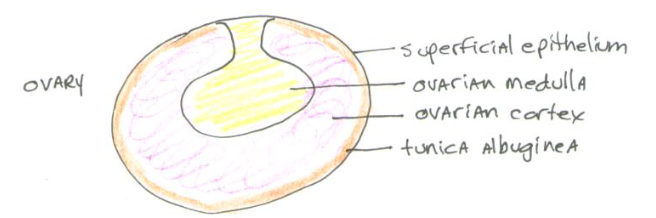
The ovary is covered with what
tissue?
Visceral peritoneum
What layer of thin dense connective
tissue is found deep to the visceral
peritoneum?
Tunica albuginea.
Internal to the tunica albuginea is
the___ and what can be found here?
Internal to that is the ovarian cortex, which is where
the developing eggs (oocytes) are found.
What layer is deep to the ovarian
cortex, and what structures does it
contain?
Internal to that is the ovarian medulla, which is loose
connective tissue with veins, arteries, nerves, and
lymphatics.
14. What is occurring during the ovarian
cycle?
15. What is the medical term for an egg
cell?
This is the process of egg development on a monthly
basis.
Oocyte
16. How many chromosomes dows the
typical (diploid) cell of the developing
blastocyte (baby) have?
17. How many come from each of the
gamete cells? (the oocyte and the sperm
cell)
The typical (diploid) cells of the blastocyte (baby)
have 46 chromosomes.
The gametes (oocyte and sperm cells) each
contribute typically 23 chromosomes.
18. The oocyte is surrounded by what
type of cells?
19. What is the whole structure called?
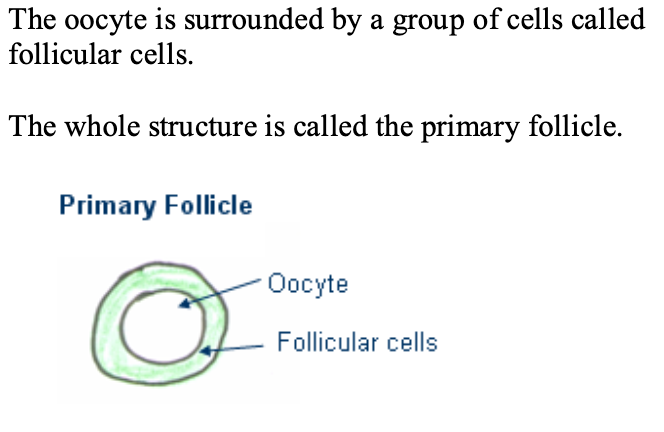
What hormone influences the
development of female secondary sex
characteristics?
Estrogen
What happens to the oocytes during
puberty?
At puberty there is a change in hormones which
causes maturing of some of these primary oocytes
which will lead to ovulation and then menstruation.
22. When does ovulation occur and what
happens during ovulation?
23. What is the luteal phase and what
happens during this phase?
24. What does the corpus luteum secrete,
and what is the function of that
secretion?
Ovulation occurs about approx 14 days through each
menstruation (28 day) cycle. An oocyte exits from
one ovary and enters the peritoneal cavity. It is then
swept into the Fallopian tube (uterine tube) waiting
to be fertilized by a sperm cell.
The luteal phase occurs after ovulation and the
remaining follicle becomes a corpus luteum.
The corpus luteum secretes progesterone, which
causes the uterus lining to thicken to prepare for
implantation of an embryo
The ovary during the ovarian (sex)
cycle
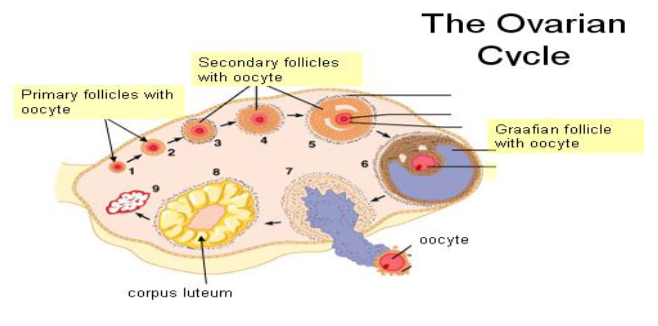
26. The average ovarian cycle is how
many days?
27. When does the ovarian cycle begin
and what occurs?
28. What happens to the oocytes during
days 1-7?
29. What hormone is secreted during
days 1-7?
The average ovarian cycle is 28 days.
Day 1
The ovarian cycle begins on the first day of
menstruation. The primary follicle begins to
develop.
Days 1-7
The oocyte grows, especially the follicle cells,
which grow and divide.
The adenohypophysis secretes FSH (follicle
stimulating hormone). This causes 20-30 eggs to be
stimulated in both ovaries
Diagram of ovaries on day 1 and day
7 of ovarian cycle
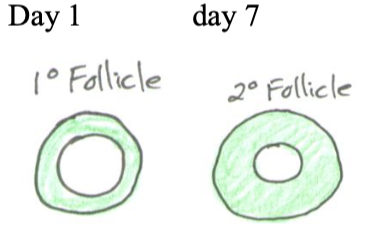
The primary follicle develops into a
___________
Secondary follicle
What hormone is secreted by the
secondary follicle?
Estrogen
Can more than one follicle develop at
once?
Sometimes more than one follicle matures causing a
double ovulation (one egg from each ovary) which
can lead to a multiple birth.
34. When does the primary follicle begin
to develop?
35. When does the female sex cycle
begin?
Day 1 of menstruation.
Day 1 of menstruation.
What is it called when a follicle is
fully mature, and on what day does this
occur?
Day 14: a fully mature follicle is called a graafian
follicle.
What is the ring that surrounds the
oocyte?
The oocyte is surrounded by a ring called the corona
radiata
What is the function of the corona
radiatia?
Provides nutrients for the ovum as it travels down
the fallopian tube.
What is the name of the space in the
graafian follicle that contains a clear
fluid?
antrum
What is the antrum surrounded by?
The antrum is surrounded by the follicular cells
By day 14 what starts to form on the
outside of the ovary?
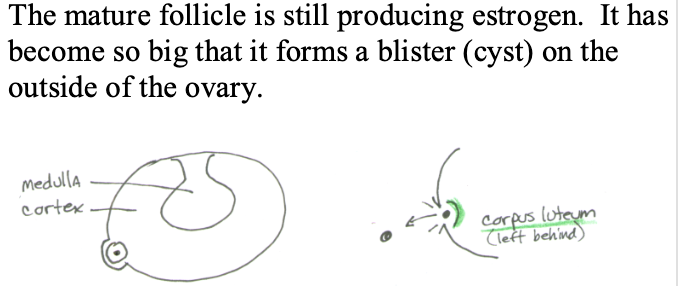
42. On the day of ovulation, the
adenohypophysis secretes what
hormone?
43. What effect does that hormone have?
44. What is this process called?
LH (luteinizing hormone).
LH causes fluid to rapidly flow into the antrum,
which then expands and pops the blister on the
ovary. The egg and corona radiata are released into
the peritoneum.
This process is called ovulation; there might be
some noticeable discomfort from this.
45. What is the corpus luteum?
46. After a pregnancy the corpus luteum
will turn into dead tissue; a white scar
called what? Does it secrete hormones?
The corpus luteum is the leftover follicle cells that
remain in the ovary after the oocyte leaves.
After a pregnancy the corpus luteum disintegrates
into a white scar called the corpus albicans. The
corpus albicans does not secrete hormones.
In autopsy, you can see how many of these scars are
present to determine how many pregnancies she had.
What hormone is secreted by the
corpus luteum?
Progesterone
Ovary diagram
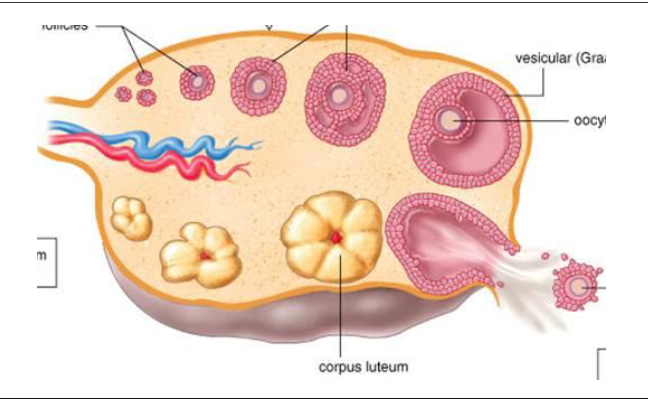
What is occurring days 14-21 during
the ovarian cycle?
The egg takes a few days to make its ways down to
the uterus. The follicular cells continue to grow and
make estrogen, which continues to build the uterus
lining so it’s ready for the egg by the time it gets
there.
What happens to the egg on day 23 if
there is no fertilization? What is
happening to the estrogen levels on day
23?
If no fertilization, the egg starts to break down.
The estrogen levels are still elevated until day 27.
What happens around day 27 during
the ovarian cycle?
Estrogen levels have dropped significantly
What happens on day 28 during the
ovarian cycle?
Menstruation starts and the uterine lining breaks
down this is the start of a new ovarian cycle. (day 1)
Can women get pregnant while they
are having a period?
A woman is only fertile when the egg is released,
but there is an ovarian reflex which is ovulation in
response to sex (not necessarily with orgasm).
There is no safe time to have unprotected sex, even
during menstruation (sperm can live up to ten days
in the female
What is one of the most common
causes of infertility in women?
One of the most common causes of infertility in
women is STD (sexually transmitted disease).
What nutrient is needed for women to
have a menstrual cycle?
Fat is needed to have the menstrual cycle. Skinny
and athletic women may not menstruate
56. Which hormone pills can a woman
take to increase her follicle stimulation?
57. How do these pills work?
Women who have trouble conceiving can increase
their chances by taking fertility pills with fsh
hormone.
Fsh causes 100 follicles to develop, 4-5 of which
may mature multiple births
58. How do birth control pills prevent
pregnancy?
59. How are they taken?
60. How does norplant prevent
pregnancy?
61. How effective are condoms at
preventing pregnancy?
Birth control pills are made of estrogen, so they
inhibit the development of the follicles, but the
uterine lining still grows.
You take them for 3 weeks, then take one week off
to allow for menstruation. Some of the new
estrogen pills can cause a period only every 3
months instead, but there are side effects.
Implantable birth control = norplant, etc, releases
tiny amount of estrogen continuously. Women that
have irregular cycles can take bcp to regulate them.
Condoms are also 99% effective if used correctly; if
not, only 85% effective. Solution = put the woman
in charge of the condom, and the failure rate drops
dramatically
How does the morning-after pill work
to possibly prevent a pregnancy?
This method involves a woman taking a higher than
usual dose of the same hormones used in birth
control pills within 72 hours (ideally, 24 hours) of
unprotected sex. It greatly reduces the chance of
pregnancy by preventing implantation of any
fertilized egg.
How does estrogen affect a woman’s
body?
The estrogen allows for deposition of subcutaneous
fat, which is what gives women their curves.
In pregnancy, it causes the breasts get larger, the
mammary glands get bigger
64. How long before planning conception
should a women stop taking BCP?
65. There is a ____% chance of getting
pregnant if you had unprotected sex
twice a week for a Year.
66. BCP/condoms are __% effective.
6-12 months before planning conception.
90% chance of pregnancy. (if not, may have fertility
Problem)
BCP are 99% effective.
Condoms up to 99% effective if used correctly
In breast cancer, the cancer cells
usually originate from where?
Cancer cells usually originate from the milk ducts.
What is a symptom of breast cancer?
The skin of the breasts will dimple because the
suspensory ligaments of the breast are involved.
Fallopian (uterine) tubes
The fallopian tube has fimbriae (“fingers”) that
surround the ovary. When the egg is released, it
goes into the peritoneal cavity
What structure in the fallopian tube
drags the egg in?
Cilia that line the fallopian tube create a current that
drags the egg in.
What are the 3 parts of the fallopian
tube made of?
It is made of the infundibulum (funnel), the ampulla
(most of the tube), and the isthmus (the part of the
tube closest to the uterus).
What part of the fallopian tube is
usually the area where fertilization
occurs?
The ampulla is where fertilization usually occurs.
73. On cross section, lumen of the
fallopian tube is lined by what?
74. Deep to the epithelium is what layer?
75. What is the function of this layer?
Ciliated simple columnar epithelium.
Deep to the epithelium are two layers of muscle; the
inner circular layer and the outer longitudinal layer,
for peristalsis.
What occurs when there is an ectopic
pregnancy?
If the egg implants outside of the uterus or on the
external surface of the wall of the uterus, it is called
an ectopic pregnancy.
Where is the most common area for
an ectopic pregnancy to occur?
The most common location for an ectopic pregnancy
is the fallopian tubes.
What is a tubal pregnancy?
A tubal pregnancy is a type of ectopic pregnancy
where the egg implants in the lining of the fallopian
tube.
What are the dangers of ectopic
pregnancies
A woman who goes into the er with abdominal pain
will always get a pregnancy test and they will do
surgery to remove the embryo. The egg can also
implant into the wall of the peritoneal cavity; also
fatal. If left undiagnosed the fallopian tube will burst
and can be fatal to the women.
Where do sperm go once they reach
the end of the fallopian tube?
Sperm swim out of the opening of the fallopian tube
and into the peritoneal cavity.
What is pelvic inflammatory disease
(PID) caused by?
Any STD (sexually transmitted disease)
What organs are not affected by PID?
It could then continue to all organs in the pelvis
except those organs which are retroperitoneal
(kidney, ureter, and urethra).
What is salpingitis?
Inflammation of the Fallopian (uterine) tube
Why is the pelvic cavity at risk for
disease and how does it protect itself?
A woman’s peritoneal cavity is open to the external
world; that’s why the lumen of the fallopian tube has
to be so narrow, and the cervix also has mucous for
protection
What is the most common cause of
pelvic inflammatory disease (pid)?
Sexually transmitted disease (std), usually
chlamydia or gonorrhea.
What are four characteristics of
pelvic inflammatory disease?
1) it can lead to sterility.
2) it is usually caused by chlamydia or gonorrhea.
3) it includes salpingitis (inflamed fallopian tube).
4) it does not inhibit ovulation.
What happens during a tubal
ligation?
A permanent way to prevent pregnancy by
surgically removing a piece of the fallopian tube so
the sperm cannot reach the egg. Only 1 in a million
does not work.
What is the least effective method of
birth control?
Withdrawing the penis before ejaculation. Statistics
say that there is a 30% chance of pregnancy with
this method.
89. What are the 5 parts of the uterus?
90. The largest gross region of the uterus
is where?
Fundus, body, cervix, cervical canal, and vagina.
The largest gross region of the uterus is its body
Uterus diagram
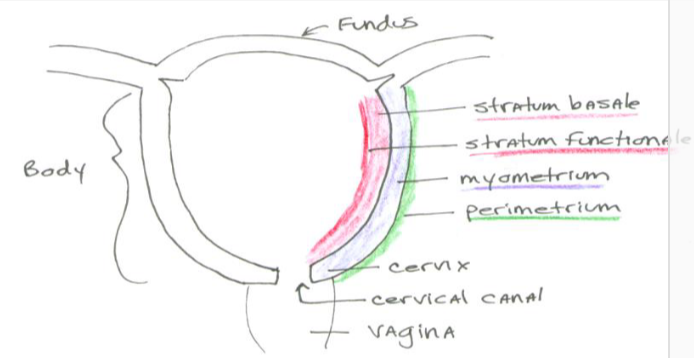
Most support of the uterus is
provided by what two structures?
It is held in place by the round ligament and by
mesentery; the broad ligament.
When a woman is standing, what
organ does the uterus sit on top of?
When a woman stands upright, the uterus sits on top
of the urinary bladder
94. What are the 2 layers of the
endometrium?
95. Which of these two layers can divide
and replace itself?
96. What layer goes through changes
during menses?
Endometrium (two layers)
1. Stratum functionale
2. Stratum basale
The stratum basale is the inner layer, and can divide
and grow to replace itself.
On top of it is the stratum functionale, which
undergoes the changes during menses.
97. What is the stratum functionale lined
by?
98. What is the function of the lamina
propria?
It is lined by simple columnar epithelium, under
which is the lamina propria with lots of uterine
glands which has lots of blood vessels.
The lamina propria secretes nutrients and coats and
protects the uterine lining.
99. What does the stratum functionale
maintain?
100. What is left over after the stratum
functionale breaks down?
The stratum functionale develops with the hormone
cycle, which causes it to grow, along with its glands
and blood vessels.
When the hormones stop, the stratum functionale
breaks down, leaving only the stratum basale.
101. Deep to the endometrium is the what?
102. When are these smooth muscles
used?
Deep to the endometrium is the myometrium, made
of smooth muscles which contract during birth.
What is another name for the
perimetrium (besides epimetrium)?
Visceral perineum. This is a general term that
applies to any organ, whereas perimetrium or
Epimetrium is specific for the uterus.
104. What is endometriosis and how does
it occur?
105. Where can pieces of tissue from
endometriosis be found?
106. How is endometriosis diagnosed?
107. How is endometriosis treated?
Pieces of the endometrium are supposed to fall
down the vagina, but sometimes its cells go up the
fallopian tube and enter the peritoneal cavity.
They can lodge anywhere: on top of the fundus, in
the lung pleura. These cells still respond to hormone
changes, grow, and break down and die, causing
pain during menstruation or other parts of the body.
It’s difficult to diagnose because the pain goes away
before the doctor appointment. The symptoms vary,
depending on the location. One lady had it on her
lung pleura and got a collapsed lung every month.
Treatment is to give hormones to prevent menses.
Surgery to remove it, if possible.
108. What are fibroids and where are they
found?
109. When are fibroids most painful?
110. What is the most common reason
women get a hysterectomy?
These are benign tumors like scar tissue in the
myometrium.
They can get large and be painful, especially during
contraction of menses and pregnancy.
Fibroids are the most common reason for
hysterectomy (surgical removal of the uterus)
What happens during a
hysterectomy?
The surgery involves going through the abdominal
wall, cut the broad ligament and fallopian tubes, and
removing the uterus by pulling it out through the
vagina.
112. What is the function of the vagina?
113. How long is the vagina?
The function is to receive the penis and sperm.
It’s about 9 cm long.
114. Lined by what and for what reason?
115. How is the vagina able to stretch
during the birthing process?
116. What is rugae and what is its
function?
117. What attaches the vagina to
surrounding structures?
It is lined by mucosa made of non-keratinized
stratified squamous epithelium, therefore its function
is to protect against abrasions.
Below it is a lamina propria with some glands (most
secretions are from the uterus). It has lots of elastic
fibers since it has to stretch during the birth process.
The vagina also has rugae. There is a muscularis
layer around it which allows for peristalsis during
orgasm and menses, which helps sperm move into
the uterus.
Surrounding that is an adventitia layer which is
dense connective tissue with elastic fibers. This
attaches the vagina to surrounding structures.
Where is the hymen found?
It is found at the vaginal opening the mucosa
extends into the vaginal orifice or hymen.
If the hymen covers the whole thing, can’t get the
menstrual flow out, so it will need surgery. Some
women are born with a small hymen, so there is not
much bleeding at the first intercourse. Some have a
hymen so thick, it needs surgery before penetration.
What are the external genitalia called?
The vulva
What area is the pad of adipose tissue
above the pubic symphysis?
Mons pubis, covered with pubic hair.
The outer labias of the vulva are
called?
The labia majora is an extension on either side of the
vestibule, also with pubic hair
The inner labias of the vulva are
called?
labia minora, which are thin folds of mucosal tissue
The area of the vulva which has
erectile tissues like a penis?
clitoris
What tissue is inside a clitoris?
Corpora cavernosa.
What tissue covers the clitoris?
Prepuce
What is the female homologue
(equivalent) of the male’s scrotum?
Labia majora
127. Where is the vestibule?
128. Within it you can find what anatomy?
Vestibule is the area bounded by the labia minora.
Within it are the urethral orifice, vaginal orifice, and
vestibular glands (in the posterior region) which
secrete mucus during sexual arousal for lubrication.
What happens to the vagina during
childbirth?
During childbirth the vaginal orifice enlarges, so it
will either stretch or tear at the posterior portion.
What happens if the outside of the
vagina tears?
If it tears, the vagina and the anus can be connected
by the tear = bad infection. The surgeon can do an
angled cut away from the anus, through the muscle
What is the purpose of an
episiotomy?
A purpose of an episiotomy during childbirth is to
minimize tearing of the central tendon and muscles
of the pelvic floor.
What issues might occur after a
vaginal delivery?
Tearing or even if there was no tearing during
childbirth, afterwards there can be weak muscles so
external urethral sphincter can become incompetent;
so can the external anal sphincter.
Treatment/prevention is exercises for the muscles
there and the external urethral sphincter.
What happens when there is a
prolapsed uterus?
A weak muscle can decrease the support of the
uterus, which can then prolapse and fall out through
the vagina
134. Where are the mammary glands
found?
135. What are the mammary glands
functions?
They are found in the breasts and are modified
sweat glands with glandular structure (undeveloped
in non-pregnant women)
Their main function is milk production and starts
after giving birth
What are the 4 main types of
reproductive system cancers found in
females?
1. Ovarian cancer arises from cells in the germinal
epithelium
2. Endometrial cancer arises from the
endometrium of the uterus
3. Cervical cancer slow-growing, arises from
epithelium at the tip of the cervix
4. Breast cancer is the second most common cause
of cancer deaths in women
5. 97% occurs in women over 50
What cells does breast cancer usually
arise from?
Cells in the milk ducts.
What causes the dimpling when the
skin is dimpled from breast cancer?
The suspensory ligaments of the breast
How is breast cancer treated?
Surgical removal of the mass (lumpectomy),
whole breast (mastectomy)
Radiation therapy
Administration of selected hormones
Chemotherapy
140. The onset of puberty occurs in
females about what age?
141. What happens to the reproductive
organs during puberty?
Period of life between ages 10-15
Reproductive organs grow to their adult size
142. Do the same events happen in the
same sequence in all females?
143. What is the first menstruation called?
Events of puberty occur in the same sequence in all
individuals. Age at which events of puberty occur
varies widely
Menarche – the first menstruation