Chemistry (kinetics)
 Call Kai
 Learn
Learn Practice Test
 Spaced Repetition
 Match
Match Flashcards
 Knowt Play
1/4

There's no tags or description
Looks like no tags are added yet.
Name | Mastery | Learn | Test | Matching | Spaced | Call with Kai | Chat |
|---|
No analytics yet
Send a link to your students to track their progress
5 Terms
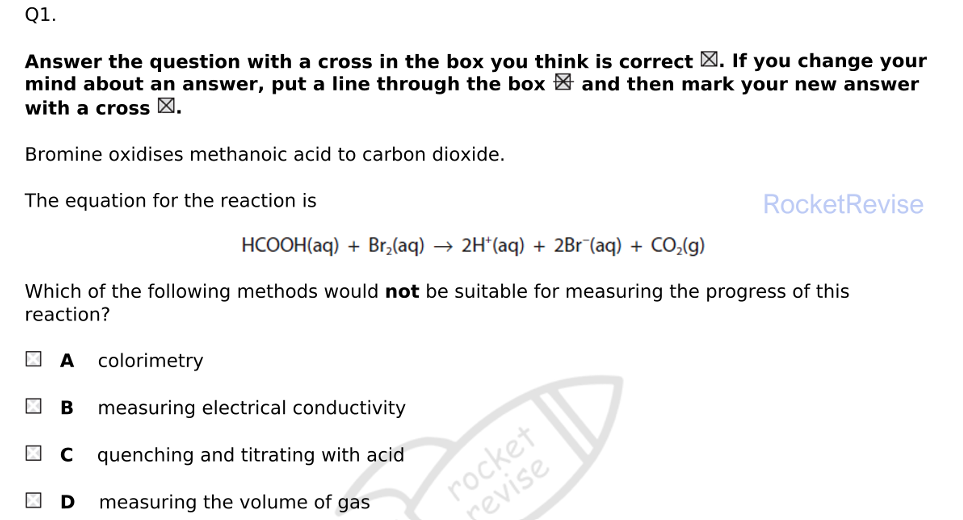
the answer is C
→ A is suitable because Br2 is colored (orange/brown) and as the reaction continues, the colour gets weaker.
→ B is suitable because
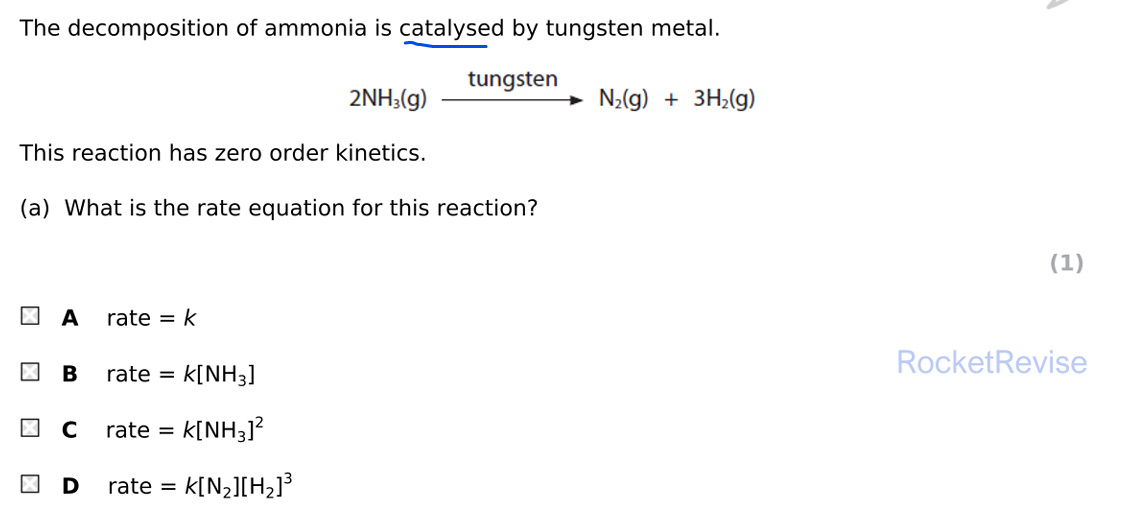
answer is A because 0 order is rate = k

the answer is A because if you look at the products, you’ll notice that there’s ions. also, if they ask about titrating then they might ask:
“Which method could be used to monitor the progress of the reaction by taking samples at regular time intervals?”
“Samples of the reaction mixture are removed at regular intervals. Describe how the concentration of X could be determined.”
“Which method could be used to determine the concentration of the reactant at different times during the reaction?”
“Explain how titration could be used to obtain rate data.”
“Describe a method for determining the concentration of X at regular intervals during the reaction.”
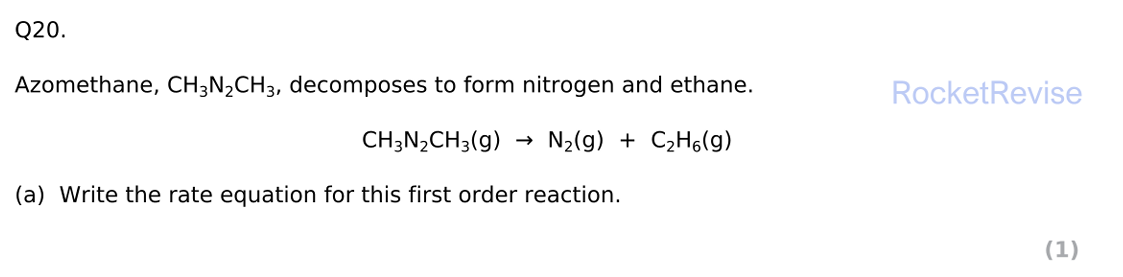
answer is rate = k[CH3N2CH3] because it’s first order
remember:
0 order - rate = k
1st order - rate = k[A[
2nd order - rate = k[A]2

first: divide 9 by 2. 9/2 = 4.5
find 4.5 on the y axis and draw across the curve
second: halve 4.5 now by 2. 5.4/2 = 2.25
find 2.25 on the y axis and draw across the curve
this happens at 270 mins.
then you do 270-135 cuz 135 is the number u got from 4.5 and 2.25
then u compare the half-life to see if it’s constant so that you’ll know if it’s first order or not.