Criminalistics (Final)- Strimlan (Pitt)
 Call Kai
 Learn
Learn Practice Test
 Spaced Repetition
 Match
Match Flashcards
 Knowt Play
1/50

There's no tags or description
Looks like no tags are added yet.
Name | Mastery | Learn | Test | Matching | Spaced | Call with Kai | Chat |
|---|
No analytics yet
Send a link to your students to track their progress
51 Terms
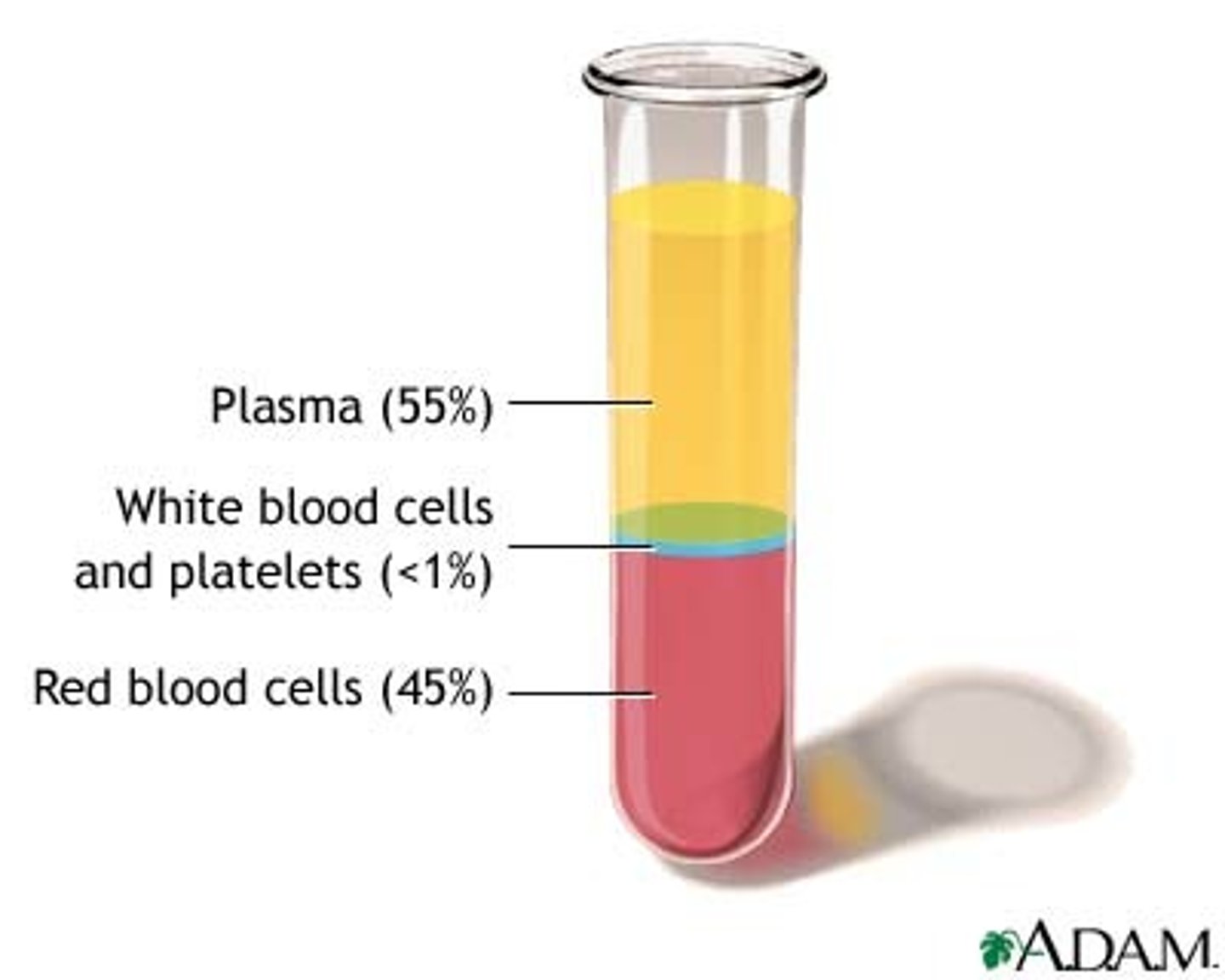
A clear yellowish fluid mark...
-a clear/yellow blood stain; plasma in blood
-plasma is the fluid portion of unclotted blood
-when remove clotted material (protein in plasma called fibrin traps), pale yellowish liquid known as serum is what's left
A mass disaster...
can be any incident greater than the resources of the region where it occur
What is the most important bone to be recovered?
hyoid bone
Blood..
-carries nutrients and oxygen to parts of the body
-carries metabolic waste away from cells
Possible characteristics of a typical shotgun wound?
-skin defect
-rim abrasion
-surrounding residues discoloration
A forensic pathologist can determine what about a gun wound?..
Ellie Thinks Dan's Tall
-enter/exit (not caliber)
-type of firearm
-distance of gun to victim
-track of projectile
A common loose contact gunshot wound..
-is produced when muzzle of weapon held in very light contact to skin at time of discharge
-would show that gun powder around skin not indented by muzzle (no muzzle imprint)
By definition, a distant gunshot entrance wound would show..
-wound of entrance without surrounding residue
-lacking powder residue
-usually exhibit a hole roughly the caliber of the projectile fired
Consistent with a typical exit wound?
Can NATALIE Really See Spirits?
-Can be any shape
-NO:
*(no) ring of abrasion
*(no) surrounding residue
*(no) skin defect
Blunt force trauma..
-most common form of trauma
-can be lethal/non-lethal
-caused by blunt objects (hammers, sticks, etc.)
Types of blunt force trauma..
C.A.L.
-contusions
-abrasions
-lacerations
(also fractures)
Objects with a sharp or pointed edge can..
-be used as a weapon and impair the skin
-knife/shank/glass/shears/forks/
hot pick/catheter
A stab wound is the penetration of..
-the skin
-the body, by a sharp or pointed instrument
In cut and stab wounds..
-stab: the wound is deeper than it is long
-incised: the wound is longer than it is deep
Muzzle impressions are..
-skin impact against muzzle
-not in contact with body's surface
The baby's life could be in danger..
Mother (+) / Baby (-) is okay
Mother (-) / Baby (+) is bad
Which of the following could help in estimating time since death?..
Terry Doesn't Find Sally Scoring Cocaine Pouches Sadly
-Temperature (algor mortis)
-Decomposition
-Food digestion
-Stiffness (rigor mortis)
-Settling of the blood (livor mortis)
-Circumstantial evidence, potassium level in eye fluid
-Skeletonization
Which statement about blood is false?
-RBC: oxygen, hemoglobin → TRUE
-WBC: nucleus → TRUE
-Platelets: clotting → TRUE
-Plasma (fluid) accounts for 55% of blood content, the solid portion accounts for 45% of blood content → TRUE
-5 to 7 liters in a human → TRUE
-7-8% of body weight → TRUE
-blood is less than/same weight as water → FALSE (blood is slightly heavier)
-level of salt = sea water
Survival time is..
-the period of time between the incident (injury/illness) and death
-the longer you wait, the harder it is to identity the time of death
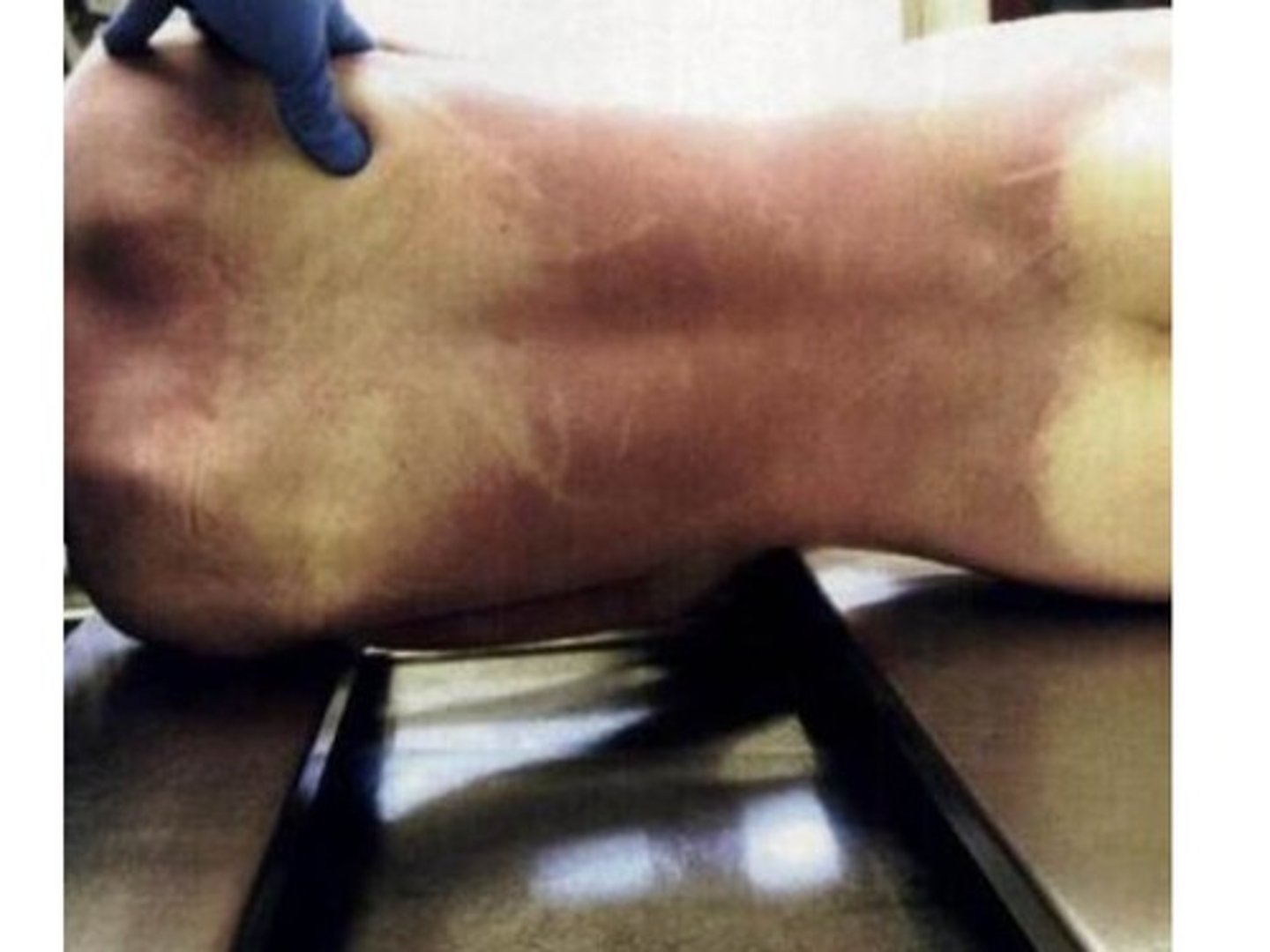
Lividity (livor mortis) can be..
-distinguished from bruising if you cut the skin and liquid pours out (CUT THE TISSUE)
-mistaken for bruising/trauma
The blanching of post-mortem...
-is pushing down on skin and spot turning white
-can only be blanched in early stages of lividity
-by 6-10 hours, reached max discoloration
-although blood will settle to lowest part of body, often doesn't settle at points of contact with hard objects
Lividity (Livor Mortis)..
-is the "color of death"
-discoloration of the skin caused by the flow of blood into venous spaces under the influence of gravity
-onset is immediate
-sets in (blood starts settling) after 4 hours
-by 6-10 hours, has reached its max and is permanent
True or False:
Blood in most corpses starts to become permanently incoaguable after 20-30 minutes.
TRUE
When estimating the time of death, it is self-evident that..
the longer the interval between death and examination of the body, then wider will be the limits of probability
The Post-Mortem Interval is...
(PMI)
-the length of time that has elapsed since a person has died
-exactly unknown, number of medical/scientific techniques used to estimate it
Rectal temperature..
-is the most accurate way to take a body temperature
-often too disruptive at scene (have to also get environmental temperature and/or ear canal temperature)
When considering time of death, algor mortis..
algor mortis → temperature
-temperature of body raises 1-2° degrees during the first hour and then after that, loses 1.5-2° degrees/hr after death until body reaches ambient temperature
When considering time of death, algor mortis is affected by..
algor mortis → temperature
Fanny Chants While Children Hum Incredibly
-Fat (faster)
-Child (faster)
-Wind (faster)
-Clothing (slower)
-Humidity (increases evaporation)
-Immersion in water or organic substance (slows conduction)
Newton's Law of Cooling States...
algor mortis → temperature
-the rate of cooling is directly proportioned to the temperature differences between an object, and its' surroundings (environment), provided this distance isn't too large
In Allegheny County, the natural cause of death may be determined by..
-police officer
-medic
-physician
A pathologist can possibly estimate time of death by looking at...
how far the food in the stomach has moved (cannot give an exact hour/minute, but can give a range)
Fibers found in the barrels of a gun..
can lead to pseudo tattooing/pseudo soot
What percentage of offspring could be blood type O from a father type A and a mother type B?
0% or 25%
What is the approximate chance of the third child being born to parents being a boy/girl?
the probability of having a boy or a girl is ALWAYS 50/50
A careful examination of the bloodstains at the scene can determine..
Ollie Paints Nails During Mom's Dinner
-Origin of blood stains/splatter
-Position of victim at time of blows
-Number of blows
-Direction of deposit
-Manner of disposition (drips, blunt force trauma, gunshot wounds)
-Direction of travel after injury
Forensic science in its broadest definition is...
the application of science to the law
When it comes to blood spatter, law enforcement agents rely on..
Natalie Was Always Buying Diamond Stones
-Number of hits
-Weapon used
-Angle
-Body position
-Direction
(serology)
Chemical tests available to detect blood are..
peroxidases
If the mother is blood type A, and the father is blood type B, the baby could be..
A, B, or AB
Processing the crime scene?..
Penny Really Can Cook Masterfully
1) process and isolate crime scene/secure the scene → first arriving officer preserve/protect area
2) record the crime scene→ limited time to work with site in untouched state (notes, photography, crime-scene recording used)
3) conduct a systematic search for evidence→ look for search patterns (strip/line search, grid search, spiral search, wheel/ray search, quadrant/zone search)
4) collecting and packaging physical evidence→ can be anything from big objects to microscopic traces.. each item should be handled carefully and separately
5) maintain chain of custody
Humans have a medullary index of..
less than 1/3
__________ is NOT a legal cause of death.
Cardiopulmonary arrest/heart failure because.. heart can fail for multiple reasons:
-sick (have a heart attack)
-car accident
Difference between manner and cause of death?
-Manner: how injury/disease leads to death (natural, accident, suicide, homicide, undetermined)
-Cause: specific injury or disease that leads to death
Rohypnol has physiological effects similar to..
the date rape drug (GHB); 10x stronger than valium
The finger-print template is..
-name of file in fingerprint database
-AFIS
-epidermal layer, more unique than DNA
The cross-section of a man-made fiber..
-are bi/double refraction
-uniform
-symmetrical
Drugs are substances of natural/synthetic origin which..
alter one's emotional state, perception, body function, and/or behavior
Low velocity impact blood spatter is..
-larger drops (5 ft / sec slower)
-25 ft/sec or less
For blood spatter, the angle of impact...
Angle of Impact = arcsin (width/length)
-arcsin=(opposite side/hypotenuse)
-how the blood hits the surface
The smaller the size of bloodspatters...
the higher the velocity of impact
Examples of high velocity impact blood spatters?
-guns, sneeze → 100 ft/sec explosion