Summer Bio Week 3
 Call Kai
 Learn
Learn Practice Test
 Spaced Repetition
 Match
Match Flashcards
 Knowt Play
1/69

There's no tags or description
Looks like no tags are added yet.
Name | Mastery | Learn | Test | Matching | Spaced | Call with Kai | Chat |
|---|
No analytics yet
Send a link to your students to track their progress
70 Terms
What elements are proteins made up of?
Carbon, Hydrogen, Oxygen, Nitrogen, Sulfur (sometimes)
Enzymes
organic catalysts that start and speed up chem rxn’s
*Every rxn requires it’s own enzyme
What is the reactant in a enzyme reaction called?
A substrate
Contractile proteins
For movement
Antibodies
Proteins made by white blood cells that inactivate and destroy viruses and bacteria
*They are specific for specific antigens
Transport proteins
proteins that carry molecules in and out of cells
Structural proteins
contain amino acids with sulfur (helps to stabilize protein)
Storage proteins
Becomes incorporated into growth tissue
*not used for energy to burn
Hormones
Allows regulation of an organism’s activity
R-group
Variable side chain gives an amino acid its chemical properties (poplar, nonpolar, acidic, basic)
If an R group contains these chemicals it is polar…
Sulfur, Oxygen, Nitrogen
How does polarity affect amino acids?
It affects how they fold into the proper shape
Where are polar amino acids located?
OUTSIDE (so they can interact with water)
Where are nonpolar amino acids located?
INSIDE (bc they do not interact with water)
Peptide bond
A covalent bond between the carboxyl group of one amino acid and the amino group of the next amino acid
*Look for the C that is double-bonded to O
How does a Polypeptide become a Functional Protein?
Needs a min of 50 amino acids
A specific 3D shape formed through several levels of structure
Primary structure
precise order of amino acids in a polypeptide chain
Secondary Structure
The polypeptide folds into small repeated patterns
*R group is NOT involved
ex- cobwebs
In secondary structure, what are the structures stabilized by?
Hydrogen bonds between the amino group of 1 amino acid and the carboxyl group of another
Tertiary structure
Created the final 3D shape of a single polypeptide formed by interactions b/t R groups
ex- insulin
What is a disulfide bridge?
S-S in structural proteins
Quaternary structure
2 or more chains fit together to make 1 functional protein
ex- hemoglobin
deNATURED
A protein changes shape and can’t function
Temperature affects protein function
Too hot: can permanently denature
Too cold: can slow down protein function (usually reversible)
What temperature is homeostasis for humans?
37 °C
Changes in pH affect protein function
most cells - pH 7
digestive(stomach) proteins- pH 2
Intestine- pH 8 or 9
Salts affect protein function
Ions/charges attract parts of the protein, pulling it out of shape
ex- chemically straightening hair
Is the primary structure of a protein affected by denaturing?
NOPE because the pep bonds don’t break
*NUMBER and SEQUENCE of amino acids don’t change
What elements are in Nucleic Acids?
Carbon, Hydrogen, Oxygen, Nitrogen, Phosphorus
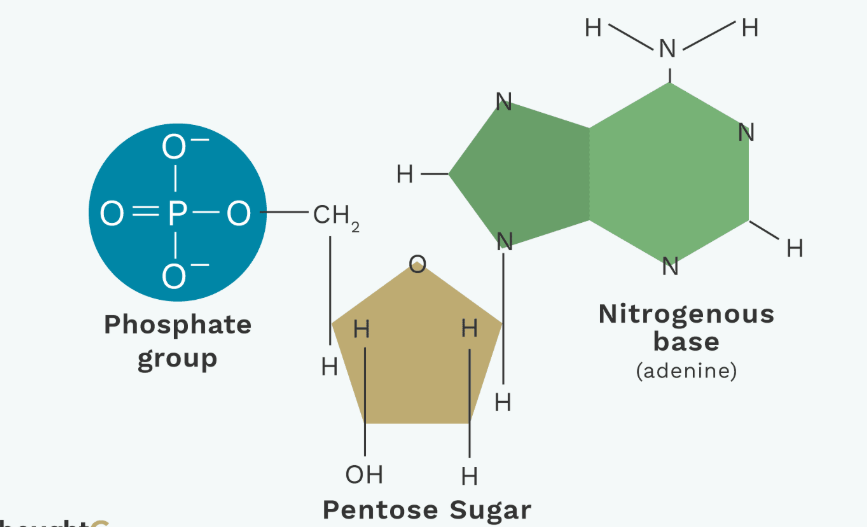
Monomer of a nucleic acid
Nucleotide
What is DNA?
The genetic code for ALL living things
What does DNA code for?
sequences of proteins (that make up a structure and allow all metabolic rxn’s)
Gene
a small portion of DNA
Genome
ALL the genes in an organism
Chromosomes
DNA is wrapped around protein structures to make a chromosomes
*we have 46
Transcription
the process that copies the DNA→RNA
Translation
the process that reads the RNA and translates the message into amino acids
Where is DNA found in a Eukaryote?
Nucleus
Where is DNA found in a Prokaryote?
floating in cytoplasm
What shape is DNA
double helix
Who discovered the shape of DNA?
James Watson, Francis Crick, Roslyn Franklin
What does Adenine bond with?
Thymine (DNA)
Uracil (RNA)
ANTIparallel
the 2 strands of DNA run side by side in opposite directions
What bonds together the base pairs?
HYDROGEN BONDS
What does RNA do?
Copies the DNA and brings it to the ribosomes so the proteins can be synthesized
Messenger RNA (mRNA)
a copy of DNA
Transfer RNA (tRNA)
helps in the process of translation
Ribosomal RNA (rRNA)
found in all ribosomes and helps in translation
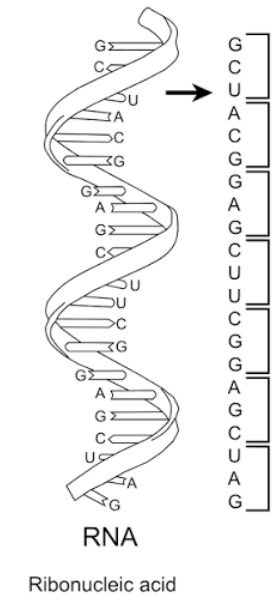
What are the groups in brackets called?
Codons- code for a single amino acid
Purine
Guanine and Adenine (2 rings)
Pyrimidine
Thymine and Cytosine (1 ring)
How many strands is DNA?
2
How many strands is RNA?
1
What is the sugar in DNA?
deoxyribose
What is the sugar in RNA?
ribose
DNA helicase (enzyme)
unzips the DNA molecule by breaking hydrogen bonds
RNA polymerase (enzyme)
binds to a region of the DNA called the promoter
What happens when the it reaches the termination signal?
RNA polymerase will break loose from DNA and the newly made mRNA will be released
Where does transcription occur?
Nucleus
What is the direction of transcription?
51 → 31
Introns
uncoded regions of mRNA that are cut out
Why are the introns cut out?
It reduces chance of mutation
Exons
coded regions of mRNA that are spliced making the final mRNA transcript
How many codons combos are there?
64
Where does translation occur?
Cytoplasm
What is needed for translation to occur?
edited mRNA
Ribosome
tRNA
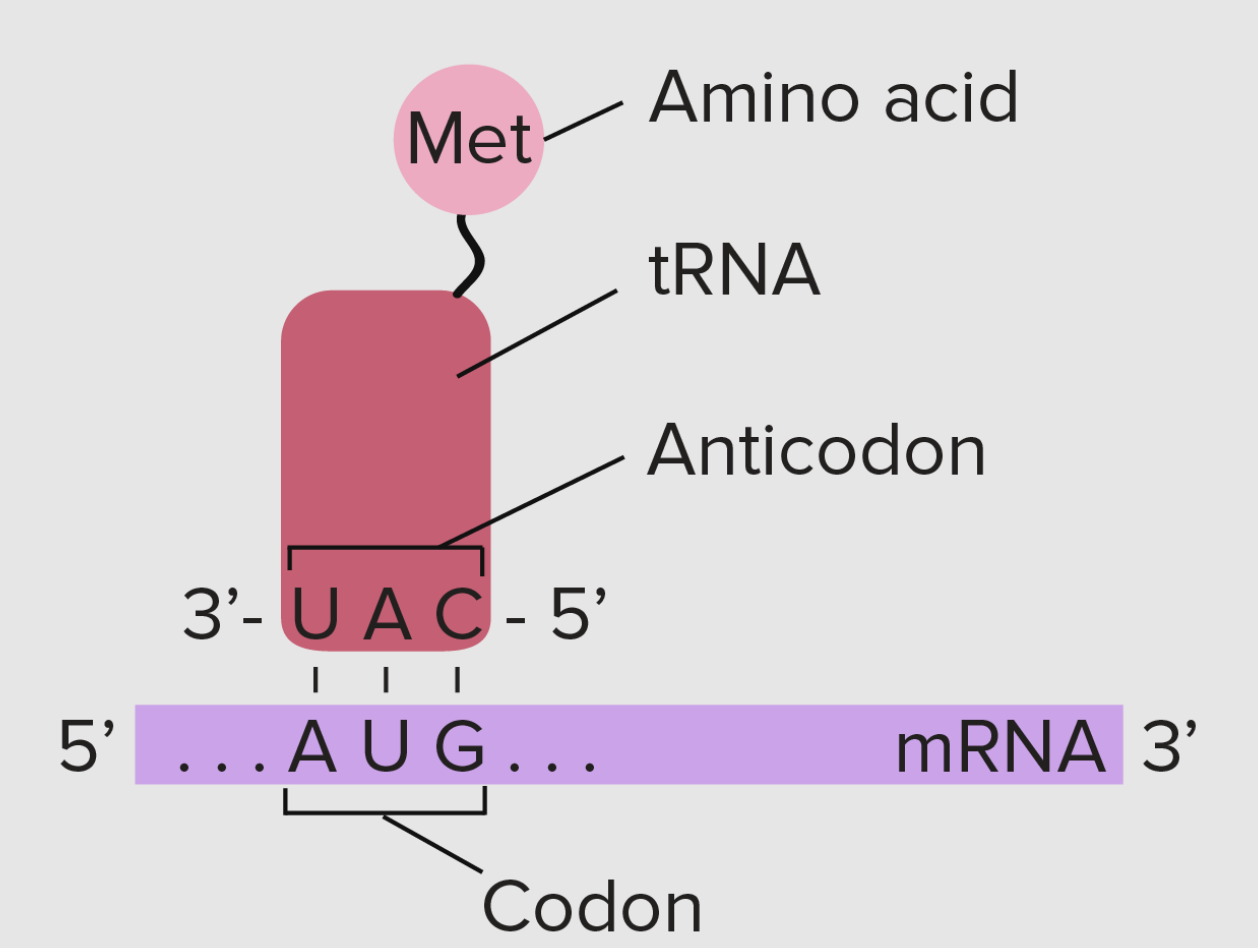
What is this?
tRNA
Anticodons
have the corresponding nitrogen bases to the mRNA
What happens to the amino acids during TRANSLATION?
they form peptide bonds with adjacent amino acids and form a polypeptide
Stop codons
UAA, UAG, UGA