Physics 2212
 Call Kai
 Learn
Learn Practice Test
 Spaced Repetition
 Match
Match Flashcards
 Knowt Play
1/33

There's no tags or description
Looks like no tags are added yet.
Name | Mastery | Learn | Test | Matching | Spaced | Call with Kai | Chat |
|---|
No analytics yet
Send a link to your students to track their progress
34 Terms
B
B
John Travoltage -- When Jonnie rubs his foot on the carpet in his new apartment, he picks up some charges. If he just rubs his foot on the carpet a few times and keeps his hand away from the doorknob, how will these charges behave?
The charges will mostly stay clustered near his foot. | |
The charges will spread out somewhat uniformly throughout his body (uniform density). | |
The charges will move between his finger and the doorknob, creating a spark and giving Jonnie a shock. | |
The charges will spread out somewhat uniformly over the surface of his body | |
The charges will mostly cluster at the tip of his outstretched index finger. |
The charges will spread out somewhat uniformly over the surface of his body.
When somebody's hair stand up after sliding on a playground, this is because
Question options:
hair experiences triboelectricity | |
the human is a charged conductor and hair is movable | |
hair is not conducting electricity | |
the human is an insulator and hair is in electric breakdown |
the human is a charged conductor and hair is movable
Consider a plastic rod that is being charged up by rubbing a wool cloth. It is then brought to an initially neutral metallic sphere, and allowed to touch the sphere for a few seconds. The rod is then separated from the sphere by a small distance. After becoming separated, the rod
Question options:
is repelled by the sphere | |
is attracted to the sphere | |
experiences no force due to the sphere |
is repelled by the sphere
After brushing your hair, you can use your comb to pick up pieces of paper, because
Question options:
the hair is a charged conductor and is movable and the pieces of paper too | |
the charged comb charges the pieces of paper through electric breakdown of air | |
the comb is charged by triboelectric effect and the paper is polarized and is attracted to the charged comb | |
both the paper and the comb are charged oppositely |
the comb is charged by triboelectric effect and the paper is polarized and is attracted to the charged comb
An electroscope is positively charged by touching it with a positive glass rod. The electroscope leaves spread apart and the glass rod is removed. Then a negatively charged plastic rod is brought close to the top of the electroscope, but it doesn’t touch. What happens to the leaves?
Question options:
The leaves spread further apart. | |
The leaves don't move | |
One leaf moves higher, the other lower | |
The leaves get closer together. |
The leaves get closer together.
B
What can be used to sense the electric field created by aluminum electrodes placed in water?
Question options:
electroscope | |
fur | |
LED (light-emitting diode) | |
plastic rod |
✅ LED (light-emitting diode)
A
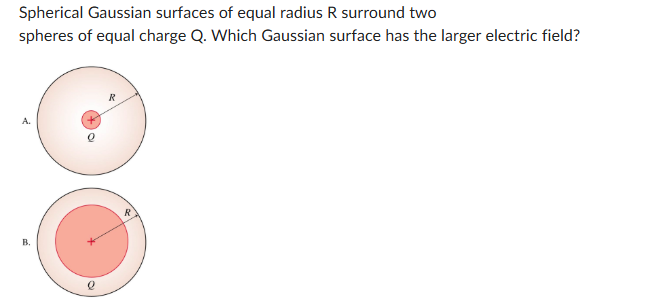
Answer Choices: Surface A, Surface B, Not enough information to tell, They have the same electric field
They have the same electric field
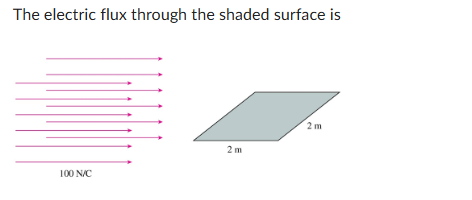
0, 200 N m/C, 400N m²/C, Some other Value
400 N m^2/C | |
0
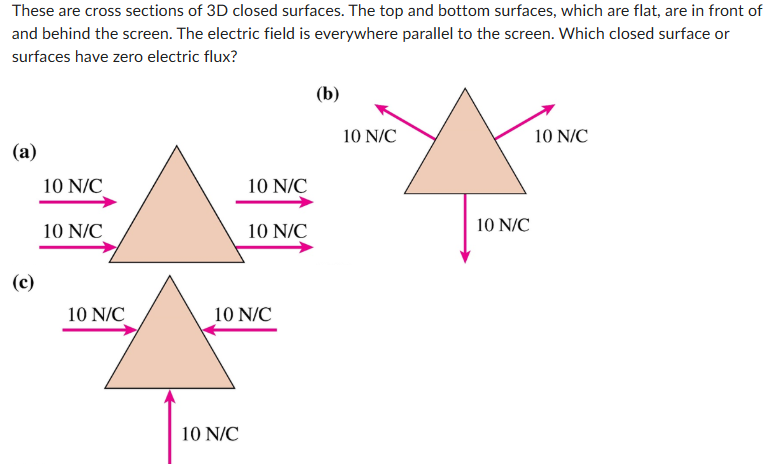
Surface A | |
Surface B | |
Surface C | |
Surfaces B and C | |
All three surfaces |
Surface A
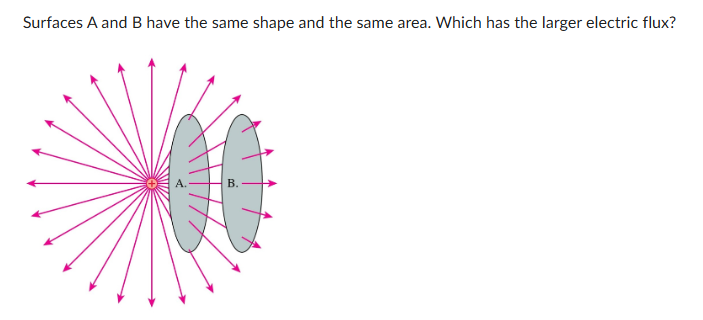
Surface B has more flux | |
= | Surface A has more flux |
It's impossible to say without knowing more about the electric field | |
The fluxes are equal |
Surface A has more flux |
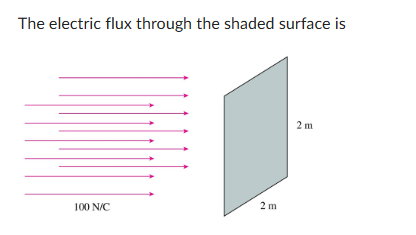
| |
400 N m^2/C | |
200 N m/C | |
0 |
400 N m²/C
A conductor carries a net charge of +Q. A cavity within the conductor contains a point charge of −Q. What is the charge on the outer surface of the conductor in electrostatic equilibrium?
Question options:
–Q | |
+Q | |
+2Q | |
0 |
0
Consider a charge q placed on the x axis at x = 2 R and a sphere with radius R centered at the origin. What is the flux through the sphere?
Question options:
0 | |
-2q/epsilon_0 | |
2q/epsilon_0 | |
-q/epsilon_0 |
0
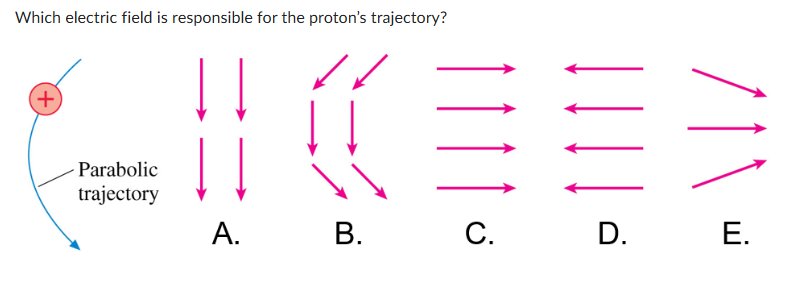
D
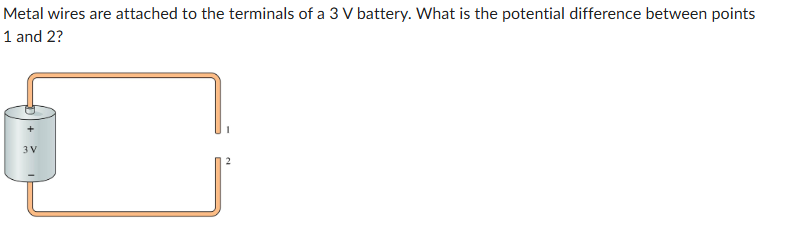
Question options:
0 V | |
Undefined | |
6 V | |
3 V | |
Not enough information to tell |
3V
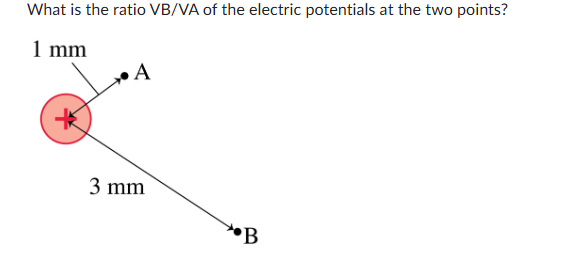
Question options:
1/3 | |
Undefined without knowing the charge | |
9 | |
3 | |
1/9 |
1/3
The electric potential inside a parallel-plate capacitor
Question options:
decreases inversely with the square of the distance from the negative plate | |
decreases inversely with distance from the negative plate | |
increases linearly from the negative to the positive plate | |
is constant | |
decreases linearly from the negative to the positive plate |
increases linearly from the negative to the positive plate
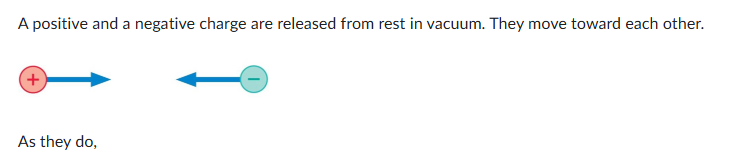
As they do,
Question options:
A positive potential energy becomes a negative potential energy | |
A positive potential energy becomes less positive | |
A negative potential energy becomes less negative | |
A negative potential energy becomes more negative | |
A positive potential energy becomes more positive |
✅ A negative potential energy becomes more negative.
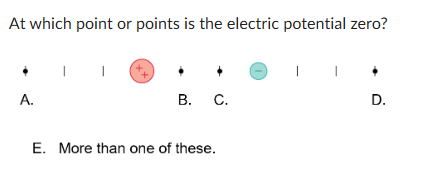
A | |
B | |
C | |
D | |
E |
C
The turning point for two point charges occurs when
Question options:
E_total = m v^2/2 + k (q1 q2)/r | |
E_total = m v^2/2 + k (q1 q2)/r^2 | |
E_total = k (q1 q2)/r^2 | |
E_total = k (q1 q2)/r |
Etotal=k(q1q2)/r
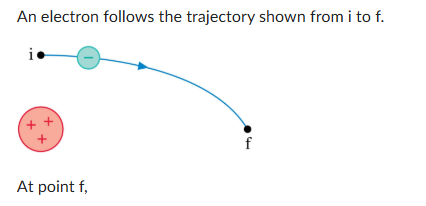
| |
vf = vi | |
vf < vi | |
Not enough information to compare the speeds at these points |
vf > vi
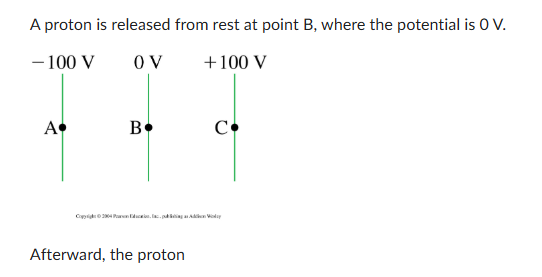
Afterward, the proton
Question options:
remains at rest at B | |
moves toward A with an increasing speed | |
moves toward C with a steady speed | |
moves toward A with a steady speed | |
moves toward C with an increasing speed |
moves toward A with an increasing speed
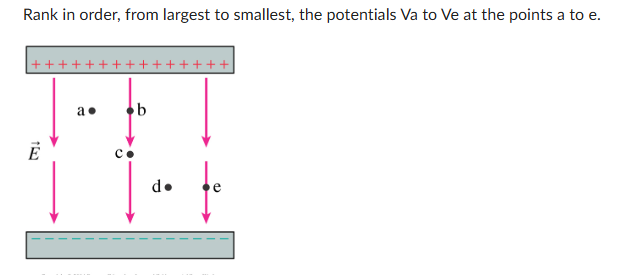
Vd = Ve > Vc > Va = Vb | |
Vb = Vc = Ve > Va = Vd | |
Va = Vb = Vc = Vd = Ve | |
Va = Vb > Vc > Vd = Ve | |
Va = Vb = Vd = Ve > Vc |
Va = Vb > Vc > Vd = Ve
If the electric field at a certain point is zero, then the electric potential at that point
Question options:
must be zero | |
We cannot tell what the potential is from the given information | |
must be positive | |
must be negative |
✅ We cannot tell what the potential is from the given information.
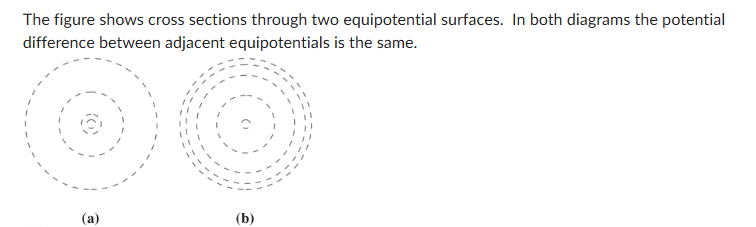
Which of these two could represent the field of a point charge?
Question options:
(a) | |
(b) | |
neither (a) nor (b) |
A
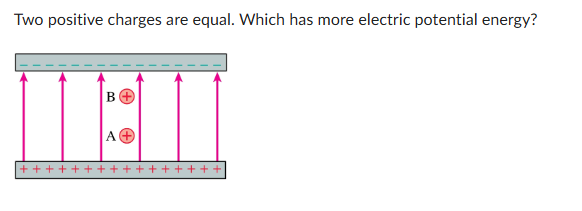
Charge A | |
Charge B | |
They have the same potential energy | |
Both have zero potential energy |
Charge B
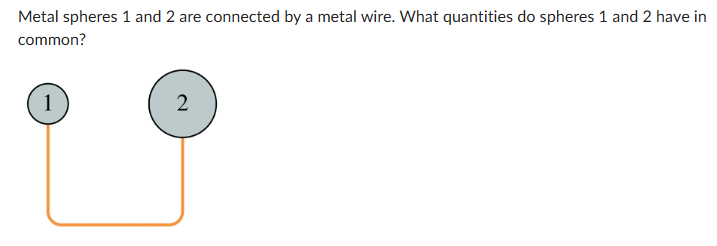
Same charge | |
Both A and B | |
Same potential | |
Both A and C | |
Same electric field |
Same potential
As an electron moves from higher potential to lower potential, its electrical potential energy
Question options:
increases | |
decreases | |
stays the same |
increases