Unit 3: section 8 - Energy and Metabolism
 Call Kai
 Learn
Learn Practice Test
 Spaced Repetition
 Match
Match Flashcards
 Knowt Play
1/35

Earn XP
Description and Tags
will focus on the energy that is used with the cell. All energy is subject to the laws of thermodynamics. Energy is released when chemical bonds are broken and energy is used to build bigger molecules. Enzymes are proteins that catalyze reactions by making them easier to start by lowering the activation energy.
Name | Mastery | Learn | Test | Matching | Spaced | Call with Kai | Chat |
|---|
No analytics yet
Send a link to your students to track their progress
36 Terms
what term do scientists use to describe the concept of energy flow?
bioenergetics
bioenergetics
concept of energy flow through living systems, such as cells. . It primarily focuses on the cellular processes that generate, store, and consume the molecule adenosine triphosphate (ATP), which acts as the primary energy currency of the cell.
metabolism
the sum of all life-sustaining chemical reactions that occur within the cells of a living organism. It allows organisms to grow, reproduce, repair damage, and respond to their environments by converting food into usable energy and building blocks for essential molecules.
During photosynthesis what is being converted?
plants use energy (originally from sunlight) to convert carbon dioxide gas (CO2) into sugar molecules (like glucose: C6H12O6). They consume carbon dioxide and produce oxygen as a waste product.
What is a metabolic pathway?
a linked series of chemical reactions occurring within a cell. Starting with a specific reactant, the pathway modifies it through several steps—aided by enzymes—to create a final product needed for cellular function.
what are the 2 diffrent processes for sugar metabolism?
the first metabolic pathway synthesized sugar from smaller molecules, and the other pathway broke sugar down into smaller molecules.
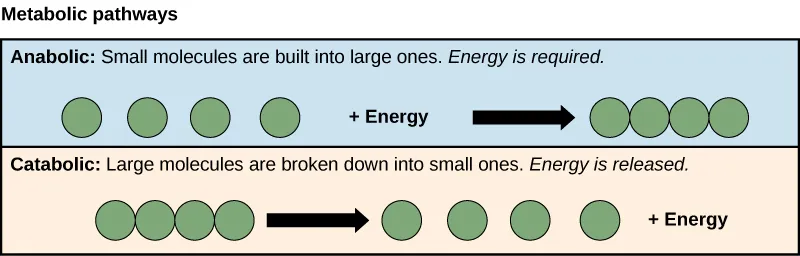
what is anabolic pathways?
(building polymers) biological series of chemical reactions that construct complex molecules from simpler ones. Because they "build up" rather than break down, these processes require an input of energy, which is typically supplied by ATP molecules produced by catabolic pathways.
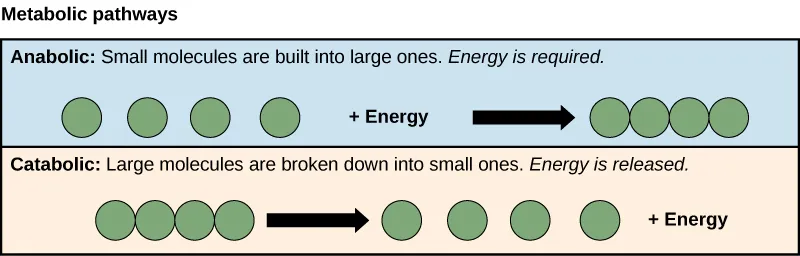
what is catabolic pathways?
(breaking down polymers into their monomers), a series of enzyme-catalyzed chemical reactions that break down complex organic molecules into simpler ones. These degradative, exergonic processes release energy, which the cell typically captures to produce ATP—the primary energy currency of the body.
what is Thermodynamics?
the study of energy and energy transfer involving physical matter.
What is The matter relevant to a particular case of energy transfer called?
a system
what is energy?
the ability to do work, or to create some kind of change.
what are example of diffrent forms of energy?
electrical energy, light energy, and heat energy
What is the first law of thermodynamics?
states that the total amount of energy in the universe is constant and conserved. energy may be transferred from place to place or transformed into different forms, but it cannot be created or destroyed.
what are examples of the first law of thermodynamics?
Light bulbs transform electrical energy into light and heat energy. Gas stoves transform chemical energy from natural gas into heat energy. Plants converting the energy of sunlight to chemical energy stored within organic molecules.
what knd of work do ATP molecules do?
building complex molecules, transporting materials, powering the motion of cilia or flagella, and contracting muscle fibers to create movement.
what is the second law of thermodynamics?
In every energy transfer, some amount of energy is lost in a form that is unusable. In most cases, this form is heat energy.
what is heat energy?
defined as the energy transferred from one system to another that is not work. For example, when a light bulb is turned on, some of the energy being converted from electrical energy into light energy is lost as heat energy.
what is High entropy?
high disorder and low energy.
what is entropy?
The more energy that is lost by a system to its surroundings, the less ordered and more random the system is. the measure of randomness or disorder within a system.
what is Kinetic energy?
Energy associated with objects in motion. EX: A speeding bullet, a walking person, and the rapid movement of molecules in the air (which produces heat) all have kinetic energy.
what if a motionless wrecking ball is lifted two stories above ground with a crane? If the suspended wrecking ball is unmoving, is there energy associated with it?
yes. The energy that was required to lift the wrecking ball did not disappear, but is now stored in the wrecking ball by virtue of its position and the force of gravity acting on it.
What is potential energy?
the stored energy an object possesses due to its position, state, or configuration relative to other objects. It represents the capacity to do work and is typically converted into kinetic energy (energy of motion) when the object is released or allowed to move.
what are exergonic reactions?
Reactions that have a negative change in free energy and consequently release free energy. These reactions are also referred to as spontaneous reactions, and their products have less stored energy than the reactants.
what are endergonic reactions?
non-spontaneous chemical processes that require an input of energy to occur. In these reactions, the products hold more free energy than the initial reactants, resulting in a positive Gibbs free energy change
what is activation energy?
the minimum amount of energy required to initiate a chemical reaction or physical process.
what is a catalyst?
A substance that helps a chemical reaction to occur
what are enzymes?
molecules that catalyze biochemical reactions. are proteins and perform the critical task of lowering the activation energies of chemical reactions inside the cell.
why are enzymes important?
Most of the reactions critical to a living cell happen too slowly at normal temperatures to be of any use to the cell. Without enzymes to speed up these reactions, life could not persist. Enzymes do this by binding to the reactant molecules and holding them in such a way as to make the chemical bond-breaking and -forming processes take place more easily.
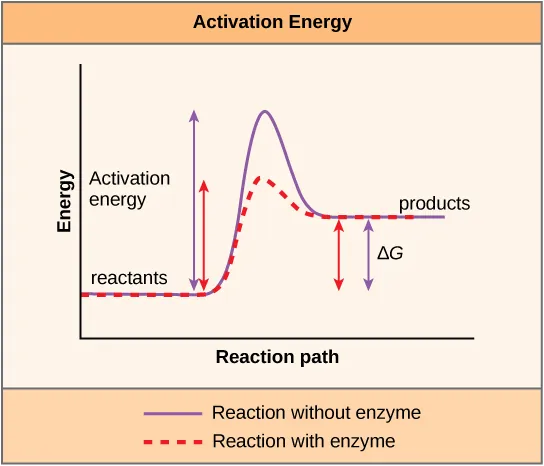
Why don't enzymes change whether a reaction is exergonic (spontaneous) or endergonic?
is because they do not change the free energy of the reactants or products. They only reduce the activation energy required for the reaction to go forward
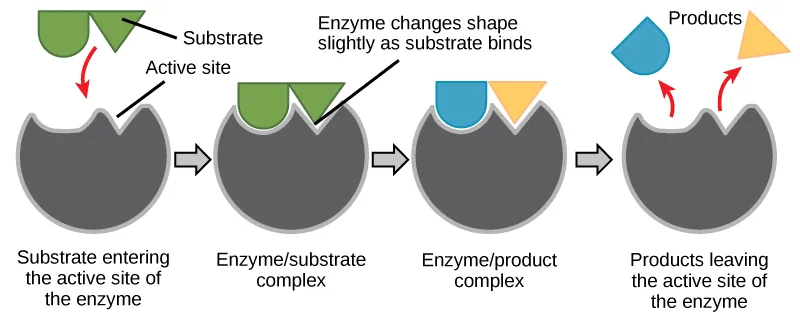
what are substrates?
The chemical reactants to which an enzyme binds. the specific molecule or reactant that an enzyme acts upon in a biochemical reaction. It binds to a specialized region on the enzyme known as the active site to form an enzyme-substrate complex, which is then converted into a new product.
what is a active site?
is where the “action” happens. Since enzymes are proteins, there is a unique combination of amino acid side chains within the active site. Each side chain is characterized by different properties. They can be large or small, weakly acidic or basic, hydrophilic or hydrophobic, positively or negatively charged, or neutral. The unique combination of side chains creates a very specific chemical environment within the active site. This specific environment is suited to bind to one specific chemical substrate
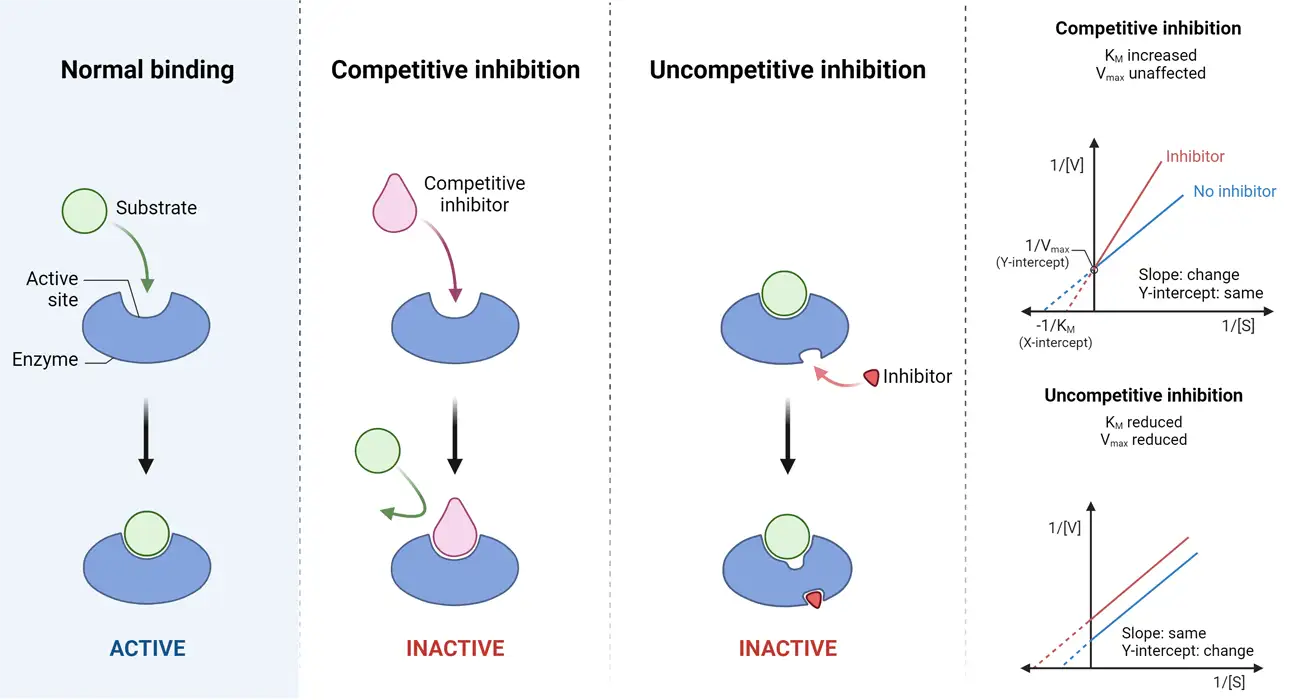
competitive inhibition
a process where a molecule structurally similar to a substrate binds to an enzyme's active site, preventing the actual substrate from attaching
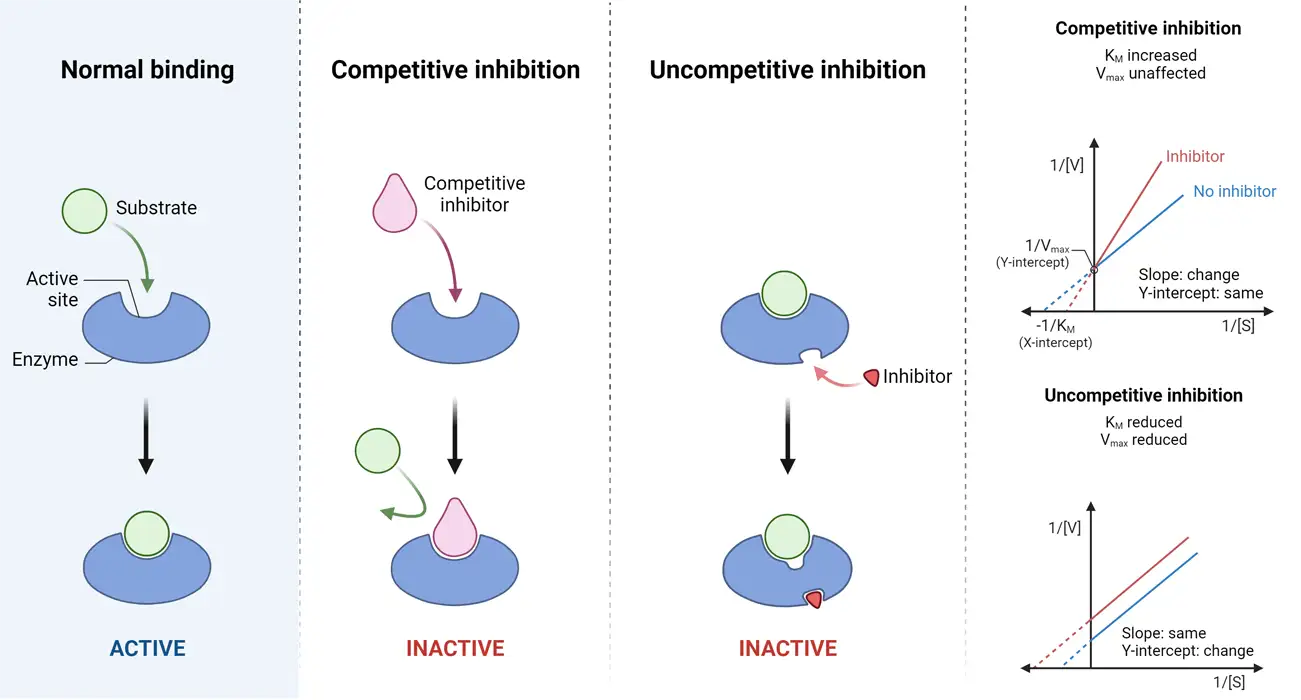
noncompetitive inhibition
ccurs when an inhibitor binds to an enzyme at a site other than the active site (an allosteric site). This binding changes the enzyme's shape, preventing it from converting substrates into products.
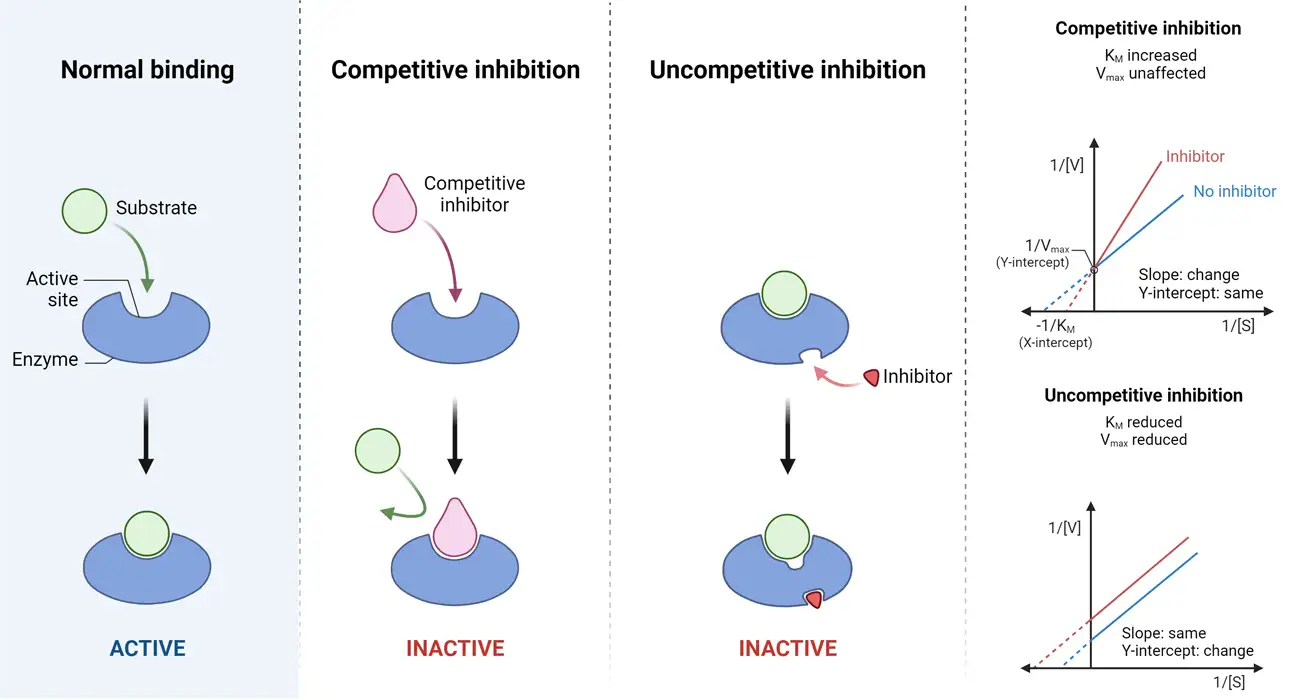
allosteric inhibition
a regulatory process where a molecule binds to an enzyme at an allosteric site (a location separate from the active site). This binding alters the enzyme's 3D shape, preventing substrates from binding to the active site and effectively turning the enzyme's activity off.
The production of both amino acids and nucleotides is controlled through what?
feedback inhibition.