Metabolic Pathways and the Effect of the Environment - Mrs Youngs Style
 Call Kai
 Learn
Learn Practice Test
 Spaced Repetition
 Match
Match Flashcards
 Knowt Play
1/29

There's no tags or description
Looks like no tags are added yet.
Name | Mastery | Learn | Test | Matching | Spaced | Call with Kai | Chat |
|---|
No analytics yet
Send a link to your students to track their progress
30 Terms
Metabolic Pathway
Is a series of chemical reactions where the product / substrate of one reaction is the substrate for the next.
Enzyme
Is a biological catalyst (speeds up) a reaction.
Precursor/Substrate
Starting molecules or molecules within a pathway that are required for the next step in a metabolic pathway.
Intermediate/Final Product
Indicates the end of the pathway.
Gene codes for Enzymes
In a metabolic pathway one gene codes for one enzyme. Each enzyme can only catalyse one specific reaction due to its unique shape.
Phenotype
Interaction between genotype + environment
The Environment
Do not change the genotype but alter the phenotype
Adaptive Changes
Means that it contributes to an individual's survival or reproductive success.
Example:When seedlings are grown in darkness, the stems are pale and elongated and the leaves remain small.
Non-Adaptive Change
That it is counterproductive to an individual's survival or reproductive success.
Example: When the environment that a plant is growing in is short of magnesium, the leaves become pale due to a lack of chlorophyll. This is non-adaptive in that it does not help the plant deal with the shortage.
Sex Determination - definition
The sex of some animals is determined by the temperature at which they were incubated during their embryonic development. Examples: Turtles, crocodiles, American alligators, tuatara.
Colour Pointing
Some breeds of cat and rabbit have darker areas of fur on the extremities (colour pointing). Colour pointing arises from a mutant mis-sense mutation causing a change in an amino acid of the enzyme tyrosinase, involved in the production of the pigment melanin which causes the dark colour. The enzyme is abnormally heat sensitive so that at cat or rabbit body temperature, the enzyme does not catalyse the reaction that produces melanin.
The Effect of pH
The colour of some flowers is determined by the pH of the soil they grow in. Example: Colour of hydrangea flowers.
Acid soils - pink flowers Alkaline soils - blue flowers
Effect of Climate - Altitude
Plants of the same species produce a smaller or stunted phenotype with altitude.
Example: This can often be seen in plants growing on mountainside. Exposure to wind, lower temperature, less water and oxygen can cause this.
Effect of Climate - Exposure to Wind
Trees growing on the coast are often bent even though their genotype codes for straight codes for straight growth.
Predators
The activity or presence of predators may cause a permanent change in the phenotype of the prey. E.g. the daphnia growing a helmet in the presence of predators
Sex Determination - Examples
Determination of Sex: The presence of other individuals of the same species may control the determination of sex of other individuals of the group. e.g. parrot fish
Metabolic disorder
An interruption in the metabolic pathway. This can happen when a mutation occurs which prevents an enzyme being expressed.
Enzymes and Metabolic Pathways
Enzymes activate (catalyse) each step of a metabolic pathway. Each enzyme, being a protein, is coded for by genes and produced by protein synthesis.
Environmental Factor
Can be an internal or external factor that affects the organism's phenotype. Such as light availability affecting how tall a plant grows. It does not change the organism's genotype.
Mutagen
A physical or chemical factor that changes the genotype / base sequence. Causes a mutation.
Mutation
A change in the base sequence of DNA
Substitution Mutation
A single nucleotide is replaced by a different nucleotide

Insertion Mutation
A mutation in which one or more nucleotides are added to a gene
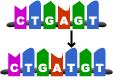
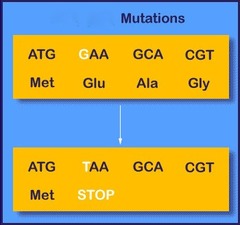
Nonsense Mutation
A mutation that changes an amino acid codon to one of the three stop codons, resulting in a shorter and usually nonfunctional protein.
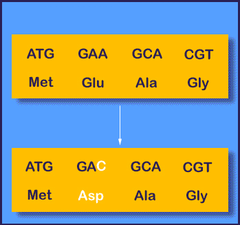
Missense Mutation
A base-pair substitution that results in a codon that codes for a different amino acid.
Deletion Mutation
a mutation in which one or more pairs of nucleotides are removed from a gene
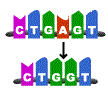
Frame Shift Mutation
mutation that shifts the "reading" frame of the genetic message by inserting or deleting a nucleotide
Silent Mutation
A mutation that still codes for the exact same amino acid due to redundancy due to degeneracy. Multiple 3 letter base sequences code for one amino acid.

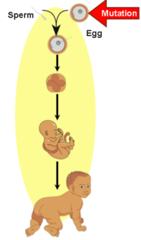
Somatic Mutation
A mutation that occurs in the body cells. Cannot be inherited.
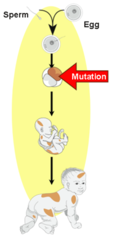
Gametic Mutation
A mutation in the sex cells. Can be inherited.