⋆.˚˖࿔ ࣪ orgo 1 ; exam 2 info!
 Call Kai
 Learn
Learn Practice Test
 Spaced Repetition
 Match
Match Flashcards
 Knowt Play
1/102

Earn XP
Description and Tags
:-)
Name | Mastery | Learn | Test | Matching | Spaced | Call with Kai | Chat |
|---|
No analytics yet
Send a link to your students to track their progress
103 Terms
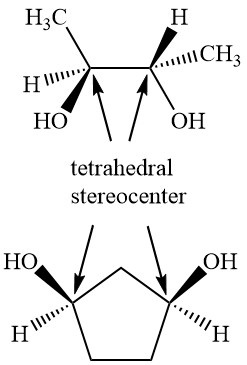
☆ how do you identify a stereocenter?
☐ a stereocenter is an atom where swapping 2 groups gives a stereoisomer
☐ in orgo 1, the most common stereocenter is an sp³ carbon bonded to 4 different groups
☐ if 2 attached groups are identical, that carbon is not a stereocenter
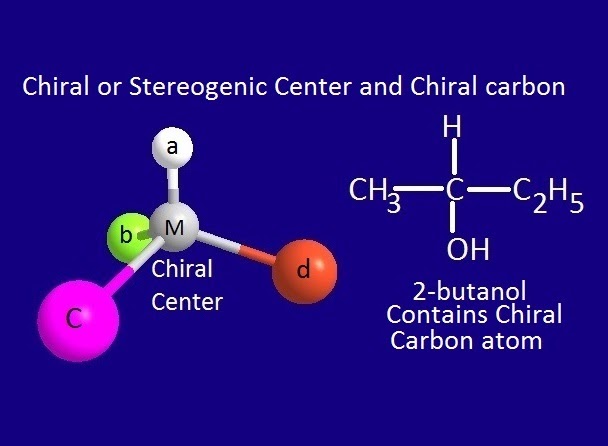
☆ what is an asymmetric atom?
☐ an asymmetric atom is usually a tetrahedral atom bonded to 4 different groups
☐ an asymmetric carbon is a common source of chirality
☐ not every chiral molecule has only carbon stereocenters, but carbon is the main case here
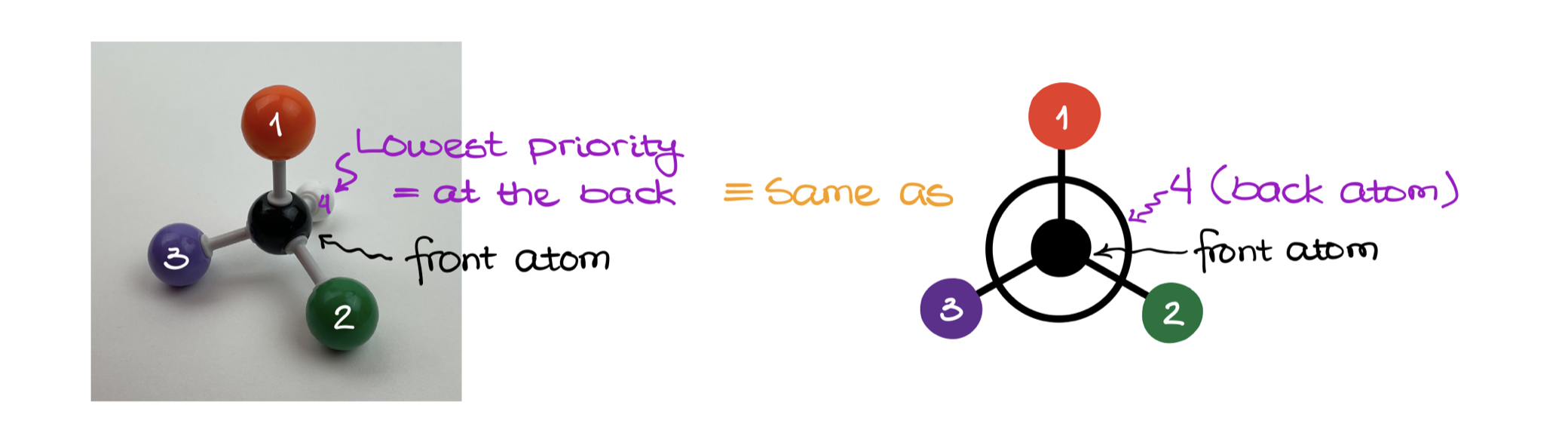
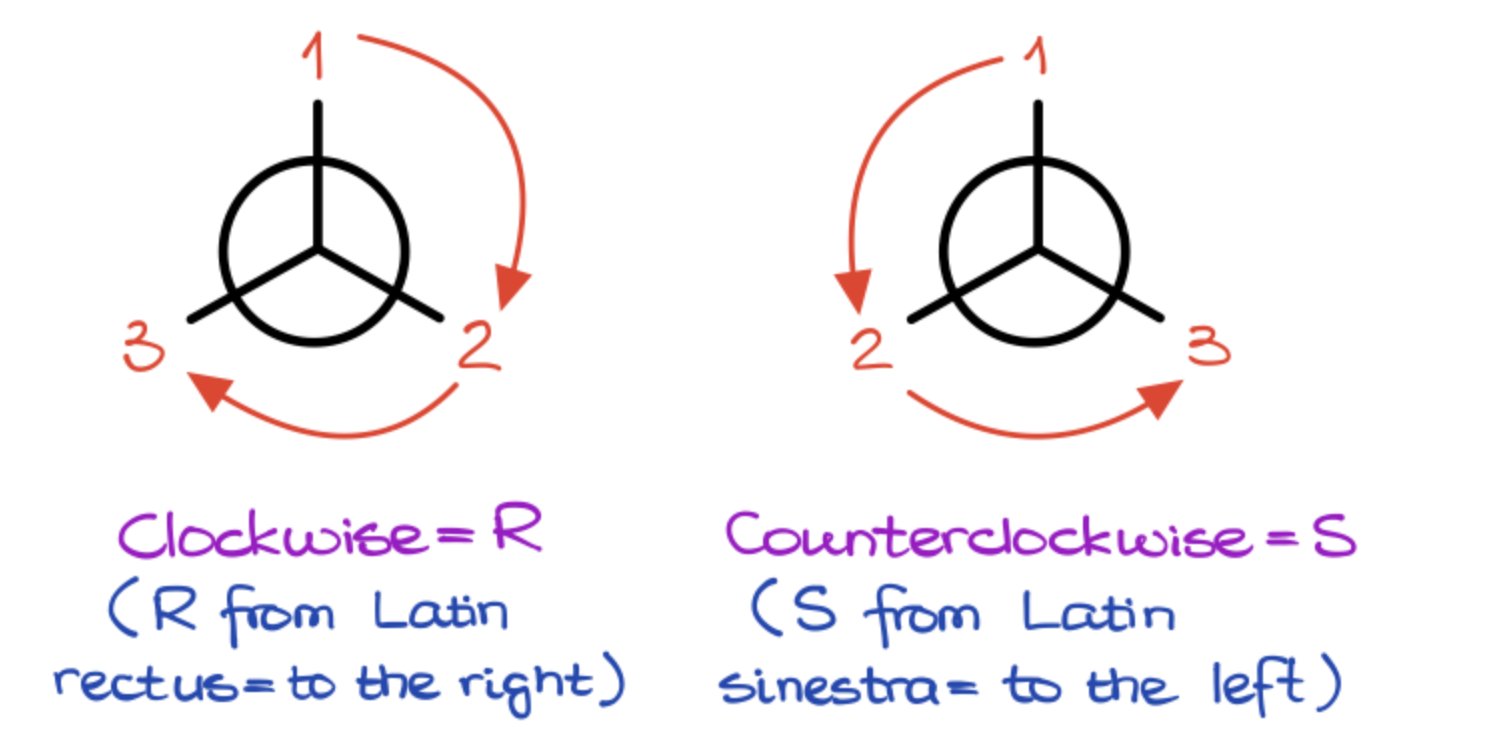
☆ how do you assign R/S configuration with CIP rules?
☐ rank the 4 attached atoms by atomic number
☐ if there is a tie, move outward to the first point of difference
☐ point the lowest-priority group away from you
☐ clockwise 1→2→3 = R
☐ counterclockwise 1→2→3 = S
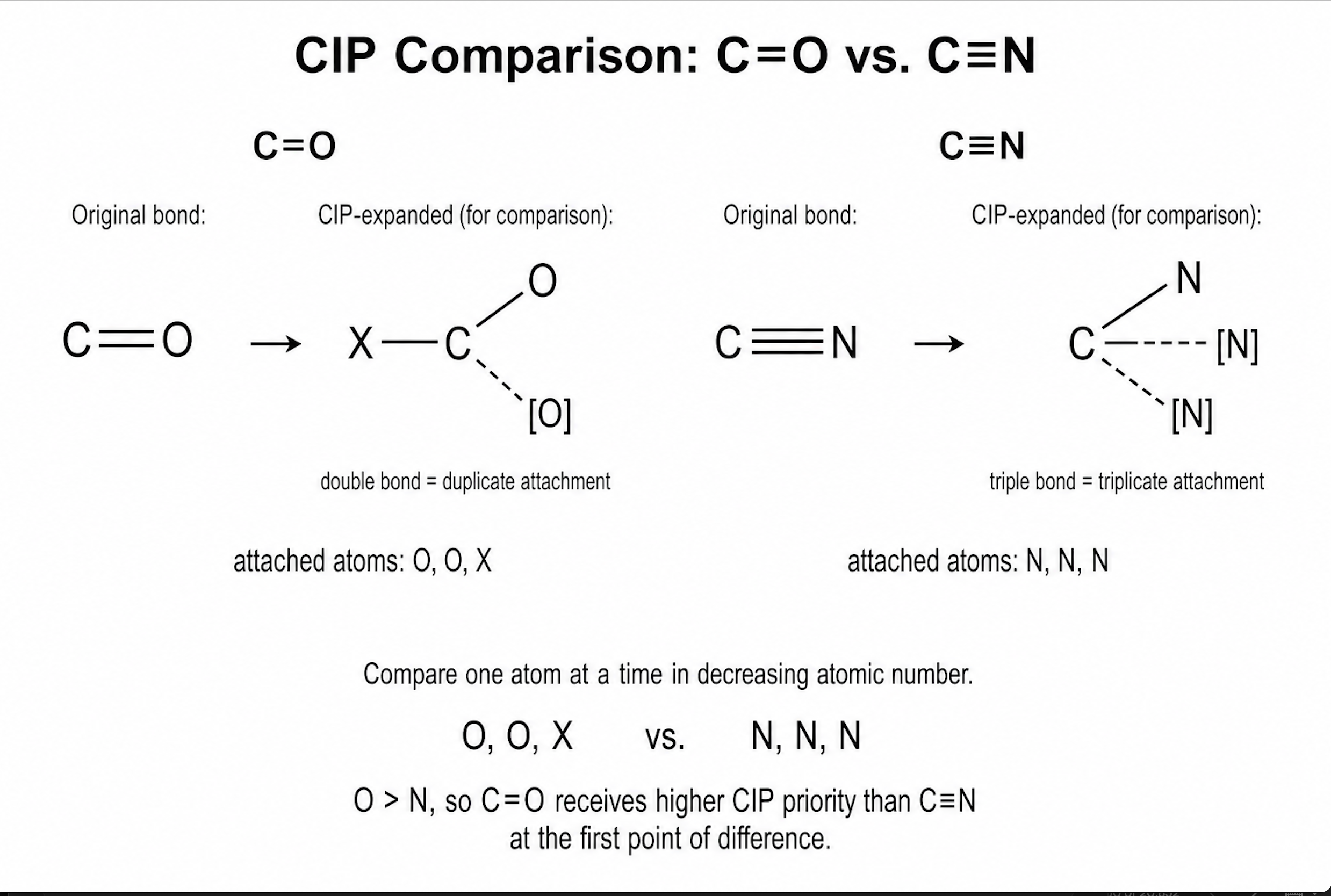
☆ how are multiple bonds treated in CIP ranking?
☐ a double bond is treated as if the atom is bonded to duplicate atoms
☐ a triple bond is treated as if the atom is bonded to triplicate atoms
☐ this matters when breaking ties in priority
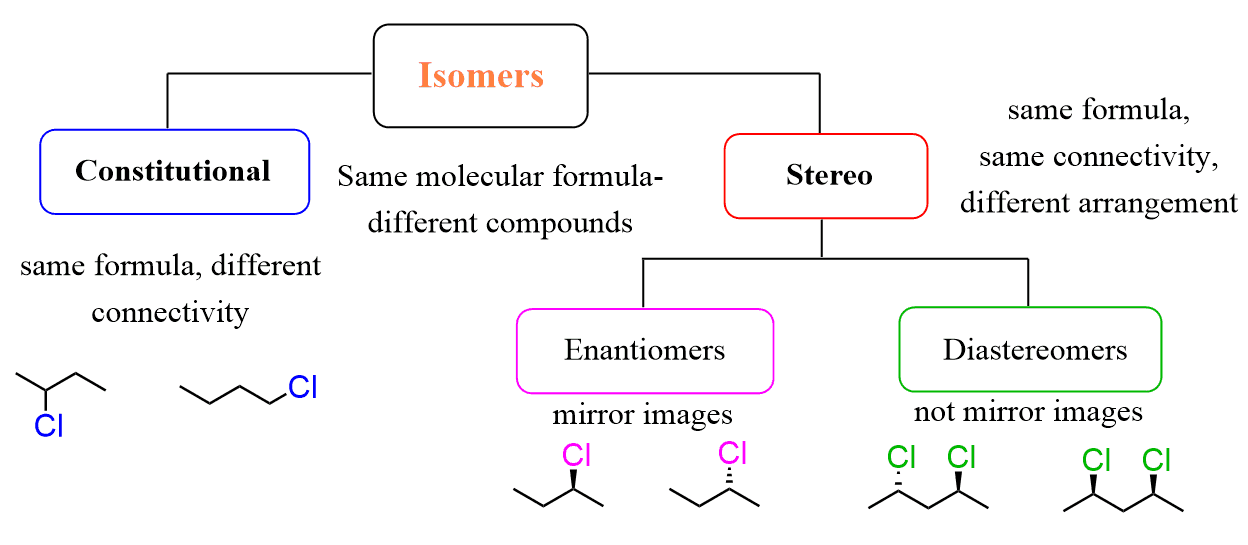
☆ how do you classify 2 isomers?
☐ constitutional isomers = same formula, different connectivity
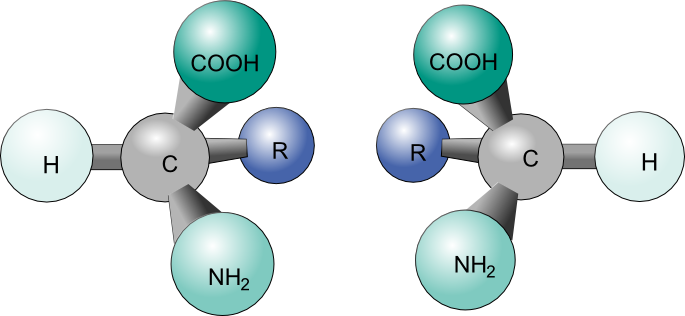
☐ enantiomers = non-superimposable mirror images
☐ diastereomers = stereoisomers that are not mirror images
☐ geometric isomers are a subtype of diastereomers, usually cis/trans or E/Z pairs
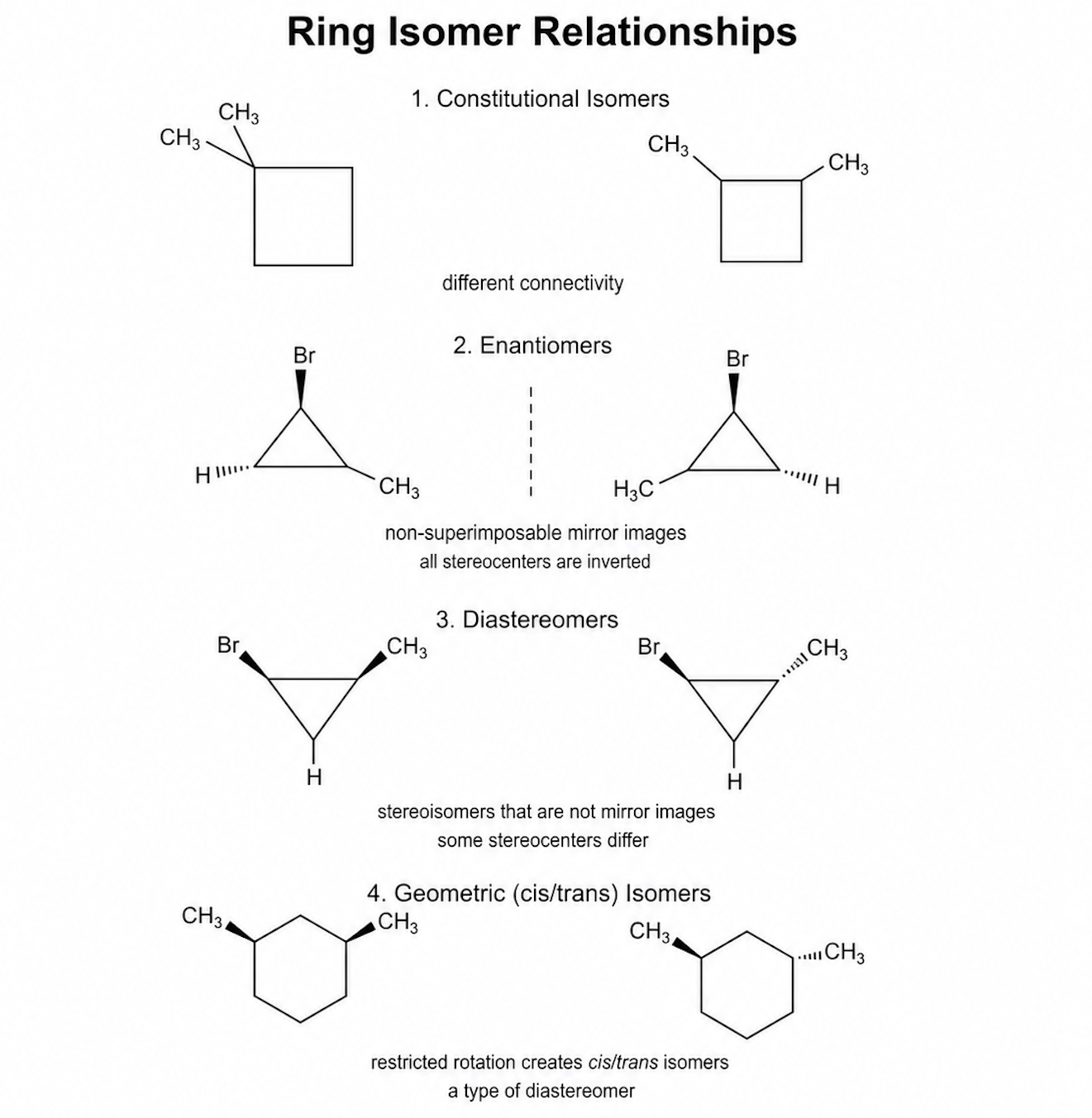
☆ what are enantiomers?
☐ enantiomers are mirror-image stereoisomers
☐ they have opposite configuration at every stereocenter
☐ they have identical physical properties in achiral environments except optical rotation
☆ what are diastereomers?
☐ diastereomers are stereoisomers that are not mirror images
☐ they differ at one or more stereocenters, but not all
☐ cis/trans isomers are commonly diastereomers
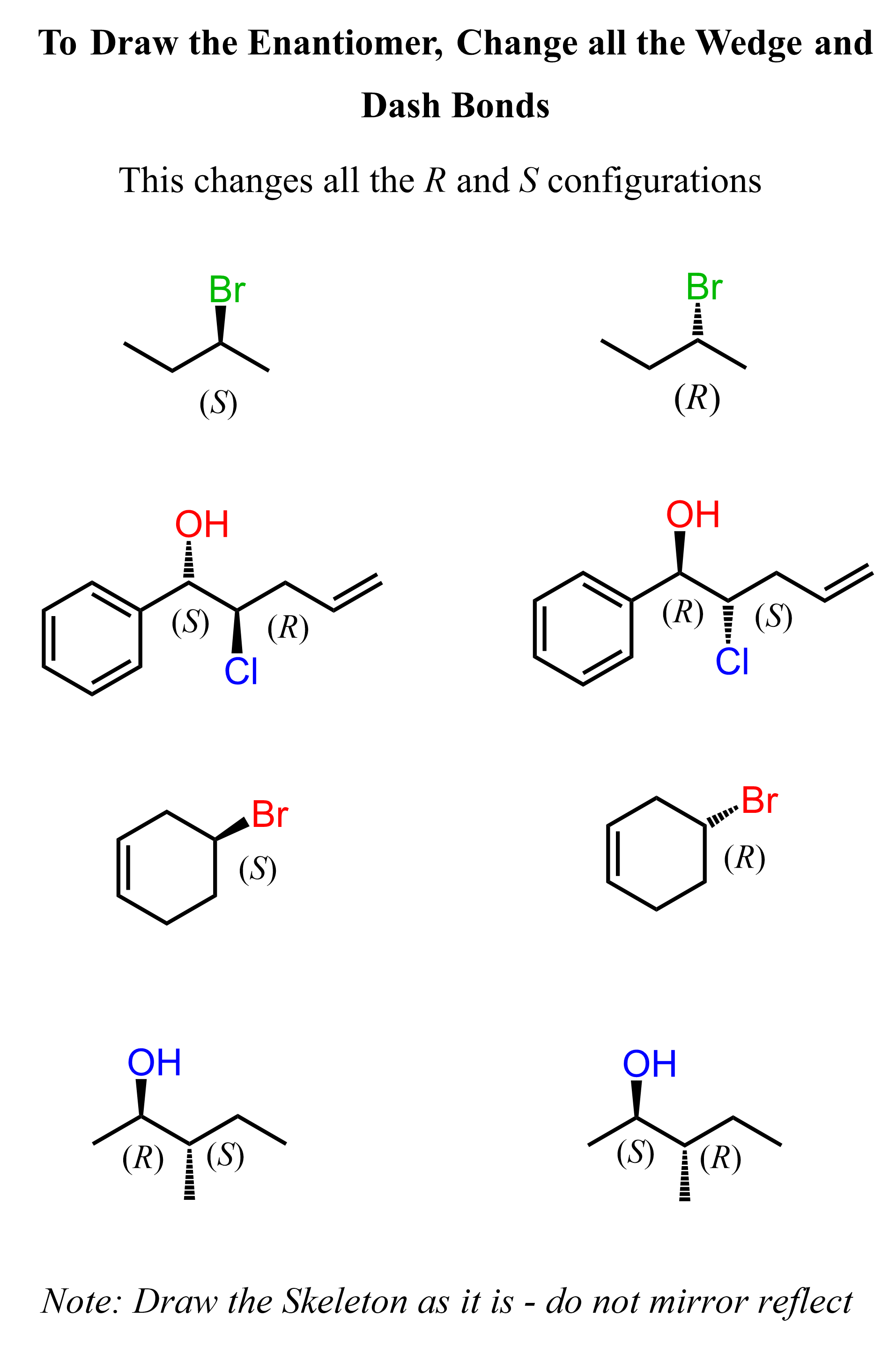
☆ how do you draw an enantiomer from a given structure?
☐ reverse the configuration at every stereocenter
☐ equivalently, swap wedge and dash at every stereocenter
☐ the result should be the mirror image of the original molecule
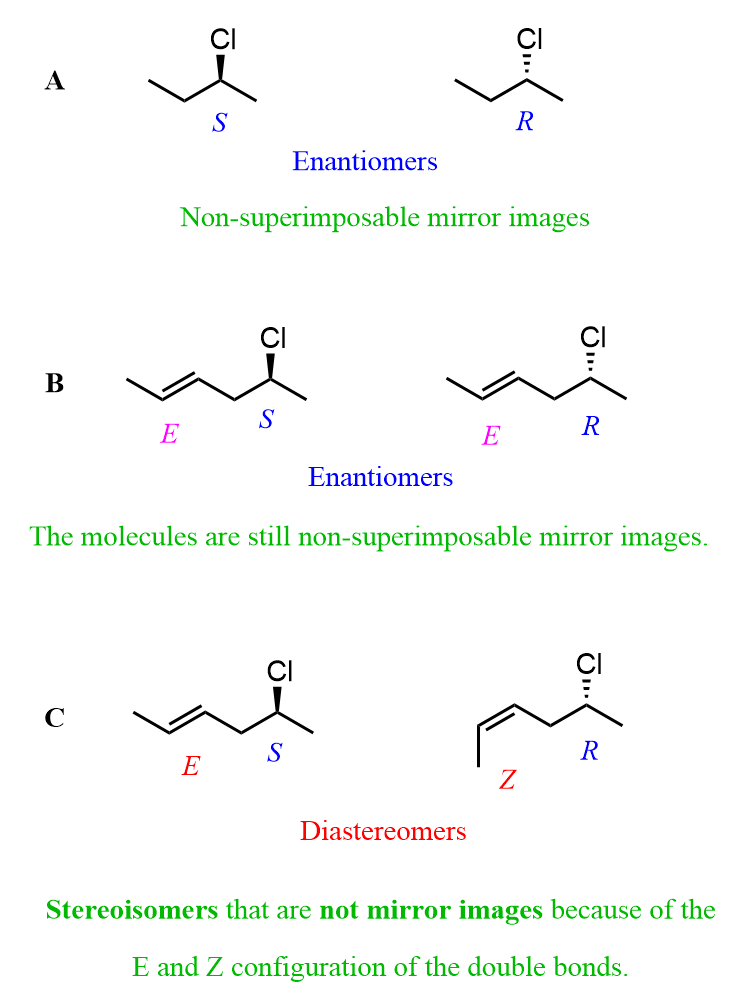
☆ how do you draw a diastereomer from a given structure?
☐ change the configuration at one stereocenter but not all stereocenters
☐ if only 1 stereocenter exists, a diastereomer does not exist
☐ the new molecule must keep the same connectivity
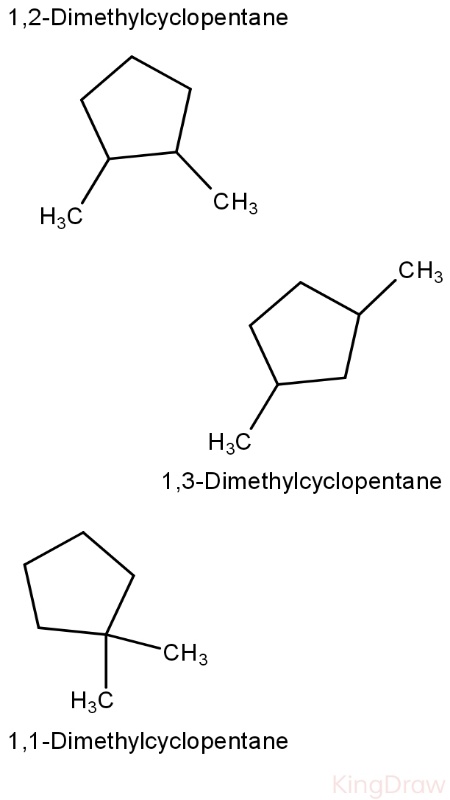
☆ how do you draw a constitutional isomer from a given structure?
☐ keep the same molecular formula
☐ change which atoms are connected to which
☐ a constitutional isomer differs in connectivity, not just 3D arrangement
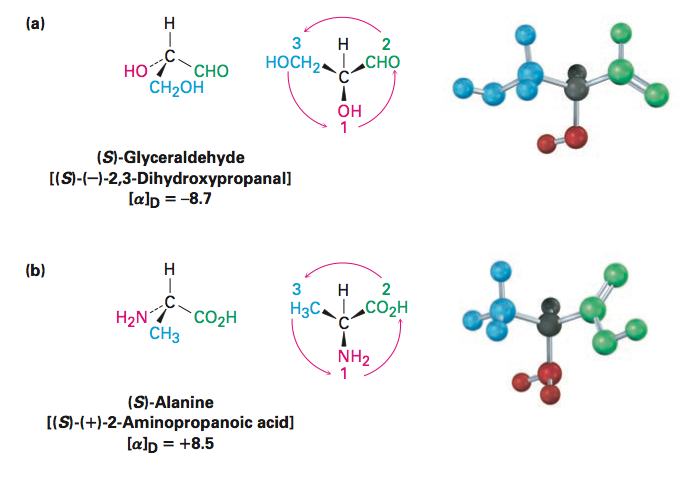
☆ how do you draw a correct line-and-wedge structure from a given configuration?
☐ draw the tetrahedral center with 2 bonds in the plane, 1 wedge, and 1 dash
☐ place groups so the assigned priorities match the requested R or S configuration
☐ always verify by re-checking the 1→2→3 order after drawing
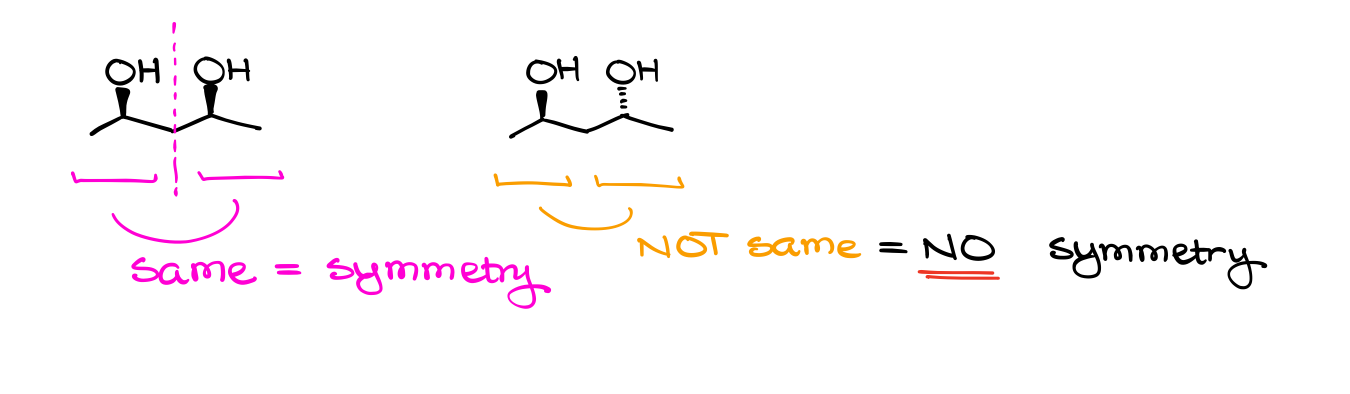
☆ what is a meso compound?
☐ a meso compound has stereocenters but is overall achiral
☐ it contains an internal symmetry element
☐ a meso compound is superimposable on its mirror image

☆ how do you recognize whether a compound has a meso stereoisomer?
☐ look for 2 or more stereocenters
☐ check whether a configuration pattern can create an internal mirror plane
☐ if internal symmetry makes the molecule achiral, that stereoisomer is meso
☆ what symmetry elements can make a molecule achiral?
☐ mirror plane
☐ center of inversion
☐ improper rotation axis in more advanced cases
☐ in this course, the key one is usually a mirror plane
☆ why is a meso compound optically inactive?
☐ its stereocenters’ effects cancel because of internal symmetry
☐ the molecule is achiral overall
☐ it does not rotate plane-polarized light as a pure compound
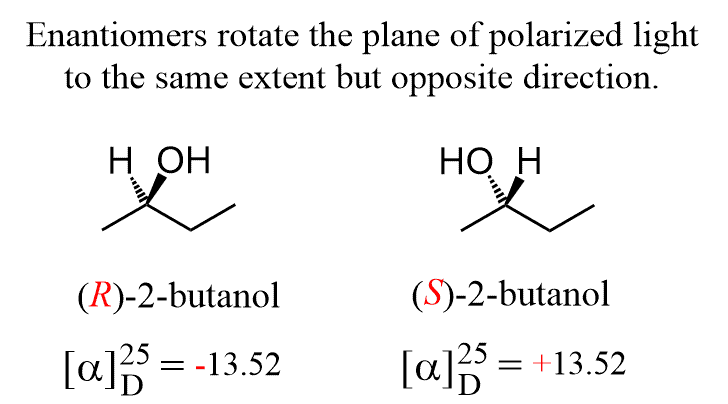
☆ what is specific rotation?
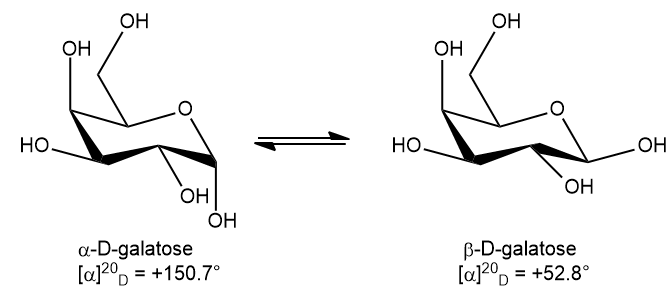
☐ specific rotation is a normalized measure of optical rotation
☐ it relates observed rotation to sample concentration and path length
☐ enantiomers have equal-magnitude but opposite-sign specific rotations
☆ how are observed rotation and specific rotation related?
☐ observed rotation = specific rotation × path length × concentration
☐ solve for the missing value if the other 3 are known
☐ opposite enantiomers give opposite signs
☆ what is enantiomeric excess (ee)?
☐ ee = |% major enantiomer − % minor enantiomer|
☐ ee also equals observed rotation ÷ pure-enantiomer rotation × 100%
☐ higher ee means the mixture is farther from racemic
☆ how do you find enantiomeric ratio (er) from ee?
☐ major % = (100 + ee) / 2
☐ minor % = (100 − ee) / 2
☐ er = major : minor
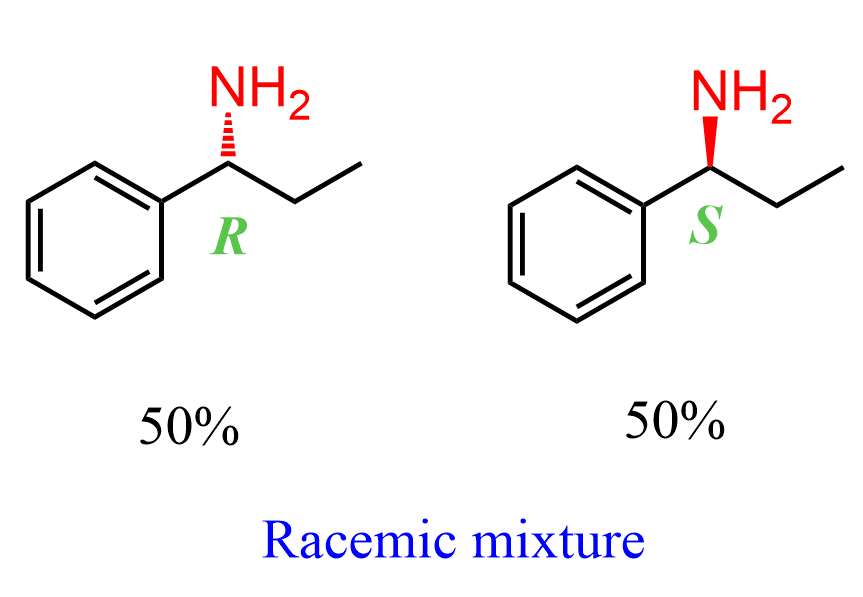
☆ what is a racemic mixture?
☐ a racemic mixture contains 50:50 enantiomers
☐ a racemic mixture has ee = 0
☐ its net optical rotation is 0
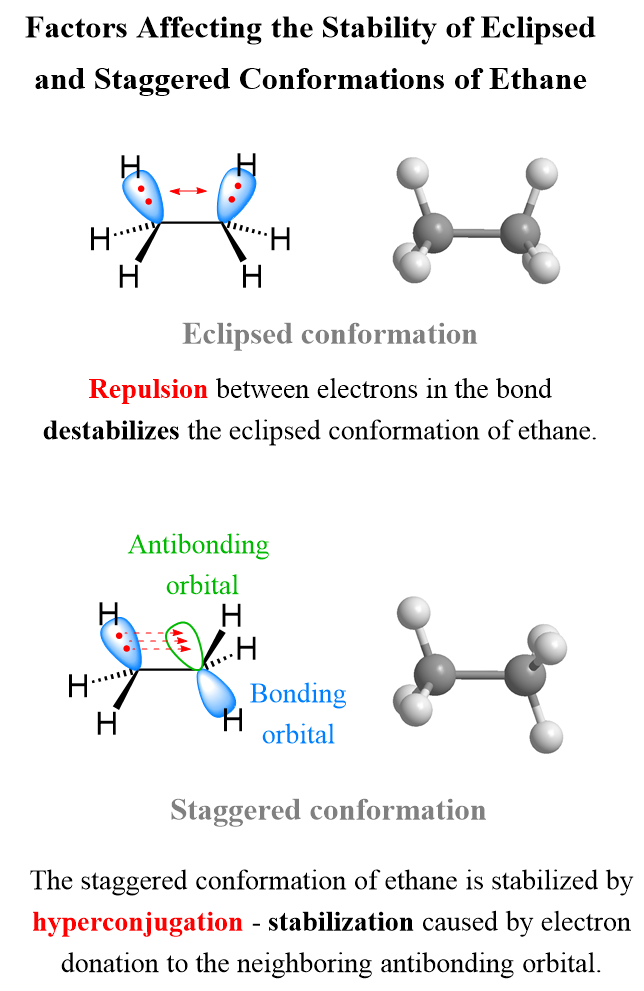
☆ how are conformations related stereochemically?
☐ different conformations can be identical, enantiomeric, or diastereomeric
☐ rapid bond rotation often connects identical conformations of the same compound
☐ some conformations become enantiomeric only when the whole shape is chiral
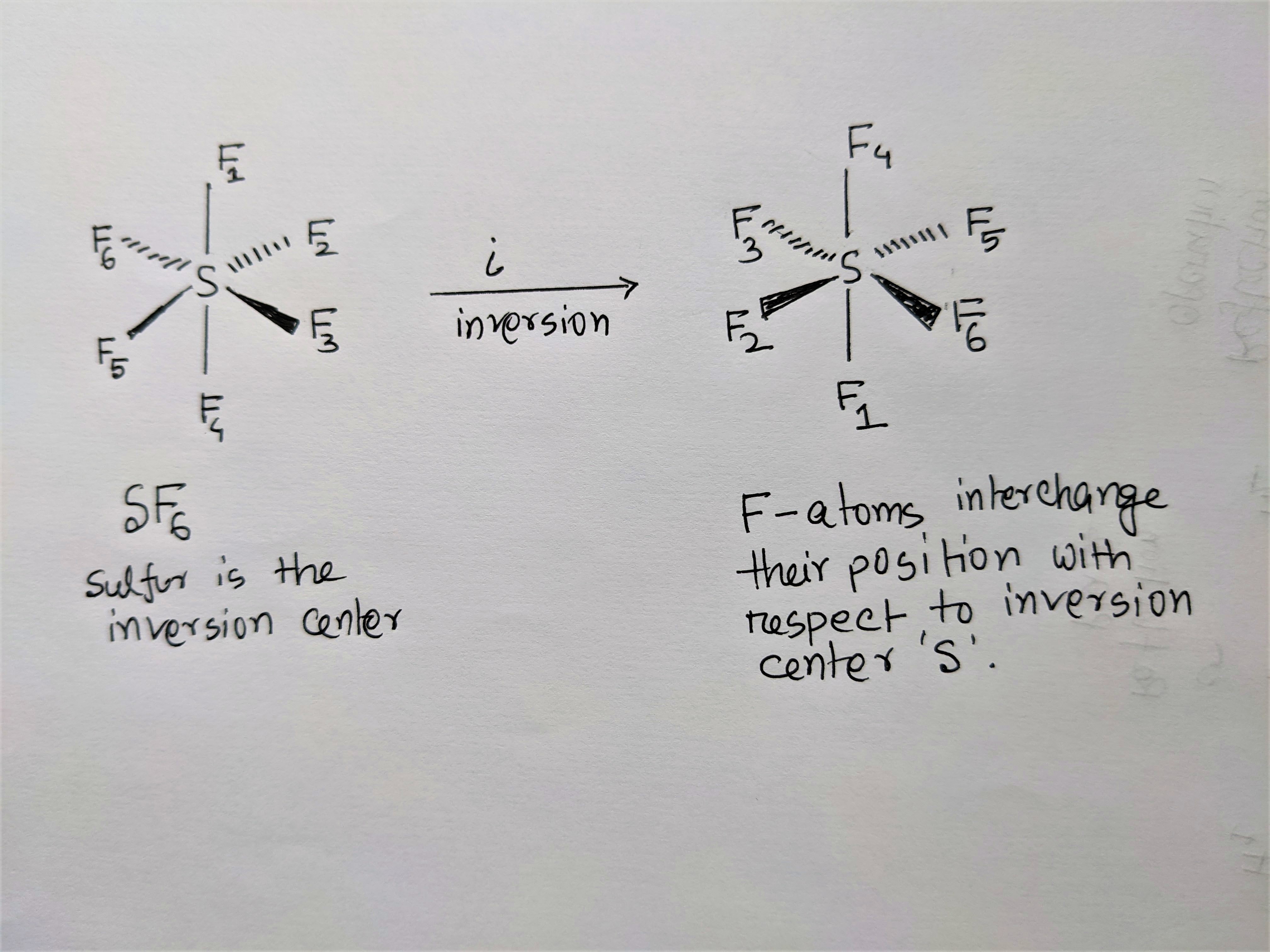
☆ what is inversion at a central atom?
☐ inversion flips the arrangement around a pyramidal center
☐ trigonal pyramidal atoms like amines can invert through a planar transition state
☐ fast inversion can prevent isolation of separate stereoisomers
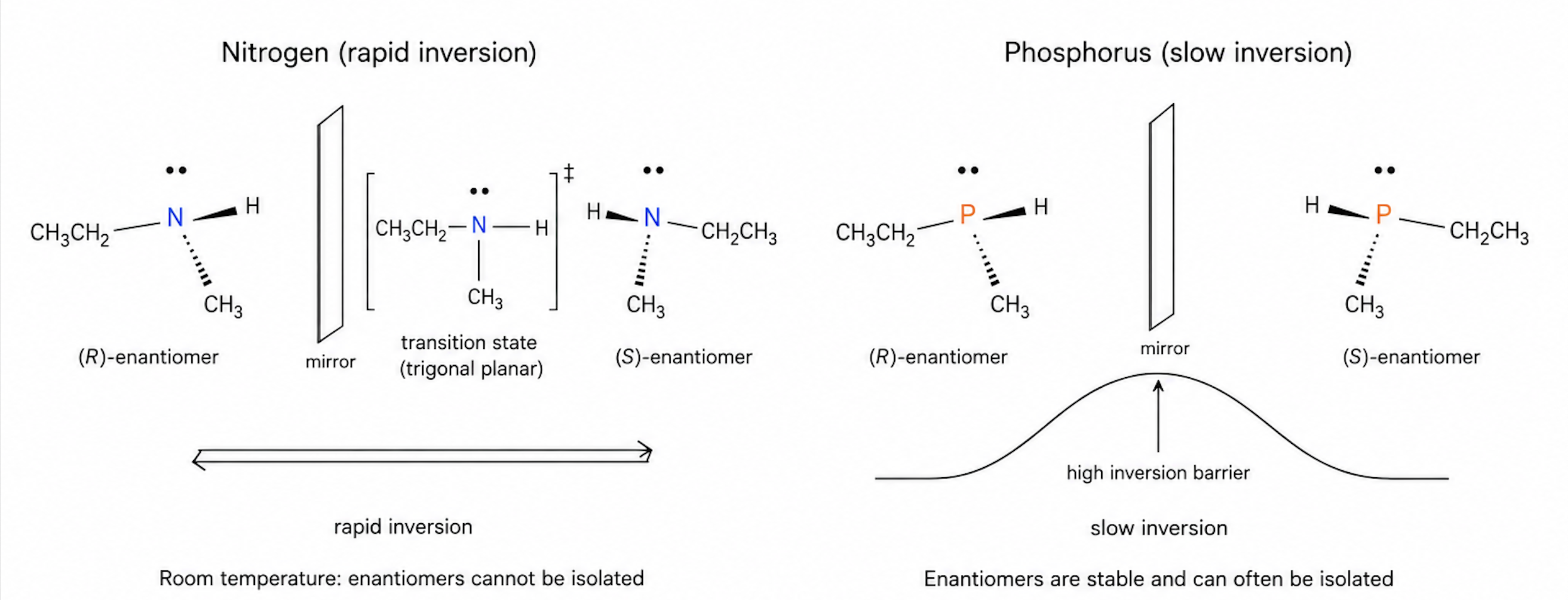
☆ when can central-atom inversion prevent isolable enantiomers?
☐ if inversion is fast, one form rapidly converts into the other
☐ ordinary amines usually invert too fast to isolate separate enantiomers
☐ heavier atoms like phosphorus or sulfur may invert slowly enough to give isolable stereoisomers
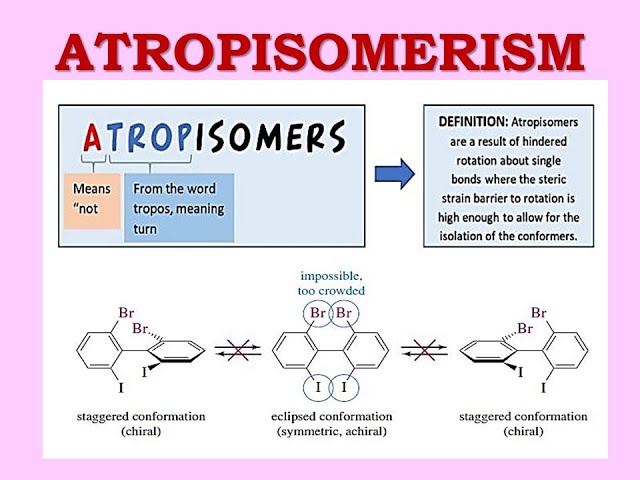
☆ what are atropisomers?
☐ atropisomers are stereoisomers caused by restricted rotation
☐ rotation is too slow to average the structures
☐ they can sometimes be isolated as separate enantiomers
☆ how can enantiomers be separated?
☐ convert them into diastereomers using a chiral resolving agent
☐ separate the diastereomers because they have different physical properties
☐ then regenerate the separated enantiomers
☆ what is resolution?
☐ resolution is the separation of enantiomers from a racemic mixture
☐ one classic method uses diastereomeric salt formation
☐ selective crystallization can separate the diastereomeric salts
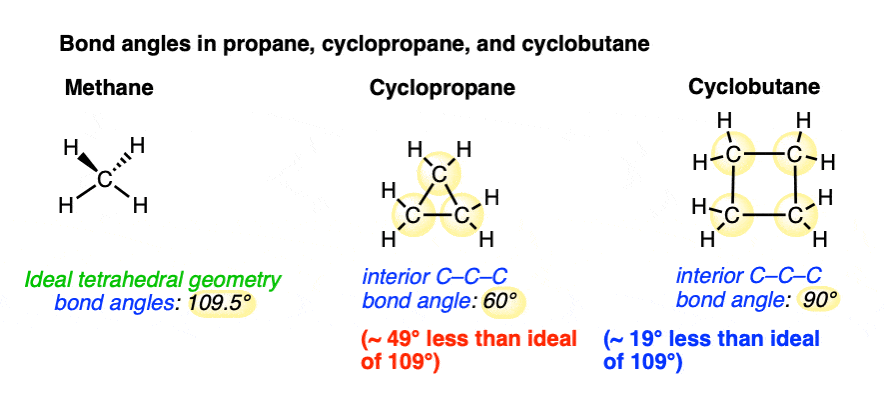
☆ why can cyclopropane and cyclobutane be strained?
☐ their bond angles are forced away from ideal tetrahedral angles
☐ they also have torsional strain from eclipsing interactions
☐ this makes them less stable than larger rings
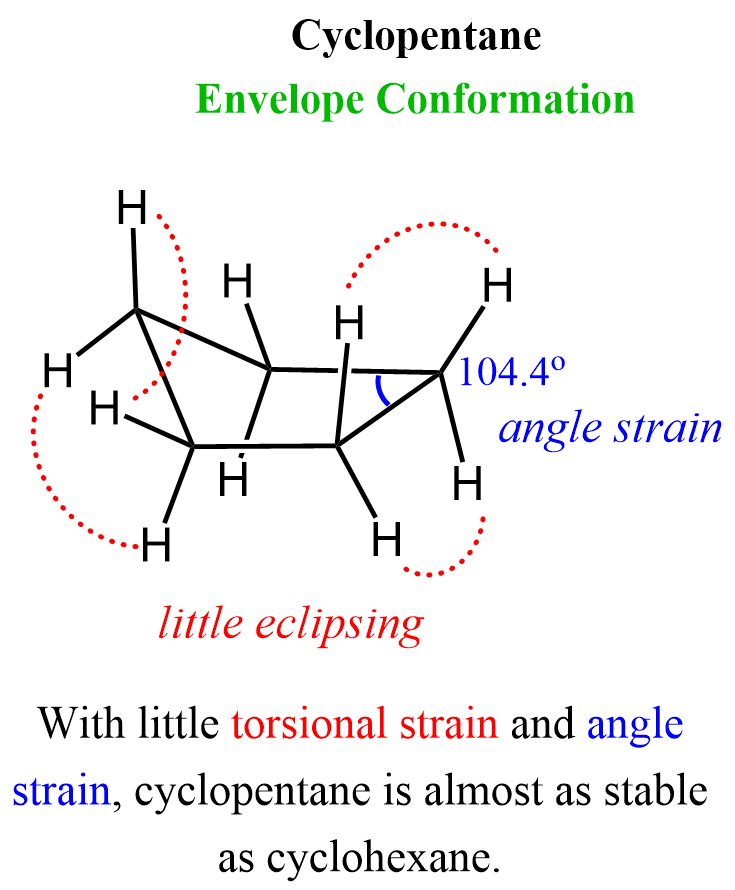
☆ why is cyclopentane less strained than cyclopropane or cyclobutane?
☐ its bond angles are closer to ideal
☐ it can pucker to reduce eclipsing
☐ it still has some strain, but less than smaller rings
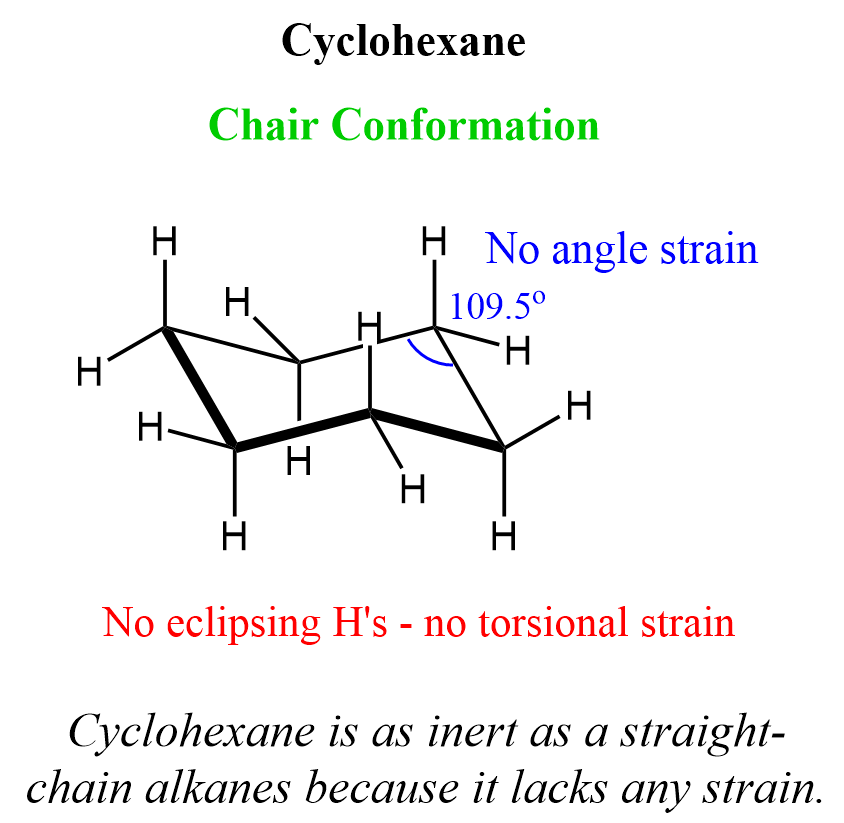
☆ why is cyclohexane especially stable?
☐ the chair conformation has near-ideal bond angles
☐ adjacent bonds are staggered
☐ angle strain and torsional strain are both minimized
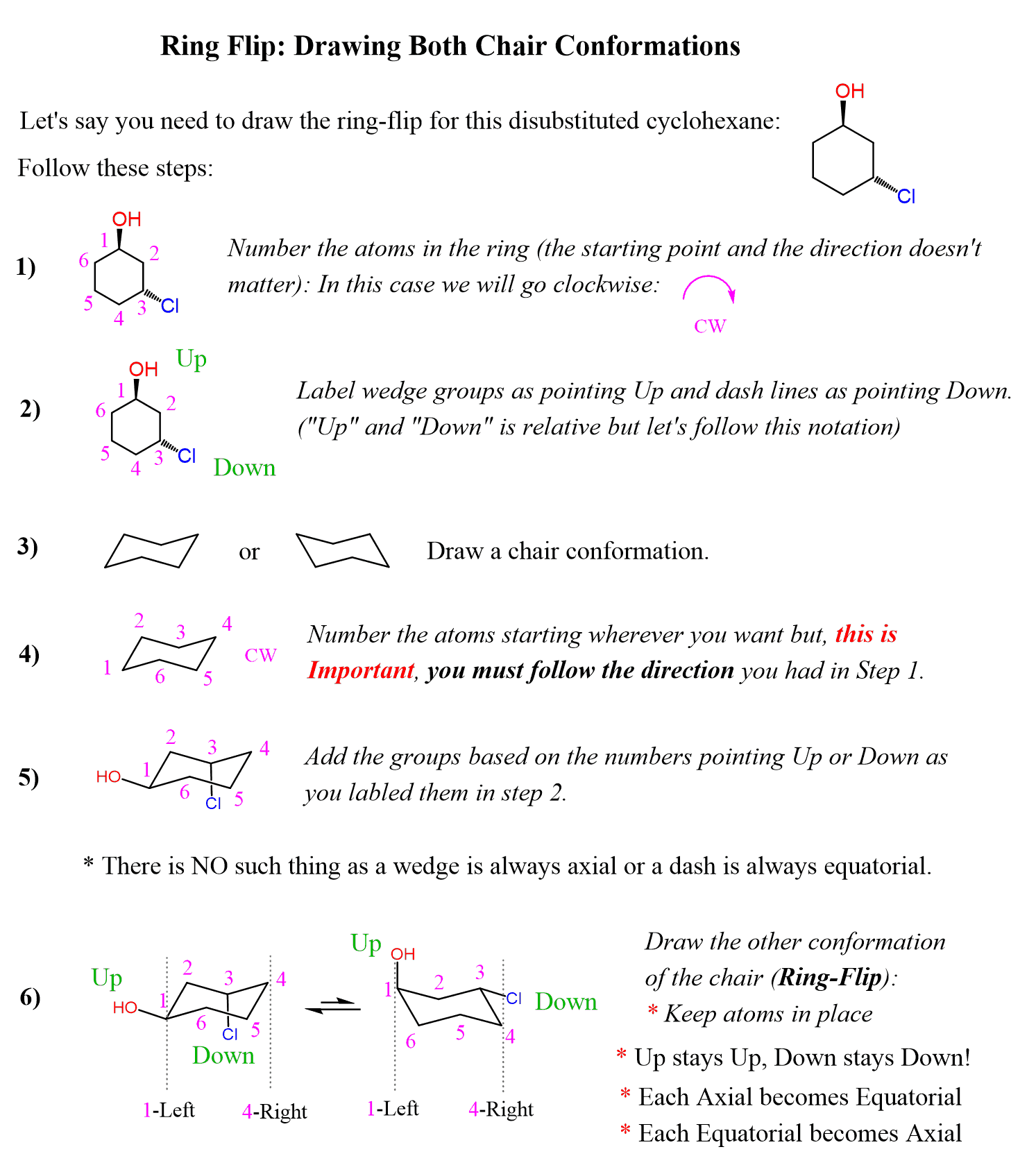
☆ how do you convert a chair into a planar line-and-wedge structure?
☐ identify whether each substituent is up or down
☐ convert up/down into wedge/dash on the flat hexagon
☐ do not confuse up/down with axial/equatorial
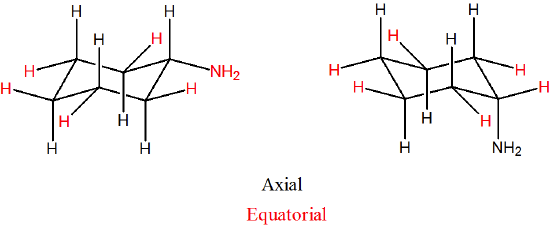
☆ how do you convert a planar line-and-wedge cyclohexane into a chair?
☐ read each substituent as up or down from the planar drawing
☐ place each substituent onto a chair position with the same up/down relationship
☐ then determine whether each one is axial or equatorial in that chair
☐ drawing the ring-flipped chair gives the alternate conformation of the same compound
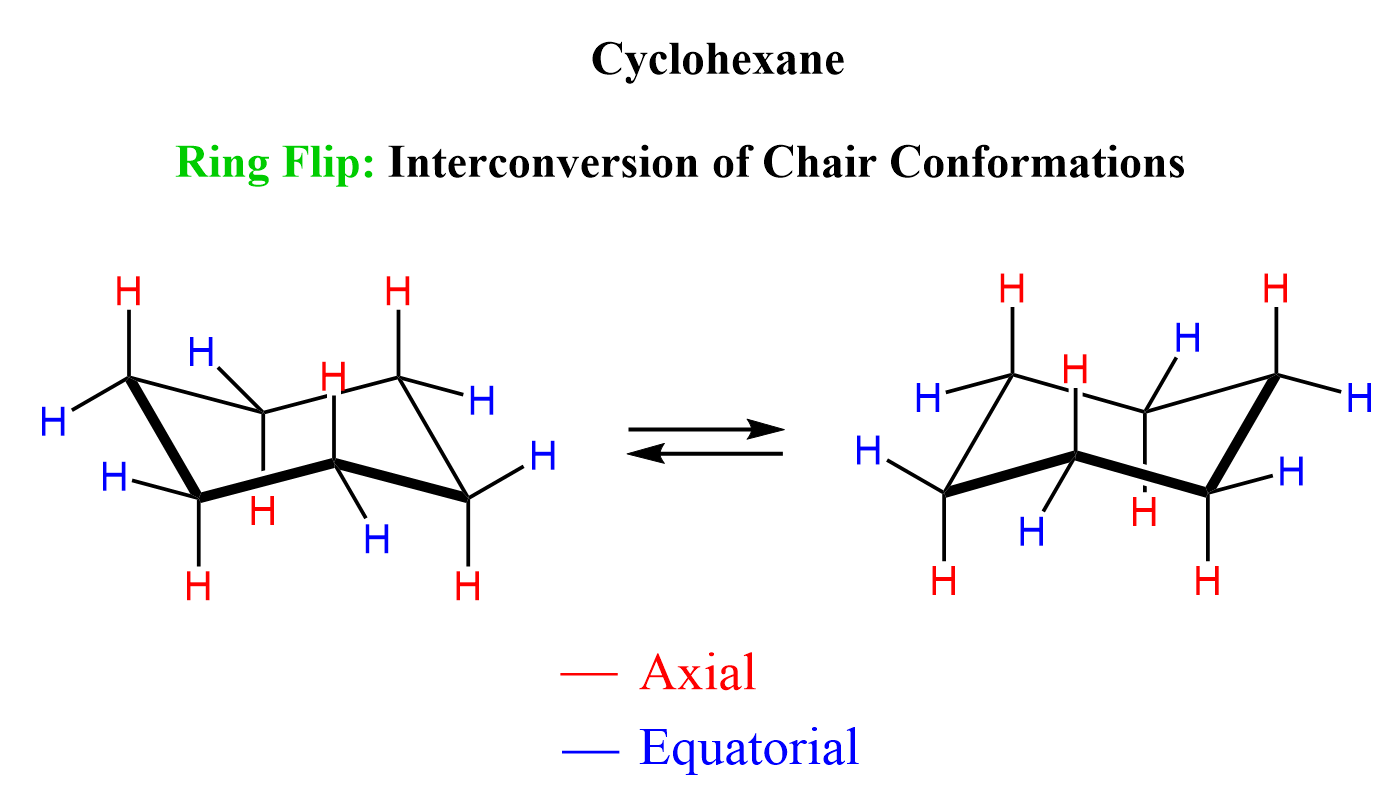
☆ what happens during cyclohexane chair interconversion?
☐ axial becomes equatorial
☐ equatorial becomes axial
☐ up remains up
☐ down remains down
☆ what is the stereochemical relationship between 2 chair forms of the same monosubstituted cyclohexane?
☐ they are identical conformations of the same compound
☐ ring flip does not change connectivity or up/down identity
☐ up substituents stay up
☐ down substituents stay down
☐ every axial substituent becomes equatorial
☐ every equatorial substituent becomes axial
☐ it only changes conformation
☆ when can 2 chair drawings be identical, enantiomers, or diastereomers?
☐ identical if one becomes the other by ring flip or simple rotation
☐ enantiomers if they are mirror images and non-superimposable
☐ diastereomers if they differ stereochemically but are not mirror images
☆ what are axial and equatorial positions?
☐ axial bonds point straight up or down
☐ equatorial bonds point outward around the ring
☐ every carbon in a chair has 1 axial and 1 equatorial bond
☆ what are cis and trans relationships in cyclohexane?
☐ cis = both substituents on the same side of the ring
☐ trans = substituents on opposite sides of the ring
☐ cis/trans depends on up/down, not axial/equatorial
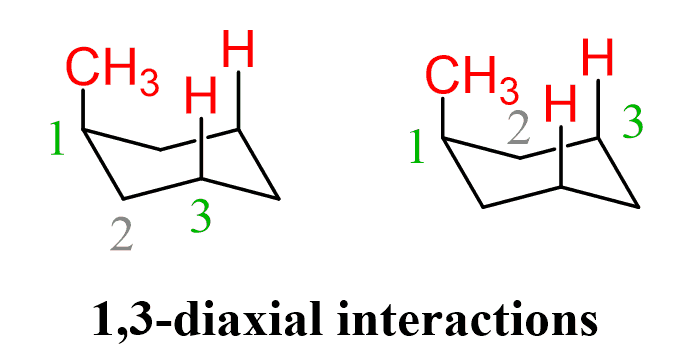
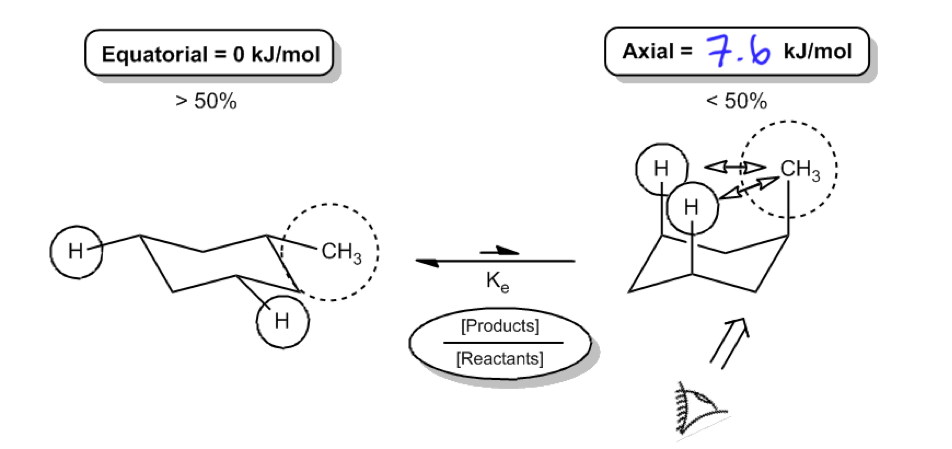
☆ what are 1,3-diaxial interactions?
☐ an axial substituent interacts sterically with axial groups on C3 and C5
☐ these are 1,3-diaxial interactions
☐ they make axial conformers less stable
☆ why is equatorial usually more stable than axial in monosubstituted cyclohexanes?
☐ equatorial avoids most 1,3-diaxial strain
☐ axial places the group in steric conflict with the ring
☐ larger groups show a bigger equatorial preference
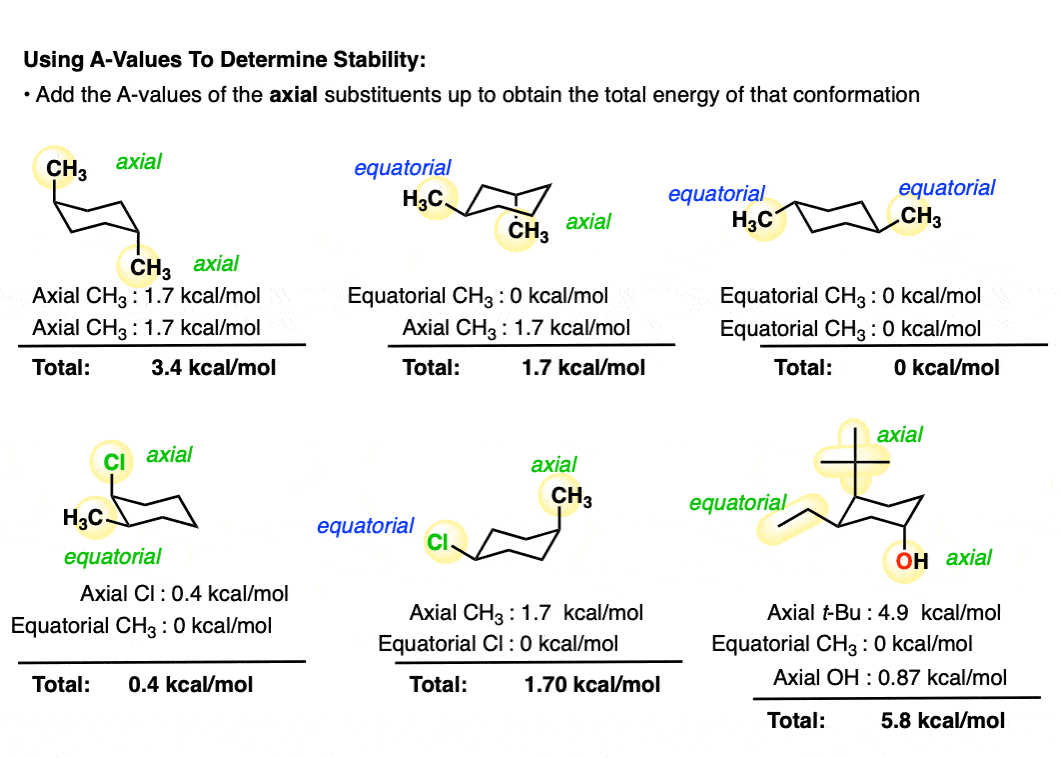
☆ how do you compare chair conformers of disubstituted cyclohexanes?
☐ place substituents on both possible chairs
☐ compare how many groups are axial versus equatorial
☐ the chair with more and larger equatorial groups is more stable
☆ what do you do with given free-energy differences for monosubstituted cyclohexanes?
☐ use each substituent’s axial penalty as an estimate
☐ add axial penalties together in a disubstituted chair
☐ the lower total energy chair is more stable
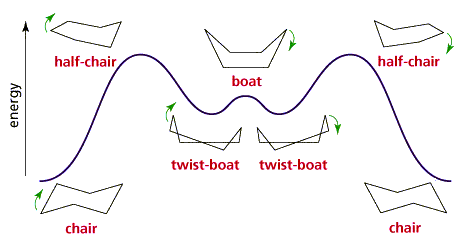
☆ what is a chair’s stability order among cyclohexane conformations?
☐ chair is lowest in energy
☐ twist-boat is higher
☐ boat is higher still
☐ half-chair is highest
☆ why is boat less stable than chair?
☐ boat has eclipsing interactions
☐ boat has flagpole steric interactions
☐ chair avoids both of these problems much better
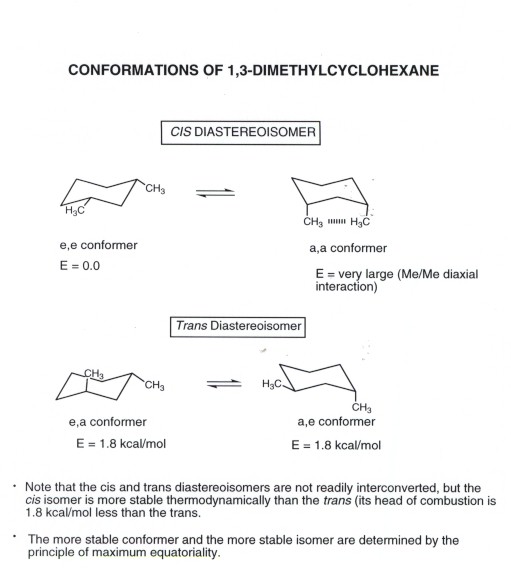
☆ what are the key disubstituted cyclohexane stability patterns?
☐ trans-1,2 can be diequatorial
☐ cis-1,3 can be diequatorial
☐ trans-1,4 can be diequatorial
☐ diequatorial conformers are usually strongly favored
☆ what are the key disubstituted cyclohexane patterns that cannot be diequatorial?
☐ cis-1,2 cannot be diequatorial
☐ trans-1,3 cannot be diequatorial
☐ cis-1,4 cannot be diequatorial
☐ these usually have one axial and one equatorial group in each chair
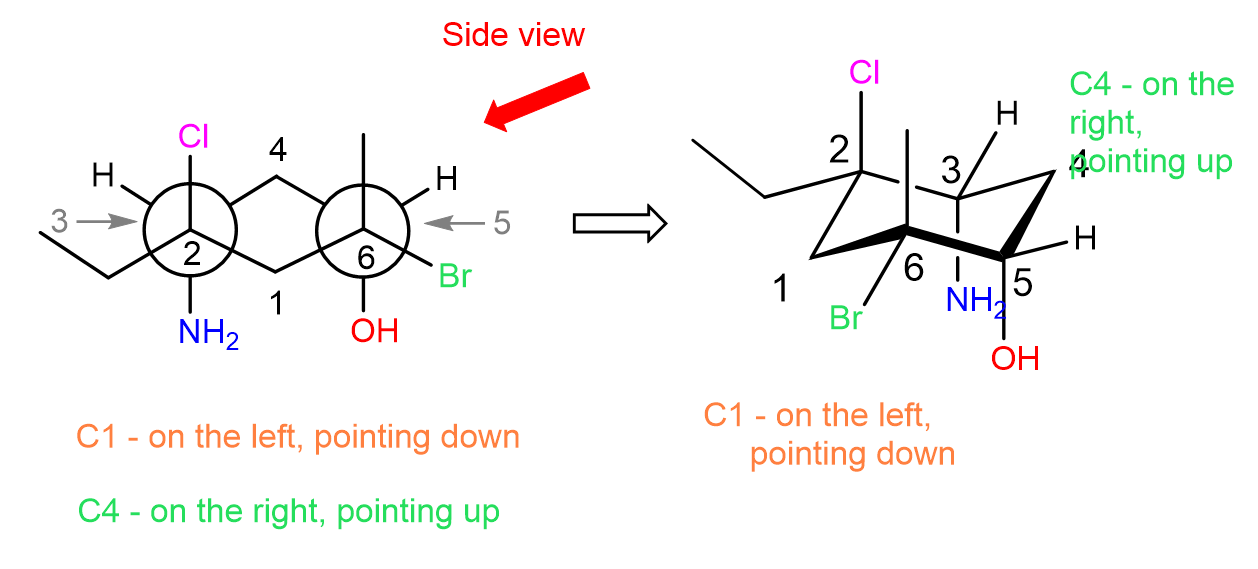
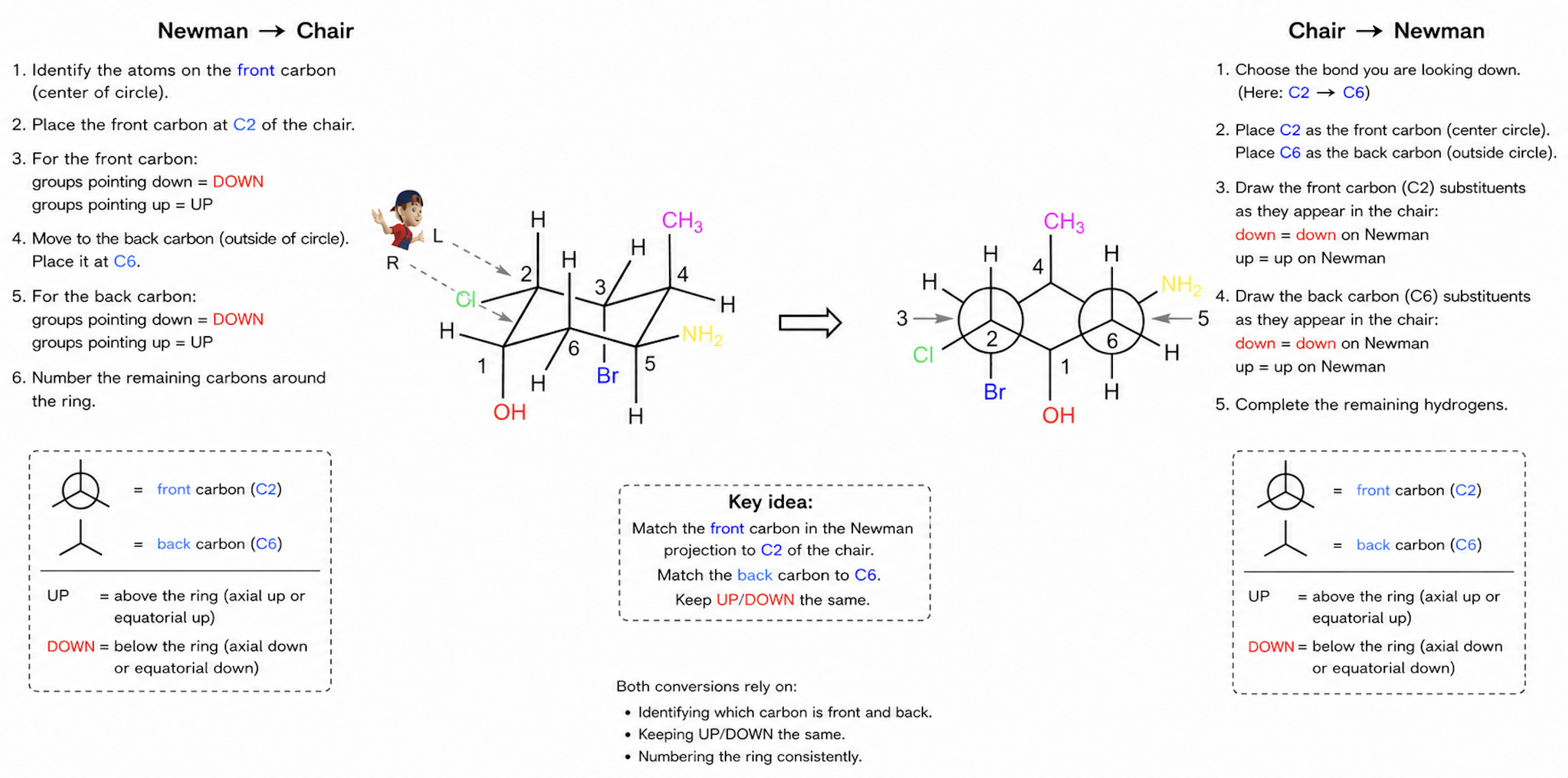
☆ how do you use chair, Newman, and wedge-dash drawings together?
☐ wedge-dash shows up/down stereochemistry
☐ chair shows axial/equatorial and conformational stability
☐ Newman helps visualize bond rotation and steric relationships
☐ all 3 represent the same molecule in different ways
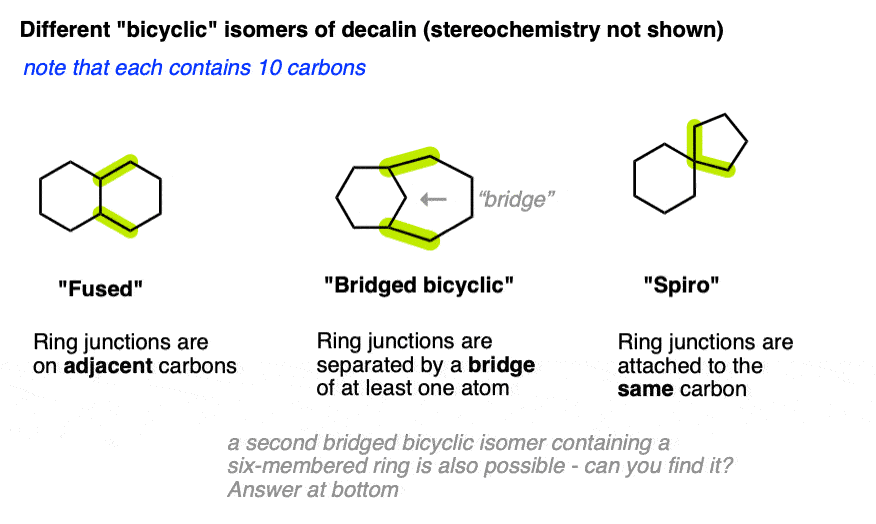
☆ what are spiro, fused, and bridged bicyclic compounds?
☐ spiro compounds share 1 atom between 2 rings
☐ fused compounds share 2 adjacent atoms and the bond between them
☐ bridged compounds share 2 nonadjacent bridgehead atoms connected by bridges
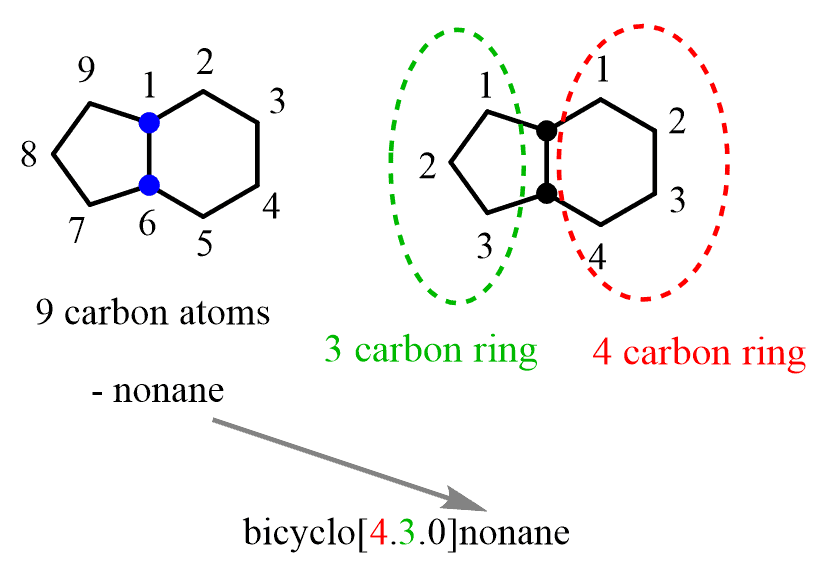
☆ how are simple bicyclic compounds named?
☐ use bicyclo[x.y.z]alkane for bridged/fused bicyclic systems
☐ x, y, z count carbons in the 3 bridges between bridgeheads
☐ write the bridge lengths from largest to smallest
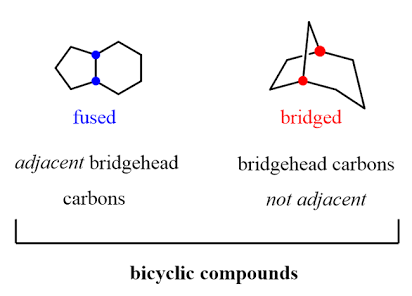
☆ what are bridgehead carbons?
☐ bridgehead carbons are the 2 shared carbons that connect the bridges
☐ they are used to define bicyclo names
☐ they are also central in Bredt’s rule
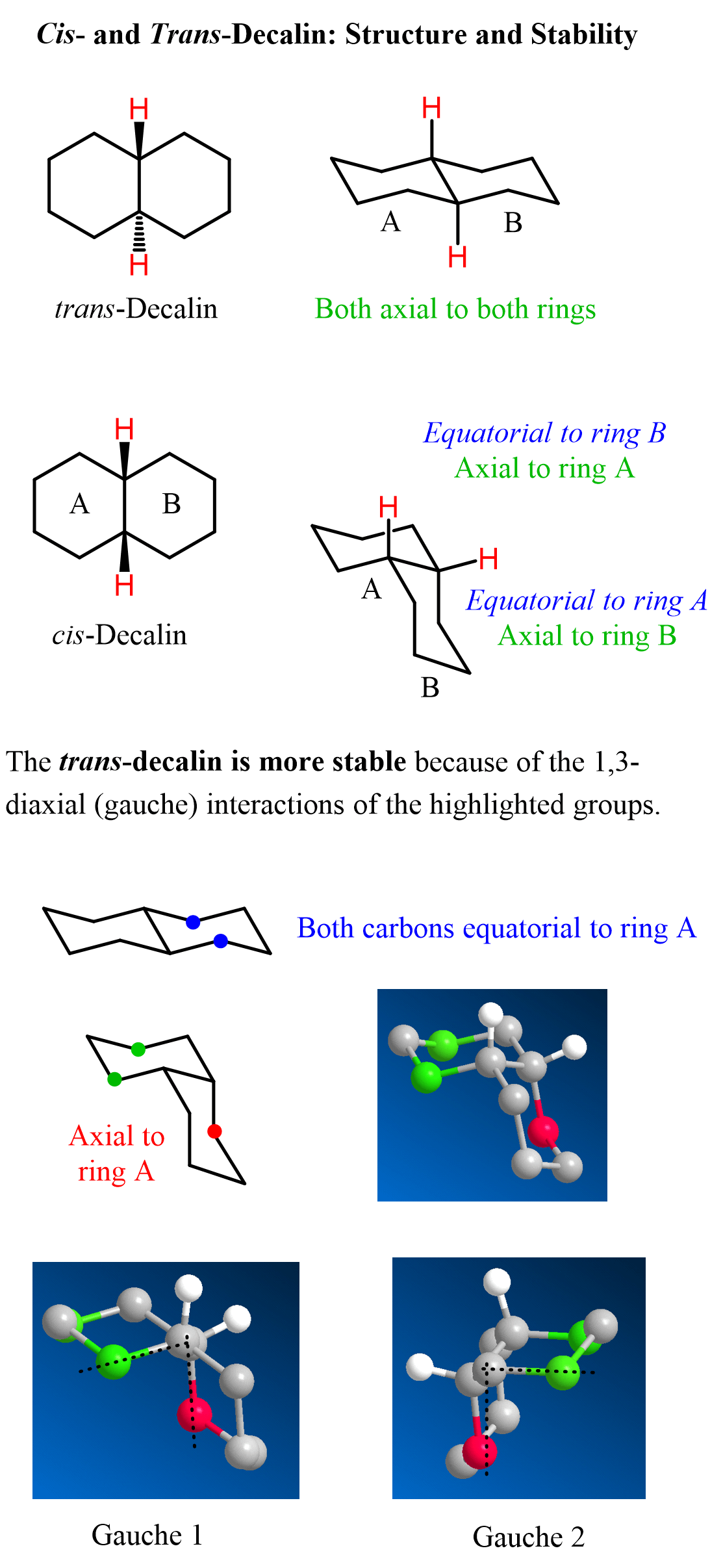
☆ how do cis- and trans-fused bicyclic six-membered rings differ?
☐ fused bicyclic compounds can differ by whether the ring-junction substituent relationships are cis or trans
☐ cis-fused means the ring-junction substituent directions are on the same side
☐ trans-fused means they are on opposite sides
☐ trans-fused systems are often more rigid and locked
☐ cis- and trans-fused systems are stereoisomers
☆ how do you convert a chair conformation into a planar line-and-wedge structure?
☐ identify whether each substituent is up or down on the chair
☐ keep the carbon connectivity unchanged
☐ translate up/down orientation into wedges and dashes on the planar ring drawing
☐ axial versus equatorial is lost in the planar drawing
☐ up/down stereochemistry must be preserved
☐ the planar drawing represents configuration, not a specific chair conformation
☆ how do you tell whether two chair drawings are the same compound, enantiomers, or diastereomers?
☐ first compare connectivity
☐ then compare the up/down orientation of every substituent
☐ if only axial/equatorial changes while up/down stays the same, they are the same compound
☐ if all stereocenters are inverted, the pair may be enantiomers
☐ if some but not all stereocenters are inverted, the pair are diastereomers
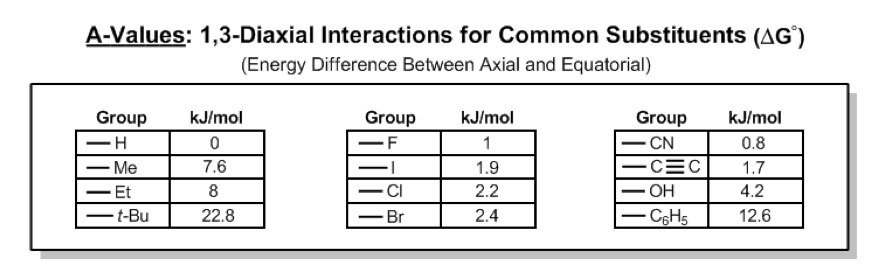
☆ how can energy differences from monosubstituted cyclohexanes help estimate disubstituted-chair stability?
☐ treat each axial substituent as adding an energy penalty
☐ use known axial-versus-equatorial preferences from monosubstituted cyclohexanes
☐ add the penalties for all axial substituents in a chair
☐ the chair with the smaller total axial penalty is predicted to be more stable
☐ this is an estimate based on conformational analysis
image
☆ why are cycloalkanes of ring size C3-C6 different in stability?
☐ their stabilities depend on ring strain
☐ ring strain includes angle strain and torsional strain
☐ cyclopropane has severe angle strain and torsional strain
☐ cyclobutane has significant strain
☐ cyclopentane reduces strain compared with smaller rings
☐ cyclohexane can adopt a chair conformation with very low strain
☆ what causes ring strain in small cycloalkanes?
☐ angle strain comes from bond angles forced away from the ideal tetrahedral angle
☐ torsional strain comes from eclipsing interactions
☐ small rings cannot easily achieve both ideal bond angles and full staggering
☐ this raises their energy
☆ what is a functional group?
☐ a functional group is a specific arrangement of atoms that gives a molecule characteristic properties and reactions
☐ the carbon framework supports the functional group
☐ identifying the functional group is a key first step in classification and naming
☆ what are the halogen-containing functional groups?
☐ alkyl halide or haloalkane = carbon bonded to F, Cl, Br, or I
☐ common halogen substituent names are fluoro-, chloro-, bromo-, and iodo-
☐ haloalkanes are classified as functionalized hydrocarbons
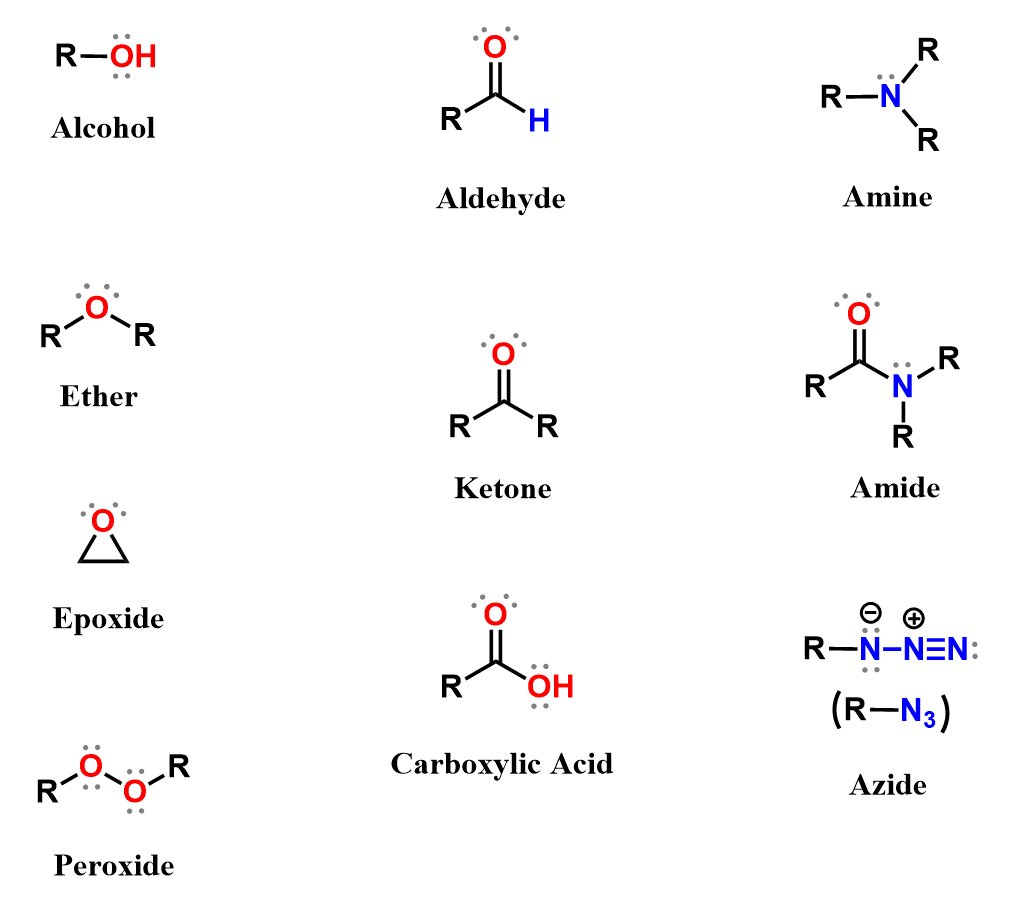
☆ what are the oxygen-containing functional groups?
☐ alcohol = R–OH
☐ ether = R–O–R
☐ epoxide = three-membered cyclic ether
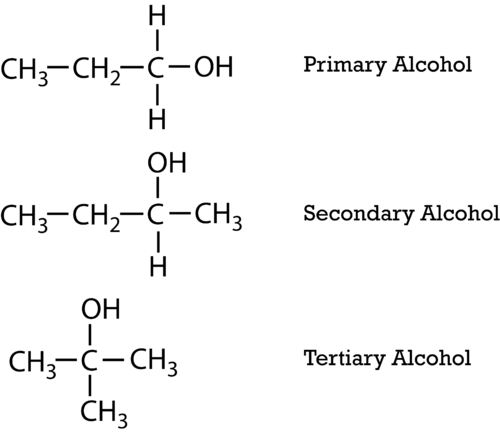
☆ how are alcohols classified?
☐ primary alcohol = the carbon bearing OH is attached to 1 other carbon
☐ secondary alcohol = the carbon bearing OH is attached to 2 other carbons
☐ tertiary alcohol = the carbon bearing OH is attached to 3 other carbons
☐ classification depends on the carbon attached to OH
☆ how are alkyl halides classified?
☐ primary alkyl halide = the carbon bearing the halogen is attached to 1 other carbon
☐ secondary alkyl halide = the carbon bearing the halogen is attached to 2 other carbons
☐ tertiary alkyl halide = the carbon bearing the halogen is attached to 3 other carbons
☐ classification depends on the carbon bonded to the halogen
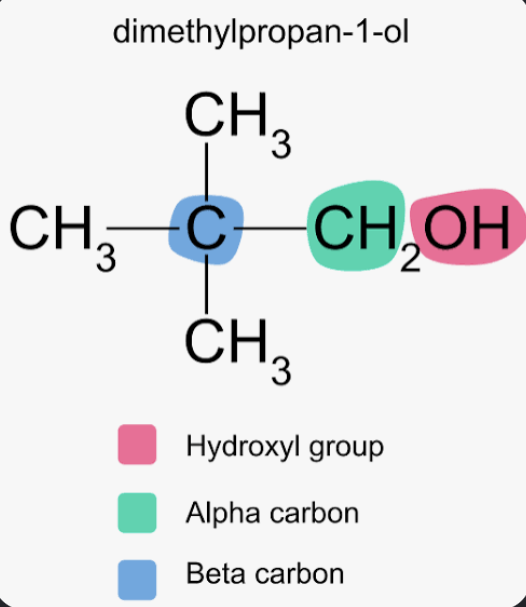
☆ what are alpha and beta carbons?
☐ the alpha carbon is the carbon directly attached to the functional group
☐ the beta carbon is the next carbon away
☐ alpha and beta labels help describe positions near a functional group
☆ what is a carbonyl group?
☐ a carbonyl group is a C=O unit
☐ it appears in several important functional groups
☐ recognizing the carbonyl helps identify aldehydes, ketones, carboxylic acids, and esters
☆ what are aldehydes and ketones?
☐ aldehyde = terminal carbonyl, R–CHO
☐ ketone = internal carbonyl, R–C(=O)–R
☐ both contain a carbonyl group
☐ they differ by what is attached to the carbonyl carbon
☆ what is a carboxylic acid?
☐ a carboxylic acid has the pattern R–COOH
☐ it contains a carbonyl and an –OH on the same carbon
☐ the carboxyl group is a distinct functional group
☆ what is an ester?
☐ an ester has the pattern R–C(=O)–O–R
☐ it contains a carbonyl adjacent to an oxygen bonded to another carbon
☐ esters differ from acids and ethers in connectivity
☆ what are the nitrogen-containing functional groups?
☐ amine = nitrogen bonded to carbon and/or hydrogen without an adjacent carbonyl
☐ amide = nitrogen directly attached to a carbonyl carbon
☐ the carbonyl next to nitrogen identifies an amide
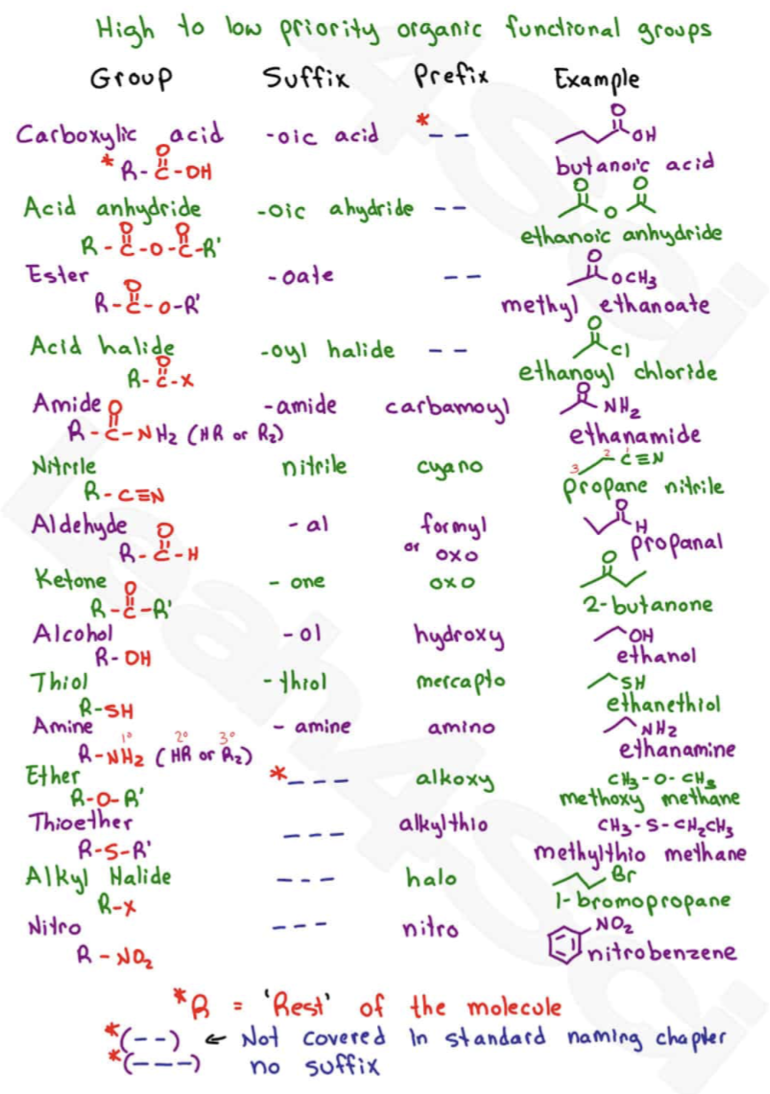
☆ what is the basic naming priority rule for functional groups?
☐ the suffix functional group has naming priority
☐ the parent name is modified to reflect the highest-priority functional group
☐ other groups may be named as substituent prefixes
☐ identifying the suffix group is essential before naming the molecule
☆ why do some IUPAC names drop a vowel before the suffix?
☐ a vowel may be dropped to avoid awkward double-vowel combinations
☐ this often happens when joining the parent ending to the suffix
☐ the final name is written in the standard IUPAC form
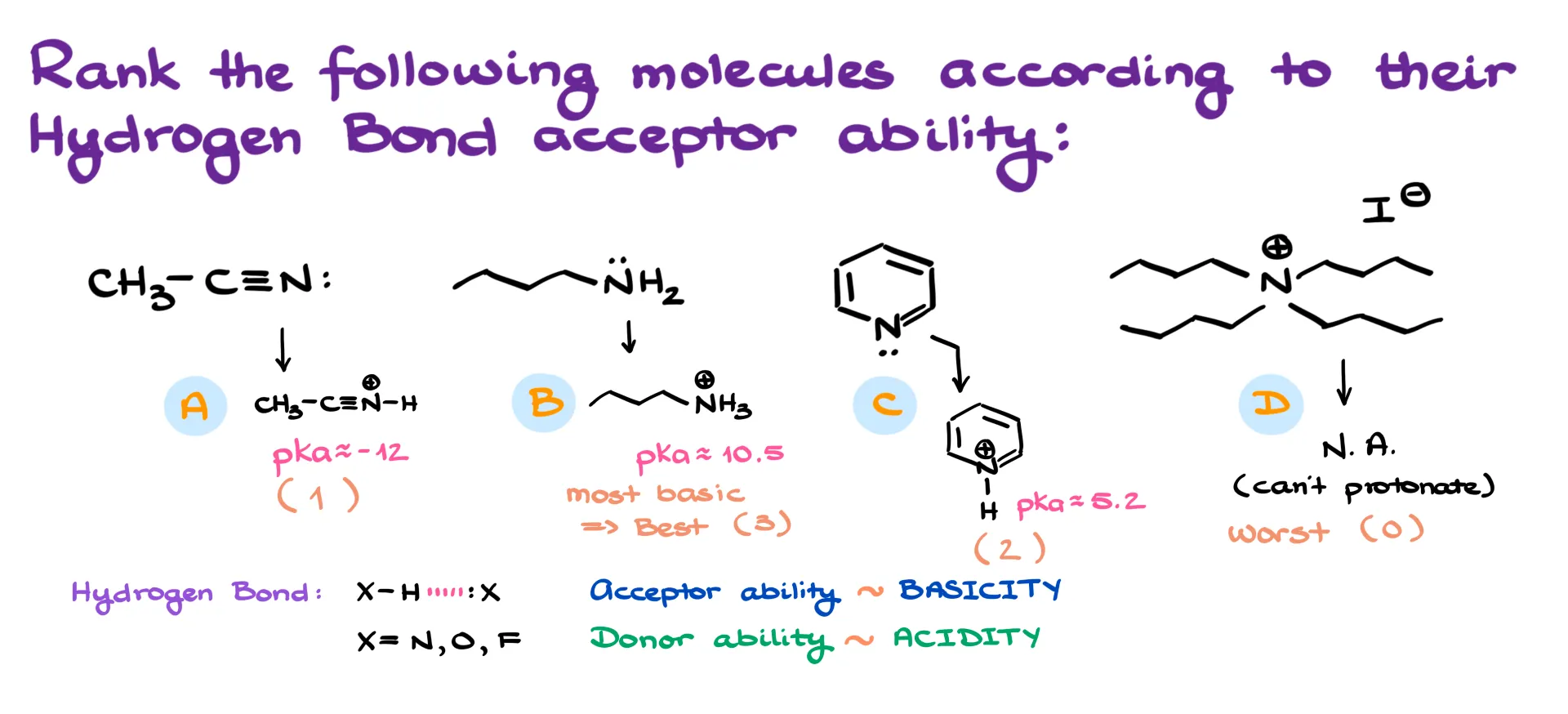
☆ what is the difference between a hydrogen-bond donor and a hydrogen-bond acceptor?
☐ a hydrogen-bond donor provides the hydrogen atom in a hydrogen bond
☐ the donor must have an H directly bonded to an electronegative atom, usually O or N
☐ a hydrogen-bond acceptor provides a lone pair to interact with that hydrogen
☐ donor examples:
☐ O–H groups
☐ N–H groups
☐ acceptor examples:
☐ oxygen atoms with lone pairs
☐ nitrogen atoms with lone pairs
☐ some atoms or groups can act as both donor and acceptor
☐ an –OH oxygen can accept, while its H can donate
☐ an amine nitrogen (bonded to carbon group) can often accept, and if it has N–H, it can also donate
☐ hydrogen bonding affects solubility, boiling point, and intermolecular interactions
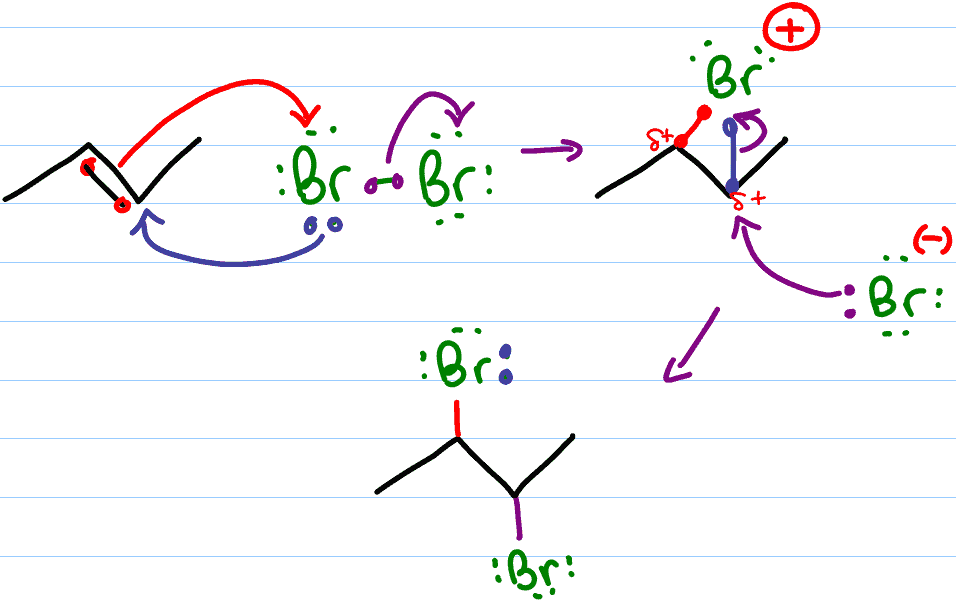
☆ how does a halogen add to an alkene?
☐ X₂ means Cl₂ or Br₂
☐ the alkene π bond acts as a nucleophile toward the halogen
☐ the reaction forms a vicinal dihalide
☐ the two halogens add across the double bond
☐ the reaction does not proceed through a free carbocation
☐ a bridged halonium ion intermediate forms first
☐ the halonium ion is three-membered and positively charged
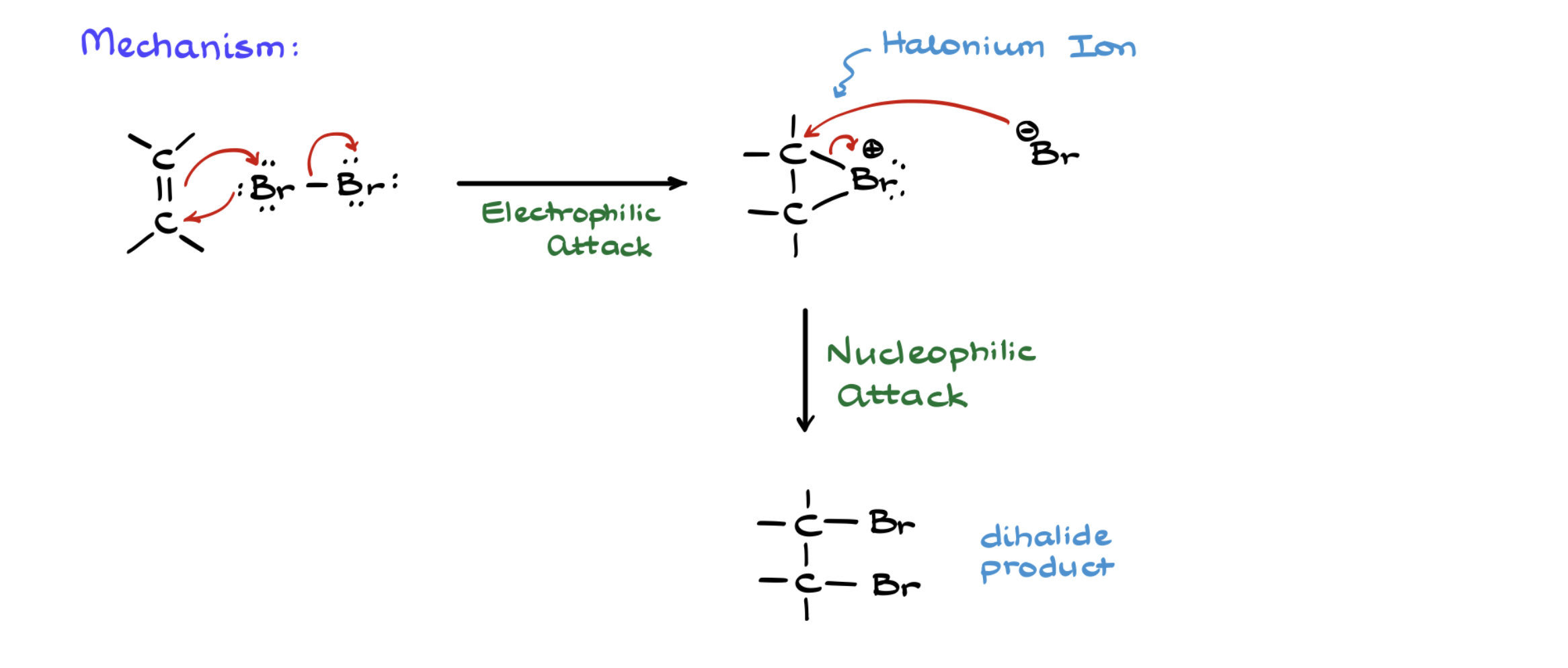
☆ what is the mechanism of halogenation of an alkene?
☐ step 1: the alkene attacks X₂
☐ the X–X bond breaks as one halogen bonds to both alkene carbons
☐ a halide ion and a halonium ion form
☐ step 2: X⁻ attacks one carbon of the halonium ion from the back side
☐ the ring opens as the C–X bond to the bridging halogen breaks at one carbon
☐ the product is an anti addition product
☐ curved arrows must begin at the π bond and at the C–X bond of the halonium ion
☐ charge must be conserved through both steps
☆ why is halogen addition anti?
☐ the bridged halonium ion blocks attack from the same face
☐ the nucleophile must open the ring from the opposite face
☐ this gives anti addition overall
☐ anti means the two newly added groups end up on opposite faces
☐ anti addition is a stereochemical outcome of the mechanism
☐ it is not just a naming convention
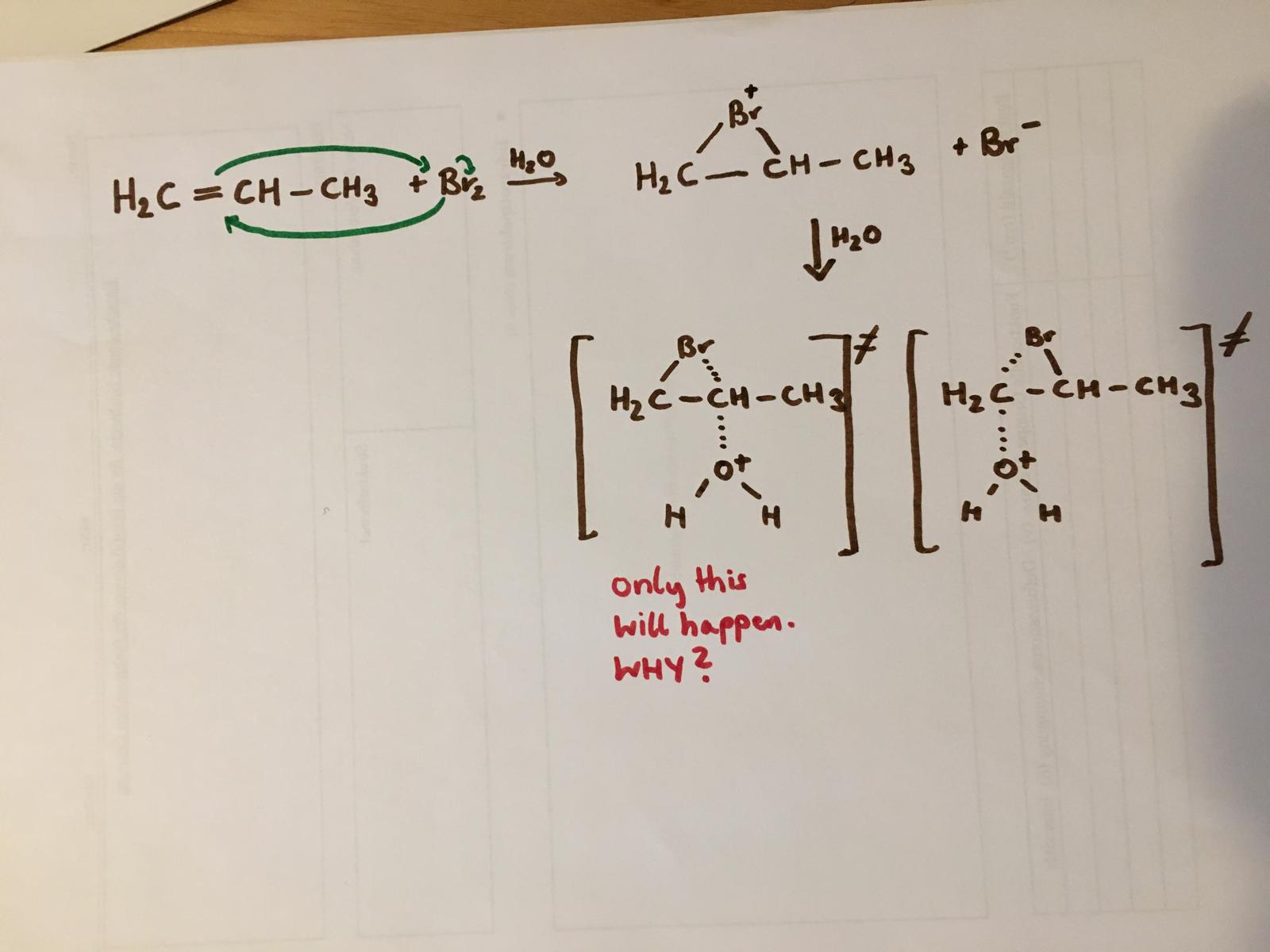
☆ how is halogen addition regioselective when the alkene is unsymmetrical?
☐ the halonium ion is unsymmetrical
☐ one carbon bears more positive character than the other
☐ nucleophilic attack occurs preferentially at the more substituted carbon
☐ the more substituted carbon better stabilizes developing positive charge
☐ this resembles opening of an unsymmetrical bridged cation
☐ the product orientation follows attack at the more electrophilic carbon
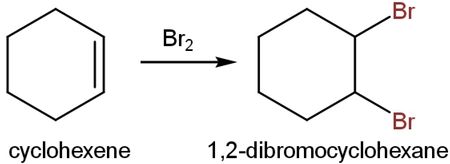
☆ what happens when a halogen adds to a cyclic alkene?
☐ halogenation still proceeds through a halonium ion
☐ backside attack gives anti addition
☐ in a ring, anti addition often gives a trans relationship between the new substituents
☐ the product may be a pair of enantiomers if new stereocenters form
☐ do not assume only one drawing represents the full stereochemical outcome
☐ ring geometry helps reveal whether the product is cis or trans
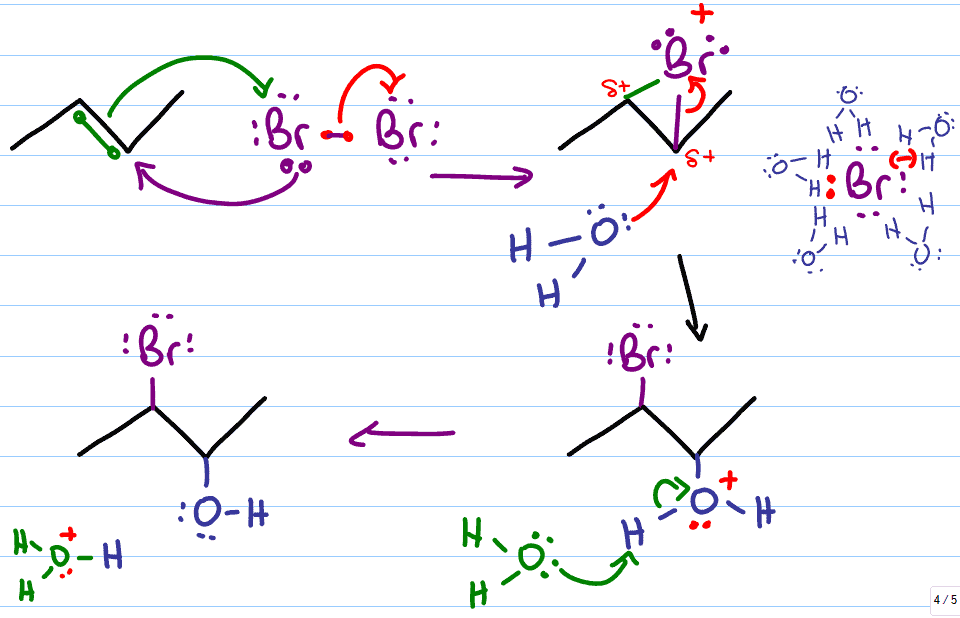
☆ what happens when an alkene reacts with X₂ in water?
☐ water competes with X⁻ as the nucleophile
☐ the reaction forms a halohydrin
☐ one carbon receives X and the other receives OH
☐ a halonium ion still forms first
☐ water opens the halonium ion from the back side
☐ the addition is anti overall
☐ the OH group comes from water
☐ deprotonation gives the neutral halohydrin product
☆ how is halohydrin formation regioselective?
☐ water attacks the more substituted carbon of the halonium ion
☐ that carbon has greater positive character
☐ therefore OH ends up on the more substituted carbon
☐ X ends up on the less substituted carbon
☐ the real reason is nucleophilic attack at the more electrophilic carbon
☐ the overall addition remains anti
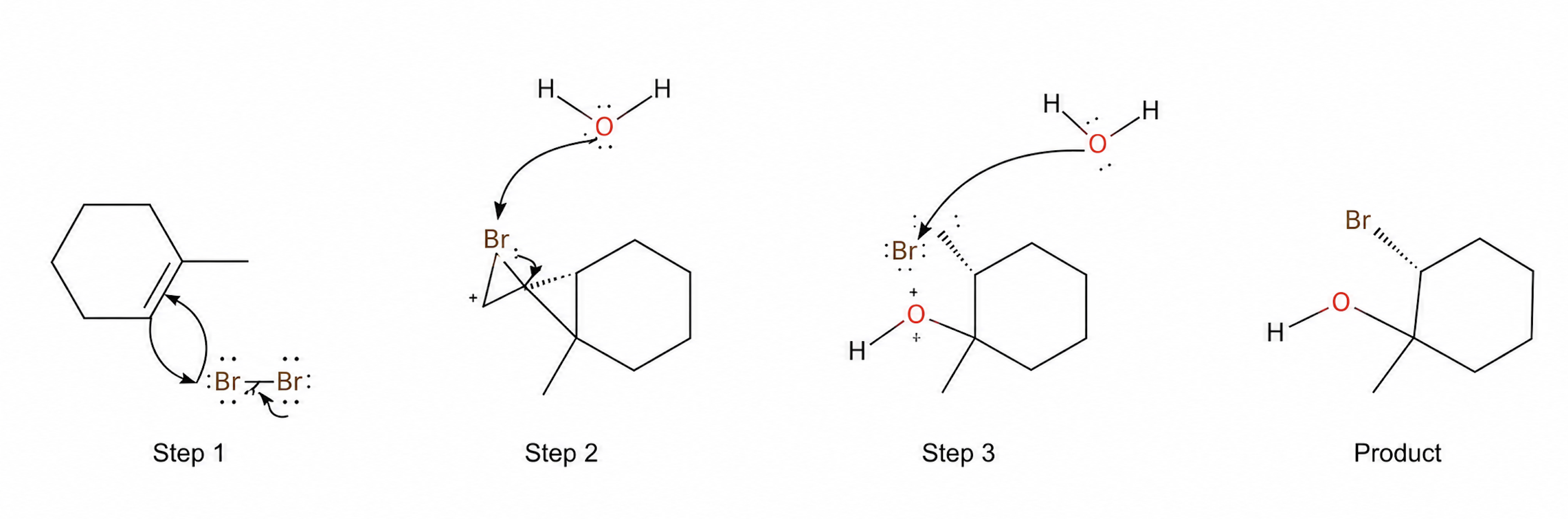
☆ what is the mechanism of halohydrin formation?
☐ step 1: the alkene reacts with X₂ to form a halonium ion
☐ step 2: H₂O attacks the more substituted carbon from the back side
☐ the ring opens to give a protonated alcohol
☐ step 3: another water molecule removes H⁺
☐ the neutral halohydrin forms
☐ the overall addition is anti
☐ this uses the same halonium logic as ordinary halogenation
☐ the main difference is the nucleophile that opens the ring
☆ how is halohydrin formation regioselective?
☐ water attacks the more substituted carbon of the halonium ion
☐ that carbon has greater positive character
☐ therefore OH ends up on the more substituted carbon
☐ X ends up on the less substituted carbon
☐ the real reason is nucleophilic attack at the more electrophilic carbon
☐ the overall addition remains anti
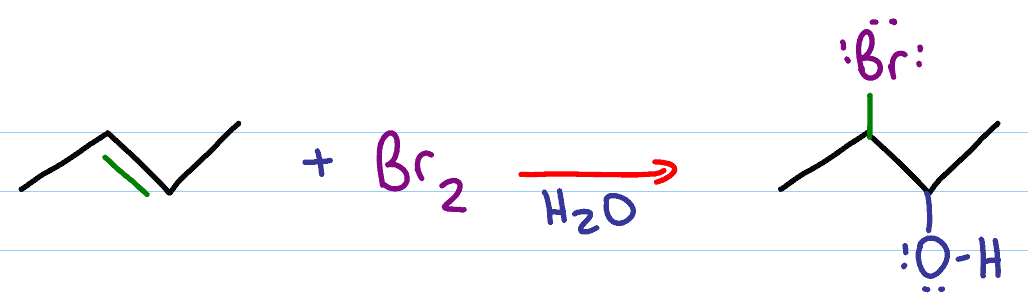
☆ what is the mechanism of halohydrin formation?
☐ step 1: the alkene reacts with X₂ to form a halonium ion
☐ step 2: H₂O attacks the more substituted carbon from the back side
☐ the ring opens to give a protonated alcohol
☐ step 3: another water molecule removes H⁺
☐ the neutral halohydrin forms
☐ the overall addition is anti
☐ this uses the same halonium logic as ordinary halogenation
☐ the main difference is the nucleophile that opens the ring
☆ how do you predict halogenation versus halohydrin formation?
☐ first identify the alkene
☐ then determine whether the reagent is X₂ alone or X₂ in water
☐ X₂ alone gives a vicinal dihalide
☐ X₂/H₂O gives a halohydrin
☐ both reactions proceed by anti addition
☐ for an unsymmetrical alkene, X₂/H₂O places OH on the more substituted carbon
☐ the halogen ends up on the less substituted carbon
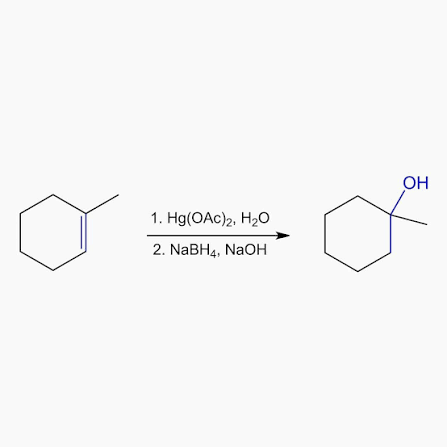
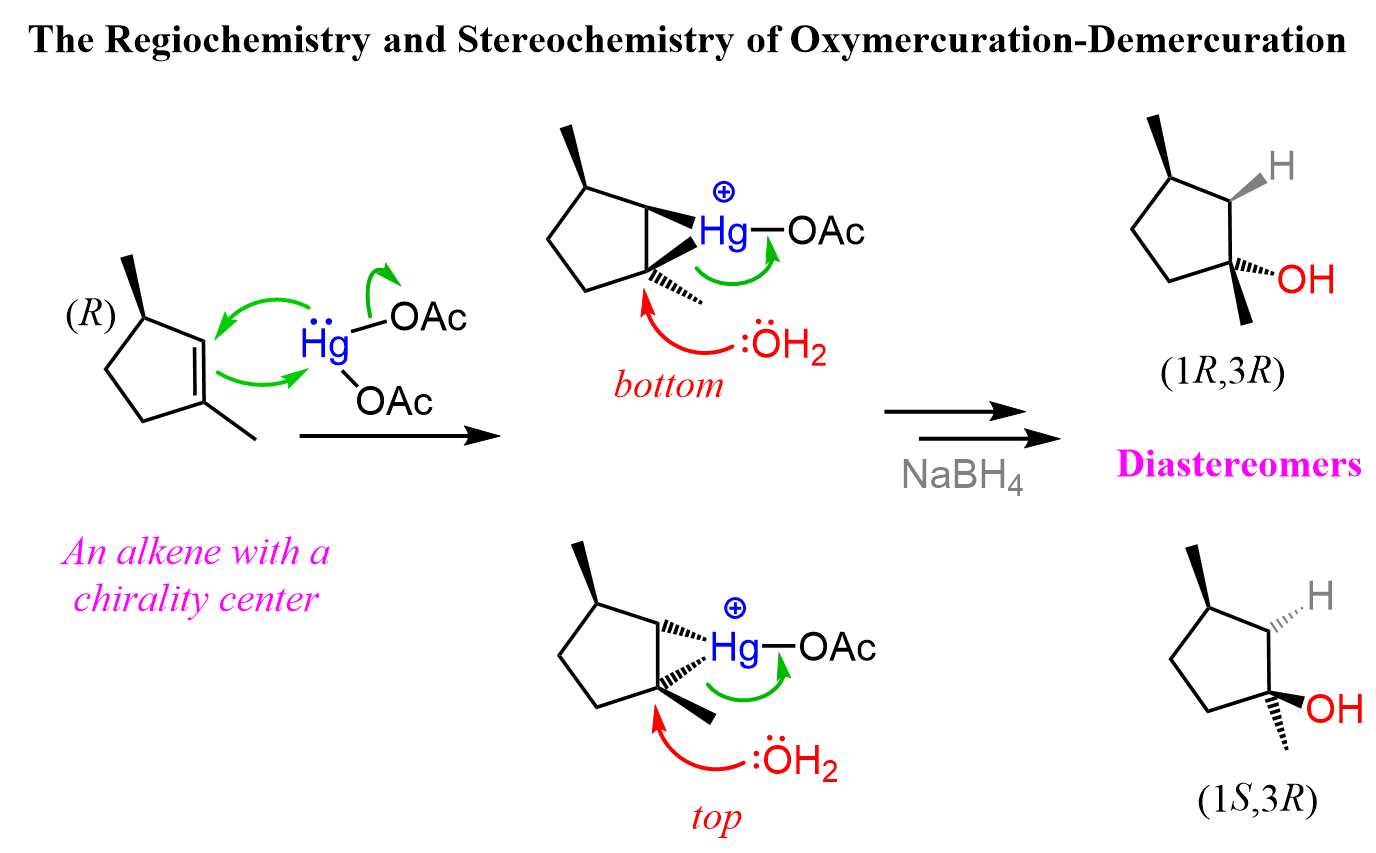
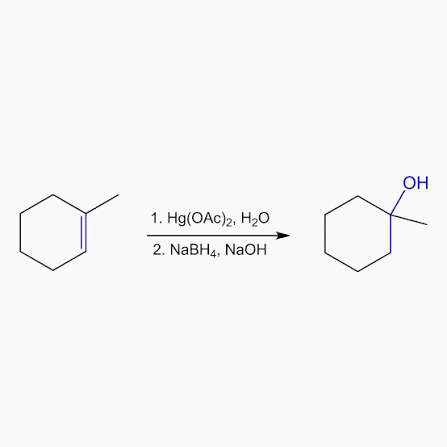
☆ what does oxymercuration–demercuration do to an alkene?
☐ it hydrates an alkene to give an alcohol
☐ the net result is addition of H and OH across C=C
☐ OH appears on the more substituted carbon
☐ the reaction gives Markovnikov hydration
☐ it avoids carbocation rearrangements
☐ common reagents are Hg(OAc)₂/H₂O followed by NaBH₄
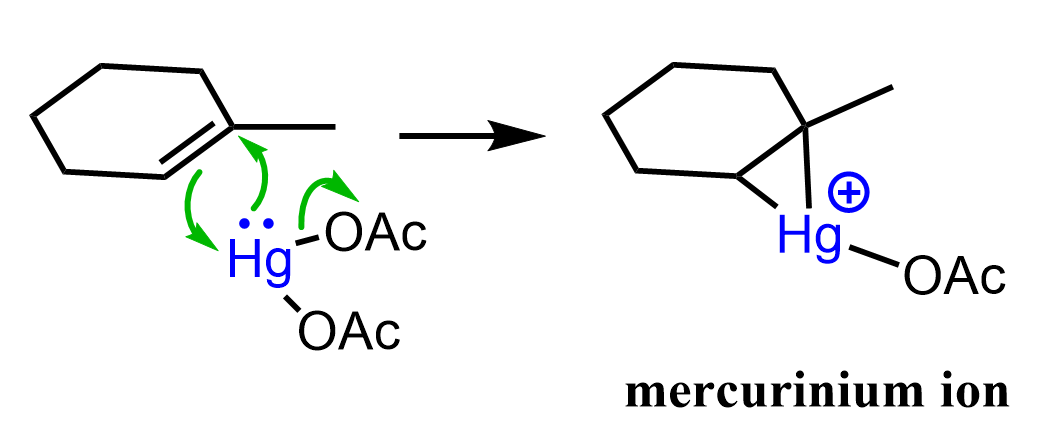
☆ why does oxymercuration avoid rearrangements?
☐ the reaction does not form a free carbocation
☐ a bridged mercurinium ion intermediate forms instead
☐ this prevents hydride or alkyl shifts before nucleophilic attack
☐ water attacks the more substituted carbon of the bridged intermediate
☐ demercuration later replaces the Hg-containing group with H
☐ the product is a rearrangement-free alcohol
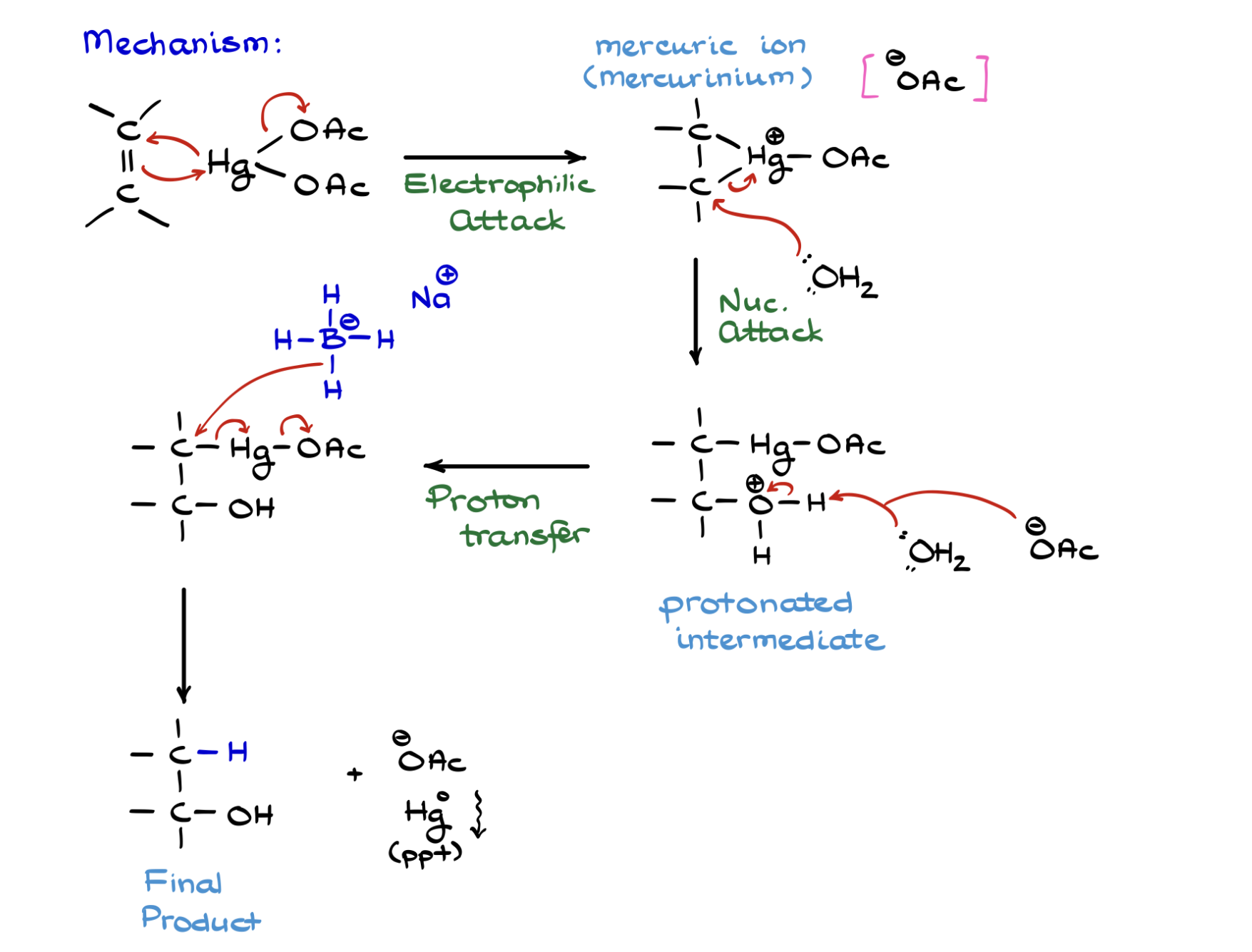
☆ what is the mechanism of oxymercuration–demercuration?
☐ step 1: the alkene reacts with Hg(OAc)₂ to form a bridged mercurinium ion
☐ step 2: water attacks the more substituted carbon
☐ step 3: deprotonation forms an organomercury alcohol
☐ step 4: NaBH₄ replaces the Hg-containing group with H
☐ the net result is hydration of the alkene
☐ OH ends up on the more substituted carbon
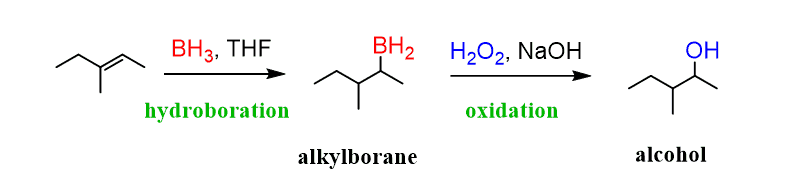
☆ what does hydroboration–oxidation do to an alkene?
☐ it hydrates an alkene to give an alcohol
☐ the net result is addition of H and OH across C=C
☐ OH appears on the less substituted carbon
☐ the reaction gives anti-Markovnikov hydration
☐ it proceeds without a carbocation intermediate
☐ common reagents are BH₃ followed by H₂O₂, OH⁻
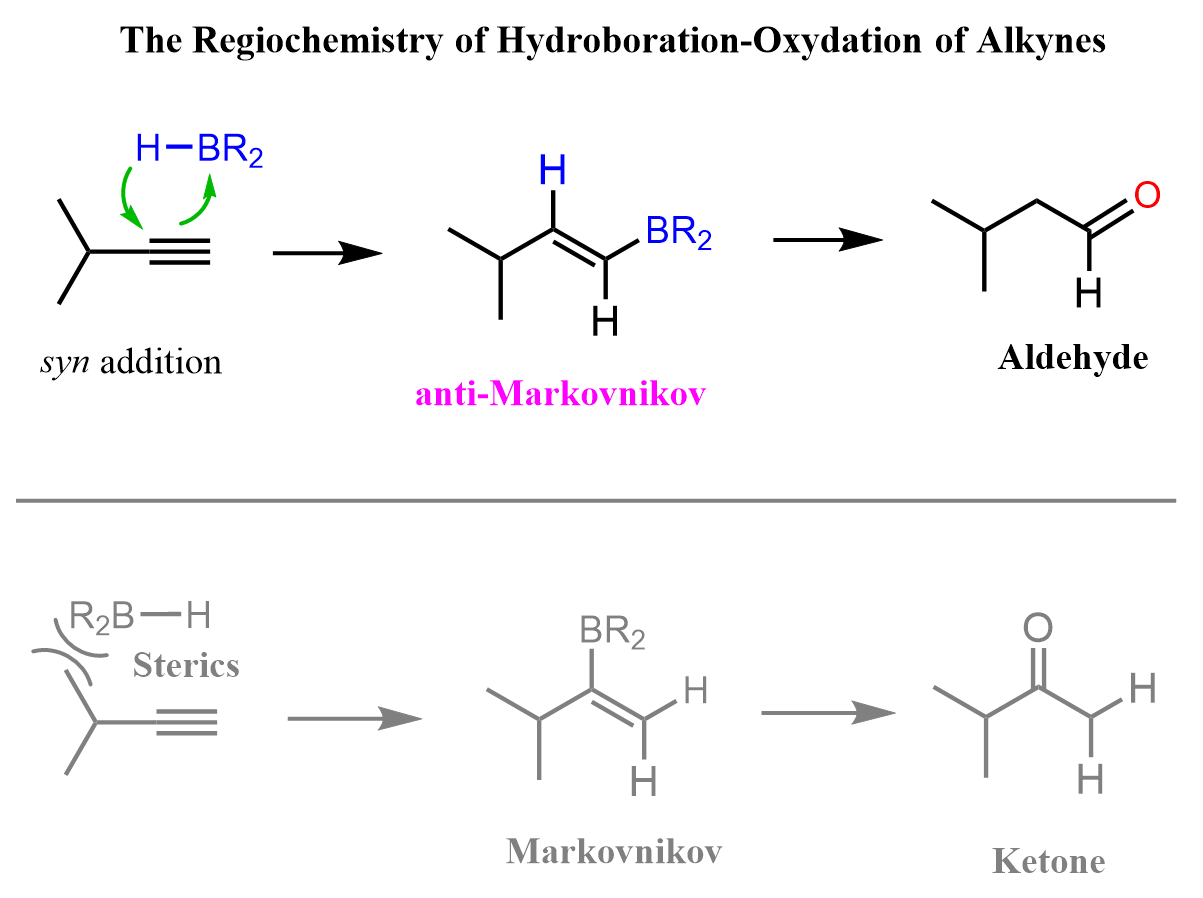
☆ why is hydroboration anti-Markovnikov?
☐ boron bonds to the less substituted carbon in the hydroboration step
☐ hydrogen bonds to the more substituted carbon at the same time
☐ oxidation later replaces B with OH at the same carbon
☐ the regiochemistry is set in the first step
☐ steric effects favor boron delivery to the less hindered carbon
☐ the final alcohol retains that orientation
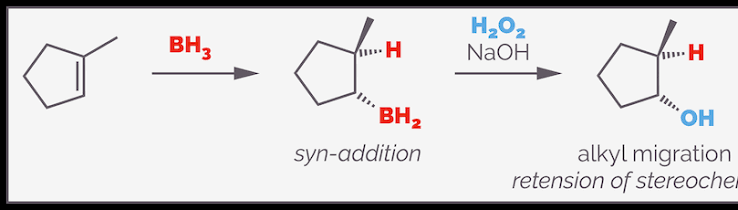
☆ what stereochemistry does hydroboration give?
☐ hydroboration is a concerted syn addition
☐ H and B add to the same face of the alkene
☐ oxidation preserves the stereochemical relationship
☐ the overall result is syn addition of H and OH
☐ syn means both added groups come from the same face
☐ stereochemistry is especially visible in cyclic or substituted systems
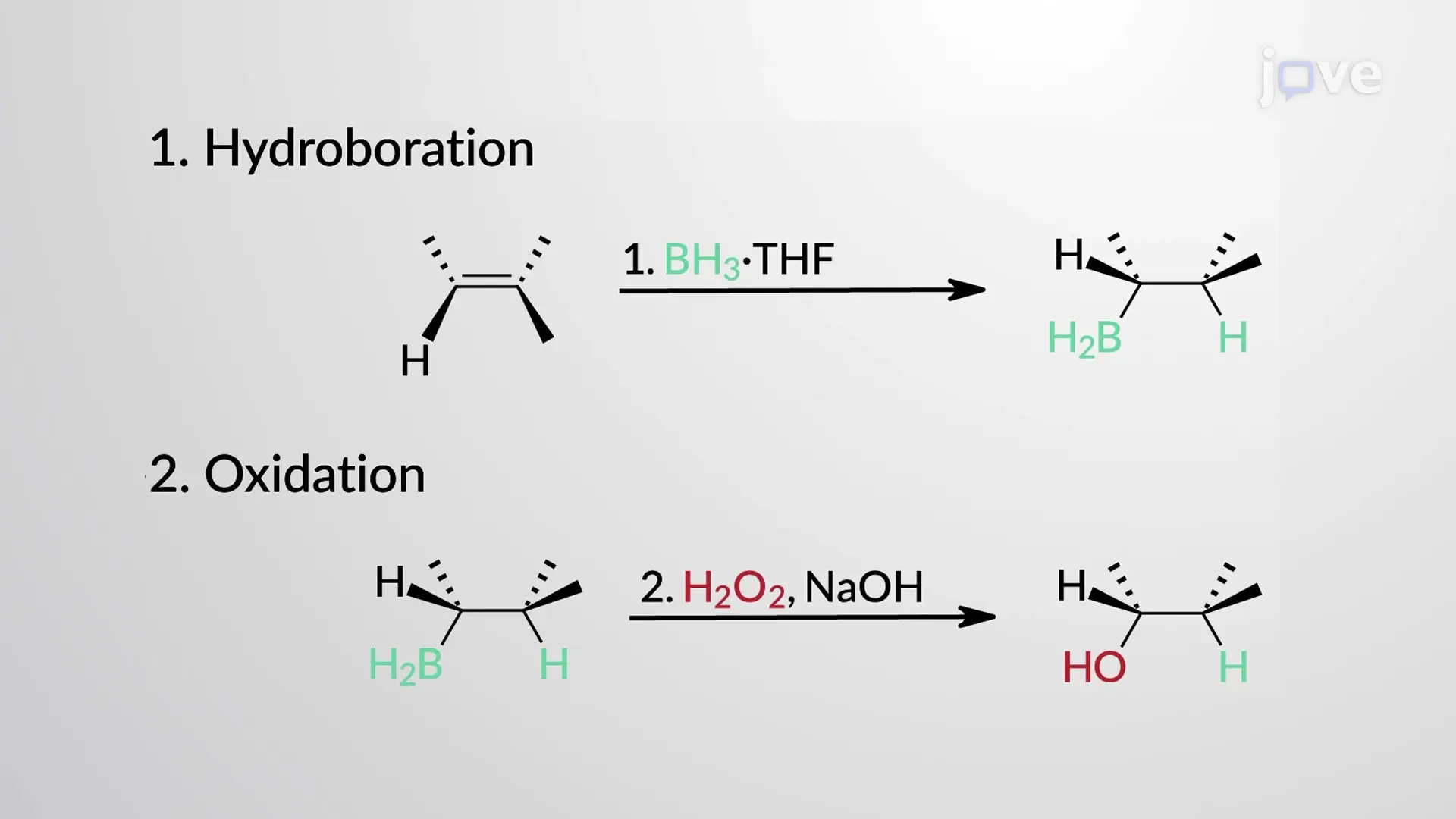
☆ what is the mechanism logic of hydroboration–oxidation?
☐ step 1: BH₃ adds across the alkene in a concerted step
☐ no carbocation intermediate forms
☐ B attaches to the less substituted carbon and H to the more substituted carbon
☐ step 2: oxidation replaces C–B with C–OH
☐ the OH appears where B was originally attached
☐ the net product is an anti-Markovnikov alcohol
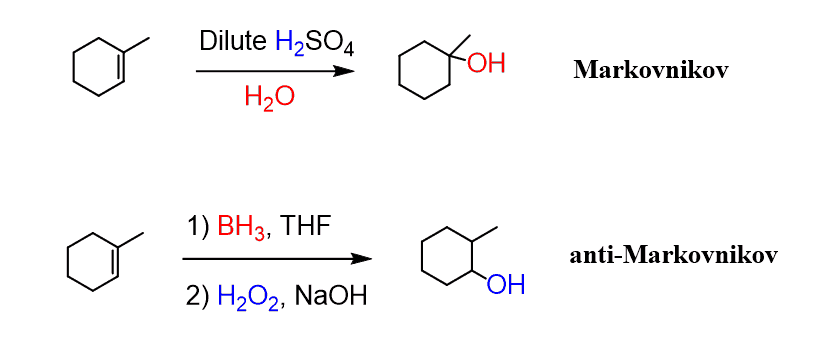
☆ how do the three alkene hydration methods compare?
☐ acid-catalyzed hydration gives Markovnikov alcohols
☐ acid-catalyzed hydration can rearrange
☐ oxymercuration–demercuration gives Markovnikov alcohols
☐ oxymercuration avoids rearrangements
☐ hydroboration–oxidation gives anti-Markovnikov alcohols
☐ hydroboration is syn and rearrangement-free
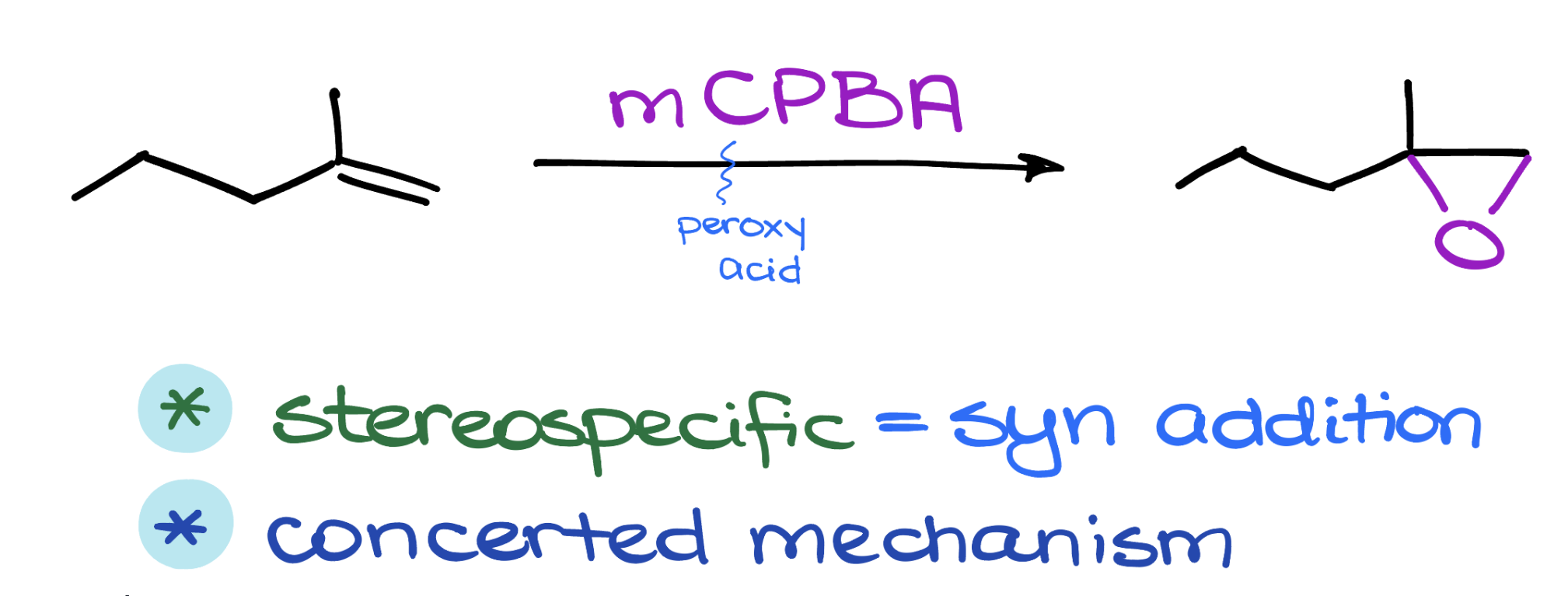
☆ what happens when a peroxyacid reacts with an alkene?
☐ the alkene is converted into an epoxide
☐ an epoxide is a three-membered cyclic ether
☐ the reaction is called epoxidation
☐ the oxygen is delivered in a single concerted step
☐ the alkene π bond is replaced by two C–O σ bonds
☐ common reagents include peroxyacids such as mCPBA

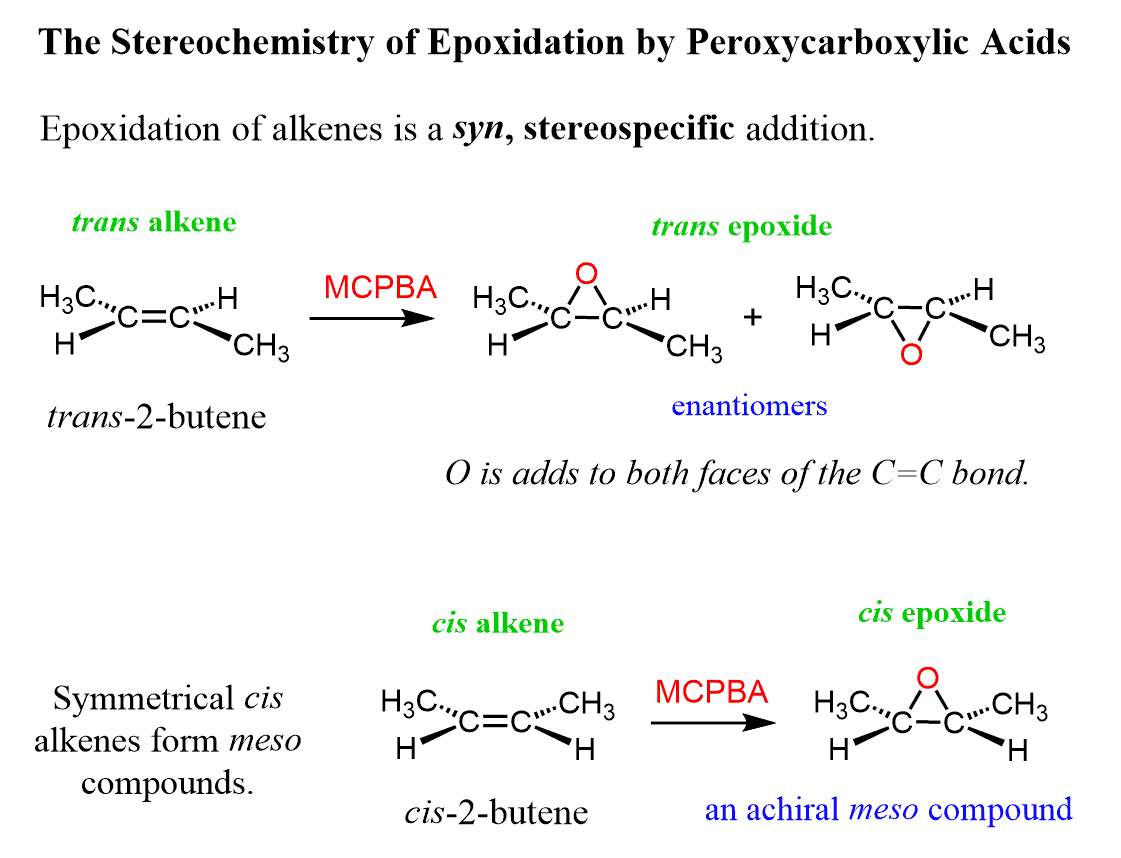
☆ what is the stereochemistry of epoxidation?
☐ epoxidation is a concerted reaction
☐ both C–O bonds form in the same step
☐ the relative stereochemistry of the alkene is retained in the epoxide
☐ a cis alkene gives a cis-substituted epoxide framework
☐ a trans alkene gives a trans-substituted epoxide framework
☐ no carbocation intermediate forms
☆ how are epoxides opened under basic conditions?
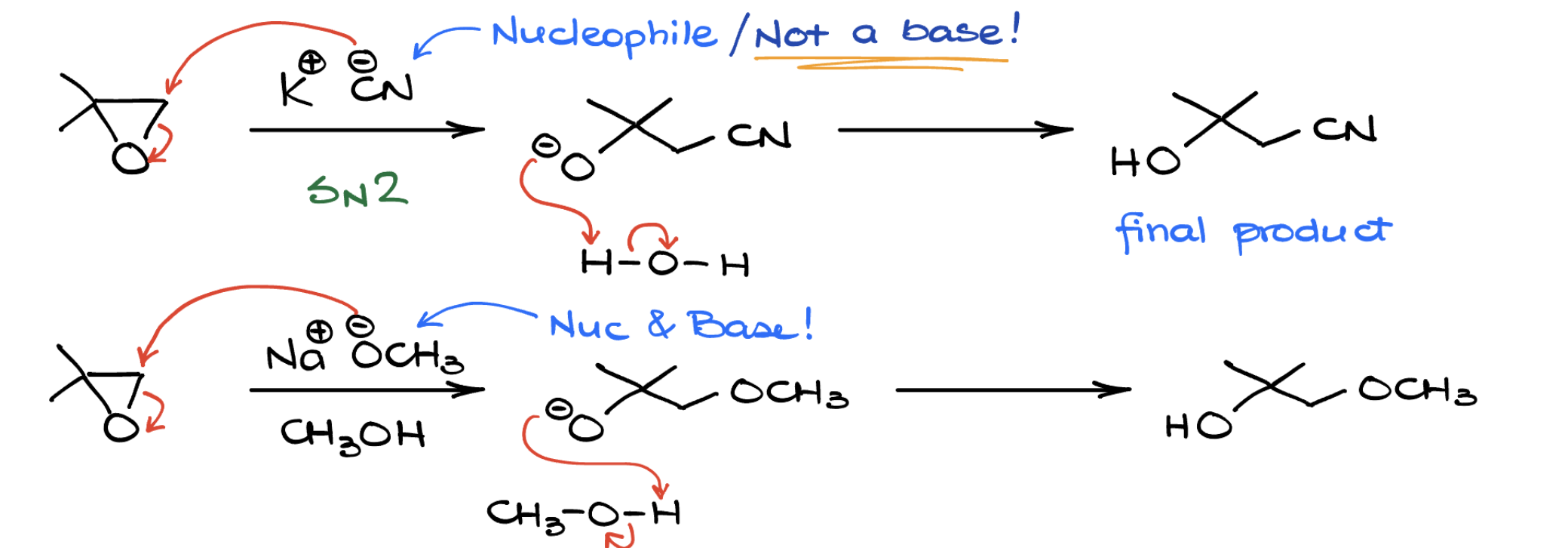
☐ a strong nucleophile attacks an epoxide carbon by backside attack
☐ the ring opens in an SN2-like step
☐ attack occurs at the less substituted carbon in an unsymmetrical epoxide
☐ the C–O bond breaks at the attacked carbon
☐ oxygen remains attached to the other carbon as an alkoxide
☐ protonation later gives an alcohol
☐ the opening gives an anti relationship between the nucleophile and OH
☐ basic opening is controlled mainly by sterics
☆ how are epoxides opened under acidic conditions?
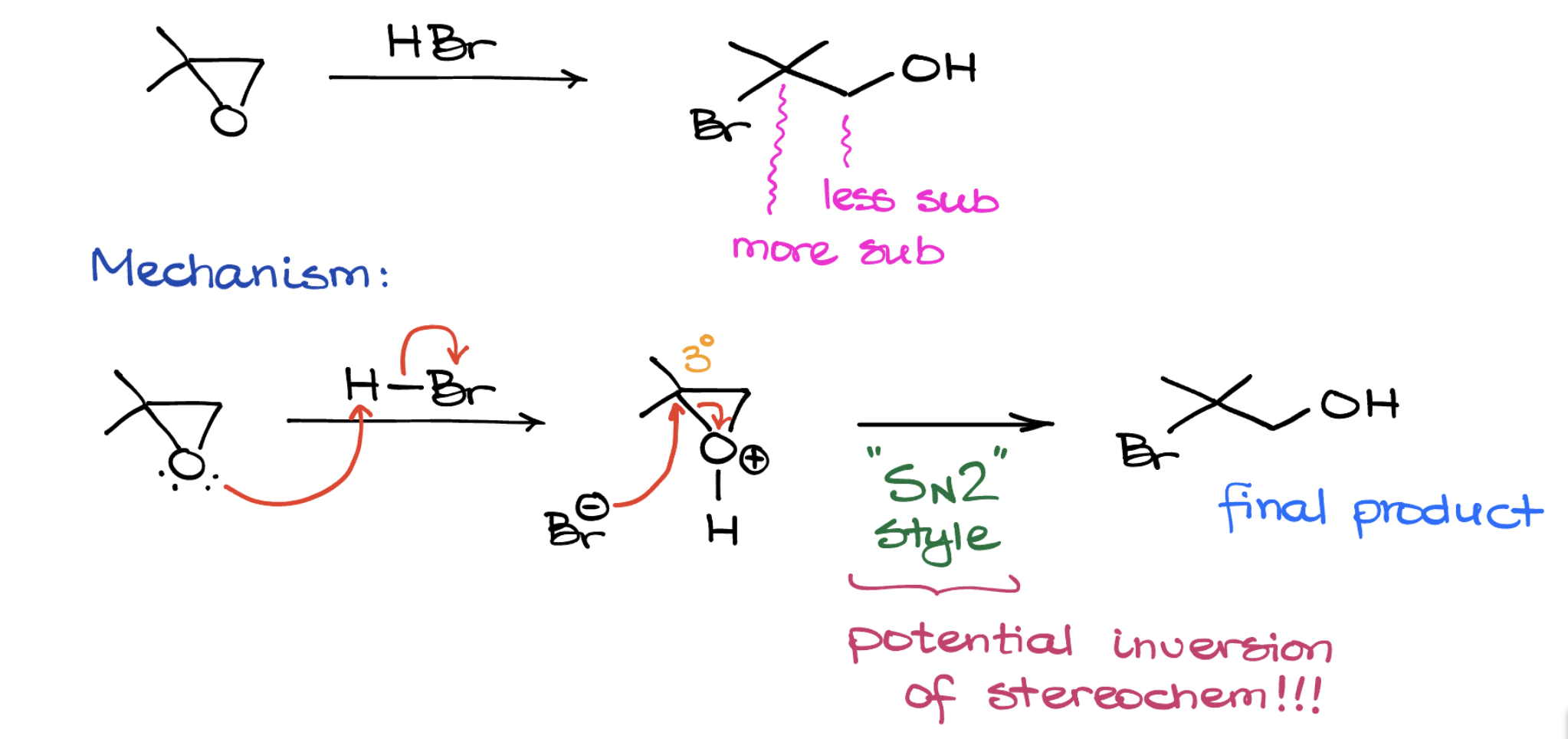
☐ the epoxide oxygen is protonated first
☐ protonation makes the ring more electrophilic
☐ a nucleophile then attacks and opens the ring
☐ in unsymmetrical epoxides, attack usually occurs at the more substituted carbon
☐ the protonated epoxide has more positive character there
☐ backside attack still gives anti opening overall
☆ how do basic and acidic epoxide opening compare?
☐ both involve backside attack
☐ both give anti opening
☐ both relieve ring strain
☐ under basic conditions, the nucleophile attacks the less substituted carbon
☐ steric effects dominate under basic conditions
☐ under acidic conditions, the epoxide is protonated first
☐ the nucleophile usually attacks the more substituted carbon
☐ positive-charge development affects regioselectivity
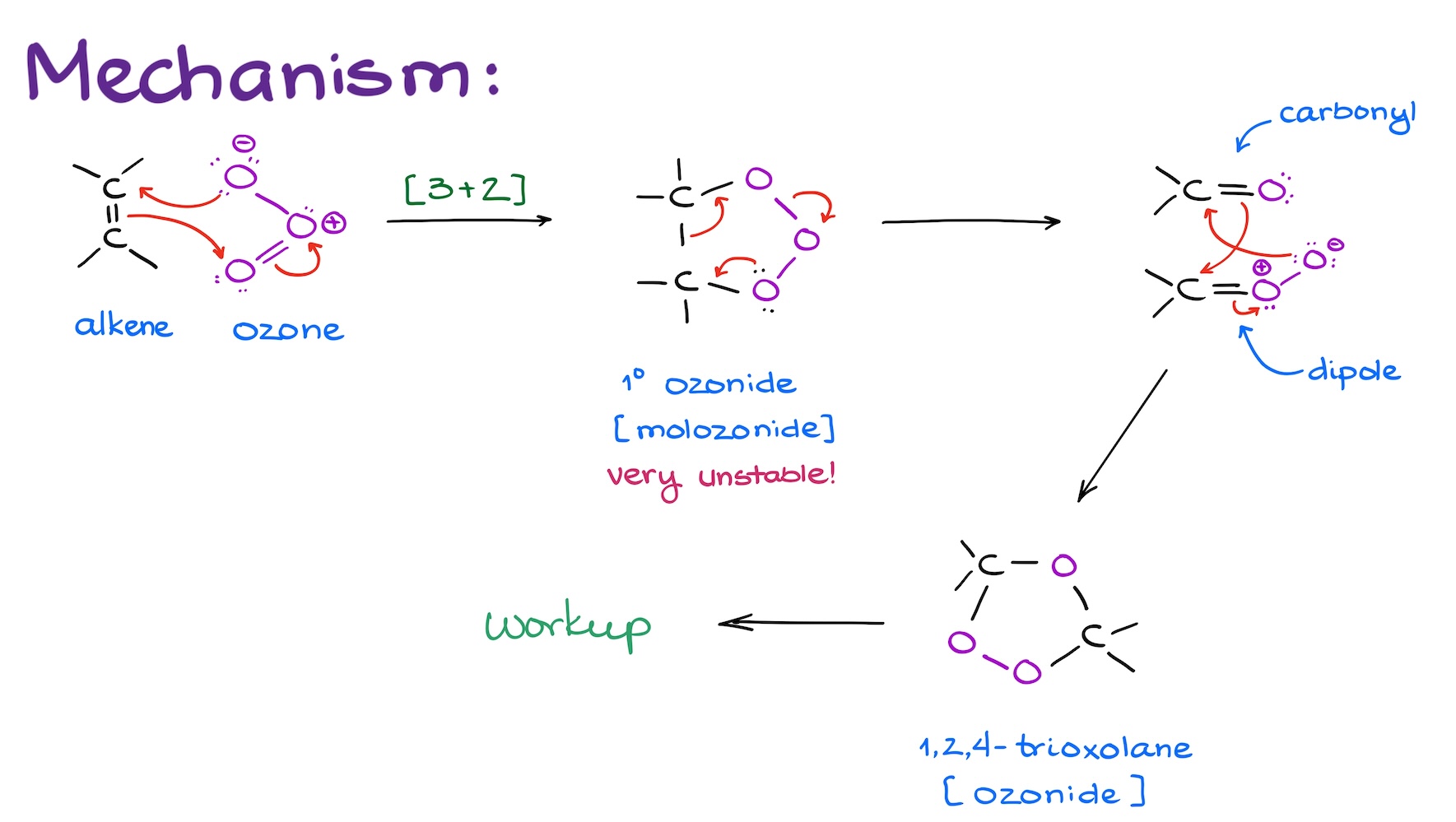
☆ what does ozonolysis of an alkene accomplish?
☐ ozonolysis cleaves the C=C bond
☐ each alkene carbon becomes a carbonyl carbon
☐ the double bond is divided into two fragments
☐ product identity depends on the substituents attached to each alkene carbon
☐ products may be aldehydes, ketones, or carboxylic acids depending on workup
☐ always track each alkene carbon into its own carbonyl product
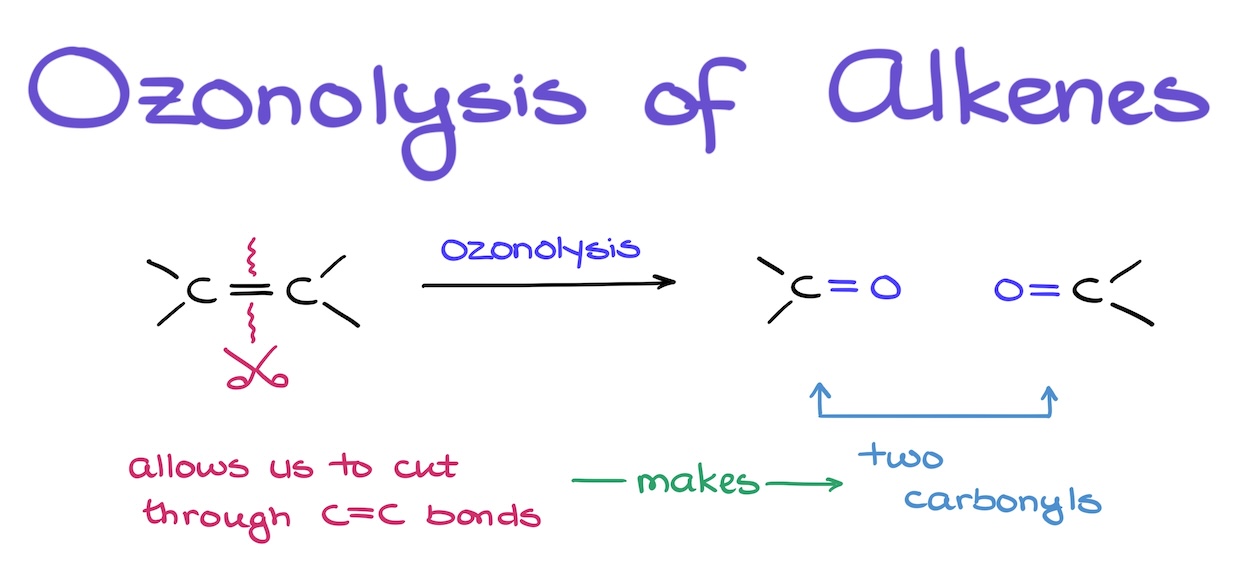
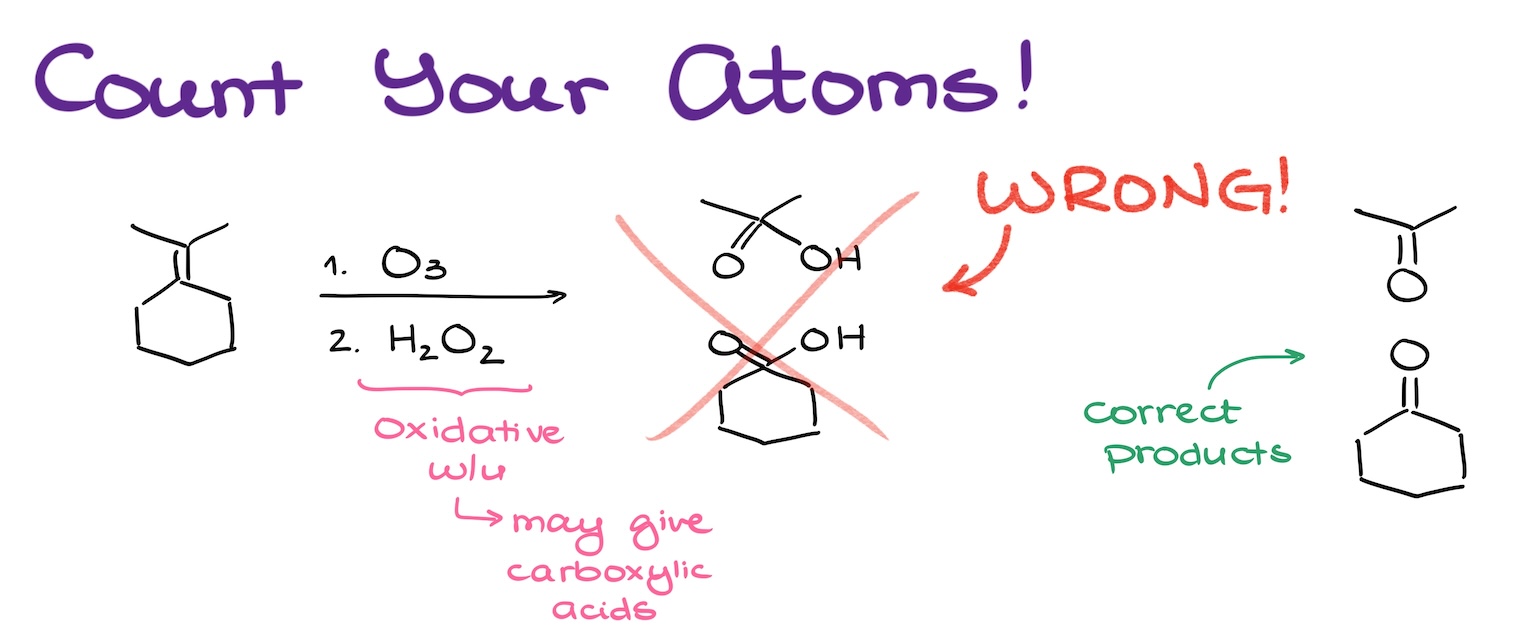
☆ how do you predict ozonolysis products from an alkene?
☐ locate the C=C bond
☐ break the bond between the two alkene carbons
☐ give each alkene carbon a double bond to oxygen
☐ an alkene carbon bearing H may become an aldehyde under reductive workup
☐ an alkene carbon bearing two carbon groups becomes a ketone
☐ cyclic alkenes open into acyclic dicarbonyl products
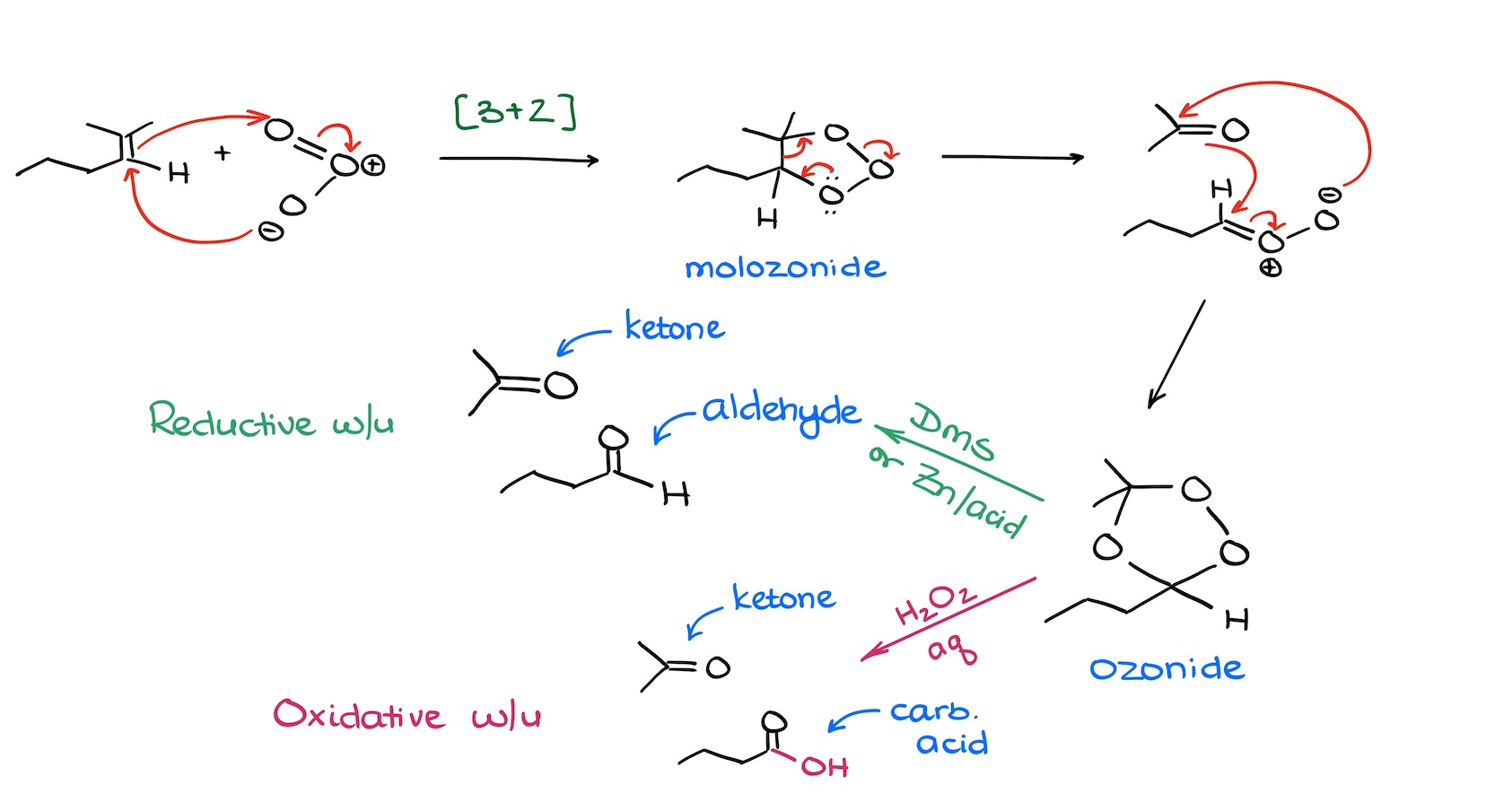
☆ what is the difference between reductive and oxidative ozonolysis workup?
☐ both begin by cleaving the alkene with ozone
☐ the difference appears in the workup step
☐ reductive workup preserves aldehydes
☐ oxidative workup converts aldehydes into carboxylic acids
☐ ketones remain ketones under either workup
☐ identifying whether an alkene carbon originally had H is crucial
☆ how do you work backward from ozonolysis products to an alkene?
☐ identify the carbonyl carbons in the products
☐ remove the oxygens conceptually
☐ connect the carbonyl carbons with a double bond
☐ if both carbonyls are in one product, the original alkene may have been cyclic
☐ if two separate molecules form, the original alkene may have been acyclic
☐ carbon counting helps confirm the reconstruction
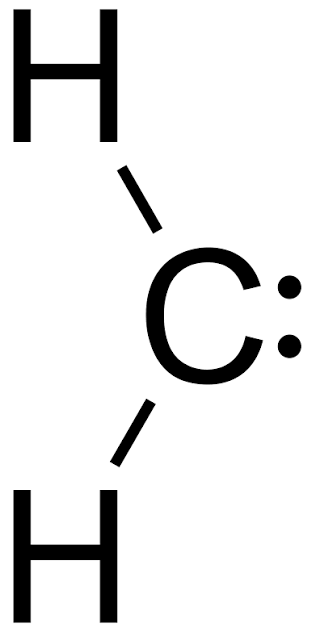
☆ what is a carbene?
☐ a carbene is a neutral carbon species with six valence electrons
☐ the carbene carbon has only two σ bonds
☐ it is electron-deficient and highly reactive
☐ carbenes can add to alkenes
☐ this addition forms cyclopropanes
☐ methylene, :CH₂, is the simplest carbene example
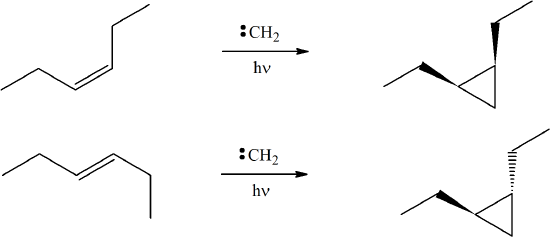
☆ how does carbene addition to an alkene affect stereochemistry?
☐ carbene addition forms a cyclopropane
☐ both new C–C bonds form in one event
☐ the reaction is stereospecific
☐ a cis alkene gives a cis-substituted cyclopropane
☐ a trans alkene gives a trans-substituted cyclopropane
☐ the original alkene geometry is retained
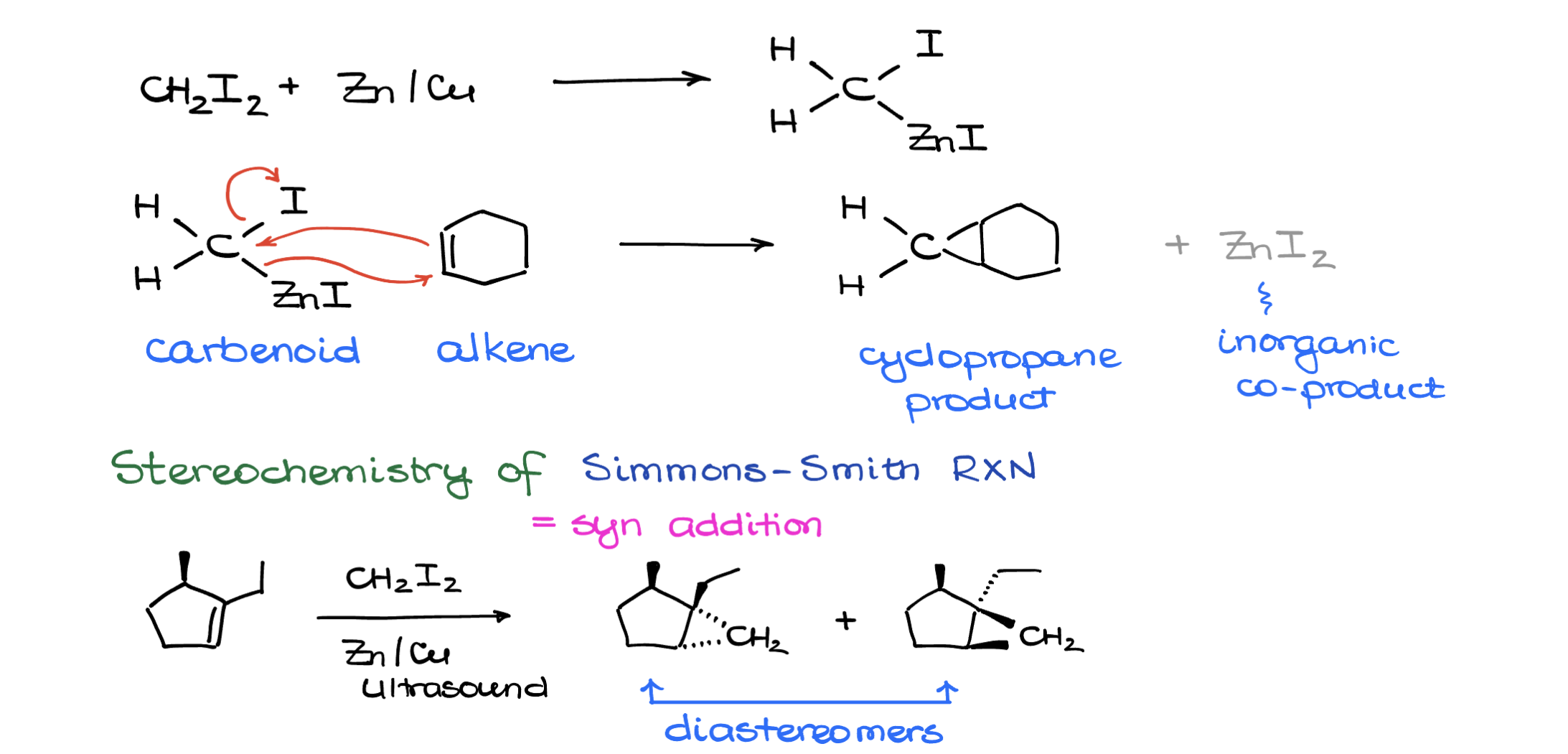
☆ what does a Simmons–Smith reaction do?
☐ the Simmons–Smith reaction converts an alkene into a cyclopropane
☐ it delivers a CH₂ unit across the double bond
☐ the reaction is stereospecific
☐ alkene geometry is retained
☐ a cis alkene gives a cis cyclopropane
☐ a trans alkene gives a trans cyclopropane
☆ how do common alkene reactions compare by regiochemistry and stereochemistry?
☐ HX addition usually gives a Markovnikov product through a carbocation
☐ acid hydration gives a Markovnikov alcohol and can rearrange
☐ oxymercuration gives a Markovnikov alcohol without rearrangement
☐ hydroboration gives an anti-Markovnikov alcohol by syn addition
☐ X₂ gives an anti vicinal dihalide
☐ X₂/H₂O gives an anti halohydrin with OH on the more substituted carbon
☐ epoxidation retains the alkene’s relative stereochemistry
☐ catalytic hydrogenation gives syn addition of H₂