CHAPTER 1: HUMAN ORGANISMS
 Call Kai
 Learn
Learn Practice Test
 Spaced Repetition
 Match
Match Flashcards
 Knowt Play
1/93

There's no tags or description
Looks like no tags are added yet.
Name | Mastery | Learn | Test | Matching | Spaced | Call with Kai | Chat |
|---|
No analytics yet
Send a link to your students to track their progress
94 Terms
Anatomy
Scientific discipline that investigates the body’s structures
Anatomy
Dissect or cut
Anatomy
Examines the relationship between the structure of a body parts and its function
Developmental Anatomy
Structural changes that occur between conception and adulthood
Embryology
Consider changes from conception to the end of eighth week of development
Cytology
Examines the structural features of cells
Histology
Examines tissues
Gross Anatomy
Study of structures that can be examined without the aid of microscope
System
A group of structures that have one or more common functions
Systematic Anatomy
Body is studied system by system
Regional Anatomy
Body is studied area by area
Surface anatomy
Looking at the exterior of the body to visualize structures deeper inside the body
Anatomical Imaging
Uses technologies to create a pictures of internal structures
Anatomical Imaging
Allows medical personnel to look inside the body with amazing accuracy
Wilhelm Roentgen (1845-1923)
Became the first medical scientist to use x-rays to see inside the body
Anatomical Anomalies
Physical characteristics that differ from the normal pattern
Blue Baby syndrome
Certain blood vessels arising from an infants heart are not attached in their correct locations
physiology
Scientific investigation of the processes or functions of living things
Cell physiology
Examines the processes occurring in cells
Cardiovascular physiology
Focuses on the heart and blood vessels
Neurophysiology
Focuses on the function of the nervous system
Pathology
Medical science dealing with all aspects of disease
Exercise physiology
Focuses on the changes in function and structure cause by exercise
Chemical Level, Cell level, tissue level, organ level, organ system level, organism level
Level of organization for the human body
Chemical Level
Involves how atoms, such as hydrogen and carbon, interact and combine into molecules
Cell
The basic structural and functional unit of all living organisms
Organelles
Carry out particular functions such as digestion and movement
Tissue
Composed of a group of similar cells and the materials surrounding them
Epithelial, connective, muscle, nervous
The body is made up of four basic tissue types
Organ
Composed of two or more tissue types that perform one or more common functions
Organ system
A group of organs that together perform a common function or set of functions and are therefore viewed as a unit
Nervous, Cardiovascular, respiratory, digestive, urinary, muscular, skeletal, integumentary, endocrine, lymphatic, reproductive system
11 major system
organism
Any living thing considered as whole whether composed of one cell or trillions of vell
Brain, heart, lungs, liver, stomach, spleen, large intestines, small intestines, pancreas, kidney, gallbladder, urinary bladder, urethra
Major organs in the body
organization, metabolism, responsiveness, growth, development, reproduction
Characteristics of life
Integumentary system
Provides protection, regulates temperature, prevents water loss and help produces vitamin D. Consists of skin, hair, nails and sweat glands
Skeletal system
Provides protection and support, allows body movement, produces blood cells and stores minerals and adipose. Consists of bones, cartilages, ligaments and joints
Muscular system
Produces body movements, maintains posture, and produces body heat.
Nervous system
A major regulatory system that detects sensations and controls movements, physiological processes, and intellectual functions.
Endocrine system
A major regular system that influences metabolism, growth, reproduction and many other functions
Cardiovascular system
Transports nutrients, waste products, gases, and hormones throughout the body; plays a role in the immune response and the regulation of the body temperature
Lymphatic System
Removes foreign substances from the blood and lymph, combats disease, maintains tissue fluid balance and absorbs dietary fats from the digestive tract.
Respiratory system
Exchange oxygen and carbon dioxide between the blood and air and regulates blood pH.
Digestive System
Performs the mechanical and chemical processes of digestion, absorption of nutrients, and elimination of wastes.
Urinary System
Removes waste products from the blood and regulates blood pH, ion balance, and water balance
Female Reproductive System
Produces oocytes and is the site of fertilization and fetal development; produces milk for the newborn; produces hormones that influence sexual function and behaviors.
Male Reproductive System
Produces and transfers sperm cells to the female and produces hormones that influence sexual functions and behaviors.
organization
refers to the specific interrelationships among the parts of an organism and how those parts interact to perform specific functions.
metabolism
is the ability to use energy and to perform vital functions.
responsiveness
is an organism’s ability to sense changes in its external or internal environment and adjust to those changes.
growth
refers to an increase in the size or number of cells, which produces an overall enlargement of all or part of an organism
development
includes the changes an organism undergoes through time, beginning with fertilization and ending at death.
differentiation
involves changes in a cell’s structure and function from an immature, generalized state to a CHAPTER 1 The Human Organism 9 mature, specialized state.
Morphogenesis
is the change in shape of tissues, organs, and the entire organism.
reproduction
is the formation of new cells or new organisms.
Homeostasis
Keeping the inside of your body stable and balanced even when things outside are changing.
homeostasis
the body's ability to maintain a relatively stable internal environment despite changes inside or outside the body, allowing cells to function normally.
healthy balance, organs work together, maintains a stable environment, everything stays just right
H.O.M.E
temperature, blood sugar, ph, water balance and oxygen levels
Homeostasis keeps conditions such as ——, ——, ——, ——, and —— within a normal range so that cells can function properly.
negative feedback
is a control mechanism in which a change in the body is reversed or reduced.
receptor, control center, effector
The 3 Parts of a Negative-Feedback System
negative feedback
a homeostatic mechanism in which a change in a variable triggers responses that oppose the original change and return the variable toward its normal range or set point.
positive feedback
a control mechanism in which the body's response increases or amplifies the original stimulus, making the change even greater until a specific event is completed.
Anatomical position
refers to a person standing erect with the face directed forward, the upper limbs hanging to the sides, and the palms of the hands facing forward
Supine
person is — when lying face upward
Prone
person is —— when lying face downward
Directional terms
describe parts of the body relative to each other.
Right and left
Used as directional terms in anatomical positions
Superior
Means above
Inferior
Means below
Anterior
In front of
Posterior
Behind
Cephalic
Closer to the head than another structure (usually
synonymous with superior)
Proximal
Closer to the point of attachment to the body than
another structure
Caudal
Closer to the tail than another structure
Ventral
Toward the belly (synonymous with anterior)
Distal
Farther from the point of attachment to the body than
another structure
Dorsal
Toward the back (synonymous with posterior )
Lateral
Away from the midline of the body
Medial
Toward the midline of the body
Superficial
Toward or on the surface
Deep
Away from the surface, internal
Frontal (Forehead), nasal (nose), oral (mouth), buccal (cheek), mental (chin), orbital (eye), otic (ear)
Head

Cervical (neck), clavicle (collarbone)
Neck

Pectoral (chest), sternal (breastbone), mammary (breast)
Thoracic

Abdominal (abdomen), umbilical (navel)
Abdomen

Pelvic (pelvis), inguinal (groin), pubic (genital)
pelvis

Thorax, pelvis, abdomen
Three parts of trunk
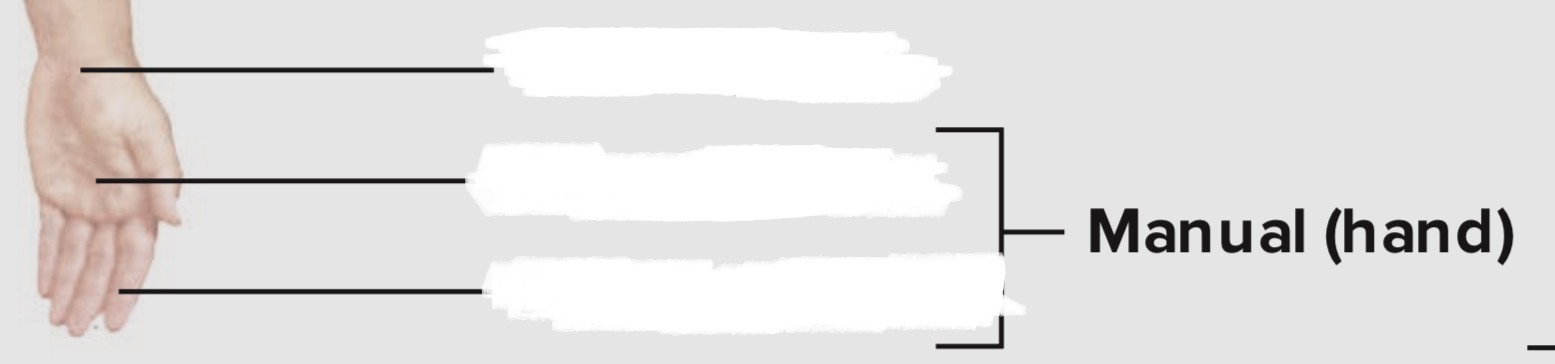
Clavicular (collarbone), axillary (armpit), branchial (arm), ante cubital (front of the elbow), ante brachial (forearm), manual (hand)
Upper limb

Carpal (wrist), palmar (palm), digital (fingers)
Hand
Coral (hip), patellar (kneecap), femoral (thigh), crural (leg), pedal (foot)
Lower limb
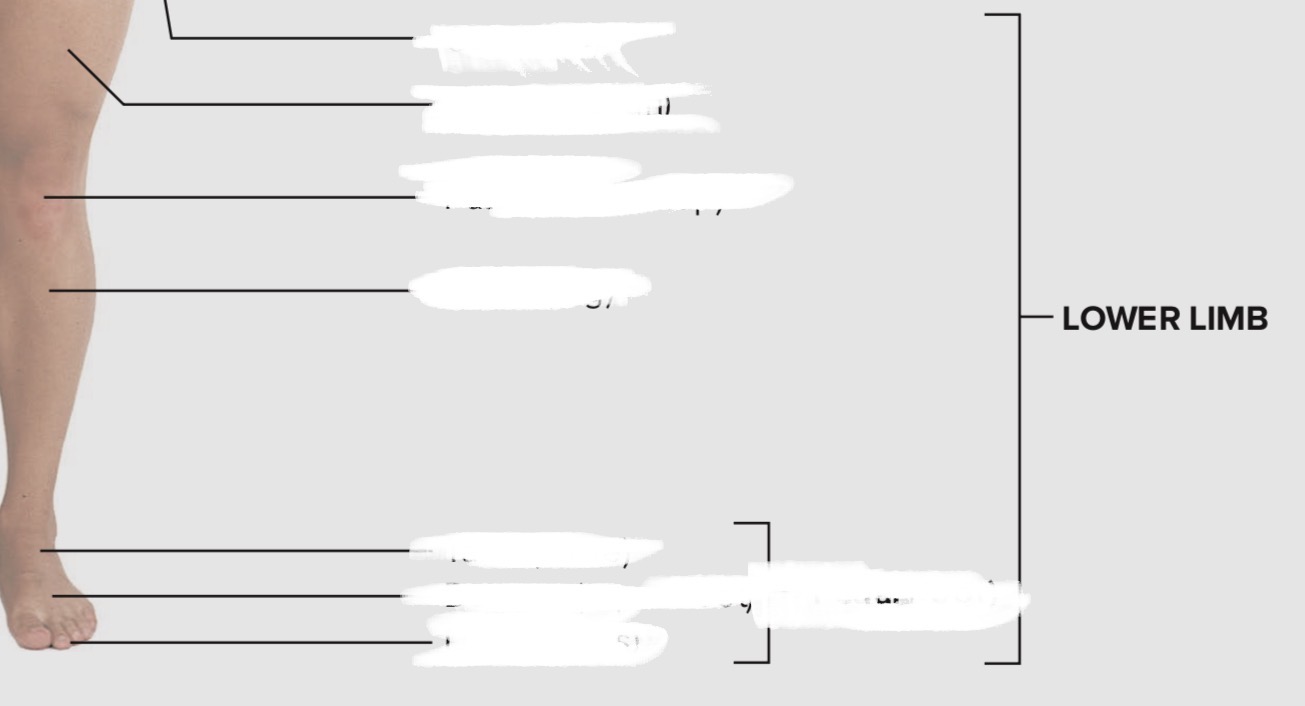
Talus (ankle), dorsum (top of foot), digital (toes)
Foot
