Unit 2 Flashcards
 AP Practice
 Call Kai
1/39

Earn XP
Description and Tags
Name | Mastery | Learn | Test | Matching | Spaced | Call with Kai | Chat |
|---|
No analytics yet
Send a link to your students to track their progress
40 Terms
Ribosomes structure
No membrane, made of rRNA
Ribosomes function
Protein synthesis (translation = ribosomes assemble AAs into polypeptide chains in a specific order determined by the RNA)
Ribosomes found where in the cell?
Found in the cytoplasm and stuck on the RER for eukaryotes
ER Structure
Membrane channels, has ribosomes stuck to it (for RER, but not for SER)
ER function
Protein Synthesis
SER Function
Synthesizes lipids + detoxifies parts of the cell
Golgi Complex (Golgi Body) Structure
Stack of flattened membrane stacks (cisternae). Interior = lumen, contains enzymes needed for Golgi Complex to function
Golgi Complex Function
Controls packaging/modification of proteins that are being transported (proteins made of free ribosomes come from the RER to the Golgi where they are modified into vesicles)
Where is the Golgi Body located in the cell
near the RER
Lysosomes Structure
Membrane-bound sacs that have hydrolytic enzymes
Lysosomes Function
digest macromolecules, break down old cell parts, apoptosis, destroy bacteria (viruses)
Vacuole Structure
Membrane, lipid layer, hydrolytic enzyme mixture
Vacuole Function
Food/water storage, wast storage, water regulation - make up majority of a plant cell’s volume
Mitochondria function
Produces energy for the cell by creating proton gradients (because of high SA) that are needed for ATP production
Mitochondria structure
Double membrane, one with folds to increase SA, matrix (enzyme), contain their own ribosomes + mtRNA (mitochondrial DNA)
Chloroplasts Structure
Double-membrane, smooth outer membrane, sacs called thylakoids in stacks (grana). Contain their own DNA called cpDNA + also have their own ribosomes
Chloroplasts prokaryotes or eukaryotes
Found in plant cells and algae.
Chloroplasts Function
Photosynthesis! Light dependent reaction: thylakoid membranes. Light-independent reactions: enzymes in stroma
Centrosome plant or animal
Animal cells
Centrosome function
stores extra glucose produced during photosynthesis
Peroxisome function
helps oxidize molecules + breaks down toxins
Nucleolus
Region in the nucleus where ribosomes are assembledCy
Cytoskeleton fibers function
help give cells their shape + more items around the cell
Endomembrane system definition + function
Makes up nuclear envelope, ER, Golgi, lysosomes, vacuoles, transport vesicles, and cell membrane. Function = transport/package polysaccharides
Endosymbiosis Hypothesis
Membrane-bound organelles (m + c) were once prokaryotes that were absorbed into larger prokaryotes which became independent. Evidence: M + C have their own DNA and ribosomes, which are similar to prokaryotes’. They also reproduce using binary fission, which is similar to how bacteria reproduces.
Compartmentalization definition + advantages
membrane-bound organelled can form compartments based on their function. Advantages = greater efficiency in the cell, less risk of cross-reacting
Importance of SA:V ratio
as the radius increases, SA:V ratio DECREASES. This limits the cell’s ability to grow + efficiently work w/ other parts of the cell. The ratio can increase by folding membranes
Plasma membrane structure + DETAILS!PAAS
Selectively permeable (some materials can cross the membrane), made of phospholipid bilayer (hydrophilic head - polar - and hydrophobic tail - nonpolar -). Small hydophoblic molecules (O2, H2, H2) can cross, but large polar molecules and ions cannot cross. Modified proteins, steroids and lipids are embedded in the bilayer then can flow throughout the surface. Proteins are for transporting materials, cell signaling, etc. Glycolipids/glycoproteins are for cell recognition. Stroids are to adjust membrane fluidity to help if the cell’s environment is changing.
Passive transport definition
the movement of molecules from high concentration areas to low conc areas. Doesn’t require energy.
Diffusion definition + types
movement of molecules down their concentration gradient (ex: osmosis = diffusion of water). Facilitated diffusion = passive transport using a membrane protein (aquaporins). Channel proteins can transport Ca or Cl, or other ions.
Active transport definition + example + types
the movement of molecules from low conc to high conc; moving molecules AGAINST their gradient —> energy IS REQUIRED. Ex: sodium potassium pump = pumps ions from low conc to high conc outside the cell. Types of active transport: Endocytosis (used by cells to absorb water and macromolecules by being surrounded by a vesicle) and exocytosis (used by cells to fuse vesicles with the plasma membrane, allowing molecules to leave the cell).
Hypotonic solution
lower concentration of solute
Hypertonic solution
higher concentration of solute
Isotonic solution
Same concentration of solute compared to another solution
water potential
potential energy of water in a solution (ability of water to do work). More water in solution = higher water potential. Less water in a solution = lower water potential. Water flows from high water potential areas —> low water potential areas. Can be calculated!

Amount of solute

Pressure
-iCRT
C=0 is the water is distilled. More solute added —> more negative solute potential becomes
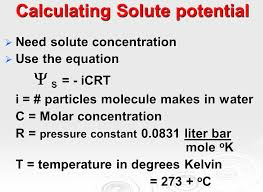
converting between degrees C to degrees K
Kelvin = degrees C + 273. Kelvin degrees cannot be negative!
osmolarity + examples
total concentration of solutes in a solution. Important for organisms to have the right amount of their internal solute concentration because of dehydration or the cells bursting. Example: contractile vacuole: specialized organelle that store extra water which will be pumped out of the cell. Example 2: saltwater fish have lower solute conc. and higher water potential than the marine enviornment. Water flows out of the fish, meaning these fish have to drink a lot of water.