AP Bio Unit 1 Module 2
 Call Kai
 Learn
Learn Practice Test
 Spaced Repetition
 Match
Match Flashcards
 Knowt Play
1/35

There's no tags or description
Looks like no tags are added yet.
Name | Mastery | Learn | Test | Matching | Spaced | Call with Kai | Chat |
|---|
No analytics yet
Send a link to your students to track their progress
36 Terms
What bond is hydrogen and oxygen joined by?
Polar covalent bonds
What does a polar covalent bond do for hydrogen and oxygen?
Holds the atoms together
What are polar covalent bonds characterized by?
Uneven distribution of electrons
Why are the bonds of water polar?
Oxygen is much more electronegative than hydrogen as a result the shared electrons are likely to be near the O atom than H atoms creating regions of slightly negative and positive charges
Polar molecule
A molecule that has regions of positive and negative charge (ex. water)
What does polar nature give to water?
It’s unique properties
Hydrogen bond
An interaction between a hydrogen atom with a slight positive charge and an electronegative atom of another molecule
When does a hydrogen bond form?
Between two water molecules when the partial positive charge of an atom charge is attracted to the partial negative charge of an oxygen atom
What is a hydrogen bond depicted by?
A dotted line
Hydrogen bonds are weaker than what bonds?
Covalent and ionic
What is waters 3 unique properties?
Cohesion, adhesion, surface tension
Cohesion
Water molecules tend to stick together
What unique property of water drives the formation of drops, puddles, streams, rivers, lakes and oceans?
Cohesion
Which of waters unique property contributes to water movement in plants?
Cohesion
Adhesion
The tendency of water to stick to other materials other than water
High surface tension
A measure of difficulty of breaking the surface of a liquid
What is a consequence of cohesion?
High surface tension
One of the highest surface tension of common liquids
Water
What causes surface molecules to stick to other surface molecules more strongly?
Surface molecules do not have other molecules surrounding them on both sides
Hydrogen accounts for what different structures of water?
Solid, gas, liquid
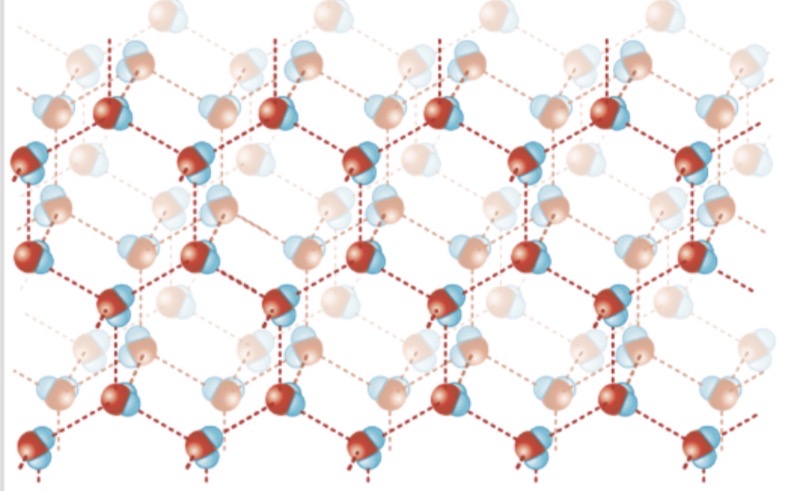
What structure of water is this?
Ice
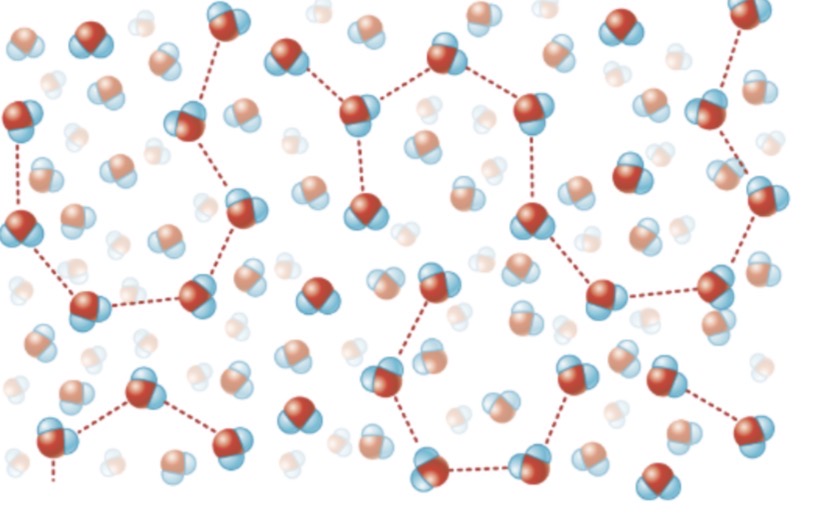
What structure of water is this?
Liquid
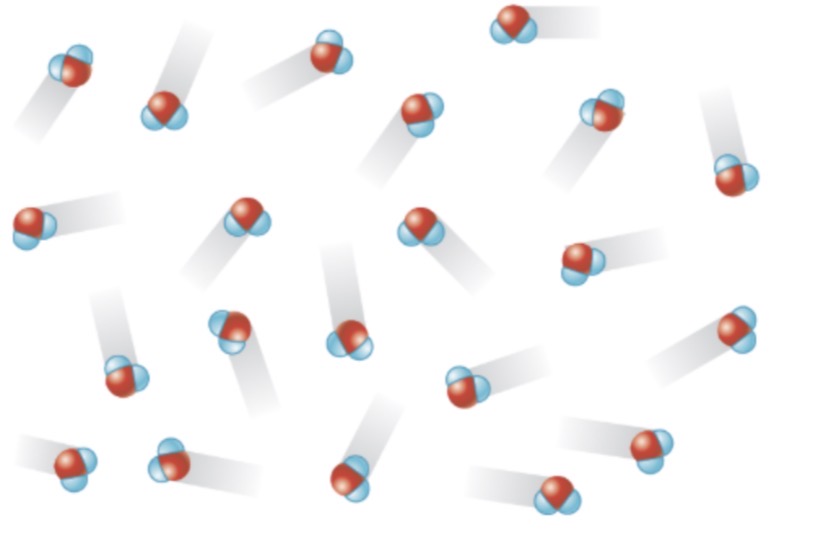
What structure of water is this?
Gaseous
In ice water structure what happens to the water molecules?
Each water molecule is hydrogen bonded to four other water molecules
In liquid water structure what happens to the water molecules?
Water molecules move around so hydrogen bonds continuously form and break apart and water molecules are closer together than ice making liquid water more dense than ice
In Gas water structure what happens to the water molecules?
Water molecules move around even more rapidly keeping the water molecules further apart and preventing most hydrogen bonds from forming
What causes water’s great stability?
The large number of hydrogen bonds
What is a consequence of water’s great stability
Changing water from liquid to a gas requires more energy input than other substances
Molecules are in constant motion, what happens when this motion increases
The temperature increases
What happens when water is heated?
Added energy is used to break apart hydrogen bond, that energy cannot be used to cause motion in the molecules so that temperature increases less than it would if hydrogen bonds were not present