Module 2.2: Species Interactions, Ecological Succession, and Population Control
 Call Kai
 Learn
Learn Practice Test
 Spaced Repetition
 Match
Match Flashcards
 Knowt Play
1/18

Earn XP
Description and Tags
Prelim topic
Name | Mastery | Learn | Test | Matching | Spaced | Call with Kai | Chat |
|---|
No analytics yet
Send a link to your students to track their progress
19 Terms
Interspecific Competition
(Species Interaction)
The most common type of interaction:
When 2 species compete for the same resource, their niches overlap
Resource Partitioning
Occurs when competing species evolve specialized traits that allow them to use shared resources at different times, in different ways, or in different places
Predation
(Species Interaction)
When an individual of one species feeds directly on another plant or animal species
The two species are engaged in a predator-prey relationship
This has a strong effect on population size and other factors
Coevolution
Happens when populations of 2 different species interact over a long period of time, changes in the gene pool of one species can lead to changes in the gene pool of the other
Parasitism
(Species Interaction)
This occurs when one species feeds on the body of, or the energy used by another organism (host) - usually by living on or in the host
They are usually much smaller than its host and rarely kills it
Tapeworms live inside the host, mistletoes and sea lampreys attached themselves outside of the host
Mutualism
(Species Interaction)
This occurs when 2 species behave in ways that benefits both
Providing each with food, shelter, protection, or some other resources
Ex: Birds ride on the backs of large animals and remove pests (African Buffalo), Bacteria that live in our intestines and help us digest food
Commensalism
(Species Interaction)
This occurs when one species benefits from species interaction, and the other is not affected or harmed at all
Ex: Air plants known as epiphytes attach themselves to the trunks or branches of large trees to access sunlight
Ecological Succession
The normal, gradual change in species composition in a given geographic area
The species composition of an ecosystem or community can change in response to changing environmental conditions
Primary and Secondary succession
Primary Succession
(Ecological Succession)
The gradual establishment of biotic communities in lifeless areas where there is no soil in a terrestrial ecosystem or no bottom sediment in an aquatic system
Takes hundreds to thousands of years
Secondary Succession
(Ecological Succession)
Occurs when communities or ecosystems have been disturbed, removed or destroyed, but retain some soil or bottom sediments
Enriches biodiversity of communities and ecosystems by increasing species diversity and interaction among species
Promotes population control: increase complexity of food webs, enhances energy flow, increases nutrient cycling
Tolerance
A population and its ability to survive under various physical and chemical environmental conditions
Some individuals in a population may also have different ranges of tolerance for temperature or other physical or chemical factors - known as limiting factors
Density
The number of individuals in a given geographic area
J-Curves
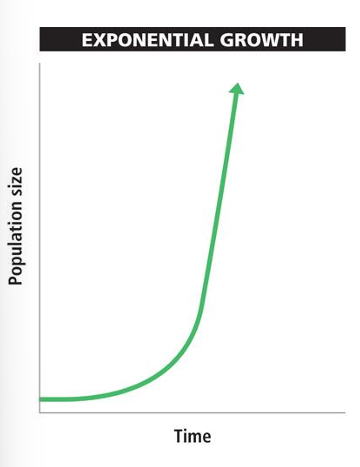
Some species reproduce and grow rapidly: plotting this data generates this curve showing exponential growth.
- Members reproduce at an early age; many offspring in each generation; time between generations is short
Environmental Resistance
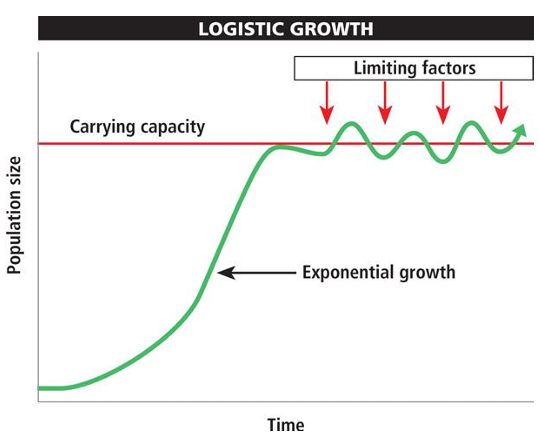
The sum of all factors that limit the growth of a population
Carrying Capacity
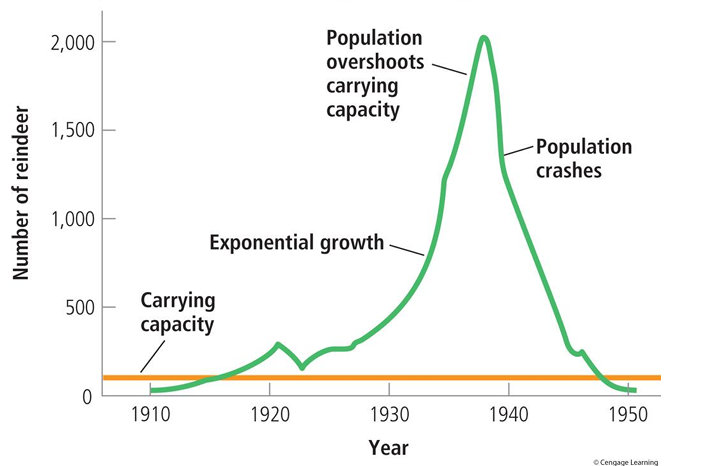
The maximum population of a given species that a habitat can sustain indefinitely
As the population approaches its carrying capacity, its J-curve becomes an S-curve of fluctuating logistic growth
Population Crash
When a population overshoots the carrying capacity, the population sharply declines
Now a population must either: stabilize its population, switch to new resources, or move to a new geographic area
r-selected species
(Species Reproductive Patterns)
These species have a capacity for high rate of population increase
They have short life spans
Have many, usually small offspring
Do not provide much parental care/protection
- Offspring loss is overcome by massive offspring production, so that at least a few will survive
Oppurtunists
(Species Reproductive Patterns)
These species reproduce rapidly under favorable environmental conditions
Often occurs after a fire or clearing an area that opens up new habitats or niches for invasion of a new species
May crash after growth or when yet another species invades the area
Go through irregular and unstable boom-and-bust cycles
k-selected species
(Species Reproductive Patterns)
These species do well in competitive conditions when population size nears carrying capacity
The reproduce later in life
Have smaller numbers of offspring with longer life spans
Typically develop inside their mothers and are born fairly large
After birth, they mature slowly and are protected by one or both parents