conceptual final
 Call Kai
 Learn
Learn Practice Test
 Spaced Repetition
 Match
Match Flashcards
 Knowt Play
1/44

There's no tags or description
Looks like no tags are added yet.
Name | Mastery | Learn | Test | Matching | Spaced | Call with Kai | Chat |
|---|
No analytics yet
Send a link to your students to track their progress
45 Terms
How many significant figures should be used for the value equal to
(0.02 + 80.00)
--------------
9.00 × 10²
A) 4
B) 3
C) 2
D) 1
Answer: B) 3
Remember:
• Add first.
• Then apply multiplication/division sig fig rules.
Pressure can be measured in units of psi, pounds per square inch.
What is 35 psi in pounds per square centimeter (lb/cm²)?
(1 in = 2.54 cm)
A) 5.4 lb/cm²
B) 14 lb/cm²
C) 89 lb/cm²
D) 230 lb/cm²
Answer: A) 5.4 lb/cm²
Remember:
Square the conversion factor because you're converting area.
Crude oil is composed of several organic compounds, visually distinguishable by phase.
Crude oil is best described as a
A) chemical compound
B) heterogeneous mixture
C) homogeneous mixture
D) pure substance
Answer: B) heterogeneous mixture
Remember:
Different visible layers or phases = heterogeneous.
Which is a chemical separation technique?
A) freezing water
B) evaporation of water
C) distillation: evaporation followed by condensation of water
D) electrolysis: passing an electrical current through water to produce hydrogen and oxygen
Answer: D) electrolysis
Remember:
Electrolysis changes chemical bonds.
Distillation is only a physical separation.
Which statement is true?
A) Sodium is a metal.
B) Copper is a nonmetal.
C) Phosphorus is a metal.
D) Aluminum is a metalloid.
Answer: A) Sodium is a metal.
Remember:
Na = alkali metal.
Cu = metal.
P = nonmetal.
Al = metal.
How many protons (p⁺) and electrons (e⁻) are in the most common ion of magnesium?
A) p⁺ = 14; e⁻ = 12
B) p⁺ = 12; e⁻ = 12
C) p⁺ = 12; e⁻ = 10
D) p⁺ = 10; e⁻ = 10
Answer: C) p⁺ = 12; e⁻ = 10
Remember:
Mg forms Mg²⁺ by losing two electrons.
Protons never change.
Which pair represents isotopes?
A) ⁷⁹X and ⁸¹X
B) ⁴⁰Z and ⁴⁰X
C) ⁴⁰X and ⁴⁰Y
D) ¹²Z²⁺ and ¹²X²⁺
Answer: A) ⁷⁹X and ⁸¹X
Remember:
Same element + different mass numbers = isotopes.
In an ionic compound with formula X₂O, X could represent which element?
A) aluminum
B) calcium
C) fluorine
D) lithium
Answer: D) lithium
Remember:
Oxygen is O²⁻.
Two X atoms means each must be +1.
Li forms Li⁺.
What is the formula of chromium(II) nitrate?
A) Cr₃N₂
B) CrNO₃
C) Cr₂NO₃
D) Cr(NO₃)₂
Answer: D) Cr(NO₃)₂
Remember:
Chromium(II) = Cr²⁺
Nitrate = NO₃⁻
Need two nitrates to balance the +2 charge.
Which compound has the greatest ionic character?
A) BBr₃
B) C₆H₁₂O₆
C) Fe₂S₃
D) XeF₄
Answer: C) Fe₂S₃
Remember:
Metal + nonmetal = ionic.
Iron is a metal.
Sulfur is a nonmetal.
The formula for strontium vanadate is Sr3(VO4)2. What is the formula of iron(III) vanadate?
(A) FeVO4
(B) Fe(VO4)3
(C) Fe3VO4
(D) Fe3(VO4)2
Answer: A) FeVO4
Remember:
Iron(III) = Fe3+
Vanadate = VO4^3−
The charges are equal and opposite, so they combine in a 1:1 ratio:
FeVO4
Uracil has an empirical formula of C2H2NO and a molar mass of 112.09 g·mol−1. What is the molecular formula of uracil?
(A) C6H6N3O3
(B) C4H4N2O2
(C) C2H3NO
(D) C2H2NO
Answer: B) C4H4N2O2
Remember:
Find how many empirical formulas fit into the molar mass.
Empirical formula mass = 56.05 g/mol
112.09 ÷ 56.05 ≈ 2
Multiply every subscript by 2.
Which substance is a non-electrolyte when dissolved in water?
(A) acetic acid (CH3CO2H)
(B) glucose (C6H12O6)
(C) potassium hydroxide (KOH)
(D) sodium chloride (NaCl)
Answer: (B) glucose (C6H12O6)
Remember:
• Non-electrolytes do NOT produce ions in water.
• Glucose dissolves as molecules.
• Acids, bases, and soluble ionic compounds are electrolytes.
What is the classification of this reaction?
Be(s) + 2HNO3(aq) → Be(NO3)2(aq) + H2(g)
(A) combustion
(B) decomposition
(C) single displacement
(D) double displacement
Answer: (C) single displacement
Remember:
A metal replaces hydrogen in an acid.
Metal + Acid → Salt + H2
What is the oxidation number for each atom in ClF3?
(A)
Cl +3
F −1
(B)
Cl +1
F −1
(C)
Cl +1
F −3
(D)
Cl −1
F −1
Answer: (A)
Remember:
Fluorine is ALWAYS −1 in compounds.
3(−1) + Cl = 0
Cl = +3
Which is the correct set of products to complete the total ionic equation?
Pb2+(aq) + 2NO3−(aq) + 2Na+(aq) + 2I−(aq) →
(A) 2NaNO3(s) + Pb2+(aq) + 2I−(aq)
(B) 2Na+(aq) + 2NO3−(aq) + PbI2(s)
(C) 2NaNO3(aq) + PbI2(s)
(D) 2NaNO3(s) + PbI2(s)
Answer: (B)
Remember:
Na+ and NO3− are spectator ions.
Pb2+ + 2I− → PbI2(s) is the precipitate.
In the balanced equation below, which species is being reduced?
Fe2+(aq) + Cl2(g) → Fe3+(aq) + 2Cl−(aq)
(A) Cl−(aq)
(B) Cl2(g)
(C) Fe2+(aq)
(D) Fe3+(aq)
Answer: (B) Cl2(g)
Remember:
Reduction = gain of electrons.
Cl2 goes from 0 to −1, so it is reduced.
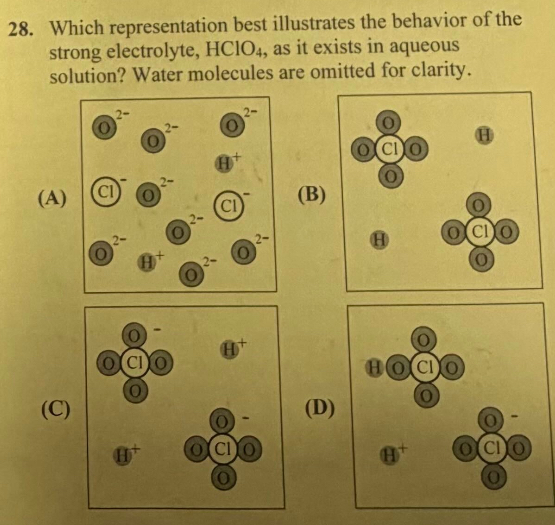
Which representation best illustrates the behavior of the strong electrolyte, HClO4, as it exists in aqueous solution? Water molecules are omitted for clarity.
Answer: (C)
Remember:
Strong electrolytes completely dissociate.
HClO4 → H+ + ClO4−
The correct diagram shows only separated H+ and ClO4− ions, with no intact HClO4 molecules.
When solid calcium reacts with aqueous hydrochloric acid, an ionic compound and a gas are produced. What are the products?
(A) Ca, HCl
(B) CaCl2, H2
(C) CaCl, H+
(D) CaH, Cl2
Answer: B) CaCl2, H2
Remember:
Metal + acid → salt + hydrogen gas.
Ca + 2HCl → CaCl2 + H2
Of the gases shown in the table to the right, which gas is represented by curve III below?
All four gases at 298 K are shown in the figure.
(A) SO3
(B) N2O
(C) C2H4
(D) Br2
Answer: B) N2O
Remember:
At the same temperature:
• Lighter gases move faster (curve farther right).
• Heavier gases move slower (curve farther left).
Order from slowest to fastest:
Br2 → SO3 → N2O → C2H4
If a system does 200 kJ of work and releases 800 kJ of heat, what is the change in internal (total) energy of the system?
(A) +1000 kJ
(B) +600 kJ
(C) −600 kJ
(D) −1000 kJ
Answer: D) −1000 kJ
Remember:
Use ΔE = q + w.
Heat released → q is negative.
Work done by the system → w is negative.
Which phase change results in a release of energy?
(A) H2O(l) → H2O(g)
(B) H2O(g) → H2O(l)
(C) H2O(s) → H2O(g)
(D) H2O(s) → H2O(l)
Answer: B) H2O(g) → H2O(l)
Remember:
Gas → liquid (condensation) releases heat.
Energy-releasing phase changes:
• Condensation
• Freezing
• Deposition
What is the correct order of these types of electromagnetic radiation by increasing wavelength?
(A) X-rays < red light < blue light < radio waves
(B) X-rays < radio waves < blue light < red light
(C) X-rays < blue light < red light < radio waves
(D) radio waves < red light < blue light < X-rays
Answer: (C) X-rays < blue light < red light < radio waves
Remember:
Shortest → Longest wavelength
Gamma < X-ray < UV < Visible (violet → red) < IR < Microwave < Radio
In a hydrogen atom, which transition produces a photon with the highest energy?
(A) n = 6 → n = 2
(B) n = 5 → n = 2
(C) n = 4 → n = 2
(D) n = 3 → n = 2
Answer: (A) n = 6 → n = 2
Remember:
The larger the drop in energy level, the higher the energy of the photon emitted.
What is an acceptable set of quantum numbers for a 3d electron in the ground state atom of titanium?
(A) n = 4, ℓ = 3, mℓ = −3, ms = −½
(B) n = 4, ℓ = 2, mℓ = 0, ms = +½
(C) n = 3, ℓ = 2, mℓ = −2, ms = −½
(D) n = 3, ℓ = 1, mℓ = +1, ms = +½
Answer: (C) n = 3, ℓ = 2, mℓ = −2, ms = −½
Remember:
For a 3d electron:
n = 3
ℓ = 2
mℓ = −2, −1, 0, +1, or +2
ms = ±½
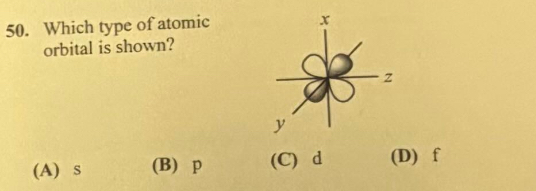
Answer: (C) d
Remember:
Four-leaf clover shape = d orbital.
How many unpaired electrons are in an atom of cobalt (Co) in its ground state?
(A) 7
(B) 3
(C) 1
(D) 0
Answer: (B) 3
Remember:
Co = [Ar] 4s² 3d⁷
A d⁷ configuration has 3 unpaired electrons.
What is the ground state electron configuration for copper?
(A) [Ar] 4s² 3d⁹
(B) [Ar] 4s¹ 3d¹⁰
(C) [Ar] 4s¹ 3d⁹
(D) [Ar] 4s⁰ 3d⁹
Answer: (B) [Ar] 4s¹ 3d¹⁰
Remember:
Copper is an exception.
A full d¹⁰ subshell is more stable than 4s²3d⁹.
Which orbital can an electron with quantum numbers ℓ = 2 and mℓ = 0 occupy?
(A) 2d
(B) 2p
(C) 2s
(D) 3d
Answer: (D) 3d
Remember:
ℓ = 2 means a d orbital.
The first energy level that has d orbitals is n = 3.
A valence electron of which element experiences the smallest effective nuclear charge?
(A) Na
(B) K
(C) Cl
(D) Br
Answer: (B) K
Remember:
Moving down a group increases shielding.
Potassium's valence electron is farthest from the nucleus, so it feels the smallest effective nuclear charge.
Which electron configuration would have the largest first ionization energy?
(A) [Ar] 4s¹
(B) [Ne] 3s²
(C) [Ne] 3s² 3p¹
(D) [Ne] 3s² 3p⁴
Answer: (D) [Ne] 3s² 3p⁴
Remember:
Ionization energy increases left → right across a period and decreases down a group.
Sulfur (3p⁴) has the highest first ionization energy of these choices.
Which ion has the largest radius?
(A) S²⁻
(B) Cl⁻
(C) K⁺
(D) Ca²⁺
Answer: (A) S²⁻
Remember:
These ions are isoelectronic (18 electrons).
For isoelectronic ions, the one with the fewest protons has the largest radius.
Which ionic compound has the lattice energy with the largest magnitude?
(A) Na₂S
(B) NaCl
(C) CaS
(D) CaCl₂
Answer: (C) CaS
Remember:
Lattice energy increases with:
• Larger ionic charges
• Smaller ionic sizes
Ca²⁺ and S²⁻ have the largest charge product (4), giving the greatest lattice energy.
What is the formal charge on sulfur in this structure?
(A) −2
(B) 0
(C) +2
(D) +6
Answer: (B) 0
Remember:
Formal Charge = Valence e− − (Lone pair e− + ½ Bonding e−)
A correctly drawn sulfate resonance structure gives sulfur a formal charge of 0.
What is the ideal C—O—H bond angle?
(A) 90°
(B) 109°
(C) 120°
(D) 180°
Answer: (C) 120°
Remember:
The oxygen shown is attached to a carbonyl carbon (carboxylic acid). The carbonyl carbon is sp² hybridized, giving an approximately 120° bond angle around that center.
What is the electron group geometry of ClF3?
(A) octahedral
(B) tetrahedral
(C) trigonal pyramidal
(D) trigonal bipyramidal
Answer: (D) trigonal bipyramidal
Remember:
ClF₃ has 5 electron groups:
• 3 bonding pairs
• 2 lone pairs
Five electron groups = trigonal bipyramidal electron geometry.
Which bond is the least polar?
(A) C—O
(B) P—O
(C) O—F
(D) P—F
Answer: (C) O—F
Remember:
The smallest electronegativity difference gives the least polar bond.
O and F have very similar electronegativities.
Which molecule is polar?
(A) XeF4
(B) SF4
(C) PF5
(D) BF3
Answer: (B) SF4
Remember:
SF₄ has a seesaw shape, so the bond dipoles do not cancel.
XeF₄, PF₅, and BF₃ are symmetrical overall.
What are the molecular geometry and the hybridization of the carbon atom?
(A) seesaw, sp3
(B) square planar, sp3
(C) tetrahedral, sp2
(D) tetrahedral, sp3
Answer: (D) tetrahedral, sp3
Remember:
Four single bonds around carbon
=
4 electron groups
=
sp³ hybridization
=
tetrahedral geometry.
The H—H bond energy is 436 kJ·mol−1. The formation of a single bond between hydrogen atoms results in the ____ per mole of H2 formed.
(A) absorption of 436 kJ
(B) absorption of 872 kJ
(C) release of 436 kJ
(D) release of 872 kJ
Answer: (C) release of 436 kJ
Remember:
Breaking bonds absorbs energy.
Forming bonds releases the same amount of energy.
Using molecular orbital theory, what is the bond order of N2+?
(A) 1
(B) 1.5
(C) 2.5
(D) 3
Answer: (C) 2.5
Remember:
N₂ has a bond order of 3.
Removing one bonding electron (N₂⁺) lowers the bond order by 0.5.
3 − 0.5 = 2.5
Which compound can form the most hydrogen bonds as a pure substance?
(A) [1-propanol structure]
(B) [ether structure]
(C) [diether structure]
(D) [1,4-butanediol structure]
Answer: (D)
Remember:
Hydrogen bonding requires:
• H bonded to O, N, or F (donor)
• Lone pairs on O, N, or F (acceptor)
Choice (D) has two –OH groups, so each molecule can form the most hydrogen bonds.
Which compound has the highest boiling point?
(A) HF
(B) LiF
(C) CH3CH2OH
(D) CH3CH2CH2CH3
Answer: (B) LiF
Remember:
Stronger intermolecular forces = higher boiling point.
Order of strength:
Ion–ion > Hydrogen bonding > Dipole–dipole > London dispersion
LiF is ionic, so it has the highest boiling point.
Which error could lead to an experiment's percent yield being greater than 100%?
(A) The mass of each reactant was lower than the value used in the calculations.
(B) Some product was lost during filtration.
(C) The reaction did not go to completion.
(D) The product was not completely dry.
Answer: (D) The product was not completely dry.
Remember:
If the product is still wet, the water adds extra mass.
Extra mass = measured yield is too high = percent yield can exceed 100%.
End
End