amt 123
 Studied by 0 people
 Call Kai
 Learn
Learn Practice Test
 Spaced Repetition
 Match
Match Flashcards
 Knowt Play
1/26

There's no tags or description
Looks like no tags are added yet.
Name | Mastery | Learn | Test | Matching | Spaced |
|---|
No study sessions yet.
27 Terms
rotating device with a central hub and angled blades that create thrust to move a vehicle through a fluid.
propeller
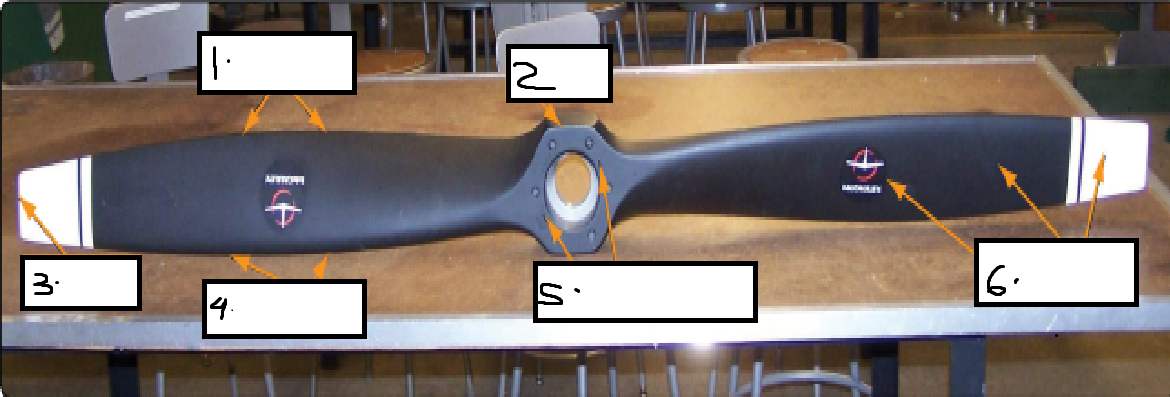
trailing edge
hub
blade tip
leading edge
propeller information
back of blade
is its outermost point, farthest from the hub, and is critical for efficiency, as
blade tip
the curved or cambered surface designed to create an area of lower pressure as the propeller rotates.
back blade
where the airflow from the upper and lower surfaces meets and exits the blade.
trailing edge
It’s primary functions and capabilities revolve around ensuring efficient thrust generation, minimizing drag, and reducing noise and vibration.
trailing edge
the initial point of contact with the oncoming airflow, initiating the flow separation that generates aerodynamic lift (thrust) and managing the boundary layer to minimize drag.
leading edge
to connect the propeller blades to the engine shaft, transferring rotational power, but it also serves to absorb shock and protect the engine from damage.
hub
on the propeller itself serves crucial purposes for identification, maintenance, and performance optimization, allowing mechanics and pilots to verify correct propeller matching to an engine, check for damage or imbalance (tracking), ensure proper operation, and meet certification requirements, all vital for safety and efficiency.
propeller information
THE FORCE TENDING TO PULL THE BLADES OUT OF THE HUB
centrifugal force
THE AMOUNT OF STRESS CREATED BY CENTRIFUGAL FORCE CAN BE MORE THAN _____ TIMES THE WEIGHT OF THE PROPELLER BLADE.
7,500
TENDS TO BEND THE PROPELLER BLADES FORWARD AT THE TIPS.
THRUST BENDING FORCE
OCCUR AS AIR RESISTANCE OPPOSES THE ROTATIONAL MOTION OF THE PROPELLER BLADES
TORQUE BENDING FORCE
THIS FORCE TENDS TO BEND THE BLADES OPPOSITE THE DIRECTION OF ROTATION.
TORQUE BENDING FORCE
TENDS TO INCREASE A PROPELLR’S BLADE ANGLE. WHEN A PROPELLER BLADE PRODUCES THRUST, THE MAJORITY OF THE THRUST IS EXERTED AHEAD OF BLADE’S AXIS OF ROTATION.
AERODYNAMIC TWISTING FORCE
IS USED TO HELP CHANGE THE BLADE ANGLE OF PROPELLER.
AERODYNAMIC TWISTING FORCE
WHEN A PROPELLER ROTATES, CENTRIFUGAL FORCE TENDS TO ALIGN THE PROPELLER'S CENTER OF MASS WITH ITS CENTER OF ROTATION.
CENTRIFUGAL TWISTING FORCE
OCCURS DUE TO THE AERODYNAMIC AND MECHANICAL FORCES.
BLADE VIBRATION
forces acting on propeller (6);
centrifugal force
thrust bending force
torque bending force
aerodynamic twisting force
centrifugal twisting force
blade vibration
blade angle permanently set by the manufacturer and cannot be adjusted in flight.
fixed pitch propeller
allows its blade angle to be changed only while the aircraft is on the ground.
ground-adjustable propeller
lets the pilot manually change blade angle in flight.
controllable-pitch propeller
uses a governor to automatically adjust blade pitch and maintain a selected engine RPM.
constant-speed propeller
can rotate its blades to a position nearly parallel to the airflow to reduce drag during an engine failure.
feathering propeller
can move its blades into a negative angle to produce reverse thrust.
reverse-pitch propeller
is a special multi-bladed wooden propeller used for ground engine testing and break-in procedures.
test club propeller
types of propeller (7);
fixed pitch propeller
ground adjustable propeller
controllable pitch propeller
constant speed propeller
feathering propeller
reverse pitch propeller
test club propeller