Atomic Theory Part 3 Quantum Mechanical Model
 Call Kai
 Learn
Learn Practice Test
 Spaced Repetition
 Match
Match Flashcards
 Knowt Play
1/10

There's no tags or description
Looks like no tags are added yet.
Name | Mastery | Learn | Test | Matching | Spaced | Call with Kai | Chat |
|---|
No analytics yet
Send a link to your students to track their progress
11 Terms
Louis de Broglie
originated the idea that the electron, previously considered just a particle, has wave properties.
Werner Heisenberg
it is impossible to simultaneously know the exact position and speed of an electron (Heisenberg’s Uncertainty Principle).
Erwin Schrödinger: Electron Behaviour
electrons behaved like light (a particle with wave properties).
electrons do not orbit atoms, but are found in spaces around the atom called orbitals.
The exact location of an electron cannot be determined;
however, there is a high probability of finding an electron
in an orbital.
Orbits are ___ as a Bohr orbit
Not the same
Orbital vs orbit
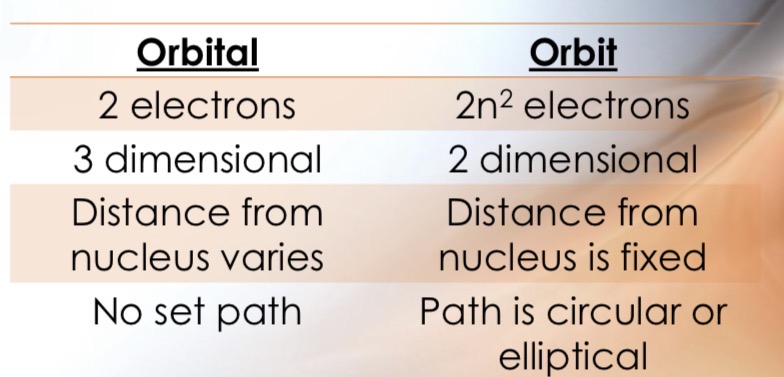
Whats an orbital
the region around the nucleus where an electron
has a high probability of being found.
also known as an electron probability density, which is a 3-dimensional plot. This plot is the solution to a wave function (equation), which is a mathematical description of an orbital.
Orbitals still correspond to
energy levels (Bohr was correct about this); that is electrons can exist in an energy level, but not in between them.
Orbitals and Electrons
each orbital orientation can hold up to 2 electrons
electrons in the same orbital will have opposite spins cw ccw
as you increase the distance from the nucleus (ie: higher
energy levels), there is room for more orbitals
Orbitals and Energy Levels Chart

What do energy level diagrams represent
the position of the electrons in an atom
Simplifies so we can see how the electrons are arranged
Understanding electron arrangement will help you understand how tthe periodic table is arranged and the trends that exist
Energy level diagrams rules
Electrons go in the lowest energy levels first
Each orbital can have a maximum of two electrons (it is possible for an orbital to have one electron, or none).
Electrons in a sublevel will not pair up until all orbitals have one electron each.