Lecture 9: Recent Advances in Memory Research

0.0(0)
Studied by 0 people
call kaiCall Kai
Locked
learnLearn
examPractice Test
spaced repetitionSpaced Repetition
heart puzzleMatch
flashcardsFlashcards
GameKnowt Play
Card Sorting

1/14

encourage image

There's no tags or description

Looks like no tags are added yet.

Last updated 8:09 PM on 8/8/26
Name
Mastery
Learn
Test
Matching
Spaced
Call with Kai
Chat

No analytics yet

Send a link to your students to track their progress

15 Terms

1
New cards

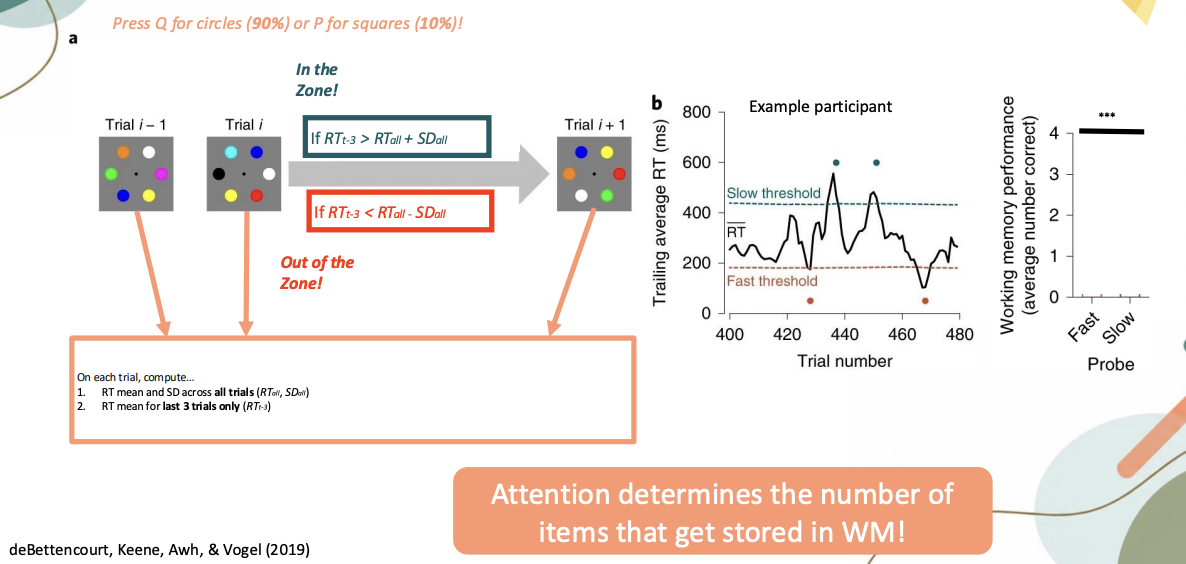
Attention Determines Working Memory- Does Attention Influence WM through selection, precision or both?

  • deBettencourt, Keene, Awh & Vogel (2019)

  • Attention fluctuates, more optimal and suboptimal times, predict attentional state what can get into WM

  • Sustained attention task

  • See 6 circles, sometimes see 6 squares, press button

  • Decide whether circles or squares

  • Majority circles as opposed to squares

    • Nulled in

    • Lapses in attention because all seem to be circles, small percentage are squares

  • Compute 2 different measures

    • Calculating how fast at responding across entire experiment

    • Second measurement what is RT for just last 3 trials

    • In general performance. Last 3 trials, RT capture to some degree what state people are in.

    • If performance on this trial is within general average that means in general performance

    • Interested in attention fluctuating

  • RT captures what state people are in

    • Ability to respond, how attention in last 3 trials versus across entire experiment

    • If performance is within general average: in general performance band

    • Interested in attention fluctuating, average measure of attention

  • Last 3 trials, lower, in the zone

    • Not mindlessly, slowing down making decision, optimal state of attention

    • Out of zone: lower, faster than average, mean nulled into quickly pressing the buttons

    • Define both in the zone and out of the zone states

    • How attentional state determines how well you remember those items

  • Out of zone: just pushing button

  • In zone: Making conscious decisions

  • When probed on WM

  • Fast = out of zone

  • Slow = in the zone

  • Expect WM is better when in the zone, actually paying attention

  • WM better when in zone vs. out of the zone

  • Picking up on individual person in and out, going with rhythm of participant

  • Attention has limits

  • Have rhythmic sampling of environment

  • Our attention drifts, naturally in or out of the zone

  • Attention determines the number of items that gets stored in WM
<ul><li><p>deBettencourt, Keene, Awh &amp; Vogel (2019)</p></li><li><p>Attention fluctuates, more optimal and suboptimal times, predict attentional state what can get into WM </p></li><li><p>Sustained attention task</p></li><li><p>See 6 circles, sometimes see 6 squares, press button</p></li><li><p>Decide whether circles or squares</p></li><li><p>Majority circles as opposed to squares</p><ul><li><p>Nulled in </p></li><li><p>Lapses in attention because all seem to be circles, small percentage are squares</p></li></ul></li></ul><p></p><ul><li><p>Compute 2 different measures</p><ul><li><p>Calculating how fast at responding across entire experiment</p></li><li><p>Second measurement what is RT for just last 3 trials</p></li><li><p>In general performance. Last 3 trials, RT capture to some degree what state people are in. </p></li><li><p>If performance on this trial is within general average that means in general performance</p></li><li><p>Interested in attention fluctuating </p></li></ul></li></ul><p></p><ul><li><p>RT captures what state people are in</p><ul><li><p>Ability to respond, how attention in last 3 trials versus across entire experiment</p></li><li><p>If performance is within general average: in general performance band</p></li><li><p>Interested in attention fluctuating, average measure of attention</p></li></ul></li></ul><p></p><ul><li><p>Last 3 trials, lower, in the zone</p><ul><li><p>Not mindlessly, slowing down making decision, optimal state of attention</p></li><li><p>Out of zone: lower, faster than average, mean nulled into quickly pressing the buttons</p></li><li><p>Define both in the zone and out of the zone states</p></li><li><p>How attentional state determines how well you remember those items</p></li></ul></li></ul><p></p><ul><li><p><strong>Out of zone</strong>: just pushing button</p></li><li><p><strong>In zone: </strong>Making conscious decisions</p></li></ul><p></p><ul><li><p>When probed on WM</p></li><li><p>Fast = out of zone </p></li><li><p>Slow = in the zone</p></li><li><p>Expect WM is better when in the zone, actually paying attention</p></li><li><p>WM better when in zone vs. out of the zone</p></li><li><p>Picking up on individual person in and out, going with rhythm of participant </p></li><li><p>Attention has limits</p></li><li><p>Have rhythmic sampling of environment</p></li><li><p>Our attention drifts, naturally in or out of the zone</p></li><li><p><span style="color: purple;"><strong>Attention determines the number of items that gets stored in WM</strong></span></p></li></ul><p></p>
2
New cards

Does attention influence WM through selection, precision or both?

  • Measure precision

  • Reduce to set size 1, 6 items, sustained attention task, 1 colour, participants use colour wheel to respond

  • How far off colour is than it actually was

  • 1 colour

    • Must be due to precision if do worse

    • Limiting manipulation, any change in memory, response error how far off colour, related to precision

  • Not attention as gateway but testing precision of that memory

  • Quality of representations

  • No difference between in the zone and out of zone for how off they are

  • Attention does not determine precision of items

  • More of a gateway of what gets stored

  • When in zone, store more items & maintain them in WM

  • Does not mean storing them at higher precision or resolution

  • Attention does not determine the precision of items that gets stored in WM

3
New cards

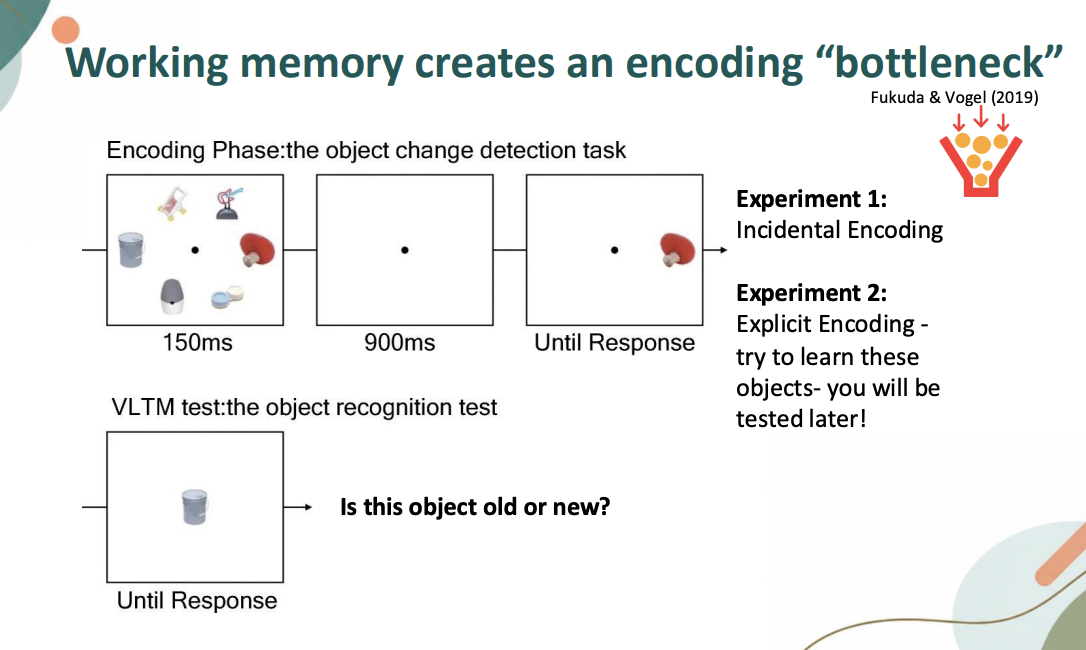
Working Memory Creates an encoding “Bottleneck”

  • Fukuda & Vogel (2019)

  • Capacity limit

  • Showing participants 6 real world objects and did change detection

  • Probed on one of the items & asked “Is it old or new”

  • 2 encoding

    • Incidental: change detection task

    • Intentional: try to remember objects, told tested on it & did change detection task

  • For LTM test had to say whether item was old or new. Item recognition test

  • Change detection, calculating WM with k

  • Split participants into high k and low k

  • High k: high capacity

  • Low k: low capacity

  • People who have higher capacity, wanted to see how increase from 2-4-6 & how different encoding conditions affect STM & LTM

  • Higher capacity how increase from 2-4-6, able to do that

    • Larger number of items able to do that, 4-6 plateaus
<ul><li><p>Fukuda &amp; Vogel (2019)</p></li><li><p>Capacity limit</p></li><li><p>Showing participants 6 real world objects and did change detection</p></li><li><p>Probed on one of the items &amp; asked “Is it old or new” </p></li><li><p>2 encoding</p><ul><li><p>Incidental: change detection task</p></li><li><p>Intentional: try to remember objects, told tested on it &amp; did change detection task</p></li></ul></li></ul><p></p><ul><li><p>For LTM test had to say whether item was old or new. Item recognition test</p></li><li><p>Change detection, calculating WM with k</p></li><li><p>Split participants into high k and low k</p></li></ul><p></p><ul><li><p>High k: high capacity</p></li><li><p>Low k: low capacity</p></li><li><p>People who have higher capacity, wanted to see how increase from 2-4-6 &amp; how different encoding conditions affect STM &amp; LTM</p></li><li><p>Higher capacity how increase from 2-4-6, able to do that</p><ul><li><p>Larger number of items able to do that, 4-6 plateaus</p></li></ul></li></ul><p></p><p></p>
4
New cards

Working Memory Creates an encoding “bottleneck”

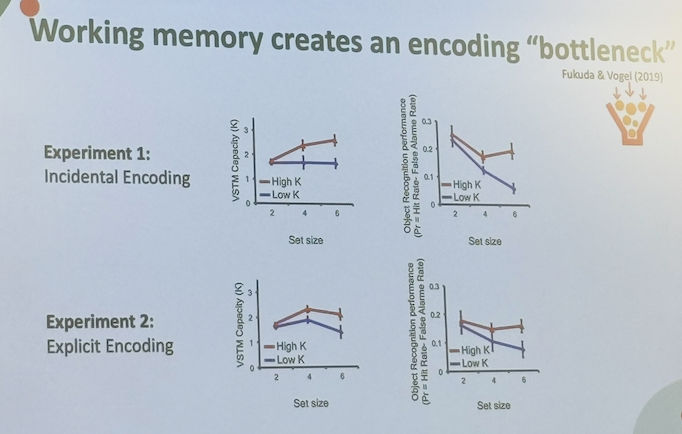
  • Low capacity individuals show lower capacity to store

    • 2 items good

    • At 4 upper limit of capacity already see a difference between people who have higher capacity vs. lower

    • Individual difference measure

  • Trying to see if these encoding limits, bottleneck transfers & shows same pattern of limitation in LTM memory task

  • We see for 2 items, when 2 items presented at encoding for change detection, everyone detected changes of items & remembered seeing those 2 items

    • Both low & high have no difference

    • No bottleneck

    • 2 very doable

  • Critically didn’t matter if it was incidental or explicit, groups high & low capacity diverged as set size increased

  • As set size increased from 2-4 items, low capacity didn’t remember seeing additional items

  • Bottleneck affecting what they can remember & what gets into LTM

  • Original bottleneck at WM, carried through to what people can report in LTM

  • WM limits the “bandwidth” of encoding to LTM, even when we are trying to learn. And the size of the bottleneck is related to individual WM capacity

    • Pattern goes down when increasing set size, LTM goes down

    • Size of bottleneck related to individual WM capacity

    • LTM performance shows separation in performance between people with smaller bucket & larger bucket
<ul><li><p>Low capacity individuals show lower capacity to store</p><ul><li><p>2 items good</p></li><li><p>At 4 upper limit of capacity already see a difference between people who have higher capacity vs. lower </p></li><li><p>Individual difference measure </p></li></ul></li></ul><p></p><ul><li><p>Trying to see if these encoding limits, bottleneck transfers &amp; shows same pattern of limitation in LTM memory task</p></li><li><p>We see for 2 items, when 2 items presented at encoding for change detection, everyone detected changes of items &amp; remembered seeing those 2 items</p><ul><li><p>Both low &amp; high have no difference</p></li><li><p>No bottleneck</p></li><li><p>2 very doable</p></li></ul></li></ul><p></p><ul><li><p>Critically didn’t matter if it was incidental or explicit, groups high &amp; low capacity diverged as set size increased</p></li><li><p>As set size increased from 2-4 items, low capacity didn’t remember seeing additional items</p></li><li><p>Bottleneck affecting what they can remember &amp; what gets into LTM</p></li><li><p>Original bottleneck at WM, carried through to what people can report in LTM</p></li></ul><p></p><ul><li><p><strong>WM limits the “bandwidth” of encoding to LTM, even when we are trying to learn. And the size of the bottleneck is related to individual WM capacity </strong></p><ul><li><p>Pattern goes down when increasing set size, LTM goes down</p></li><li><p>Size of bottleneck related to individual WM capacity</p></li><li><p>LTM performance shows separation in performance between people with smaller bucket &amp; larger bucket</p></li></ul></li></ul><p></p>
5
New cards

Is it actually bottleneck at LTM or perceptual limitation?

  • If given more time, do we do better?

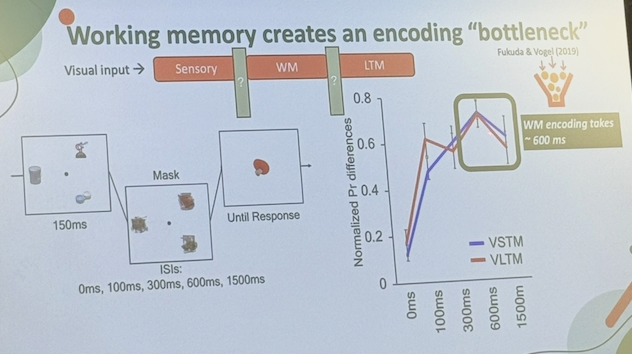
  • Does memory store for visual WM or LTM task, this is results of memory based on when masked at encoding

  • Is it perceptual bottleneck or bottleneck of getting info into LTM

  • Giving people more time to encode information before hide the answers, does that help people get into WM

  • confirms bottleneck at WM, not perceptual

  • Memory is best at 600ms

  • Takes about 600ms, ideal amount of time to see items on screen, WM encoding tasks to have better memory

  • Bigger question is bottleneck at WM affecting what we can remember in LTM?

    • Pattern of results

    • Blue & red follow each other

    • Performance in VSTM mimicked during LTM

    • Not just got in or didn’t for WM, that information continues to travel into LTM, whatever go affected by WM affects what’s in LTM

  • This “bandwidth” limit is due to WM encoding, NOT perceeption
<ul><li><p>If given more time, do we do better? </p></li><li><p>Does memory store for visual WM or LTM task, this is results of memory based on when masked at encoding</p></li><li><p>Is it perceptual bottleneck or bottleneck of getting info into LTM</p></li><li><p>Giving people more time to encode information before hide the answers, does that help people get into WM</p></li><li><p>confirms bottleneck at WM, not perceptual</p></li></ul><p></p><ul><li><p>Memory is best at 600ms</p></li><li><p>Takes about 600ms, ideal amount of time to see items on screen, WM encoding tasks to have better memory</p></li><li><p>Bigger question is bottleneck at WM affecting what we can remember in LTM? </p><ul><li><p>Pattern of results</p></li><li><p>Blue &amp; red follow each other</p></li><li><p>Performance in VSTM mimicked during LTM</p></li><li><p>Not just got in or didn’t for WM, that information continues to travel into LTM, whatever go affected by WM affects what’s in LTM</p></li></ul></li></ul><p></p><ul><li><p><span style="color: rgb(66, 128, 181);"><strong>This “bandwidth” limit is due to WM encoding, NOT perceeption</strong></span></p></li></ul><p></p>
6
New cards

Why can we only remember 3-4 items in WM?


7
New cards

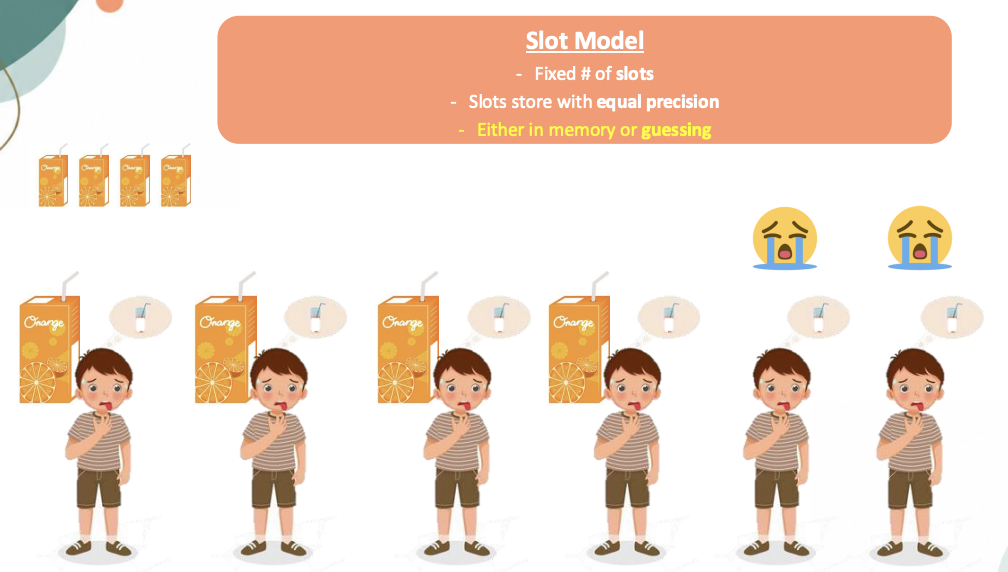
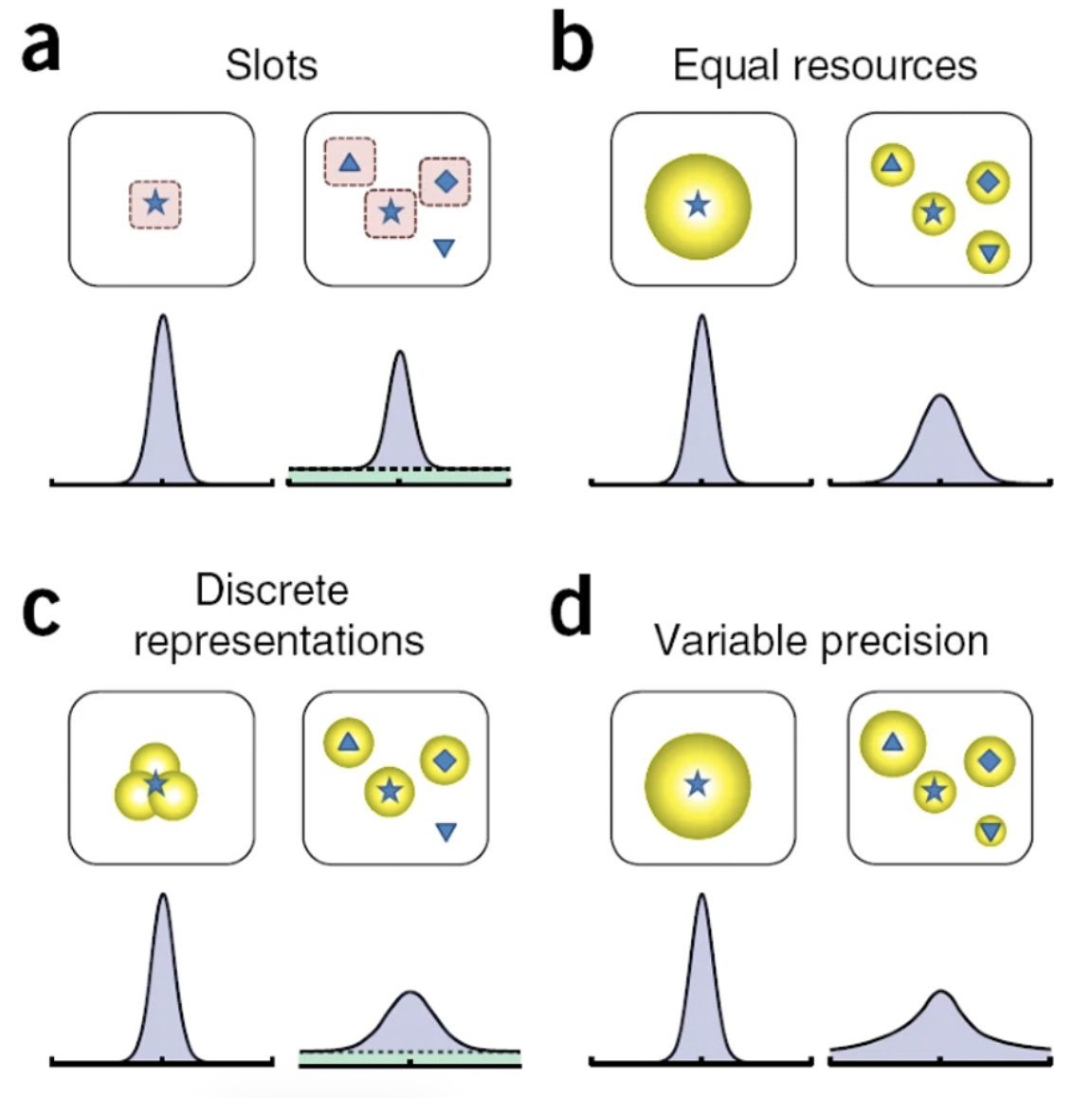
What is the Slot Model- JuiceBox Analogy

  • Fixed # of slots

  • Slots store with equal precision

  • Either in memory or guessing

  • Give juice to students 1-4, 5-6 students stay dehydrates

  • Idea is that only 4 items get into WM, anything else that surpasses doesn’t get in, starts looking like guesses

  • Increases uniform distribution

<ul><li><p>Fixed # of slots</p></li><li><p>Slots store with <strong>equal precision</strong></p></li><li><p>Either in memory or guessing</p></li></ul><p></p><ul><li><p>Give juice to students 1-4, 5-6 students stay dehydrates</p></li><li><p>Idea is that only 4 items get into WM, anything else that surpasses doesn’t get in, starts looking like guesses</p></li><li><p>Increases uniform distribution</p></li></ul><p></p>
8
New cards

What is the Equal Resource Model?

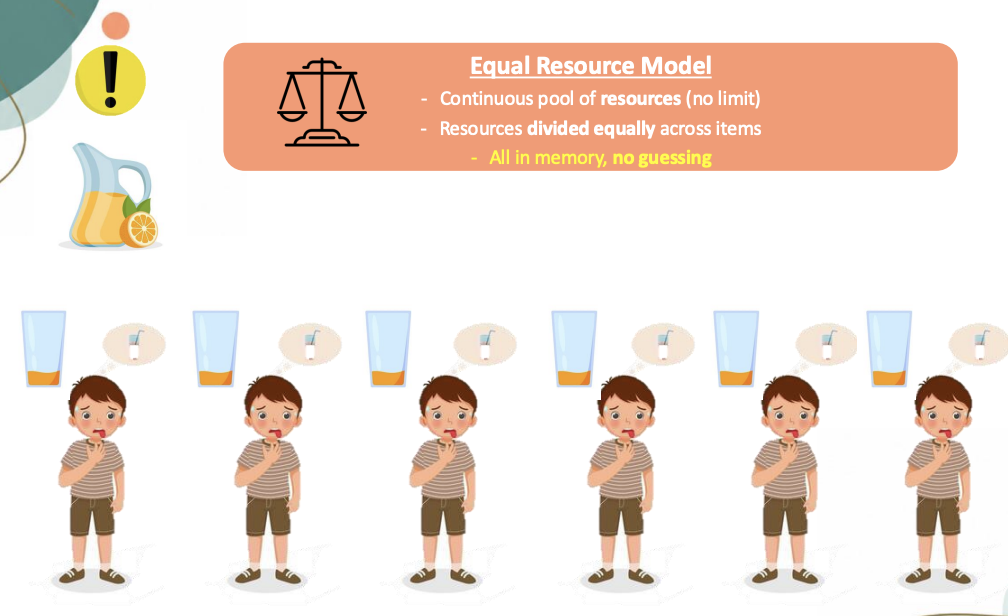
  • Continuous pool of resources (no limit)

  • Resources divided equally across items

  • All in memory, no guessing

  • Egalitarian

  • Pour into 1 jug and give same amount to every child

  • Idea here is everyone gets a little bit of juice

  • No guessing

  • All items get into WM, but at lower precision

  • Little bit of juice/resources dedicates
<ul><li><p>Continuous pool of resources (no limit) </p></li><li><p>Resources divided equally across items</p></li><li><p>All in memory, no guessing</p></li></ul><p></p><ul><li><p>Egalitarian</p></li><li><p>Pour into 1 jug and give same amount to every child</p></li><li><p>Idea here is everyone gets a little bit of juice</p></li><li><p>No guessing</p></li><li><p>All items get into WM, but at lower precision</p></li><li><p>Little bit of juice/resources dedicates</p></li></ul><p></p>
9
New cards

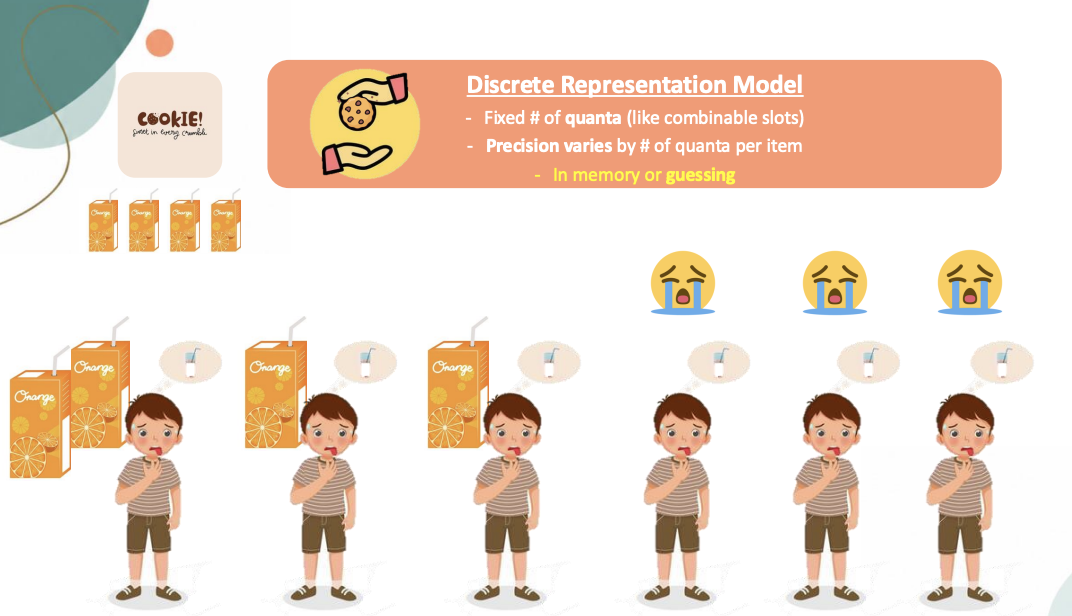
What is the Discrete Representation Model?

  • Fixed # of quanta (like combinable slots)

  • Precision varies by # of quanta per item

  • In memory or guessing

  • Which child has a cookie and take a bribe.

    • More juice if trade cookie

    • 2 juice to one child, 1 to other, other 3 get none

    • Slot model says everyone gets 1

    • This model idea is more flexible, juice boxes allocated

    • Dedicate one item more, more quanta

    • Anything that doesn’t get in is pure guessing

    • Some go without juice

<ul><li><p>Fixed # of quanta (like combinable slots)</p></li><li><p>Precision varies by # of quanta per item</p></li><li><p>In memory or guessing</p></li></ul><p></p><ul><li><p>Which child has a cookie and take a bribe.</p><ul><li><p>More juice if trade cookie</p></li><li><p>2 juice to one child, 1 to other, other 3 get none</p></li><li><p>Slot model says everyone gets 1 </p></li><li><p>This model idea is more flexible, juice boxes allocated</p></li><li><p>Dedicate one item more, more quanta</p></li><li><p>Anything that doesn’t get in is pure guessing</p></li><li><p>Some go without juice</p></li></ul></li></ul><p></p>
10
New cards

What is the Variable Precision Model?

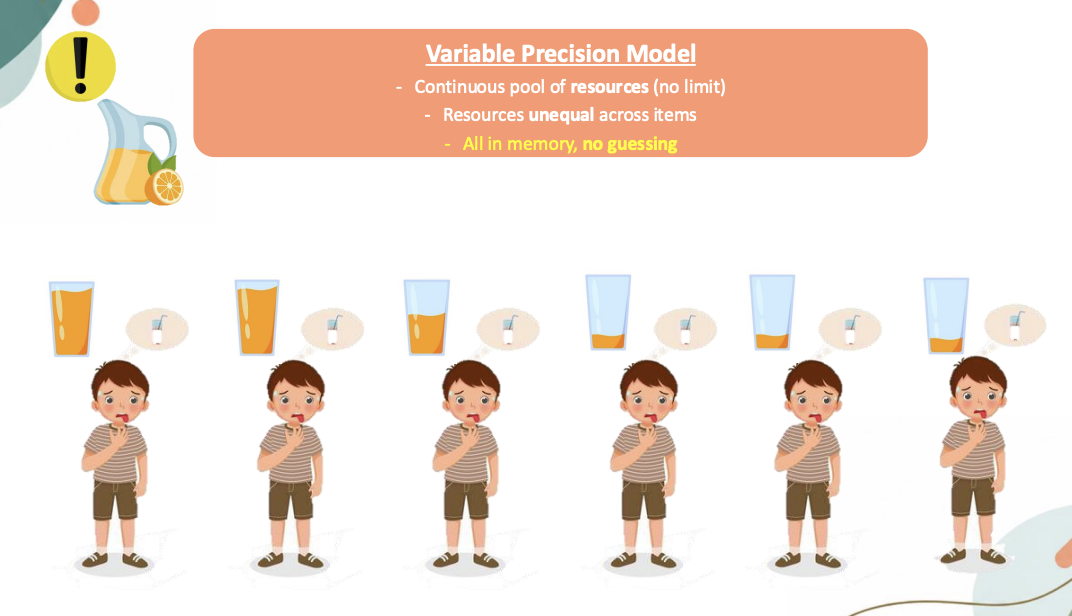
  • Continuous pool of resources (no limit)

  • Resources unequal across items

  • All in memory, no guessing

  • Pour juice into one pool of resources/jug, everyone gets juice

  • All items represented, no guessing

  • Less precision

  • Some get more juice than others

  • First 2 children get a lot, later get a little but still getting somsething

  • Earlier models do not account for precision

  • That’s where discrete & variable comes in
<ul><li><p>Continuous pool of resources (no limit)</p></li><li><p>Resources unequal across items</p></li><li><p>All in memory, no guessing</p></li></ul><p></p><ul><li><p>Pour juice into one pool of resources/jug, everyone gets juice</p></li><li><p>All items represented, no guessing</p></li><li><p>Less precision</p></li><li><p>Some get more juice than others</p></li><li><p>First 2 children get a lot, later get a little but still getting somsething</p></li></ul><p></p><ul><li><p>Earlier models do not account for precision</p></li><li><p>That’s where discrete &amp; variable comes in</p></li></ul><p></p>
11
New cards

What are the different models?

knowt flashcard image
12
New cards

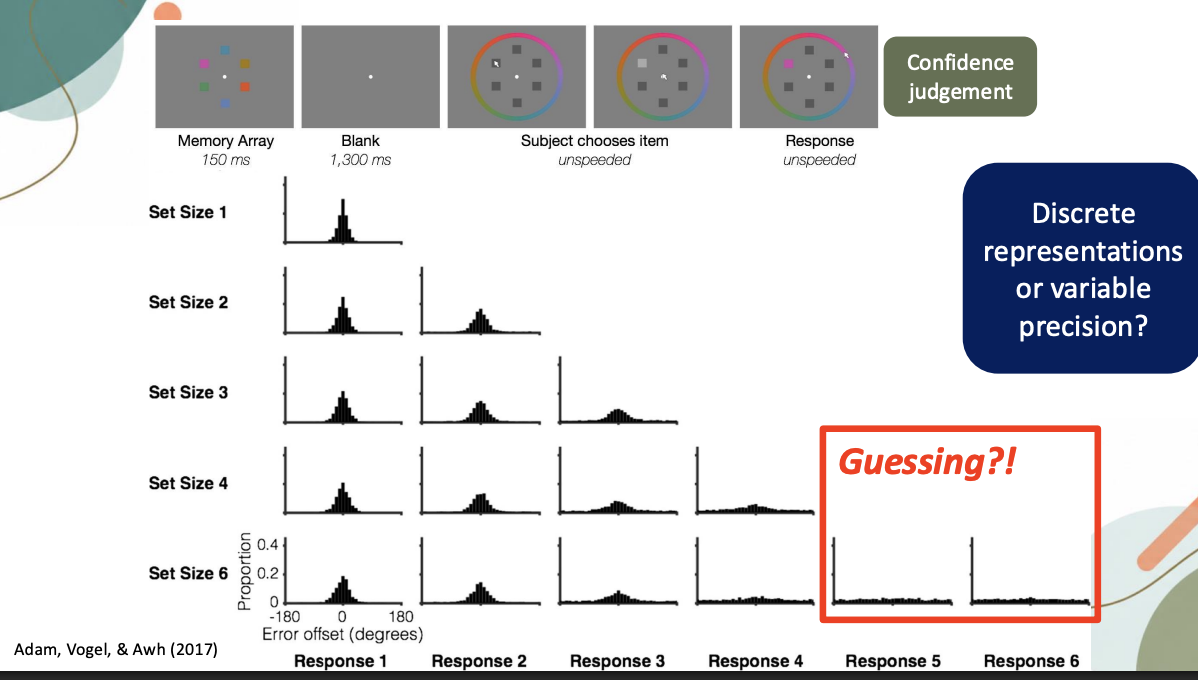
Adam, Vogel et al Experiment on Discrete Representations or variable precision

  • In favour of discrete vs. variable precision

  • Given a memory array, 6 different squares of varying colours, choose square want to report, report & then go to the next

  • As go alone, longer since saw array so get worse

  • Expect that set size 1 is easier, than set size 6 have to hold in mind

  • First respond well, idea of what colour they saw

  • Peak lower in set size 6, shows widening, lower precision, worse when 6 things need to hold in mind

  • Second square report we see broadening/widening of the peak & flattening of the peak until the last 2

  • The last 2 look more so like guessing, uniform distribution

  • Looked at guessing parameter & confidence judgement

  • Low confidence = guessing

  • Guessing rates estimated by the mixture model were strongly correlated with guessing rates reported by participants

    • Correlation between what model suggested was guessing & what people saying they were guessing

    • Evidence to suggest line truly flat & not uniform distribution
<ul><li><p>In favour of discrete vs. variable precision</p></li><li><p>Given a memory array, 6 different squares of varying colours, choose square want to report, report &amp; then go to the next</p></li><li><p>As go alone, longer since saw array so get worse</p></li><li><p>Expect that set size 1 is easier, than set size 6 have to hold in mind</p></li><li><p>First respond well, idea of what colour they saw</p></li><li><p>Peak lower in set size 6, shows widening, lower precision, worse when 6 things need to hold in mind</p></li></ul><p></p><ul><li><p>Second square report we see broadening/widening of the peak &amp; flattening of the peak until the last 2</p></li><li><p>The last 2 look more so like guessing, uniform distribution</p></li></ul><p></p><ul><li><p>Looked at guessing parameter &amp; confidence judgement</p></li><li><p>Low confidence = guessing</p></li><li><p>Guessing rates estimated by the mixture model were strongly correlated with guessing rates reported by participants</p><ul><li><p>Correlation between what model suggested was guessing &amp; what people saying they were guessing</p></li><li><p>Evidence to suggest line truly flat &amp; not uniform distribution</p></li></ul></li></ul><p></p>
13
New cards
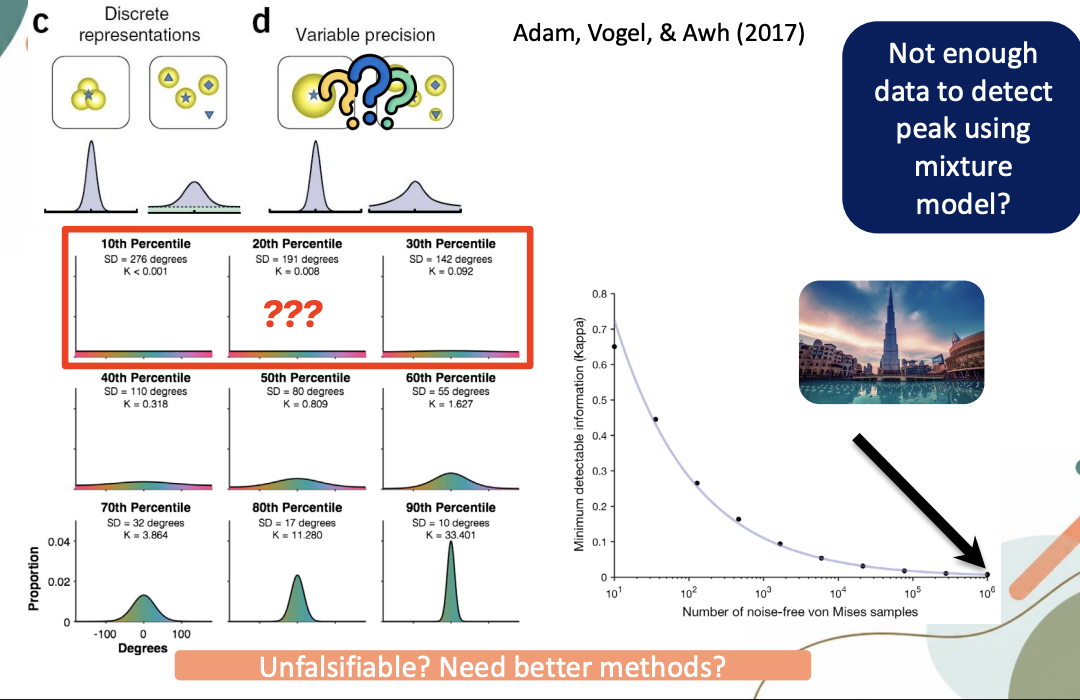
  • Possible may not be enough data to estimate & differentiate between something flat & something broad

  • Simulation to try to understand in 10, 20 & 30 percentile (strong to weak memory) for algorithm to distinguish between lower percentile & higher percentile

  • 10 million trials needed to dissociate between a flat uniform distribution & shallow, flat peak

  • Take half a year to run that experiment

  • Unfalsifiable

<ul><li><p>Possible may not be enough data to estimate &amp; differentiate between something flat &amp; something broad</p></li><li><p>Simulation to try to understand in 10, 20 &amp; 30 percentile (strong to weak memory) for algorithm to distinguish between lower percentile &amp; higher percentile</p></li><li><p>10 million trials needed to dissociate between a flat uniform distribution &amp; shallow, flat peak</p></li><li><p>Take half a year to run that experiment</p></li><li><p>Unfalsifiable </p></li></ul><p></p>
14
New cards
<p>Distinguishing guessing from fuzzy memories</p>

Distinguishing guessing from fuzzy memories

  • Ngiam, Foster, Adam, & Awh (2023)

  • Create situation in which guessing is still unrelated to the target, but no longer random?

  • Guesses vs. weak memories

  • Distinction between guesses & weak memories, guesses can be right memory by accident

  • Had a standard condition: see all orientations, full circle with line in direction remember seeing it

  • Background condition: has different colours & quadrants, biasing people. There is a tick mark to show orientation. If people forget what say, fall back on quadrant/background that has nothing to do with the orientation they saw

  • For angle they saw & thought they saw, perfect good memory should correlate really well

  • If randomly guessing, should be everywhere no correlation
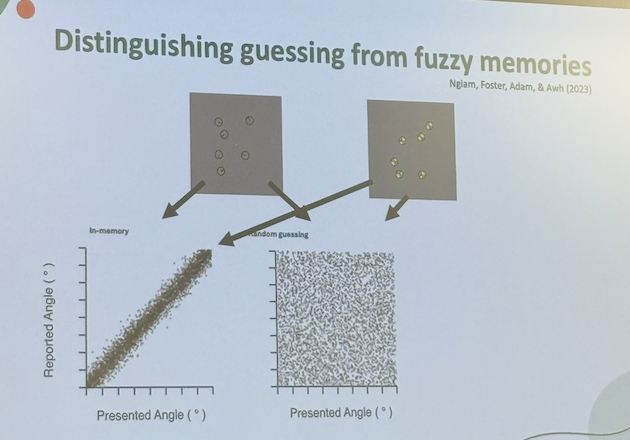
  • In background condition might see random guessing, might see people don’t need to fall back on background. But might see fall back on the orientation of the grid. Get clear different pattern of result that is still guessing but systematic guessing

15
New cards
  • In standard condition as people made more responses, more precise but got worse. Uniform distribution

  • In background condition, weaker, weaker then looks like random guessing

  • For first 3 responses within WM capacity, see good diagonal like get getting noisier & noisier

  • Guessing not just a vague memory

<ul><li><p>In standard condition as people made more responses, more precise but got worse. Uniform distribution</p></li><li><p>In background condition, weaker, weaker then looks like random guessing</p></li><li><p>For first 3 responses within WM capacity, see good diagonal like get getting noisier &amp; noisier </p></li><li><p>Guessing not just a vague memory</p></li></ul><p></p>