Lecture 24 - Stomatal Regulation
 Studied by 0 people
 Call with Kai
 Learn
Learn Practice Test
 Spaced Repetition
 Match
Match Flashcards
 Knowt Play
1/8

There's no tags or description
Looks like no tags are added yet.
Name | Mastery | Learn | Test | Matching | Spaced | Call with Kai |
|---|
No study sessions yet.
9 Terms
Stomata
Evolved before vascular tissue (400 millions years ago) and aided in plants growing taller & bigger. Pores, typically on the underside of leaves where the spongy mesophyll is. that allow for gas exchange and transpiration (regulating water, heat, etc).
As they open, heat & liquid may move in either direction between the mesophyll, epidermis, and outside environment.
Stomata Anatomy
They can be dumb-bell shaped (as in monocots) or kidney bean shaped (as in eudicots). A stomata is made up of two guard cells that will change its turgidity in order to open or close. To do this, they require energy, typically acquired from sugars from surrounding mesophyll cells.
When open, guard cells can exhange vapour with air in the stomata pore channel and liquid water with epidermal cells
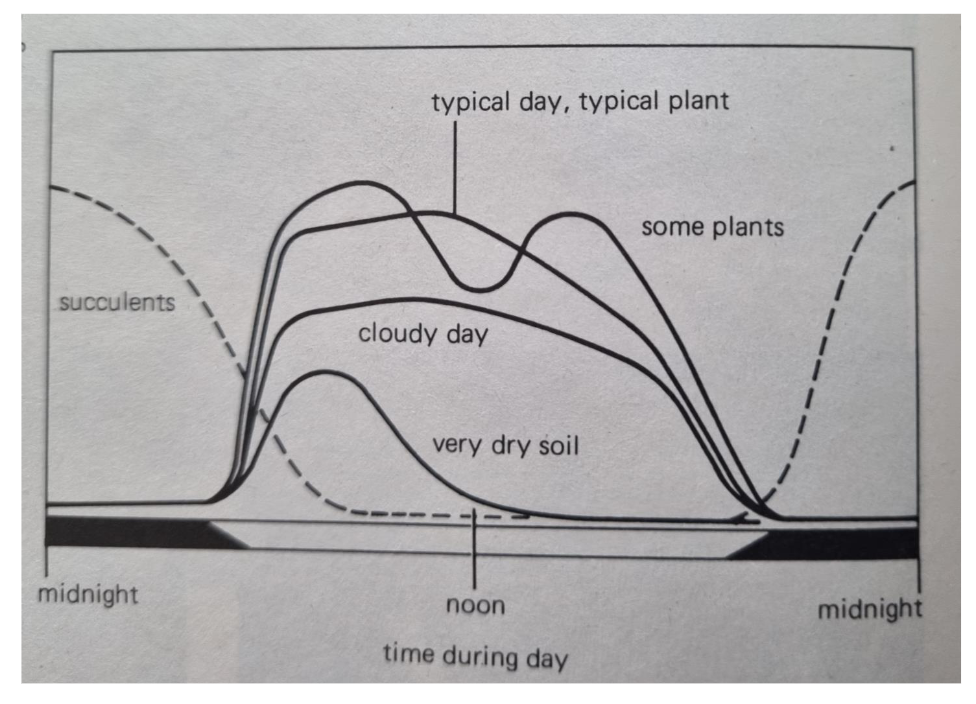
Stomatal Aperture & Environmental Conditions/Throughout the Day
For most plants, they’d have their stomata opened during the day in order to gain CO2 for photosynthesis while the light is still there.
At peak sunlight, it may close to help prevent damage to photosystems
On cloudy days, since there is less light, stomata don’t open as much
Then, they’d close their stomata at night because there is no need to have flux of CO2 inside because there is no light.
As we know, CAM plants do the opposite to retain water during the day and buildup CO2 at night
As for environmental conditions:
Low CO2 induces opening (to gain CO2)
High CO2 induces closing (enough CO2)
High temperatures induce closing (to save water from transpiration)
High winds/water stress induce closing (to save water)
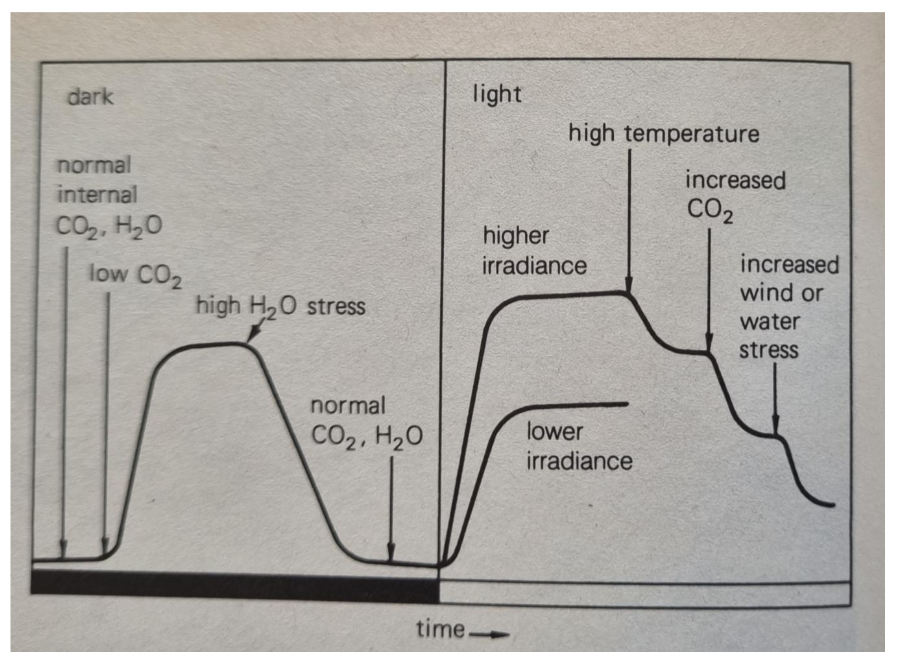
Stomatal Regulation: Biological Daily Rhythms
Stomata do operate on a 24-hour clock that can continue despite constant light.
Stomatal Regulation: Light Intensity
Photosynthesis requires light, so stomata open as light increases to allow CO2 to enter for photosynthesis (especially in a well-watered plant)
So as stomatal conductance increases, so will photosynthetic output
It acts in opposite to ABA by promoting stomata opening
Stimulating proton pump to move H+ out of the guard cell
Stimulating K+ channels to carry more K+ into the guard cell
Promote the movement of sugars into guard cells
Overall creating an osmotic imbalance where there is a higher solute concentration inside the cell to let water flow inside and make the guard cells turgid
Stomatal Regulation: Water Balance & Humidity
Wilting plants close their stomata to save water
Guard cell turgor declines as VPD increases (guard cells close as VPD/dryness increases)
Drier air would encourage stomatal closure (stomatal conductance decreases)
Stomatal Regulation: ABA & Potassium Ions (Osmoticums)
Abscisic acid is a phytohormone that signals for stomatal closure by making the plant expell osmoticum (ions like K+ and Cl-) so that it drives the water outside of the cell and can become flaccid.
So the opposite is true, K+ influx would mean water influx so the guard cells become turgid and the pore opens
K+ influx is stimulated by light and CO2
ABA is produced in response to phsyiological stress (drought, water stress, soil-salinity, frost, etc) either in the guard cell itself or elsewhere. Plant taxonomic groups have different ABA patterns
Some are always passive (ferns + moss, lacking a stomatal response to ABA)
Others are passive + active (gymnosperms, allowing stomata to respond to ABA)
And many are active regulators (angiosperms, meaning rapid ABA biosynthesis)
Steps of ABA Signalling Pathway
ABA is received by ABAR & PLC which will produce messenger molecules IP3 and activate ROS (reactive oxygen species)
IP3 will activate with Ca2+ channels on vacuoles and ROS will activate Ca2+ channels on membranes to buildup Ca2+ intracellularly
Ca2+ will deactivate K+ influx channels, promote Cl- efflux channels, and deactive proton efflux pumps
The increased acidity will also activate K+ efflux channels
The buildup of Ca2+ and Cl- (to compensate K+ efflux) intracellularly will further drive K+ and Cl- efflux
The osmotic imbalance (more solutes outside) will drive water to go out of the guard cells so they become turgid and closed
Stomatal Regulation: Water Supply & Transpiration
There is a relationship between stomatal conductance (gs), essentially opening, and transpiration (water coming out of leaves)
There are three main phases:
As VPD increases from low to moderate, gs (stomatal opening) remains relatively constant while transpiration increases
As VPD increases from mid-range, gs (stomatal opening) decreases as transpiration remains constant
So, even though the stomata are closing, transpiration/water loss is still happening at a constant rate
As VPD exceeds 2.8 kPa, gs and transpiration declines
VPD can be thought of as air dryness