CAD/CAM
 Note
Note Call Kai
 Learn
Learn Practice Test
 Spaced Repetition
 Match
Match Flashcards
 Knowt Play
1/39

There's no tags or description
Looks like no tags are added yet.
Name | Mastery | Learn | Test | Matching | Spaced | Call with Kai | Chat |
|---|
No analytics yet
Send a link to your students to track their progress
40 Terms
CAD stand for?
Computer Aided Design
CAM stand for?
Computer Aided Manufacturing
when did CAD/CAM occur?
1950s and was introduced to dentistry in the 1980’s by Duret
whats the chairside technique?
(patient waits in chair while crown is being made)
*to perform a one-visit procedure for fixed restorations
The first CAD/CAM devices introduced were?
EREC (Sirona) and Procera (Nobel Biocare)
what did the first PROCERA produce?
coppings
original material on the procera system was?
alumina
(shortly after it milded zerconia)
what are some reason why we try to get rid of metal?
*allergies
*aesthetic
*cost
*get rid of metal finishing department
ceramics can be used as
Zirconia
Lithium Disilicate
Nanoceramics
metals can be used as
Chrom Cobalt
Titanium
Alloys
acrylics can be used for
Models
Occlusal Guards
Surgical Guides
PEEK
PMMA
Dentures
Teeth
Base
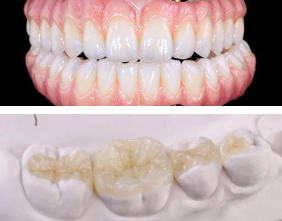
Zirconia can be
(milled) used for…
Single units to full arches
Implants
Substructures
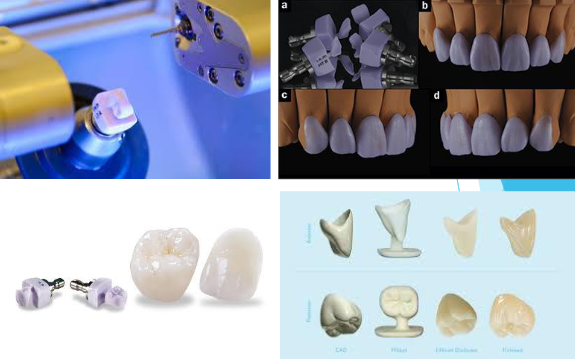
Lithium Disilicate can be
(milled/pressed) used for..
Single units
Crowns
Veneers
Inlays/Onlays
Three unit bridges (max)
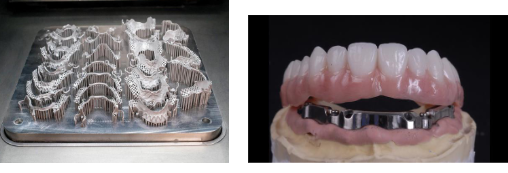
Chrome Cobalt can be
(milled/printed-SLS) used for..
Substructures
Full contour crowns/bridges
Bars
Partial Denture Frameworks
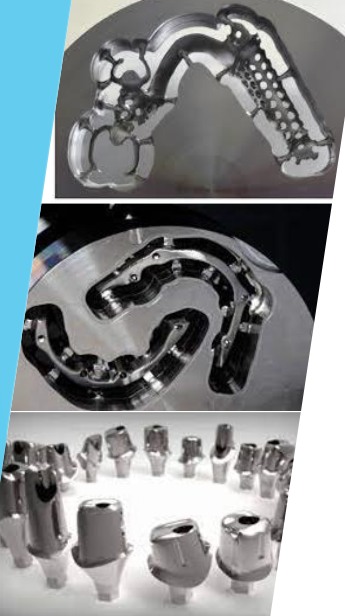
Titanium can be
(milled/printed-SLS) used for..
Implant Components
Substructures
Bars
Partial Denture Framework
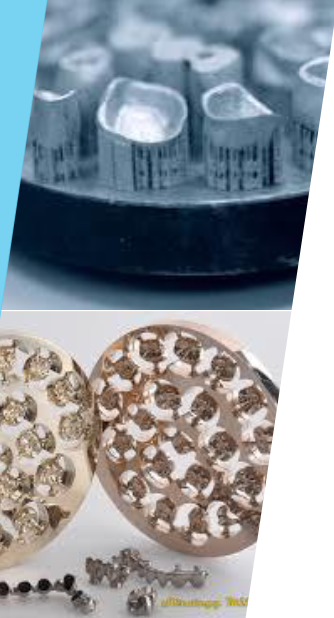
Alloys can be
(milled/printed-SLS) used in…
Full Contour Crowns/Bridges
Substructures
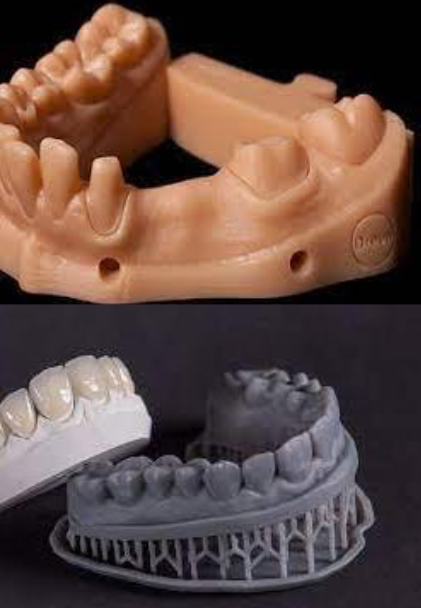
Acrylics can be
(milled/printed) used in…
Study Models
Working Models
Removable Single Dies
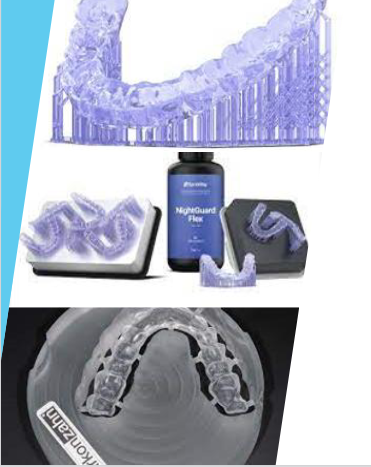
Occlusal guard can be
(milled/printed) used in
Treatment of Bruxism
Thermoplastic
Hard
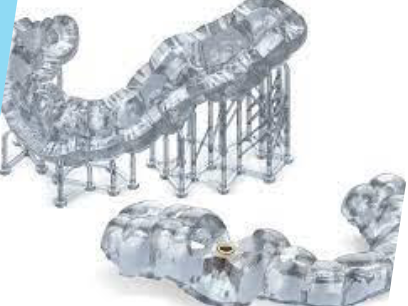
Surgical Guides can be
(printed/milled) used for…
Used to guide implant placement
and bone augmentation during oral
surgery
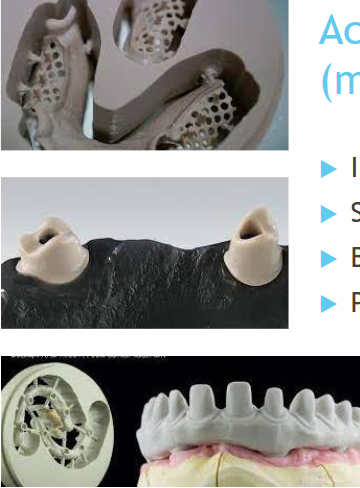
PEEK can be
(milled/pressed) used for…
Implant components
Substructures
Bars
Partial Denture Frameworks
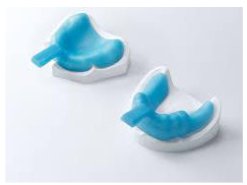
PMMA can be
(milled/printed) used for…
Custom trays
Temporary
restorations
Denture try-ins
Chairside - Advantages
One-visit fixed restorative procedure
No impression taking
No temporary restoration required
Reduced potential for tooth sensitization
No laboratory costs
No model or die pouring
Increased accuracy
Less opportunity for error
Aids prep visualization
Projects a state-of-the-art image
Chairside - Disadvantages
⚫ Soft tissue management more critical
⚫ Customization may be required
⚫ Learning curve
⚫ Higher production required to cover capital investment
most popular cermaic
zirconia
can zirzonia be printed?
can only be milled
whats monochromatic
one colour
what does SLS stand for
Selective laser sintering
whats milling
subtraction of material (sculpting)
3D printing is used when
Ideal for complex geometries and quick production
Milling is used when
used for hard materials; provides high precision for restorations.
Integrated Lab – Scanning:
Digital scans of the patient’s oral cavity taken in the dental office.
High accuracy for designing restorations.
Integrated Lab - Design:
Virtual design of restorations, such as crowns and frameworks.
CAD software used for precise customization and planning.
Integrated Lab - Production:
Mill: Fabrication of restorations from materials like wax or ceramic.
Print: 3D printing of models and components.
SLS (Selective Laser Sintering): Advanced method for creating intricate parts from powdered materials.
advantages of Intraoral Scanning
Chairside Analysis: Facilitates patient education and understanding.
Accuracy: Provides more consistent impressions.
Time-Saving: Reduces chair time for patients.
Cost-Saving: Less need for impression materials.
True Mucostatic Impression: Maintains soft tissue contours.
Patient Comfort: Easier for patients with gag reflex or limited opening.
No Need for Disinfection: Digital scans reduce cross-contamination.
Digital Archivability: Easy storage and retrieval of patient data.
Full Color Analysis: Allows for detailed assessments.
Ability to Print or Mill Master Casts: Enhances workflow efficiency.
disadvantages of Intraoral Scanning
High Initial Cost: Significant investment in technology.
Steep Learning Curve: Requires training and adaptation.
Possible Scanning Fees: Additional costs may be incurred.
Difficulty with Movable Tissue: Challenges in scanning soft tissue.
Camera Size: Larger cameras may be unsuitable for small mouths.
Deep Margin Preparations: Complicated to capture accurately.
Possible Lack of Detail: Some scans may miss finer details.
Blood/Saliva Management: Handling fluids can complicate scanning.
is zirconia non-lithic true or false?
true
whats non lithic?
made out of one metal
Why do we measure restorative material with Mega-pascales?
To quantify the durability & resistance of materials used in restorations
whats Megapascals (MPa)
Originally designed to measure the strength of concrete in the construction industry, now it is also used for measuring the strength of restorative dental materials
whats E-max
Lithium Disilicate glass, an all-ceramic system