World Religions Midterm Study Guide
 Studied by 0 people
 Call with Kai
 Learn
Learn Practice Test
 Spaced Repetition
 Match
Match Flashcards
 Knowt Play
1/170

There's no tags or description
Looks like no tags are added yet.
Name | Mastery | Learn | Test | Matching | Spaced | Call with Kai |
|---|
No study sessions yet.
171 Terms
Ninian Smart
Scottish scholar and a pioneer in the secular academic study of religion, best known for developing the seven-dimensional framework for analyzing and comparing different religions
pantheism
the belief that the divine reality exists in everything
faith
Strong belief, trust, and confidence in someone or something, often without complete proof, involving loyalty, commitment, or belief in a religious system or God
7 dimensions
a framework to understand religions through their core components: Experiential, Mythic/Narrative, Doctrinal, Ethical, Ritual, Social/Institutional, and Material/Artistic
cosomolgy
the understanding of the nature of the universe
Mystery
Stereotypes
Oversimplified generalizations about groups of people, can be positive or negative
Prejudice
beliefs, thoughts, feelings, and attitudes someone holds about a group; not based on experience; racism and colorism
Discrimination
prejudice with actions against a group of people
Ethnocentrism
belief that your culture/ethnicity is the center of everything and superior to others, and make false assumptions about cultural difference (yours is best)
Ex: saying that people in England drive on the "wrong" side of the road
Xenocentrism
Belief that another culture is superior to your own, and being obsessed with other cultures (yours is last)
Nostra Aetate
Declaration On the Relation Of the Church to Non-Christian Religions
Why was Nostra Aetate written?
Pope John XXIII wanted to make a statement after the holocaust
Who wrote Nostra Aetate, and when?
Pope Paul VI in 1965
What does Nostra Aetate say about other religions?
The Catholic Church acknowledges that there is truth and holy things in other religions, and respects them as they reflect truth that englightens people
What does the Church consider above all when writing Nostra Aetate?
what men have in common and what draws them to fellowship
One goal that all people on earth share
God / their origin
How do Buddhists and Hindus contemplate the mystery of the divine?
Myths, meditation, and philosophy
4 things that Muslims and Christians have in common
1. adore God 2. submit to his decrees 3. honor Mary 4. await a judgement day
What does the Church recommend we do today because of the conflicts over time between Christians and Muslims?
Forget the past; work toward mutual understanding, and to preserve and promote social justice, moral welfare, peace, and freedom
What does Nostra Aetate say about the Jews' responsibility in Jesus' death
although some Jews pressed for death, the Romans didn't have to do it, and can not be charged against all Jews living or dead.
What does the Church say about anti-Semitism?
Church rejects it completely
Patrimony
inheritance / heritage (father)
How does patrimony relate to Christianity and Judaism?
Christianity comes from Judaism, so they share common values and foundations
True or False: All people are God's people
True
Why is Discrimination based on religion unacceptable, according to Nostra Aetate?
We are all Made in God's image and it goes against God (our relationship is linked)
How do we study World Religion?
Prudently and lovingly through dialogue and in witness of Christian faith and life
What is the definitive aspect of a world religion?
the influence a particular religion now wields, has exerted in the past, or both
Western Beliefs
Judaism, Christianity, Islam; monotheistic; single omnipotent, omniscient diety; God is independent; relationship with us; morality is based on God's wants; time is linear
Eastern Beliefs
Buddhism, Hinduism, Confucianism, Taoism, Shintoism; polytheist and monistic (one reality); focus on the NOW; unknowable, impersonal dietys or reality; time is cyclical
How does the Aztec tradition differ from typical indigenous religious traditions?
The Aztecs built a highly developed civilization with a large urban population, but they still emphasizing myth and ritual, including human sacrifice.
What geographical area does Mesoamerica encompass?
Most of Mexico, extending to Honduras, Nicaragua, and Costa Rica.
Which god is credited with creating and ordering the world in Aztec cosmology?
Quetzalcoatl.
What ancient city is considered the origin of the cosmos in Aztec belief?
Teotihuacan.
Who was Topiltzin Quetzalcoatl and what was his significance?
He was an earthly devotee of Quetzalcoatl and served as a king-priest, providing the Aztecs with a perfect role model.
What did the Aztecs call their present age and what was their anticipation for it?
The Age of the 5th Sun; they anticipated a similar fate of destruction as the previous four suns.
How did the Aztecs conceptualize the spatial world?
They viewed it as having four quadrants extending from the center of the universe (axis mundi), connecting the earthly realm to the multi-layered heavens and underworld.
Why did the Aztecs see each human being as an axis mundi?
They believed two divine forces in the head and heart nurtured humans with basic needs, connecting them to the divine realms.
What special religious capabilities did the Aztec knowers of things possess?
They could communicate with the gods and make offerings through language as an alternative to sacrifice.
What historical coincidence contributed to the fall of Tenochtitlan?
Cortez arrived in Mesoamerica in 1519 wearing a feathered helmet, coinciding with the Aztec belief that Topiltzin Quetzalcoatl would return.
How does the Day of the Dead reflect the survival of Aztec religious culture?
It joins the living and the dead through rituals that are festive and spiritually meaningful, similar to Aztec practices.
In which countries do the Yoruba primarily reside?
Nigeria, Benin, and Togo.
Why is the city of Ife significant in Yoruba religion?
It is where the god Orishna-nla began to create the world.
What is the Yoruba understanding of the cosmos?
It consists of two worlds: the invisible world of gods and ancestors (heaven) and the earthly realm of humans; earth also has witches and sorcerers, perverted forms of humans, that can cause disaster.
Who is Olorun in Yoruba religion?
The supreme god, the origin of all powers in the universe, and the creator of life, who is distant and not commonly worshipped.
What are orishas and their role in Yoruba religion?
Lesser deities that can help or harm humans based on how well rituals to appease them are performed.
Name two orishas and describe their significance.
Orishna-nla, the supreme creator, and Ogun, the god of iron and war, who was the first king of Ife.
What is a trickster figure in Yoruba belief?
A mischievous supernatural being.
Describe the two types of Yoruba ancestors.
Family ancestors gain supernatural status through good deeds and longevity; deified ancestors were once important figures known throughout Yoruba society.
What is the role of Yoruba ritual practitioners?
They mediate between the gods and ancestors in heaven and humans on earth.
What is divination in Yoruba culture and why is it essential?
It is the practice of learning and interpreting one's future, essential for determining how to proceed in life.
What did the Ancestors create during the Dreaming in Aboriginal culture?
They shaped the landscape, created life, gave each tribe a place to live, and established language, social rules, and customs; They also left behind presence in natural landmarks and rock paintings.
What survives in the symbols left behind the ancestors?
The spiritual essence. The sites where the symbols are formed are thought to be charged with sacred power.
What is a totem in Aboriginal belief?
A natural form in which an Ancestor appeared during the Dreaming, such as an animal or rock formation.
What is a taboo in Aboriginal belief?
Refers to the system of social ordering that dictates certain things and activities; What people can and can't do.
Why are rituals essential in Aboriginal life?
Rituals are the means through which the sacred power of the Dreaming can be accessed and experienced.
How did Aboriginal rituals originate?
They were taught by the Ancestors to the first humans.
What are the purposes of Aboriginal imitation rituals?
1. Awaken spiritual identity with totemic Ancestors. 2. Redefine social identity within the tribe. 3. Prepare for spiritual rebirth into adulthood. 4. Teach essential truths about the world.
Identify two acts of Dieri initiation rituals that symbolize death.
Circumcision and knocking out a boy's lower two middle teeth, which are then buried, and inflicting woulds to leave scars on boy's neck and back.
When do scholars believe humans first migrated to America?
As early as 40,000 years ago, crossing the Bering Strait from Asia.
What is the significance of Plains Indian religion?
It serves as a model for pan-Indian religion across North America; also a recent, popular movement uniting North American tribes
What does Wakan Tanka refer to in Lakota belief?
Wakan Tanka is the Lakota name for the supreme reality, great spirit, or most sacred referring to 16 separate deities.
Who is Inktomi in Lakota mythology?
Inktomi is the trickster figure who mediates between the supernatural and human worlds that taught the 1st humans their ways and shows us how not to behave.
What do the Lakota believe happens to souls after death?
Four souls depart, journey along the spiritual path of the Milky Way, and are judged by an old woman, who decides their fate and either lets then continue to the world of the ancestors or sends it back to earth as a ghost; the other parts of the souls are reborn as new babies.
What is the purpose of a vision quest?
To access spiritual power that ensures success in hunting, warfare, and healing.
Describe the structure and function of a sweat lodge.
A sapling hut covered with animal skins making it dark and airtight, representing the universe, used for physical and spiritual purification through sweating through heated stones and water.
What form does a vision typically take during a vision quest?
The vision often appears as an animal, object, or natural force and is accompanied by a message.
Who presides over the Sundance among the Blackfeet tribe?
A woman of outstanding moral character
What is the axis mundi in general and in the Sundance?
In general, it is the center of the universe; in the Sundance, it is a cottonwood tree around which the lodge is constructed to represent the universe with its four cardinal directions
Why do some Sundance participants skewer their chests?
They believe their bodies are their only true possession, and body mutilation is seen as a suitable sacrifice to the supreme being.
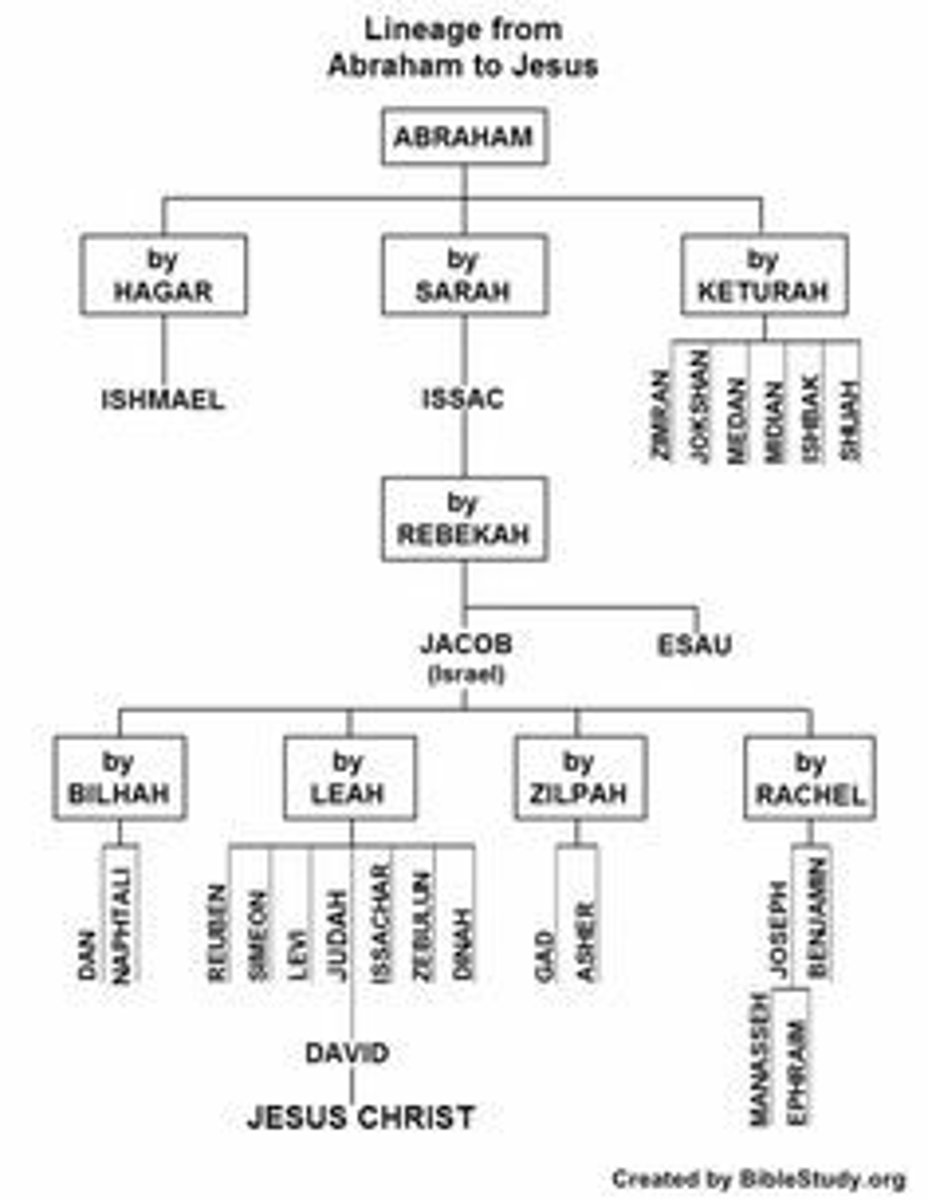
Abraham Family Tree
bar mitzvah / bat mitzvah
ritual celebration marking the coming of age of a Jewish child, at which they take on the religious responsibilities of an adult (bar - boys, bat - girls)
rabbi
Hebrew for "my teacher"; a teacher of Torah and leader of Jewish worship
repentance
translated as "return", atoning for sins
Shoah
Hebrew for "mass destruction"; another name for the Holocaust
Synagogue / Temple
Jewish house of worship; centers for prayer, stdy, and fellowship; all contain a scroll of the five books of the Torah, which is encased in a box called an ark
prophet
means "one who speaks for"; books that include both historical accounts of ancient Israel and proclamations of the will of God spoken by others (ex: Jeremiah, Moses)
Seder
Occurs during Passover, and is a recitation of the events of the Exodus as well as meal of traditional foods that symbolize those events (matzo/unleavened bread)
The 10 commandments
Moral code of laws, written by god and given to Moses on the top of Mount Sinai
Circumcision
rite of passage, signifies entrance into Jewish faith, done as a sign of the covenant between Abraham, his descendents, and God
Talmud
Hebrew for "study"/"knowledge"; vast depository of the oral Torah, based on the Mishnah with extensive rabbinic commentary on each chapter
Hasidism
a form of Judaism that arose in eastern Europe in the eighteenth century and that emphasizes mysticism, a personal relationship with God, a close-knit community, and the leadership of the zaddik, a charismatic holy man; ultra-orthodox / strict observance of the Torah
Diaspora
The situation fo Jews living away from their ancestral homeland; been true of most Jews since the classical period
Zionism
original movement arising in the late 19th century to establish a Jewish homeland, and since 1948, the support for the state of Israel
Torah
Hebrew for "instruction", revelation of God's will to the people / Divine Law; 1st 5 books of the Bible (Pentateuch), believed to have been revealed directly by God to Moses, contain 613 specific laws / 10 Commandments
Mishnah
Written down in about AD 200; contains collected teachings of the rabbis of the preceding four centuries; along with the Talmud, is the most important text of the oral Torah.
Kosher/Kashrut
Means "good"/"proper", and "fitness" for ritual use; Jewish dietary laws on how to prepare, store, and eat food; Non-Kosher foods are known as "treyf"
Peyot
Means Corners of the Head; sidelocks of hair worn by Orthodox Jewish men to observe the commandment in Lev. 19:27 not to round the corners of your head or mar the corners of your beard.
Kippa
Jewish "skull cap" worn by males for prayer and sacred occasions
Prayer Shawl
Tallit prayer shawl made with special twined and knotted fringes known as tzitzit attached to its four corners
Observant Jews avoid speaking who's name, out of reverence?
God; do not call Him Yahweh
When does the Sabbath begin and end?
From sundown on Friday to sundown on Saturday
What does every synagogue contain?
A scroll of the 5 books of the Torah
Does Mahmous Ahmadinejad, the President of Iran, support Israel and the Jewish people?
No.
What is the Kosher law involving meat and dairy products?
Meat and dairy products may not be combines or eaten at the same meal, and must wait several hours or rinse your mouth after eating one to have the other.
Rosh Hashannah
Jewish festival celbrating the first day of teh New Year, lasting 8 days
Yom Kippur
Jewish Day of Atonement, occurring on the 10th day of the New Year, lasting 1 day
Hanukkah
celebrates the rededication of the temple, Jewish festival of light lasting 8 days
Passover
Jewish festival (traditionally 8 days) celebrating the exodus of the Israelites from Egypt; eat seder meal, put lamb blood on the door so angel can pass over; eat lam, matzah (unleavened bread), 7 wines 7 times, and bitter herbs; ritual of the youngest person going to the front door to chick to see if Elijah i there / has a plate for him
Orthodox jews
Very traditional, believe Torah is unchanging and the society mus =t conform to the Torah, 1/10 of Jews in the U.S. are Orthodox and live in separate communities, women wear headscarves when they are married, observe the Sabbath (Hasidics, Haredi, ultra-Orthodox)