NORMAL NEONATES
 Call Kai
 Learn
Learn Practice Test
 Spaced Repetition
 Match
Match Flashcards
 Knowt Play
1/41

There's no tags or description
Looks like no tags are added yet.
Name | Mastery | Learn | Test | Matching | Spaced | Call with Kai | Chat |
|---|
No analytics yet
Send a link to your students to track their progress
42 Terms
Documentation
Head circumference
PMA - Post Menstrual Age
Respiratory status (spontaneous, assisted)
When baby was last fed
Body temp
Temp management protocol
Sedation/neuroactive meds
details of questionable events/ spells
Age Terminology: Preterm
up to 37 weeks PMA
Age Terminology: Term
37-44 weeks PMA
Age Terminology: Post Term
44-48 weeks PMA
ACNS neonatal guideline
2 finger width of space between head wrap and scalp
No collodion
Never use needles on neonates except in CVEEG
Electrode Placement guidelines
ACNS states full 10-10 system placement can be used, if not measured use ESTIMATED 10-20
Minimum of 12 channels + 2 polygraphic channels (ex : EKG, EOG, EMG, Respirations)
electrode placement
Cz must be included for positive “rolandic” sharp waves and extremely focal seizures
FZ, CZ, PZ is useful in visualizing rolandic sharp waves
multiple montages can be helpful
extra parameter electrodes
EKG (required by ACNS)
EOG (suggested by ACNS) Eye leads 0.5cm (5mm) below slightly lateral to outer canthus LOC, 0.5cm (5mm) above and slightly lateral to outer canthus ROC
EMG (suggested by ACNS Chin movement 2-3cm apart on chin
Respirations (suggested by ACNS)
We do not expect to see state changes until at least…
32 weeks PMA and clear reactivity closer to full term
State changes in the neonate
ACNS guidelines 16- state changes are present if the clinical condition lasts 1 minute. that is 6 pages of 10 sec of EEG
Neonate state changes identified by:
Wake, Quiet Sleep, Active Sleep, and Indeterminate sleep
Wake and sleep defined by ACNS in neonates
eyes opened for at least 60 seconds. eyes closed for 60 seconds
Active sleep
eyes closed
persistent EMG
movement
(looks like the baby is about to wake up)
This is a premature version of REM)
Quiet sleep
Eyes closed
Low EMG
Rare movements
This is a premature version of slow wave sleep
When its possible to define wakefulness
32 weeks PMA, EEG differentiation of wakefulness is appreciated at 41weeks PMA
Wake <32weeks
No wake features on EEG
Wake 32-34 weeks
Wake EEG increasing continuity
Sleep EEG <29 weeks PMA
No differentiation on EEG mainly quiet sleep
Sleep EEG 29-31 weeks PMA
Developing active sleep
Sleep EEG 32-34 weeks PMA
Increasing continuity for active sleep
discontinuity correlates with quiet sleep
Sleep EEG 34-37 weeks PMA
discontinuity in quiet sleep is replaced by trace alternant
Sleep EEG 38-40 weeks PMA
trace alternant gradually becoming slow wave sleep
Sleep EEG 41-44 weeks PMA
Slow wave sleep replaces trace alternant
Active sleep becomes activite moyenne
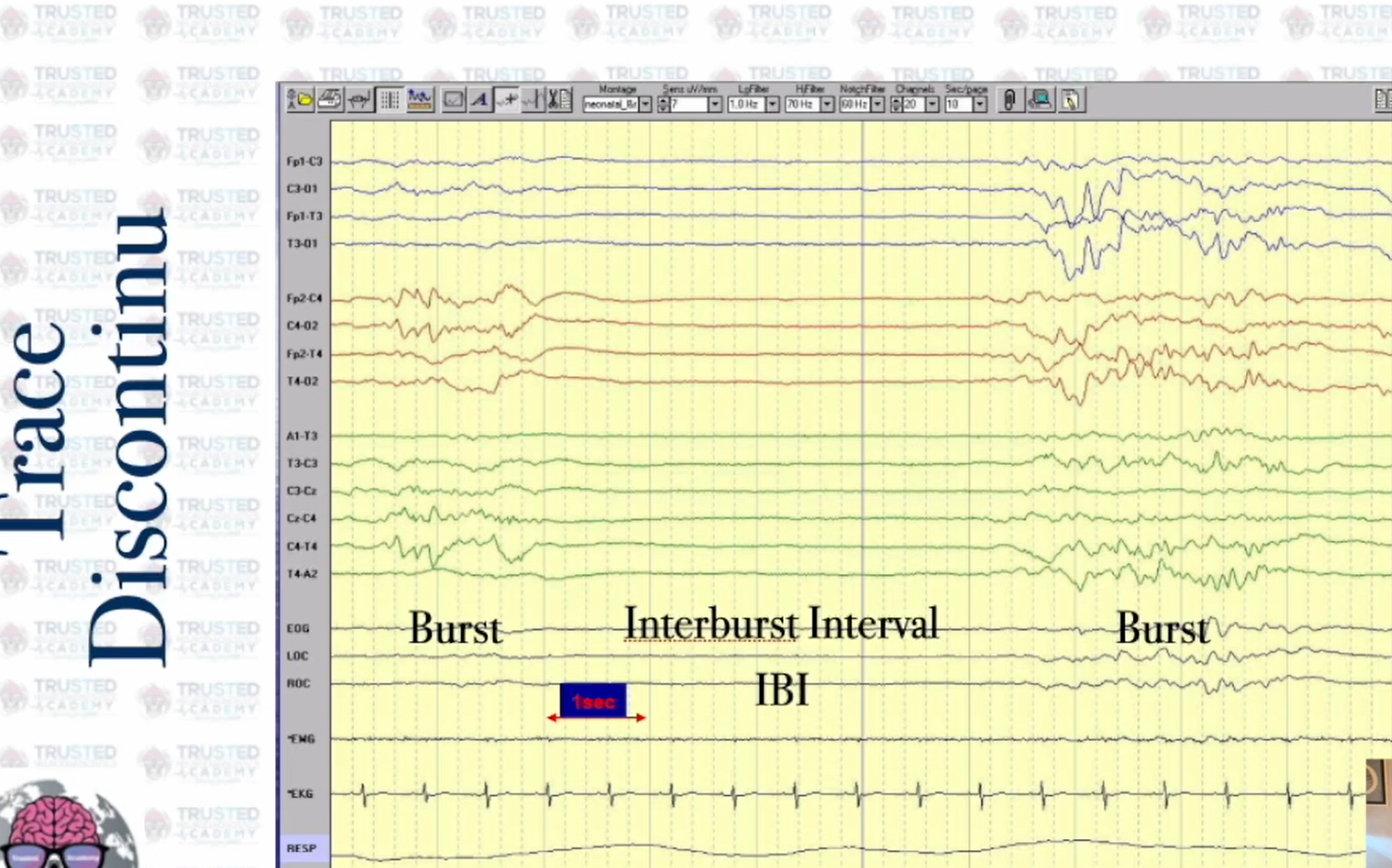
Trace discontinu
intermittent, irregular, mixed bursts of theta-delta with sharp & fast activity interrupted by periods of suppression
IBI <30 seconds under 29 weeks
0.3-1 hz delta burst, sometimes mixed with theta activity of 4-5hz frequency
Trace alternant
has a shorter IBI and higher voltage
35-37 weeks PMA
22-27 weeks PMA
Trace discontinu ( IBI usually 30 seconds, Synchronous bursts of delta to beta activity lasting 1 to several seconds)
Asymmetry between hemispheres
No wake/Sleep on EEG, No reactivity
27-29 weeks PMA
Trace discontinu (IBI usually <30 seconds, bursts longer but morphology is similar to 22-27 weeks)
Asymmetry between hemispheres
Bursts are often synchronous
May see Delta Brush activity
No wake/sleep on EEG
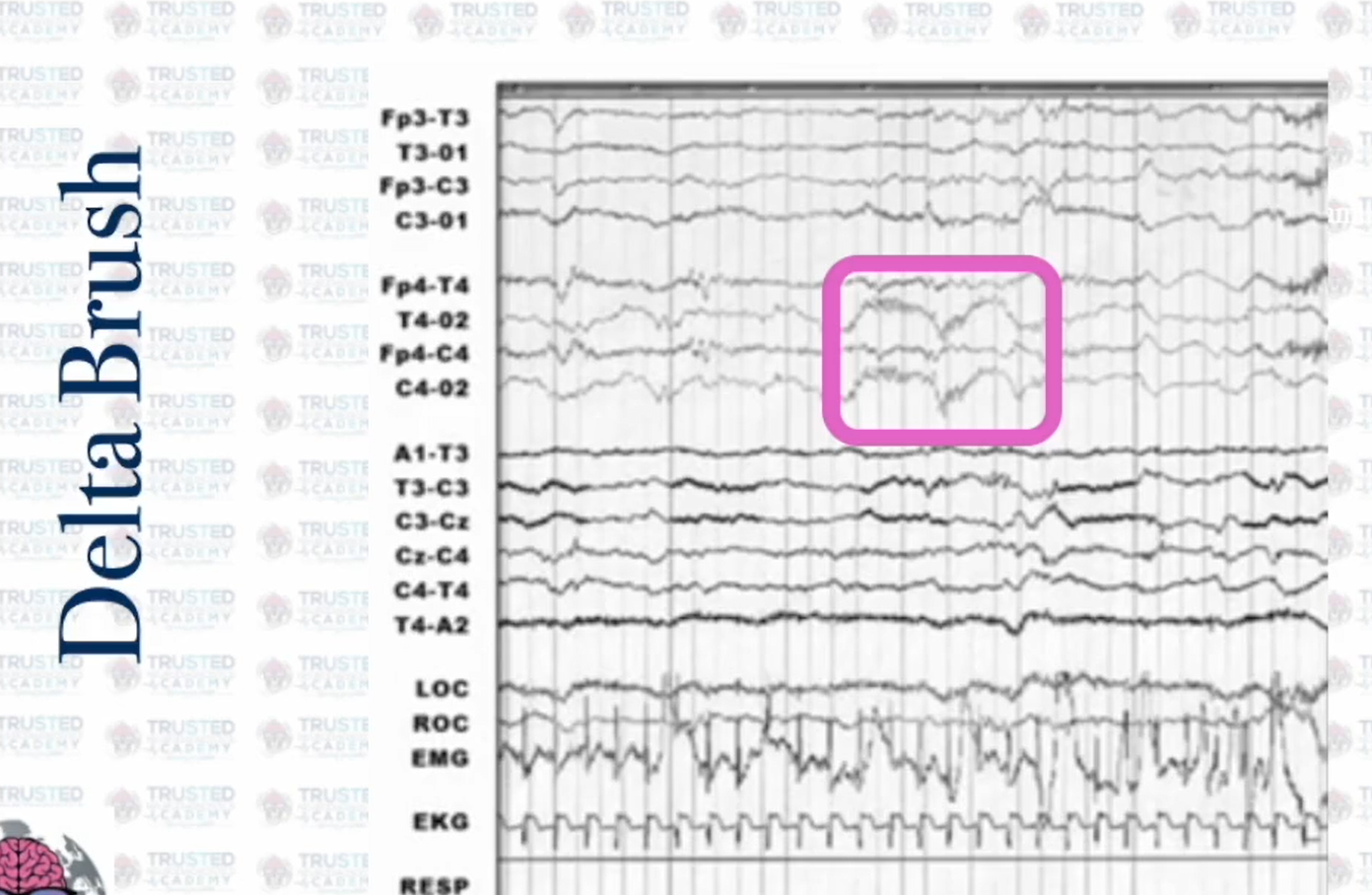
Delta Brush
spindle like fast activity, brushes, rapid bursts & ripples of prematurity
High amplitude delta activity with superimposed fast activity
maximal central, temporal or occipital areas
Appear 27 weeks PMA, abundant 31-34 weeks PMA, disappear by 44 weeks PMA
29-31 weeks PMA
Trace discontinu IBI shorter, bursts are longer
delta brushes more prominent
discontinuity decreasing overall
No differentiation between wake/sleep
New transition develops: Temporal theta bursts/temporal sharp transients. temporal sawtooth waves & Monomorphic occipital delta
Temporal Theta Bursts
Brief bursts of rhythmic, sharply contoured theta activity
4-7hz
150-200uV
29-32 weeks PMA
Synonyms: Temporal sharp transients, Temporal sawtooth waves
Monomorphic Occipital Delta
medium to high amplitude delta activity in the occipital region
1-4hz
150-200uV
29-32 weeks PMA
32-34 weeks PMA
Differentiation between wake, active & quiet sleep begins
Delta Brushes more abundant, spindle portion slower & more dominant
Trace discontinu decreases in discontinuity
New feature: Multifocal sharp transients ( appear during ALL stages)
32-34 weeks PMA awake-clinically eyes open
Trace alternant »»» Continuous
Low amptiude 15-60uV
Mixed theta-delta activity
Superimposed low voltage alpha & beta activity
Multifocal sharps
Delta brushes seen more with awake
32-34 weeks PMA Active sleep-clinically low EMG, frequent movements
background activity resembles low voltage, continuous EEG or active sleep
Delta brushes
Multifocal sharp transients
Only distinction between active sleep & wakefulness is eyes open
32-34 weeks PMA Quiet sleep (Non REM)-Clinically, persistent EMG, Low movements
discontinuity, trace discontinu
Rare delta brushes
Fewer multifocal sharp transients
Activite’ Moyenne
Average amplitude(low to medium voltage)
Average frequency (delta and theta with superimposed beta) activity with little fluctuating in amplitude
Encoches Frontales
frontal sharp transients of high amplitude in the neonate
Occur unilaterally or bilaterally
Asynchronously
Transition from active to quiet sleep
Appear about 35-36 weeks PMA
Sharper at 36-37 weeks PMA
Persist until 44 weeks PMA
34-37 weeks PMA
Quiet sleep - Trace discontinu changed to Trace alternant as infant approaches 37 weeks PMA
Delta brushes more frequent quiet sleep
Bursts should be completely synchronous by 37 weeks PMA
New features: Encoches frontales appear between active and quiet sleep, Activite Moyenne is present during wake and active
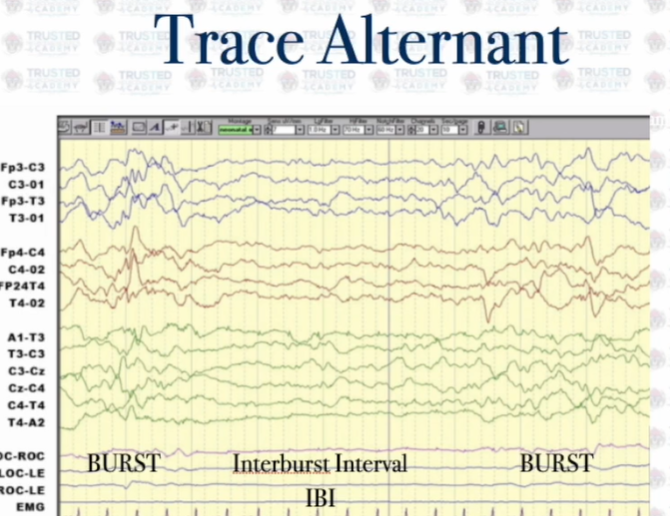
Trace alternant
bursts of theta and delta activity lasting 2-5 seconds, 50-100uV voltage
IBI of lower amplitude mixed frequency activity in the beta and alpha range lasting a second to 30 seconds depending on age
38-40 weeks PMA (full term)
Trace alternant and delta brushes decrease in occurrence
Trace alternant transitions to CSWS
New features: CSWS
40-44 weeks PMA ( full term)
increasing continuity
Increasing activite moyenne
Delta brush disappears by 44 weeks PMA
CSWS replaces trace alternant
New features: Lambda in occipital regions during wake
44-48 weeks PMA (full term)
CSWS is dominant in quiet sleep
Delta brushes are gone
Trace alternant is gone
Entire EEG is continuous & synchronous
Activite moyenne present
New features: PDR starts to develop, V waves develop