Quiz 1 - Feeding and Swallowing
 Call Kai
 Learn
Learn Practice Test
 Spaced Repetition
 Match
Match Flashcards
 Knowt Play
1/80

There's no tags or description
Looks like no tags are added yet.
Name | Mastery | Learn | Test | Matching | Spaced | Call with Kai | Chat |
|---|
No analytics yet
Send a link to your students to track their progress
81 Terms
Who is the mother of dysphagia?
Jeri Logemann
What are some disadvantage of MBSS/VFSS?
1. radiation - limits time for study (1.5-3 minutes)
2. accessibility limited - not portable
What are some disadvantages of FEES?
1. the oral phase cannot be observed
2. gag reflex may interfere with study
3. during swallow, there is a white out
What are some advantages of MBSS/VFSS?
1. you can observe the swallow in multiple positions
2. you can observe the oral phase
What are some advantages of FEES?
1. no radiation - no limit on time
2. it is accessible and portable
Who conducts a Barium Swallow Study (BSS)?
radiologist
What is the scope of practice for SLPs regarding feeding and swallowing?
We can evaluate and manage the oral and pharyngeal phases of swallowing
Where does our scope of practice begin for feeding/swallowing?
the lips
Where does our scope of practice end for feeding/swallowing?
cricopharyngeus muscle (upper esophageal sphincter)
Which cranial nerve innervates the cricopharyngeus muscle (UES)?
Vagus nerve (X)
The oral cavity is a shared system. Another word for this is an __________ system.
aerodigestive
The oral cavity is shared with ______ and _______.
respiration, swallowing
What is the ramus of mandible?
The second portion of the mandible that projects upward at an angle from the posterior part of each mandibular body.
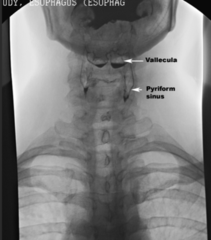
Where is the pyriform sinus located?
above the epiglottis
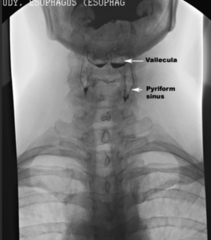
Where is the valleculae?
located between the tongue and epiglottis - valley
What does NG tube stand for?
Nasogastric tube
Where is the duodenum tube located?
below the stomach
An NG tube is inserted through _________________
the nose
The NG tube (specifically nasoduodenal) is _________ in color
yellow
What is the NG tube used for?
feeding
What does PEG tube stand for?
percutaneous endoscopic gastrostomy tube
How is a PEG tube inserted?
through endoscopy
What does J tube stand for?
jejunum tube
How is a J tube inserted?
through general surgery - surpass stomach
NG tubes and nasoduodenal tubes are (short term/long term) solutions.
short term
PEG tubes, G tubes, and J tubes are (short-term/long-term) solutions.
long term
Can SLPs recommend any tube feeding?
No. We can recommend NPO - nil per os (nothing by mouth)
What are some common causes for feeding tubes?
swallowing problems, coma, stomach cancer, psychogenic problems
What is the definition of dysphagia?
difficulty in swallowing
True or false: Dysphagia is a primary medical diagnosis.
False; dysphagia is always a symptom
What are some common causes of dysphagia?
dementia, Parkinson's, head and neck injury, etc.
What are the 4 stages of swallowing?
1. oral preparatory phase
2. oral phase
3. pharyngeal phase
4. esophageal phase
What does the oral preparatory phase entail?
mastication and holding liquid
What does the oral phase entail?
The tongue starts moving, and the bolus goes from anterior to posterior
What does the pharyngeal phase entail?
The bolus enters the pharynx and continues to go toward the esophagus
Where does the pharyngeal cavity begin and the oral cavity end?
the anterior and posterior faucial pillars
The epiglottis is a ___________ cartilage
laryngeal
What is aspiration?
food or liquid passes below the VF into airway
What is penetration?
food or liquid enters the airway and stays above the vocal folds
What is choking?
complete obstruction of airway
What are the levels of the penetration-aspiration scale?
1-2: normal
3-5: penetration
6-8: aspiration
8: silent aspiration
What is a score of 1 on the penetration-aspiration scale?
material does not enter airway
What is a score of 2 on the penetration-aspiration scale?
material enters the airway, remains above the VF, and is ejected from the airway
What is a score of 3 on the penetration-aspiration scale?
material enters airway, remains above VF, and is not ejected from the airway
What is a score of 4 on the penetration-aspiration scale?
material enters airway, contacts the VF, and is ejected from the airway
What is a score of 5 on the penetration-aspiration scale?
material enters the airway, contacts the VF, and is not ejected from airway
What is a score of 6 on the penetration-aspiration scale?
material enters airway, passes below the VF, and is ejected into the larynx or out of the airway
What is a score of 7 on the penetration-aspiration scale?
material enters the airway, passes below the VF, and is not ejected from the trachea despite effort
What is a score of 8 on the penetration-aspiration scale?
material enters the airway, passes below the VF, and no effort is made to eject
What is white out on FEES?
the reflection of the epiglottic inversion
What is the Yale Swallow Protocol (3 oz water protocol)?
give client 3 oz of water to drink continuously, which is enough to produce a cough if aspirating
True or false: the Yale Swallow Protocol (3 oz water protocol) is pass/fail.
true; if the client stops or coughs, they fail
How much time does it take a bolus to go from the pharynx to the esophagus?
less than one second
What is a common breathing pattern in patients with COPD regarding swallowing?
Inhale instead of exhaling after swallowing
What is the first swallow exhalation pattern?
inhale - swallow - exhale
What is the second swallow exhalation pattern?
inhale - small exhalation - swallow - exhale
What is the first step in a clinical evaluation of swallowing?
medical chart review
What is the second step in a clinical evaluation of swallowing?
patient interview
What is the third step in a clinical evaluation of swallowing?
oral mech and cranial nerve exam
What is the final step in a clinical evaluation of swallowing?
performing the clinical swallow evaluation (bedside swallow)
What are signs of pharyngeal dysphagia?
coughing, throat clearing, voice change
How do SLPs diagnose pharyngeal dysphagia?
through instrument evaluation
Where are the three areas a liquid can go in a misdirection of swallowing?
-nasal cavity
-airway (trachea)
-out of mouth
What is the #1 cause of dysphagia?
stroke
Examples of neurological conditions that can lead to dysphagia
-stroke
-TBI
-dementia
-motor neuron disease
-Myasthenia Gravis
-Cerebral Palsy
-Guillain-Barre syndrom
-Poliomyelitis
-Infectious disorders
-Myopathy
-Progressive disorders (Parkinson's, Huntington's, etc.)
-age-related changes
Examples of connective tissue/rheumatoid diseases that can lead to dysphagia
1. polydermatomyositis
2. progressive systemic sclerosis
3. Sjorgren's disease
4. Scleorderma
5. Overlap syndromes
What is an iatrogenic diagnosis?
a side effect of other medical treatment
Examples of iatrogenic diagnoses that can lead to dysphagia
-radiation therapy
-chemo therapy
-intubation and tracheostomy
-post-surgical cervical spine fusion
-post-surgical CABG (coronary artery bypass grafting)
What are the three branches of the Vagus nerve?
pharyngeal nerve, superior laryngeal nerve, recurrent laryngeal nerve
The (left/right) side of the recurrent laryngeal nerve loops around the heart and goes back toward the vocal folds
left side
The (left/right) side of the recurrent laryngeal nerve loops around the subclavian artery and goes back to the vocal folds
right
All cranial nerves are __________
ipsilateral
What does ipsilateral mean?
belonging to or occurring on the same side of the body
If there is left vocal fold analysis, the patient can try a (left/right) head rotation during swallowing.
left
True or false: the superior laryngeal nerve innervates all intrinsic laryngeal muscles.
False; the recurrent laryngeal nerve innervates all intrinsic laryngeal muscles except the cricothyroid
The cricothyroid is innervated by the __________ nerve (a branch of the Vagus nerve)
superior laryngeal nerve
If a patient has difficulty in changing pitch and also has dysphagia, it may be an issue with the __________ muscle and _________ nerve
cricothyroid muscle; superior laryngeal nerve (Vagus)
What are the 4 muscles of mastication?
-temporalis
-masseter
-lateral pterygoid
-medial pterygoid
The _______ nerve innervates the muscles of mastication
trigeminal (V)
What are the three paired laryngeal cartilages?
-arytenoids
-corniculates
-cuneiforms
What are the three unpaired laryngeal cartilages?
-cricoid
-thyroid
-epiglottis