3.9-3.16 Rates of reaction
 Call Kai
 Learn
Learn Practice Test
 Spaced Repetition
 Match
Match Flashcards
 Knowt Play
1/19

There's no tags or description
Looks like no tags are added yet.
Name | Mastery | Learn | Test | Matching | Spaced | Call with Kai | Chat |
|---|
No analytics yet
Send a link to your students to track their progress
20 Terms
Reactions take place at different rates depending on…
Chemicals involved
Conditions of reaction
What is an example of a slow reaction?
Rusting
What is an example of a fast reaction?
Explosions
Fill in the gaps for investigating the effect of SA on rate of reaction:
Add dilute [ ] to the conical flask
Use a [ ] [ ] to connect this flask to an [ ] [ ] [ ] [ ] [ ] in a [ ] [ ]
Add [ ] [ ] [ ] into the [ ] [ ] and close the bung
Measure the [ ] of gas produced in a [ ] time using the measuring cylinder
Repeat with different [ ] of [ ] [ ] [ ]
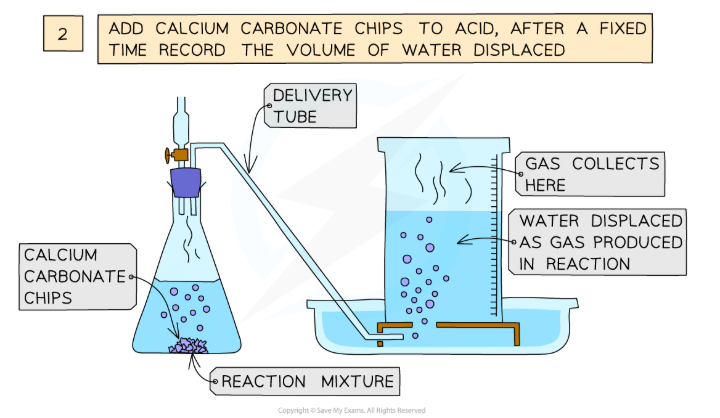
Add dilute HCl to the conical flask
Use a delivery tube to connect this flask to an inverted measuring cylinder upside down in a water trough
Add calcium carbonate chips into the conical flask and close the bung
Measure the volume of gas produced in a fixed time using the measuring cylinder
Repeat with different sizes of calcium carbonate chips
Fill in the gaps for investigating the concentration of a solution on rate of reaction:
Measure 50 cm3 of [ ] [ ] solution into a flask
Measure 5 cm3 of dilute [ ] into a measuring cylinder
Draw a [ ] on a piece of paper and put it [ ] the flask
Add the acid into the flask and [ ] [ ] [ ] [ ]
Look down at the [ ] [ ] [ ] and stop the stopwatch when the cross [ ] [ ] [ ] [ ] [ ]
Repeat using [ ] [ ] of sodium [ ] solution (mix different volumes of sodium thiosulfate solution with water to dilute it)
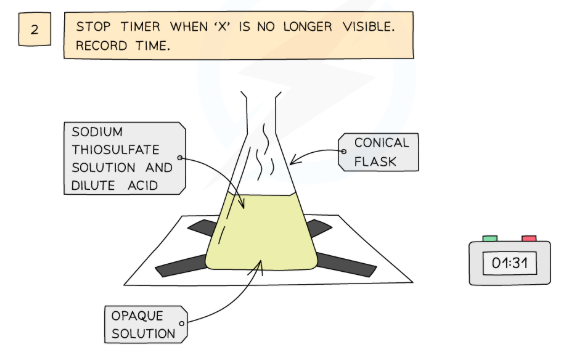
Measure 50 cm3 of sodium thiosulfate solution into a flask
Measure 5 cm3 of dilute HCl into a measuring cylinder
Draw a cross on a piece of paper and put it underneath the flask
Add the acid into the flask and immediately start the stopwatch
Look down at the cross from above and stop the stopwatch when the cross can no longer be seen
Repeat using different concentrations of sodium thiosulfate solution (mix different volumes of sodium thiosulfate solution with water to dilute it)
What will happen to the rate of reaction due to the concentration of a solution increasing?
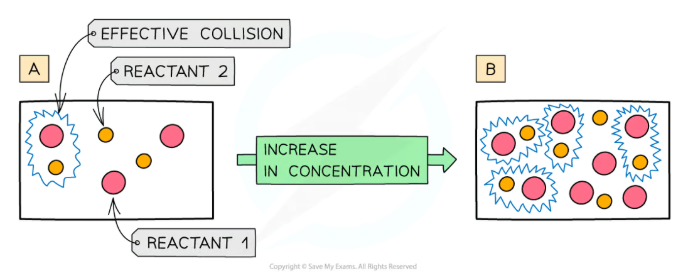
The rate of reaction will increase
Why does increased concentration increase rate of reaction?
More reactant particles in a given volume, allowing more frequent collisions
The number of collisions is [ ] to the number of particles present
Proportional
Fill in the gaps for investigating the effect of temperature on rate of reaction:
Dilute HCl is heated to a [ ] [ ] [ ] [ ] [ ]
Add the dilute HCl into a [ ] [ ]
Add a [ ] [ ] [ ] and [ ] [ ] [ ]
Stop the time when the magnesium [ ] [ ]
Repeat at different temperatures and compare results
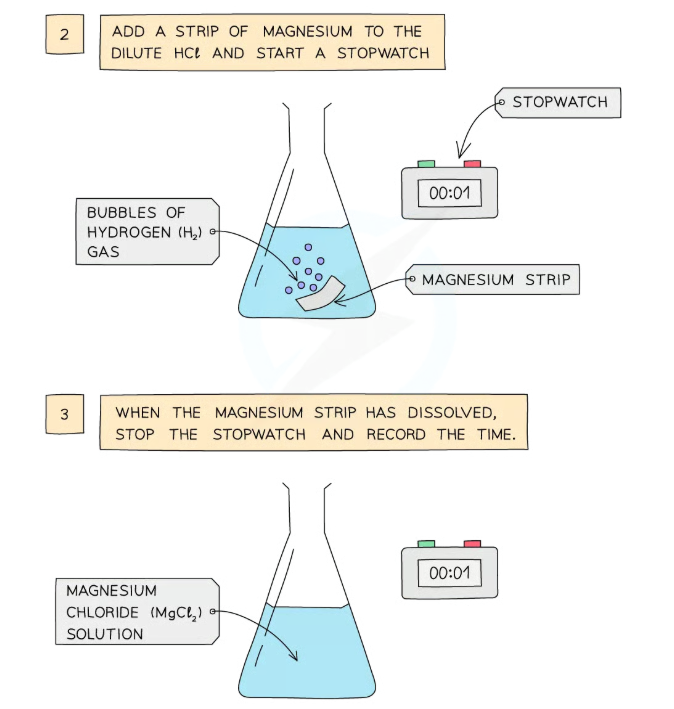
Dilute HCl is heated to a set temperature using a water bath
Add the dilute HCl into a conical flask
Add a strip of magnesium and start the stopwatch
Stop the time when the magnesium fully dissolves
Repeat at different temperatures and compare results
Why does increasing temperature increase rate of reaction?
Particles have more kinetic energy than the required activation energy, so more frequent and more energetic collisions will occur
What are factors that can affect the rate of a reaction?
The [ ] of the reactants in solution or the [ ] of reacting gases
The [ ] of the reaction
[ ] [ ] of solid reactants
The presence of a [ ]
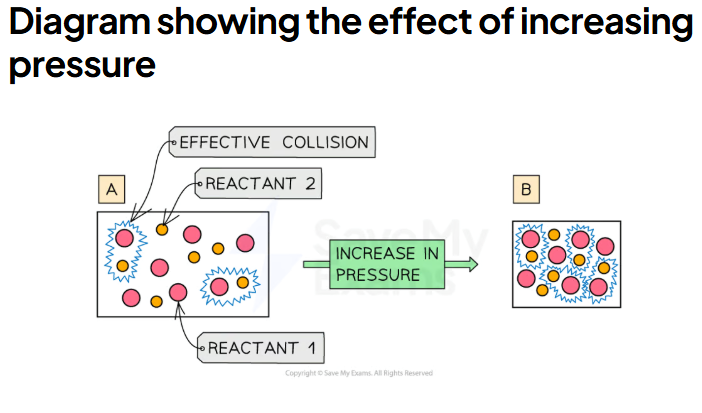
The concentration of the reactants in solution or the pressure of reacting gases
The temperature of the reaction
Surface area of solid reactants
The presence of a catalyst
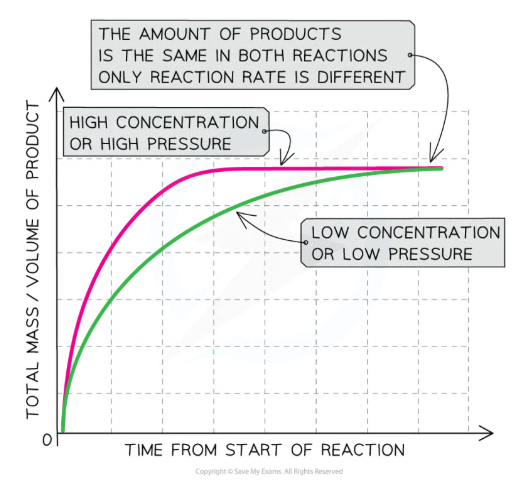
Why is it of economic interest to have a higher rate of reaction?
Implies a higher rate of production and hence a more efficient and sustainable process
Increasing the pressure means that there are the same number of reactant particles in a [ ] volume
Smaller
What are catalysts?
Substances which speed up the rate of a reaction without themselves being altered or consumed in the reaction
What are widely regarded as catalysts as they have variable oxidation states to readily donate and accept electrons?
Transition metals
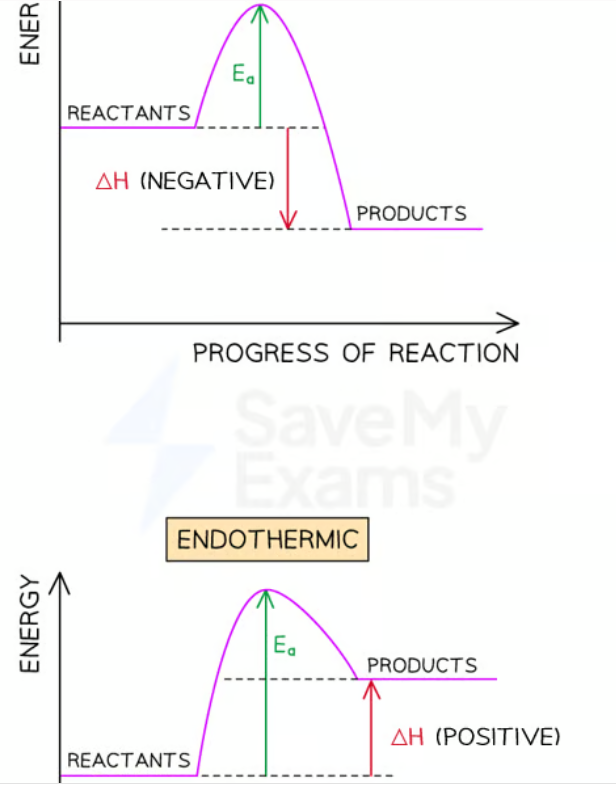
What represents the overall enthalpy change of a reaction in reaction profiles?
The difference in height between the energy of the reactants and of the products
What does the initial increase in energy represent?
The activation energy required to start the reaction
What do catalysts do to the activation energy?
Catalysts lower the activation energy
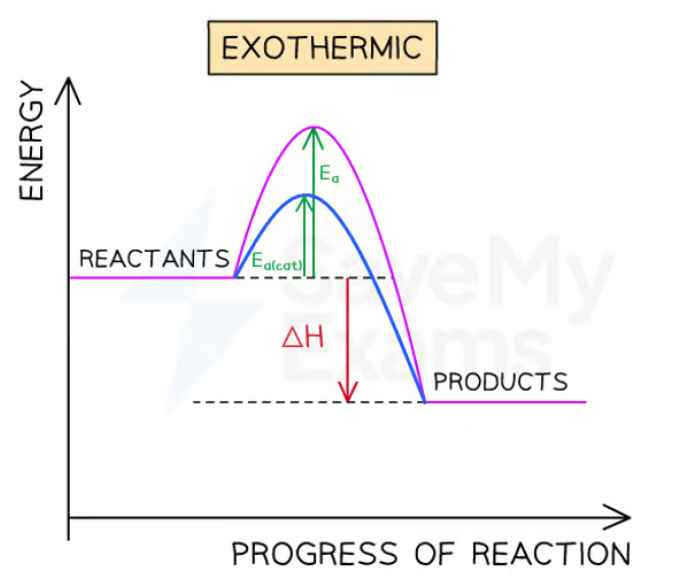
Why does lowering activation energy increase rate of the catalysed reaction?
A greater proportion of the molecules in the reaction mixture will have sufficient energy for an effective collision
Why do reactions with a low activation energy occur readily?
Little energy is needed to break the bonds to start the reaction