How to Practice Science - Week 1
 Call Kai
 Learn
Learn Practice Test
 Spaced Repetition
 Match
Match Flashcards
 Knowt Play
1/5

Earn XP
Description and Tags
Study design/RQ, etc
Name | Mastery | Learn | Test | Matching | Spaced | Call with Kai | Chat |
|---|
No analytics yet
Send a link to your students to track their progress
6 Terms
What does study design involve? How would you go about designing a study?
Study design involves:
RQ and sub-questions
Embedding in previous RQ/research —> there’s always previous knowledge and research into a topic! How are you after something new?
Research plan/methodology
Relevance
Expected Outcome! (Hypothesis)
How do we conduct research? Why?
Discovery/understanding!
We use deductive reasoning = support our inductive reasoning (based on what is already known/may predict outcome), then conduct experiments to produce evidence from which we can deduce to draw valid conclusions
Deductive = from experiements, valid conclusions (e.g. conduct experiement and realize there are also black swans in australia)
Inductive = from previous knowledge/experience/observations, can draw conclusions, but must test, and not neccessarily valid (e.g. all swans i’ve seen are white, so swans are white)
What makes a good RQ?
Things to consider when constructing a RQ:
Why do we want to study something? What is the key question, concern or observation?
What data are needed? What type of data to collect?
How to design the study to get the data needed
Aspects of a good RQ:
Embedded in discipline/research area
Relevant → have a real purpose (specific or broad)
Specific → very clear on what an answer will be/when there will be an answer or conclusion
Functional → answerable + type of study connects
What types of RQ are there?
There are 5 types:
Descriptive:
Questions: What does it look like? Characteristics/qualities, etc.
Answer: List of characteristics/phases/elements without origin or causes
Not science fields → only when barely anything is known
Non-evaluative! No judgement of quality, value, etc.
E.g: “What does X look like?” or “What are most important steps in X?”
Comparison:
Questions: What are the differences between X and Y?
Answer: Overview of similarities/differences of the respective topic categorised and structured in a useful way
Potential topics: Two or more approaches, cultures, systems, objects, etc.
Definition:
Questions: In which category can X be placed? Does X belong to this family? What is the nature of X?
Answer: Statement on the extent to which a phenomenon may or may not be classified in a certain way
Evaluation:
Questions: What is the worth of X? What are the advantages/disadvantages of X?
Answer: Statement about the positive/negative characteristics of a phenomenon
e.g. impact of implementing a law or new technology
Explanation:
Questions: Why is X the way it is? How could X happen? What is X a consequence of?
Answer: Statement about the causes of a phenomenon observed.
Predictive power → often builds on descriptive research
What types of RQ are used in scientific research?
Descriptive
Relational
Interventional
Relies of POCI:
P = Population
O = Outcome
C = Comparison/Connection
I = Intervention
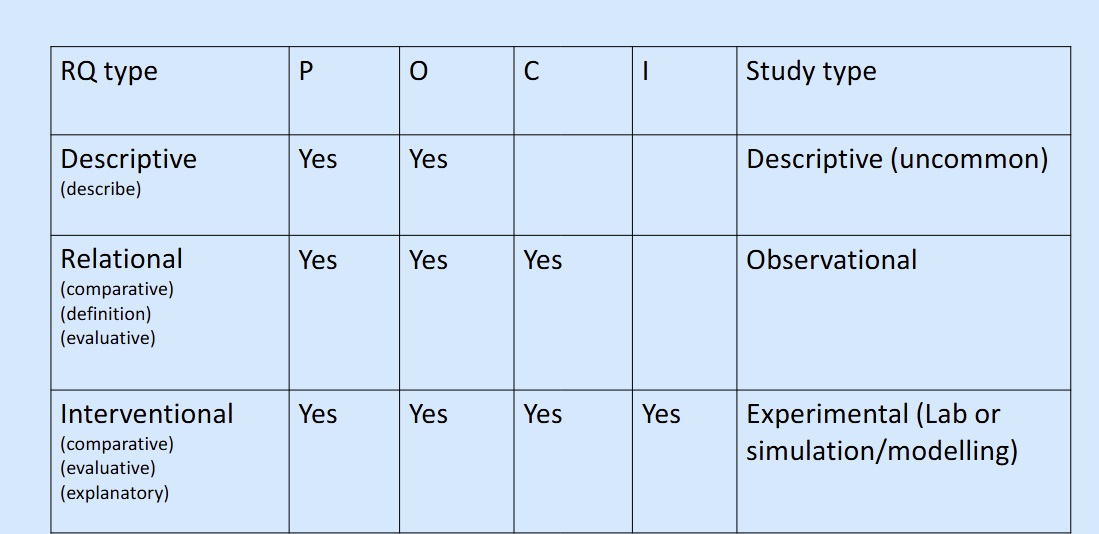
What are common methodologies in science?
Observational
Experimental → includes lab work and simulation