CPrac K - QA
 Call Kai
 Learn
Learn Practice Test
 Spaced Repetition
 Match
Match Flashcards
 Knowt Play
1/14

There's no tags or description
Looks like no tags are added yet.
Name | Mastery | Learn | Test | Matching | Spaced | Call with Kai | Chat |
|---|
No analytics yet
Send a link to your students to track their progress
15 Terms
Describe observation and deductions when addition of KI to unknown solution
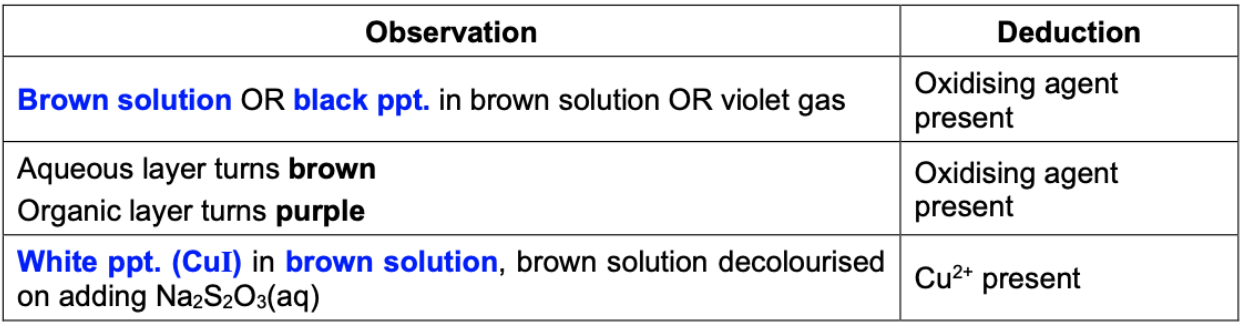
Describe observation and deductions when addition of CuSO4 and Cu2+

Describe deduction from decolourisation of KMnO4, Yellow FeCI3 turns pale green and heating
Decolourisation of KMnO4 -> reducing agent present
Yellow FeCI3 turns pale green -> reducing agent present
Heating
Heating of a solid sample should be done last if its residue is not needed to continue in other tests
Describe the reaction between CO32- and dilute acid (equations)
Acid-base reaction:
CO32- + 2H+ → H2CO3 → CO2 + H2O
CO2 + Ca(OH)2 → CaCO3 + H2O
Excess CO2: CaCO3(s) + CO2(g) + H2O(l) -> Ca(HCO3)2(aq) (CaCO3 dissolves and colourless solution is formed)
Describe the reaction between CI- and AgNO3 followed by NH3
White ppt. is AgCl.
Ag+(aq) + C/-(aq) = AgC/(s) -- (1)
Ag+(aq) + 2NH3(aq) = [Ag(NH3)2]+ (aq)
White ppt. dissolved in NH3(aq) due to formation of [Ag(NH3)2]+ which caused [Ag+] to decrease and hence equilibrium position of (1) will shift to the left
Describe the reaction between Br- and AgNO3 followed by NH3
Pale cream ppt. is AgBr
Br ion has a more polarisable charge cloud as it has a larger size than Cl-. Hence AgBr is partially soluble in NH3(aq) due to its greater covalent character.
Describe test for I-

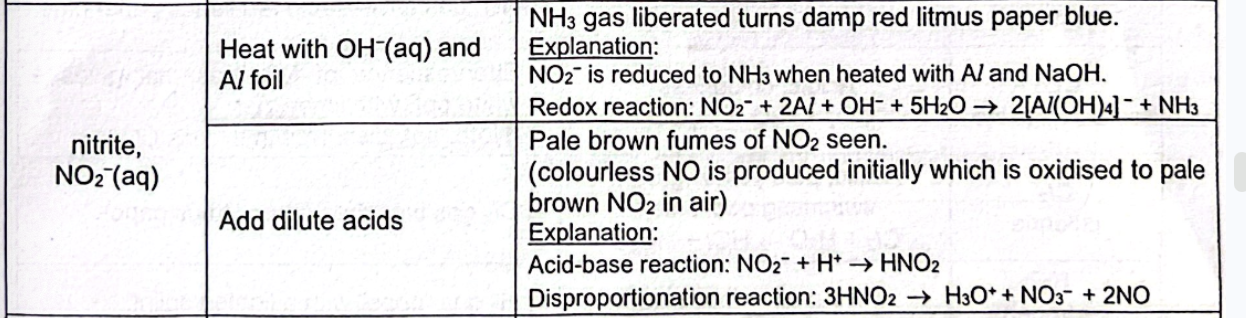
Describe 2 tests for NO2-
Describe test for NO3-

Describe test for SO42-

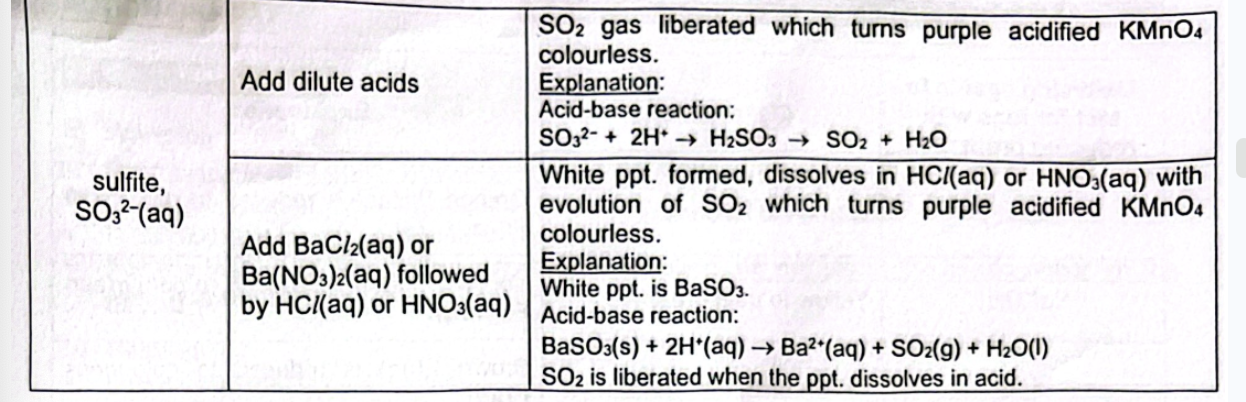
Describe test for SO32-
How to differentiate NO2− from NO3−
Add dilute hydrochloric or sulfuric acid and warm
If brown NO2 gas (or fumes) is evolved, then NO2− is present
How to differentiate SO32− from SO42−
Add dilute hydrochloric or nitric acid to the solution and warm
If pungent SO2 gas is evolved which decolourises acidified KMnO4(aq), then SO32− is present
BaSO4 is insoluble in aqueous acid
How to differentiate Br- and I- (OTHER than AgNO3)
Add some dilute H2SO4 and an equal volume of KMnO4(aq) to separate samples of both ions (oxidised both anions)
Add an equal volume of hexane, shake well and observe the colour of the hexane layer
Br2 gives an orange-red colour in hexane while I2 gives a purple colour in hexane
Precaution when warming
Apply the heating, using a gentle flame, near the surface of the liquid -> reduces the risk of the solution spurting out of the tube
Wear goggles