[10] Environmental Laws and Regulation
 Call Kai
 Learn
Learn Practice Test
 Spaced Repetition
 Match
Match Flashcards
 Knowt Play
1/55

There's no tags or description
Looks like no tags are added yet.
Name | Mastery | Learn | Test | Matching | Spaced | Call with Kai | Chat |
|---|
No analytics yet
Send a link to your students to track their progress
56 Terms
P.D. 1586
ENVIRONMENTAL IMPACT STATEMENT SYSTEM
Environmental Impact Assessment (EIA)
The process involving predicting and evaluating the likely impacts of a project on the environment during construction, commissioning, operation, and abandonment.
Environmental Compliance Certificate (ECC)
According to Section 4 of P.D. 1586, this is the mandatory legal document that no person, partnership, or corporation shall undertake or operate an Environmentally Critical Project (ECP) or Area (ECA) without securing first.
Environmental Compliance Certificate (ECC)
A document issued by DENR/EMB after a positive review of an ECC application, certifying that based on the representations of the proponent, the proposed project or undertaking has complied with all requirements of the EIS System and committed to implement its approved Environmental Management Plan (EMP).
1. Proponent's Information
List of conditions within EMB mandate
List of recommendations pertaining to compliance/satisfaction to concerned LGUs/agencies/stakeholders
The three required contents of an Environmental Compliance Certificate (ECC).
1. There is no significant project expansion
There is no change in technology
There is no change in location
Project was implemented within five (5) years from the date of issuance
The complete conditions under which an ECC remains valid throughout the entire project lifetime.
Certificate of Non-Coverage (CNC)
The document issued by DENR stating that a proposed project is not covered by the Philippine Environmental Impact Assessment System, meaning the proponent is not required to secure an ECC prior to commencement of operation.
Category A
Under MC 2014-005, the EIA project category defined as Environmentally Critical Projects (ECP) required to secure an ECC using an Environmental Impact Statement (EIS).
Category B
Under MC 2014-005, the EIA project category defined as Non-Environmentally Critical Projects (Non-ECP) required to secure an ECC using an EIS or Initial Environmental Examination (IEE) Checklist.
Category D
Under MC 2014-005, the EIA project category defined as Not Covered by the EIS System, which may secure a Certificate of Non-Coverage (CNC) using Project Description (PD Part I only).
Pollution Control Officer (PCO)
A technical person competent in pollution control and environmental management, performing duties and responsibilities in an establishment, and officially accredited by the EMB Regional Office.
1. Establishments that discharge solid, liquid, or gaseous wastes, or whose activities/products/services are potential sources of land, air, or water pollution
Local Government Units (LGUs)
Development Authorities
Government-Owned and Controlled Corporations (GOCCs) and other public establishments
Establishments, entities, and government bodies that are required to appoint an accredited Pollution Control Officer.
1. Ambulant vendors and stall owners as defined under RA 6977
Materials Recovery Facilities (MRFs) operated by Barangays that do NOT handle hazardous wastes
The specific entities and facilities explicitly exempted from needing a Pollution Control Officer.
1. ___vendors and stall owners as defined under RA ____
___ operated by Barangays that do NOT handle hazardous wastes
1. Chemical Usage
Hazardous waste generated/handled
Air emission
Wastewater discharge
Solid waste generated/handled
Sludge generated/handled
The six operational criteria used to determine the categorization of a Pollution Control Officer (PCO).
1. ___Usage
___ waste generated/handled
___ emission
___ discharge
___ waste generated/handled
___ generated/handled
1. Ensure compliance with requirements of PD 1586, RA 6969, RA 8749, RA 9003, RA 9275, their IRRs, and related regulations
Attend to all permitting and registration requirements prior to construction, installation, or operation of sources and control facilities
Attend technical conferences, hearings, and meetings regarding pollution cases of their establishment
Initiate and intensify environmental management activities and awareness campaigns within their organization
The primary duties and responsibilities of an accredited Pollution Control Officer.
1. Ensure compliance with requirements of ___, and related regulations
Attend to all permitting and registration requirements prior to construction, installation, or operation of sources and control facilities
Attend technical conferences, hearings, and meetings regarding ___ of their establishment
Initiate and intensify ___ activities and awareness campaigns within their organization
DAO 2014-02
1. Ensure compliance with requirements of PD 1586, RA 6969, RA 8749, RA 9003, RA 9275, their IRRs, and related regulations
Attend to all permitting and registration requirements prior to construction, installation, or operation of sources and control facilities
Attend technical conferences, hearings, and meetings regarding pollution cases of their establishment
Initiate and intensify environmental management activities and awareness campaigns within their organization
RA 9275 / DAO 2016-08
WATER QUALITY & EFFLUENT STANDARDS
Public Water Supply Class I - Intended primarily for waters requiring processing (disinfection) to meet the National Standards for Drinking Water (NSDW)
Freshwater classification Class AA intended beneficial use.
Public Water Supply Class II - Intended for sources requiring conventional treatment (coagulation, sedimentation, filtration, disinfection) to meet NSDW
Freshwater classification Class A intended beneficial use.
Recreational Water Class I - Intended for primary contact recreation (bathing, swimming, skin diving, etc.)
Freshwater classification Class B intended beneficial use.
1. Fishery Water (propagation & growth of fish & other aquatic resources)
Recreational Water Class II (boating, fishing, etc.)
Agriculture, Irrigation, and Livestock Watering
Freshwater classification Class C intended beneficial uses.
Navigable waters
Freshwater classification Class D intended beneficial use
1. Protected Waters (National Parks, sanctuaries)
Fishery Water Class I (shellfish harvesting for direct human consumption)
Marine water classification Class SA intended beneficial uses.
1. Fishery Water Class II (commercial production)
Tourist Zones and Recreational Water Class I (swimming, skin diving)
Marine water classification Class SB intended beneficial uses.
1. Fishery Water Class III (propagation & growth of fish)
Recreational Water Class II (boating)
Marshy and/or mangrove areas declared as fish sanctuaries
Marine water classification Class SC intended beneficial uses.
Navigable waters
Marine water classification Class SD intended beneficial use.
BOD, Total Suspended Solids, Total Coliform (for Class B & SB), Ammonia, Phosphate
Significant effluent parameters for Animal Production (PSIC 014) under DAO 2016-08 Table 8
pH, Total Suspended Solids, Nitrate, Cyanide, Copper, Zinc, Arsenic, Mercury, Lead (Platinum also includes Sulfate, Manganese, Iron, Cadmium)
Significant effluent parameters for Gold, Silver, and Platinum Ore Mining (PSIC 0722) under DAO 2016-08 Table 8.
Quezon City, Pasig City, Taguig City, Muntinlupa City, Marikina City, Pateros
Metro Manila cities falling under the jurisdiction of the Laguna Lake Development Authority (LLDA) for wastewater discharge permitting instead of EMB-NCR
Manila, Makati City, Mandaluyong City, San Juan City, Las Piñas City, Parañaque City, Navotas City, Pasay City, Malabon City, Caloocan City, Valenzuela City
Metro Manila cities falling directly under EMB-NCR Jurisdiction for discharge permitting.
1. Discharging, depositing, or causing to be deposited material of any kind directly or indirectly into water bodies or along margins
Discharging regulated water pollutants without a valid discharge permit
Refusal to allow entry, inspection, monitoring, and access to reports/records
Disposal of potentially infectious medical wastes into seawater by vessels
Refusal or failure to submit reports and/or designate a Pollution Control Officer
List of prohibited acts under Republic Act 9275.
1. Discharging, depositing, or causing to be deposited material of any kind directly or indirectly into water bodies or along margins
Discharging regulated water pollutants without a valid discharge permit
Refusal to allow entry, inspection, monitoring, and access to reports/records
Disposal of potentially infectious medical wastes into seawater by vessels
Refusal or failure to submit reports and/or designate a Pollution Control Officer
RA 8749
CLEAN AIR ACT REGULATIONS
1. Source Sampling
Motor Vehicle Emission Test (DOTr thru LTO)
Continuous Ambient Air Quality Monitoring Stations
The three main air sampling activities conducted under RA 8749.
APSI: Boiler, Furnace, Generator Set, Gasoline Station
APCD/F: Cyclone, Scrubber, Filter Baghouse, Precipitator
Examples of Air Pollution Source Installations (APSI) and Air Pollution Control Devices/Facilities (APCD/F) required to maintain a valid Permit to Operate (PTO).
Boiler, Furnace, Generator Set, Gasoline Station
APSI
Cyclone, Scrubber, Filter Baghouse, Precipitator
APCD/F
Mandatory installation of CCTVs on stacks of fuel-burning equipment
Requirement established by DAO 2008-81 for stack monitoring of fuel-burning equipment.
Equipment criteria explicitly exempted from source compliance emission testing under MC 2016-008
1. Boilers rated <=50 hp
Diesel Generator Sets rated <= 300 kW
Sources producing <=10 T per year of air pollutant
Particulates, Sulfur Oxides , Nitrogen Oxides , Ozone, Carbon Monoxide, Lead, Volatile Organic Compounds (VOCs)
The primary air criteria pollutants regulated under the Philippine Clean Air Act.
RA 6969 & DAO 2013-22
TOXIC SUBSTANCES & HAZARDOUS WASTE
Philippine Inventory of Chemicals and Chemical Substances (PICCS)
The national inventory list of all existing chemicals and chemical substances used, sold, distributed, imported, processed, manufactured, stored, exported, treated, or transported in the Philippines.
To screen harmful substances before they enter the commerce of the Philippine
Purpose of the Pre-Manufacturing and Pre-Importation Notification (PMPIN) system.
Priority Chemical List (PCL) definition
A list of existing and new chemicals that DENR has determined to potentially pose an unreasonable risk to public health, workplace, and the environment
Chemical Control Order (CCO)
An order that prohibits, limits, or regulates the use, manufacture, import, export, transport, processing, storage, possession, and wholesale of priority chemicals that DENR determined should be regulated, phased-out, or banned due to serious risks to public health, workplace, and environment
Mercury , Lead, Cyanide , Polychlorinated Biphenyls , Ozone Depleting Substances , Arsenic , Cadmium , Vinyl Chloride, Benzene, Chromium
Specific regulated/banned chemical substances explicitly listed as subject to Chemical Control Orders (CCO) or Priority Control.
Online Manifest System covering Proper Storage, Packaging, Labeling, Transport, and Treatment ("from cradle to grave")
The standard administrative system required for proper hazardous waste management under DAO 2013-22.
RA 9003
SOLID WASTE MANAGEMENT MANDATES
1. National Solid Waste Management Commission (NSWMC)
National Ecology Center (NEC)
Solid Waste Management Board in every province, city, and municipality
The institutional entities created at national and local levels under RA 9003 to oversee ecological solid waste management.
1. Formulation of the National Solid Waste Management Framework
10-year solid waste management plans by LGUs
Establishment of Materials Recovery Facility (MRF) in every barangay or cluster of barangays
Prohibition against open dumps and guidelines for controlled dumps and sanitary landfills
The four major operational mandates and facility guidelines set forth by RA 9003.
1. Provision of rewards/incentives (fiscal and non-fiscal), financial assistance, and grants to LGUs and public
Mandatory segregation of solid waste conducted primarily at source (household, institutional, industrial, commercial, agricultural)
Minimum requirements for systematic collection/transport and protection of garbage collectors' health
Key policy provisions under RA 9003 regarding incentives, segregation, and collection standards.
₱15,000.00
The DENR application fee for an ECC requiring a Programmatic EIS or EIS.

FLASHCARD 24

FLASHCARD 28
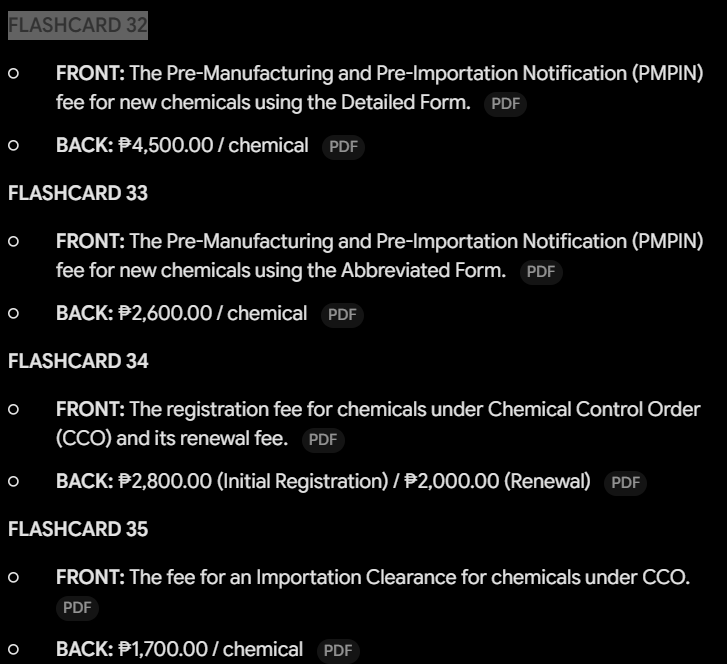
FLASHCARD 32
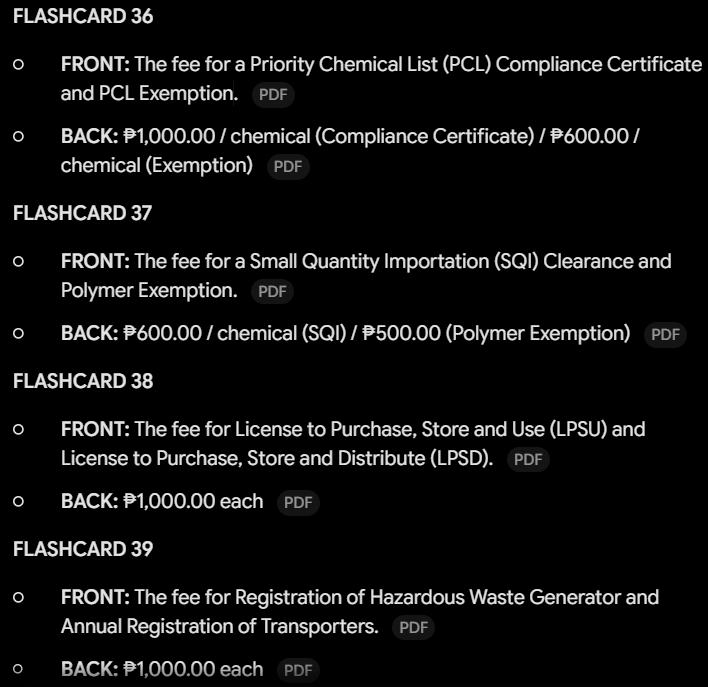
FLASHCARD 36