Lab 2 Cyanobacteria & Algae
 Call Kai
 Learn
Learn Practice Test
 Spaced Repetition
 Match
Match Flashcards
 Knowt Play
1/72

There's no tags or description
Looks like no tags are added yet.
Name | Mastery | Learn | Test | Matching | Spaced | Call with Kai | Chat |
|---|
No analytics yet
Send a link to your students to track their progress
73 Terms
What group is Closterium in?
Desmid Green Algae
What characteristics does Closterium have?
Unchanging Cell Shape
Appearing non-motile or motile
Very thin with pointy ends
Slightly crescent-shaped with two equal halves
The nucleus is in the middle of the cell
Each half contains one chloroplast
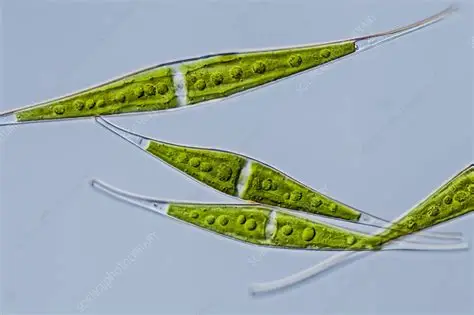
What organism is this?
Closterium
Unchanging Cell Shape
Appearing non-motile or motile
Very thin with pointy ends
Slightly crescent-shaped with two equal halves
The nucleus is in the middle of the cell
Each half contains one chloroplast
What organism has these characteristics?
Closterium
What characteristics are there of Euglena?
Cells shape changes frequently
Definitely motile
Not so thin with rounded ends
Patch of red pigment (eyespot) near flagellum insertion
What group is euglena in?
Euglenoids
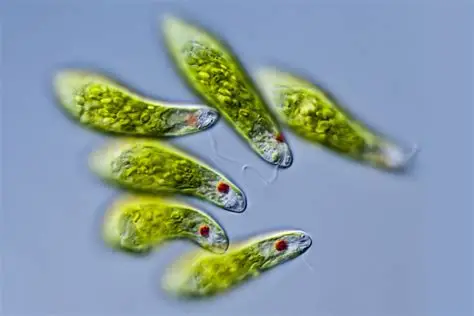
What organism is this?
Euglena
Cells shape changes frequently
Definitely motile
Not so thin with rounded ends
Patch of red pigment (eyespot) near flagellum insertion
What organism has these characteristics?
Euglena
How do Closterium and Euglena differ?
Closterium has an unchanging cell shape, appears to be non-motile, is very thin with pointy ends, has two equal halves, the nucleus is in the middle, and each half contains one chloroplast.
Euglena has a frequent changing cell shape, definitely motile, not as thin with rounded ends, and a patch of red pigment (eyespot) near flagella insertion.
What characteristics are there of Chlamydomonas?
Cells ovoid
Motile
Small groove on the narrower end of 2 flagella inserts
Red eyespot typically visible
What group is Chlamydomonas in?
Green Algae
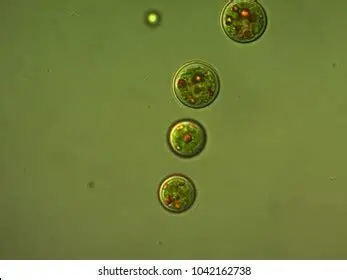
What organism is this?
Chlamydomonas
Cells ovoid
Motile
Small groove on the narrower end of 2 flagella inserts
Red eyespot typically visible
What organism has these characteristics?
Chlamydomonas
What is the difference between Euglena and Chlamydomonas?
Euglena has a cell shape that frequently change and it has a rounded edge.
Chlamydomonas has an ovoid shape and has two flagellum while Euglena has one flagella.
Both have a red eyespot
What characteristics are there of Chlorella?
Round Cells
Not apparently motile (not flagellate)
No red spots
What group is Chlorella in?
Green Algae
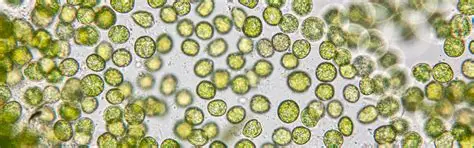
What organism is this?
Chlorella
Round Cells
Not apparently motile (not flagellate)
No red spots
What organism has these characteristics?
Chlorella
How do Chlamydomonas and Chlorella differ?
Chlamydomonas are motile, has an ovoid shape, have flagellum, and have a red eyespot
Chlorella are not apparently motile due to not being a flagellate, a round shape, and no red eyespot.
What characteristics are in Volvox?
Round colonies
Some cells are green or golden green
What group is Volvox in?
Green Algae
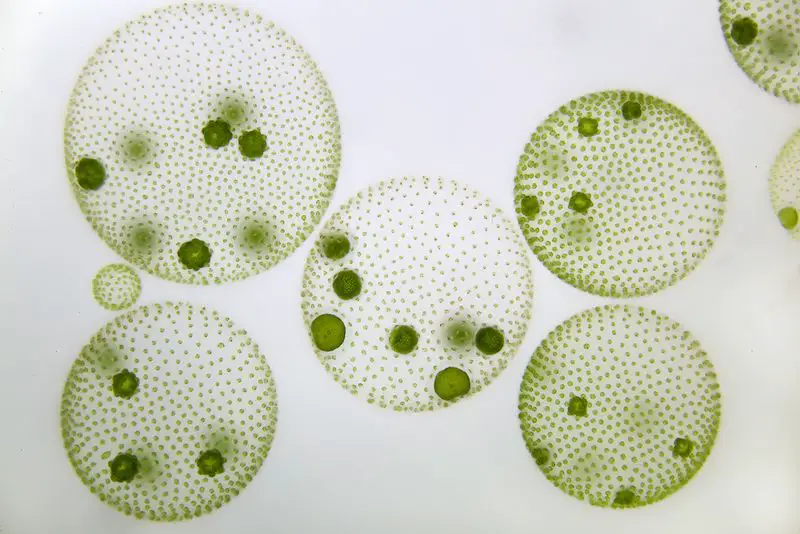
What organism does this show?
Volvox
Round colonies
Some cells are green or golden green
What organism has these characteristics?
Volvox
How do Chlorella and Volvox differ?
Chlorella are free floating unicellular organisms.
Volvox are colonial unicellular organisms.
What characteristics are in Anabaena?
Filaments with constrictions between cells
Blue-green color
What group is Anabaena is?
Cyanobacteria

What organism does this show?
Anabaena
Filaments with constrictions between cells
Blue-green color
What organism has this?
Anabaena
What characteristics does Oscillatoria have?
Filaments without constrictions between cells
Sometimes moving
Blue-green color
What group is Oscillatoria in?
Cyanobacteria
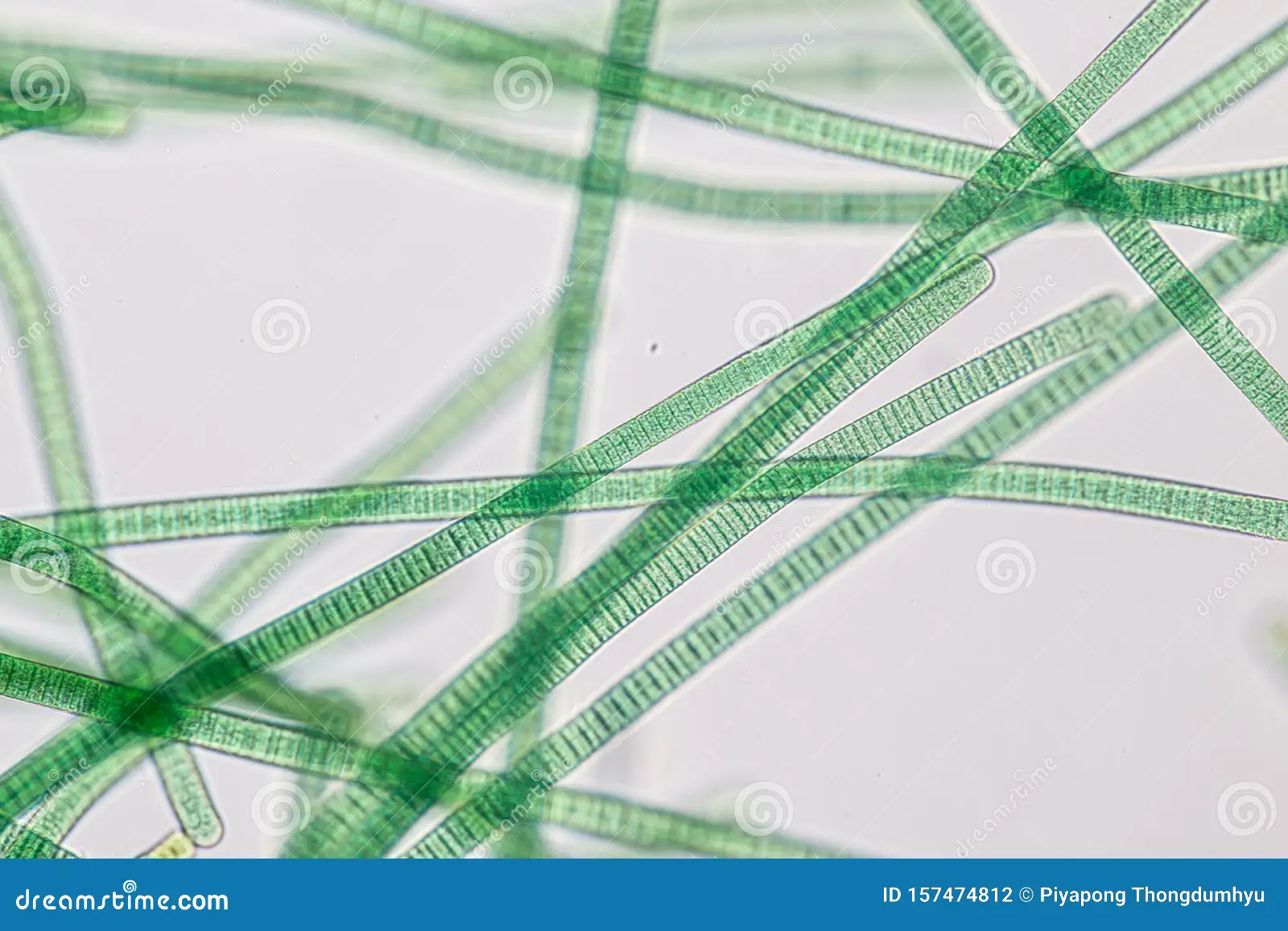
What organism does this show?
Oscillatoria
Filaments without constrictions between cells
Sometimes moving
Blue-green color
What organism has these characteristics?
Oscillatoria
How do Anabaena and Oscillatoria differ?
Anabaena has constrictions between cells.
Oscillatoria does not have constrictions between cells and it sometimes moves.
What characteristics does Spirogyra have?
Chloroplast in each cell is not round
Somewhat coiled
Multicellular
What group is spirogyra in?
Green Algae

What organism is shown?
Spirogyra
Chloroplast in each cell is not round
Somewhat coiled
Multicellular
What organism has these characteristics?
Spirogyra
What characteristics does Oedogonium have?
Round chloroplast
Multicellular

What organism does this show?
Oedogonium
Round chloroplast
Multicellular
What organism has these characteristics?
Oedogonium
What group is Oedogonium in?
Green Algae
How do Spirogyra and Oedogonium differ?
Spirogyra has coiled chloroplast while Oedogonium has round chloroplast
What characteristic does Synedra have?
Light golden brown chloroplast
Highly transparent glass-like cell walls
Cells elliptic or oblong
What group is Synedra in?
Diatom
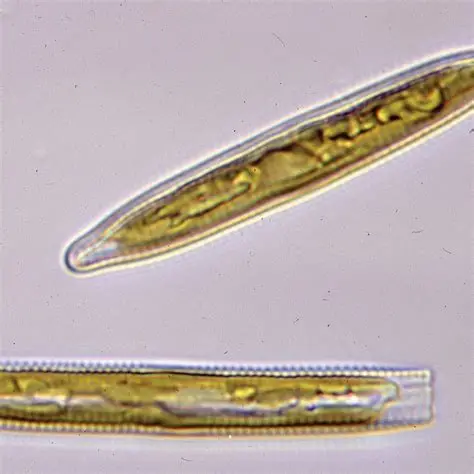
What organism is this?
Synedra
Light golden brown chloroplast
Highly transparent glass-like cell walls
Cells elliptic or oblong
What organism has these characteristics?
Syndera
Cyanobacteria Characteristics
Prokaryote
Unicellular
Plasmid DNA → circular chromosomes
Binary Fission
Binary Fission?
3rd way to divide a cell
Only for prokaryotes
cell exists, grows 2x bigger, then divides
What cell types are under unicellular?
Filamentous
Colonial
Algae main characteristics
Eukaryotic
Photosynthetic
Kingdom Protista
Uni and multicellular
NOT embryophytes
Algae Major Classifications
Euglenoids
Dinoflagellates
Diatoms
Seaweeds
Brown algae
Red algae
Green algae

Form: Unicellular
Pigment(s): Chlorophyll a, Chlorophyll b,
Cell Wall: Pellicle
Distinguishing Characteristics: Contractile vacuole, eyespot
Euglenoids characteristics
Pellicle
Auto and heterotrophic
Contractile vacuole
Eyespot
Pellicle
like a cell wall, thin
Contractile vacuole
collects and expels excess water
Eyespot
Photoreceptive organelle
allows to sense light

Form: Unicellular
Pigment(s): Peridinin
Cell Wall: Theca plate
Distinguishing Characteristics: 2 flagella, theca plate
Dinoflagellates characteristics
Theca plate
Auto and heterotrophic

What group is this organism apart of and what does it cause?
Dinoflagellates and it causes red tide
Theca plates
can’t stretch
segments on cell (normally 4)
like body armor

Form: Unicellular
Pigment(s): Fucoxanthin
Cell Wall: Frustule
Distinguishing Characteristics: pennate and centric
Diatom Characteristics
Phytoplanton
Frustule
Symmetry:
Pennate
Centric
Floats through water because no movement structure
Frustule
Silica (glass like)
think of a petri dish
Pennate means ____ and Centric means ____
linear, circular
Seaweed
Algae not a plant
Thallus body
Kinda like a sponge
Thallus body
Multicellular
Lacks tissue differentiation (homoegenous) → lacks xylem

Form: Multicellular
Pigment(s): Fucoxanthin
Cell Wall: Cellulose
Distinguishing Characteristics: Blade, stipe, gas bladder
What is brown algae?
Kelp

Form: Multicellular
Pigment(s): Phycobilin
Cell Wall: Cellulose
Distinguishing Characteristics: blade, stipe, gas bladder
Phycobilin
pigment that absorbs blue light → gives a pinkish color to plants when they are brought to surface
Red Algae
Deep water habitat
Rigid (calcium)

Form: Multicellular, Unicellular, colonial, and filamentous
Pigment(s): Chlorophyll b
Cell Wall: Cellulose
Distinguishing Characteristics: Transition to true plants
Green Algae classes
Chlorophyta
Uluvophyta
Carophyta