Module 3: Factors Impacting Learning
 Call Kai
 Learn
Learn Practice Test
 Spaced Repetition
 Match
Match Flashcards
1/29

There's no tags or description
Looks like no tags are added yet.
Name | Mastery | Learn | Test | Matching | Spaced | Call with Kai | Chat |
|---|

30 Terms
Locus of Control (LOC)
There are two ways to motivate students, and neither is effective for ALL students.
External Motivation
People who believe that life is not in their control and that control is in the hands of others or is up to fate. the challenge is finding the reinforcement they want.
Internal Motivation
motivated by their internal goals and desires. believe they are in control, or reasonably so. They have a positive sense of self-efficacy or belief about what they can accomplish and control in their lives.
motivation formula.
A Task Worth Accomplishing + A Sense that They can be Successful = Motivation
A Task Worth Accomplishing (Students' Perception)
There is a compelling need (Maslow). |
The task is motivating. |
Completing the task will achieve a personal goal. |
The task elicits curiosity. |
There is a desire to understand. |
A Sense that They Can Be Successful (Students' Perception)
They have been successful in the past at similar tasks. |
There is a safe environment to encourage risk. |
Failure may only be known to the teacher. |
Completing the task will result in a reward. |
Completing the task will avoid punishment. |
a clearly defined _______ for learning is essential to your students’ motivation.
purpose
Factors influencing a student's readiness to learn.
Learner Mindset
Health and Home Life
Previous Experience
Prior Knowledge
Self-Efficacy
Learner Mindset
Learning occurs best when the student is in a state of relaxed alertness.
Health and Home Life
A student’s health and home life are significant factors in their readiness to learn. You cannot control your student’s home life, but getting to know them personally will help you account for distractions they may carry into your classroom.
Previous Experience
Diverting from the specific lesson to review your students’ experiences and concepts is an excellent way to connect the curriculum to their life experiences. Try to relate your lessons to various experiences that will be relatable to many or most of your students, and express equal appreciation for each student’s frame of reference, no matter how varied.
self-concept
our impressions, feelings, attitudes, and beliefs about ourselves.
The focus of the classroom should be _________, not performing.
learning
This learning vs. performing objective
creates a safe place to take risks and try new things. Fear of failure is replaced with an opportunity to learn.
As a teacher, be positive.
If a student has a poor performance, focus on the positives. If their test score is better than last time, even if it is still not on target, focus on the improvement. Help them set a goal for a little more improvement next time. Utilize the power of "not yet". If possible, give actionable feedback that allows for continued improvement. Statements that honor the thinking and struggle are powerful. "I can see how hard you worked on this problem. You should be proud of your effort. Take another look at ..... and ask yourself..... You're on the road. You haven't solved it yet, but you will."
Be a positive teacher
Provide positive reinforcement frequently. Reward the effort and growth behind the score. Make yourself available to students and be a good listener. Help them to see the possibilities in their lives. Be an encourager. Make positive eye contact with every student with a smile every day, if possible. Use their names frequently, and try to speak personally with each student often. Show them they are special.
Developmental Assets
Support- Young people need to be surrounded by people who love, care for, appreciate and accept them.
Empowerment- Young people need to feel valued and valuable. This occurs when youth feel safe, believe they are liked and respected and when they contribute to their families, schools, and communities.
Boundaries and Expectations- Young people need the positive influence of their peers and adults who encourage them to be and do their best.
Constructive Use of Time- Young people need the opportunity to learn and develop new skills and interests.
Commitment to Learning- Young people need a variety of learning experiences that cultivate a desire for academic success, a sense of the lasting importance of learning, and a belief in their own abilities.
Positive Values- Young people need to develop strong guiding values, such as care for others, high standards for personal character, and belief in protecting their own well-being.
Social Competencies- Young people need to develop strong guiding values, such as care.
Positive Identity- Young people need to believe in their own self-worth, feel they have control over the things that happen to them and to have a sense of purpose in life.
Intelligence
how every one of us comprehends, examines, and responds to outside stimuli, whether it be to solve a math problem correctly or to anticipate an opponent’s next move in a game of tennis. According to educational theorists, our intelligence is our singular, collective ability to act and react in an ever-changing world.
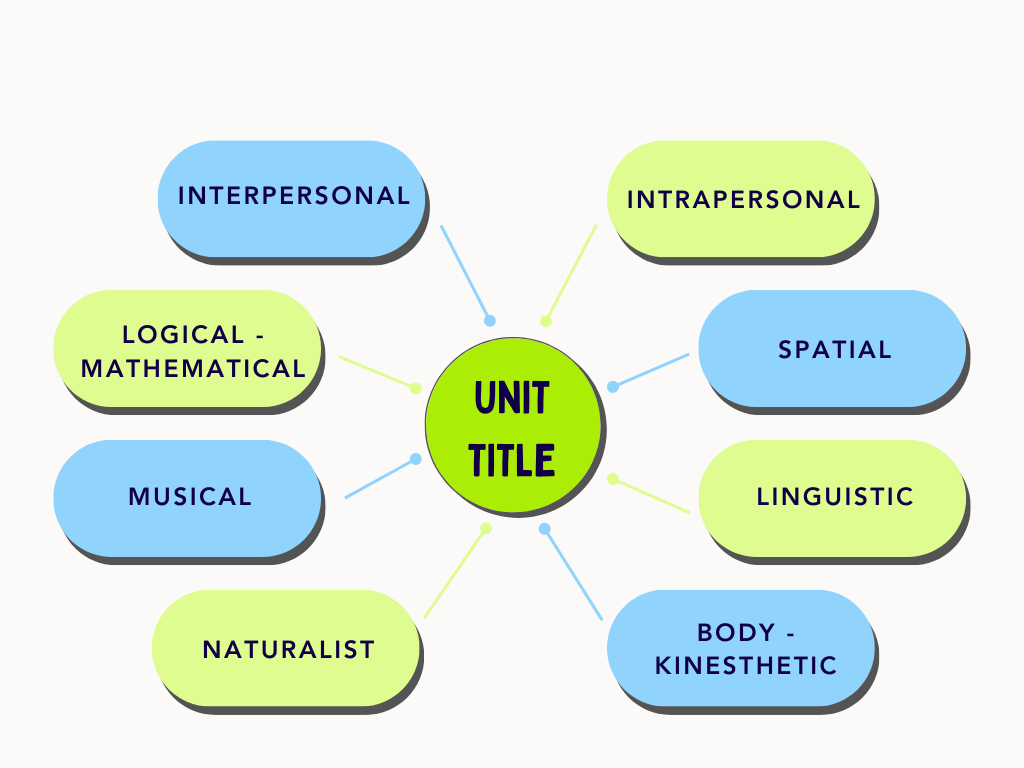
Multiple intelligences
visual-spatial
bodily-kinesthetic
musical
interpersonal
intrapersonal
linguistic
logical-mathematical
naturalist
Visual-Spatial intelligence
Spatial intelligence involves accurately perceiving and manipulating visual-spatial information, whether in wide or confined spaces. Individuals with high spatial intelligence excel in visualization, drawing, sense of direction, puzzle solving, and map reading. They possess the ability to recognize and work with patterns in various contexts, such as navigation, sculpting, chess playing, and graphic design. People strong in visual-spatial intelligence enjoy reading, writing, and interpreting visual materials like pictures, graphs, and charts and often engage in activities like drawing and painting.
Suggested Classroom Activities for a History Class:
Create a mural that depicts diversity in different regions of the nation.
Create a visual map of North America showing the lifestyles of various peoples, including Native Americans, explorers, and settlers.
Bodily-kinesthetic intelligence
involves using the body effectively to solve problems or create products. It encompasses physical coordination, balance, dexterity, strength, and flexibility. Individuals strong in this intelligence excel in activities like sports, dance, acting, and physical crafts, demonstrating excellent hand-eye coordination and dexterity. They enjoy hands-on activities, have strong physical coordination, and prefer learning through active engagement.
Suggested Classroom Activities for a History Class:
Dramatize great moments from the history of the period.
Identify dances, music, or ceremonies of the period and demonstrate them.
Musical intelligence
encompasses proficiency in performing, composing, and appreciating musical patterns. Individuals with high musical intelligence possess sensitivity to rhythm, pitch, melody, and tone color. They excel in singing, playing instruments, and composing music, and have a strong appreciation for musical structure and rhythm.
Suggested Classroom Activities for a History Class:
Explore the music of the period and perform it.
Create a song in the style of the time.
Identify the different cultural groups and their musical contributions.
Interpersonal intelligence
refers to the capacity to understand and effectively interact with others, including recognizing their intentions, motivations, and desires. Individuals strong in this intelligence possess sensitivity to others' moods, temperaments, and motivations, and excel in communication and building rapport.
Suggested Classroom Activities for a History Class:
Create a scrapbook of the clothing of this period.
Using sign language, create a dialogue between two characters from this period from different cultures.
Intrapersonal intelligence
involves understanding oneself, including desires, fears, and capacities, and using this self-awareness effectively in life management. They recognize and analyze their own moods, desires, and motivations, aiding in goal setting and achievement. Individuals with intrapersonal intelligence excel in self-reflection, analyzing strengths and weaknesses, and understanding personal motivations and feelings. They enjoy exploring ideas, theories, and relationships with others.
Suggested Classroom Activities for a History Class:
Imagine you lived during this time. Write a week-long diary recounting the events in your life.
Create interview questions you would like to have asked a major character from this time period.
Linguistic Intelligence
focuses on proficiency in spoken and written language, language learning, and using language effectively to achieve goals. They are typically skilled at writing, memorization, and reading and typically enjoy activities like storytelling, debating, and persuasive speaking. These individuals have a knack for explaining concepts clearly and often employ humor in their communication.
Suggested Classroom Activities for a History Class:
Identify and orally present key historical events from this period.
Logical-mathematical intelligence
encompasses the ability to analyze problems logically, perform mathematical operations, and explore scientific inquiries. Individuals strong in this intelligence excel in using logic, reasoning, and critical thinking to solve problems, understand patterns, and conceptualize numerical relationships. They have strong problem-solving skills, enjoy contemplating abstract concepts, engage in scientific experimentation, and are proficient in complex computations.
Suggested Classroom Activities for a History Class:
Describe the patterns of historical development.
Create a visual aid that shows the diversity in different regions about issues and events that resulted in conflict
Explore how these issues were resolved during this time.
Naturalist intelligence
involves recognizing, categorizing, and utilizing patterns in the natural world. Individuals with this intelligence are sensitive to natural phenomena, such as flora and fauna, and excel at classifying natural forms. They have expertise in identifying various species and are attuned to subtle environmental changes. People with naturalistic intelligence often have interests in subjects like botany, biology, and zoology, enjoy outdoor activities like camping and hiking, and prefer learning topics connected to nature.
Suggested Classroom Activities for a History Class:
Research to find what animals people on the frontier hunted for food and clothing.
Describe how deer meat was prepared and what clothing items were made from deerskin.
Describe five plants that provided food and medicine for people and how these were made.