Perio 3 - Etiology and Risk Factors of Periodontal Disease (Dr. Gyurko)
 Call Kai
 Learn
Learn Practice Test
 Spaced Repetition
 Match
Match Flashcards
 Knowt Play
1/108

There's no tags or description
Looks like no tags are added yet.
Name | Mastery | Learn | Test | Matching | Spaced | Call with Kai | Chat |
|---|
No analytics yet
Send a link to your students to track their progress
109 Terms
Etiology
Define the following:
The cause of a disease
Risk factor
Define the following:
A modifying characteristic that is associated with an increased chance of developing a disease
Extrinsic
Intrinsic or extrinsic factor?
Plaque
Extrinsic
Intrinsic or extrinsic factor?
Smoking
Extrinsic
Intrinsic or extrinsic factor?
Dental restorations
Intrinsic
Intrinsic or extrinsic factor?
Genetics
Intrinsic
Intrinsic or extrinsic factor?
Age
Intrinsic
Intrinsic or extrinsic factor?
Gender
Intrinsic
Intrinsic or extrinsic factor?
Race
Intrinsic
Intrinsic or extrinsic factor?
Diabetes
Intrinsic
Intrinsic or extrinsic factor?
Tooth anatomy
Unknown
What is the cause of idiopathic factors?
periodontitis
____________ is an inflammatory disease initiated by bacteria
True (does not always correspond with amount of plaque)
T/F: For some people only gingivitis develops, for others it progresses to periodontitis
- Gram-negative anaerobes
- Inflammatory response
- Destruction of PDL and bone
- Deeper periodontal pockets (--> more bacteria)
What is the positive feedback loop of inflammation causing periodontitis?
gram negative anaerobes
What type of bacteria contributes to the host response/destruction of PDL and bone?
- PGE2
- IL1B
- Collagenase
What are contributors of the host inflammatory response?
- Contain more bacteria
- Contain more Gram-negative anaerobe bacteria
- Harder to keep clean
Development of deeper pockets creates a positive feedback loop. What are three characteristics of deeper pockets?
True (only groups of bacteria)
T/F: No single bacterial strain has been identified as a cause of periodontitis
- Red complex
- Orange complex
What are the groups of bacteria that have been seen as bacteria with disease-potential?
600 strains
Other yet un-identified bacteria may play significant roles in the causative agents of periodontitis. What is the current estimated number of strains in the mouth?
False (tissue damage is caused by the body's immune response to the bacteria)
T/F: Tissue damage is directly caused by bacteria
- P. gingivalis
- T. forsythensis
- T. denticola
What 3 bacteria make up the red complex?
Periodontal attachment loss
What can lead to these?
- Periodontal pocket formation
- Gingival recession
- Root exposure
- Bone loss
- Tooth loosening
- Tooth loss
Gingiva
Gingivitis affects what tissues?
- Gingiva
- PDL
- Bone
Periodontitis affects what tissues?
It is a fixed reference point to measure pocket depth and disease progression
Why is the periodontal attachment level considered a key landmark in periodontal assessment?
attachment loss
What characterizes periodontitis?
Gingivitis
Gingivitis or periodontitis?
- Inflammation only
- No attachment loss
- No bone loss
Periodontitis
Gingivitis or periodontitis?
- Inflammation
- Attachment loss
- Bone loss
gingivitis
Gingivitis or periodontitis?
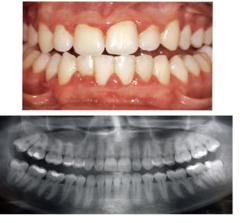
periodontitis
Gingivitis or periodontitis?
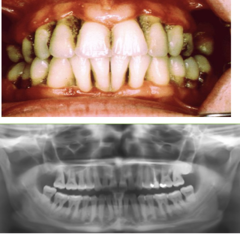
Symbiosis
Define the following:
A co-existence of two organisms, which may be beneficial to one or the other. Ex: Biofilm in a healthy mouth
Dysbiosis
Define the following:
An imbalance of bacteria and the host. In this case a disproportionate immune response to periodontal bacteria causes tissue injury and bone loss
A) Clinical Health
What state has proportionate host response and health promoting symbiosis?
A) Clinical Health
B) Gingivitis
C) Periodontitis
B) Gingivitis
What state has proportionate host response and incipient dysbiosis?
A) Clinical Health
B) Gingivitis
C) Periodontitis
C) Periodontitis
What state has disproportionate host response and frank dysbiosis?
A) Clinical Health
B) Gingivitis
C) Periodontitis
- Removal of plaque/calculus
- Improved home care
What can resolve gingival inflammation?
- Brushing
- Flossing
- Prophylaxis
What are three ways plaque and calculus are removed?
gram negative anaerobes
When you remove plaque, which component of the positive feedback cycle are you eliminating?
- Smoking
- Diabetes
What are the two major risk factors for periodontitis?
Minor
Major or minor risk factor for periodontitis?
Genetics
Minor
Major or minor risk factor for periodontitis?
Age
Minor
Major or minor risk factor for periodontitis?
Gender
Minor
Major or minor risk factor for periodontitis?
Race
Minor
Major or minor risk factor for periodontitis?
Obesity
Minor
Major or minor risk factor for periodontitis?
Poor nutrition
Minor
Major or minor risk factor for periodontitis?
Alcohol consumption
Minor
Major or minor risk factor for periodontitis?
Medication
Minor
Major or minor risk factor for periodontitis?
Dental restorations
Minor
Major or minor risk factor for periodontitis?
Occlusal trauma
less
Do smokers have more or less teeth compared to non-smokers?
deeper
Do smokers have shallower or deeper periodontal pockets compared to non-smokers?
more
Do smokers have more or less supragingival calculus compared to non-smokers?
more
Do smokers have more or less attachment loss compared to non-smokers?
more
Do smokers have more or less bone loss compared to non-smokers?
LESS
Do smokers have more or less gingival bleeding on probing compared to non-smokers?
C) Heavy smokers (4.75x for periodontal attachment loss and 7.28x for severe bone loss)
The Erie County cross-sectional study (1426 subjects) found greater relative risk of periodontal attachment loss and severe bone loss among which populations?
A) Non-smokers
B) Light smokers
C) Heavy smokers
- Neutrophil chemotaxis and phagocytosis
- Decreased IgG antibody production
- Decreased B-helper lymphocyte numbers
What are some components of immune response that are impaired with smoking?
decrease
Does smoking increase or decrease IgG antibody production?
decrease
Does smoking increase or decrease B-helper lymphocyte numbers?
increase
Does smoking increase or decrease prevalence of periodontal pathogens?
fibroblast
Smoking alters what cell's attachment and function?
negative
Does smoking have positive or negative local effects on cytokine and growth factor production?
true
T/F: Smokers have a poor response to periodontal therapy
What is a normal fasting glucose level?
>126 mg/dl
What is a hyperglycemic fasting glucose level?
glycation
Define the following:
Non-enzymatic addition of glucose to proteins or lipids
less than 5.7%
What is the normal HbA1c level?
less than 6.5%
What is the therapeutic target for HbA1c level?
chronic
Are these acute or chronic clinical consequences of diabetes?
- Retinopathy (relative risk: 25x)
- Glomerulosclerosis (relative risk: 17x)
- Cardiovascular complications (relative risk : 2-4x)
- Neuropathy
- Impaired wound healing
chronic (2.3x risk)
Periodontal disease is an acute or chronic consequence of diabetes?
2.3x higher
Diabetics have what risk of developing periodontal disease compared to non-diabetics?
blood vessel damage
Diabetic pathways (too much glucose) lead to what?
Vascular changes (microvascular)
What diabetic pathomechanism?
- Leads to diabetic microangiopathy, resulting in kidney failure, retinopathy, atherosclerosis, and impaired wound healing
Altered host immune response
What diabetic pathomechanism?
- Impairment of neutrophil adherence, chemotaxis and phagocytosis that impairs bacterial killing
- Hyper-responsiveness of monocytes and macrophages resulting in increased pro-inflammatory cytokines and mediators
Alteration in CT metabolism
What diabetic pathomechanism?
- May uncouple the resorptive and formative responses and impair bone remodeling
Increases
The American Academy of Periodontology stated that diabetes ___________ the risk of periodontal diseases, and biologically plausible mechanism have been demonstrated in abundance.
true
T/F: American Diabetes Association stated that research shows that there is an increased prevalence of gum diseases among those with diabetes, adding serious gum disease to the list of other complications associated with diabetes, such as heart disease, stroke, and kidney disease.
true
T/F: Twin studies have showed that early forms of periodontitis (localized aggressive) may be partially inherited
inherited leukocyte deficiency
What deficiency may play a role in genetic periodontal disease?
38%
According to twin studies, what is the estimated heritability of periodontitis?
interleukin 1
What genotype has been associated with periodontitis in non-smokers?
inflammation
What does IL-1 contribute to?
B. High levels of IL-1 production
According to Kornman et al., the IL-1 gene variant is associated with:
A. Low levels of IL-1 production
B. High levels of IL-1 production
C. Increased collagen synthesis
D. Reduced bone resorption
C. Severe vs. mild periodontitis
The IL-1 gene cluster polymorphism was reported to help distinguish individuals with:
A. Gingivitis vs. periodontitis
B. Early vs. late caries
C. Severe vs. mild periodontitis
D. Aggressive vs. chronic gingivitis
- IL-1
- TNF alpha
What pro-inflammatory cytokines are key regulators of the host response to microbial infection during periodontal pathogenesis?
IL-1
What pro-inflammatroy cytokine is a major modulator of extracellular matrix catabolism and bone resorption?
True
T/F: Increased production of IL-1 may result in greater periodontal tissue destruction (i.e. alveolar bone, extracellular matrix)
increase
Does the prevalence and severity of periodontitis increase or decrease with age?
true (not an inevitable consequence of aging)
T/F: There are many older individuals without periodontitis so a true relationship cannot be formed but is most likely due to longer exposure of risk factors
no (females have better oral hygiene but may retain teeth longer with periodontitis)
Is there a difference between males and females in susceptibility to periodontitis?
No (pattern not shown worldwide, in US- Mexican-Americans and Non-Hispanic blacks show higher prevalence of periodontitis)
Is there a difference between race/ethnicity and periodontitis?
- Socio-economic status
- Access to care
Epidemiological data do not consistently show a higher prevalence of periodontitis among U.S. Mexican-Americans and non-Hispanic Black populations worldwide. What key confounding factors might better explain these observed disparities?
Yes
Do obese/overweight individuals have a higher odd ratio of having periodontal disease?
Vitamin C (scurvy)
What vitamin deficiency may contribute to severity of periodontal breakdown?
dose dependent
How is alcohol consumption associated with increased severity of attachment loss?
- Anticonvulsant
- Beta blockers
- Immuno-suppressants
- Calcium channel blockers
Gingival hyperplasia is a well-known consequence of administration of what types of medications?
Local contributing factors
All of the following are what type of factors for periodontitis?
- Overhanging / defective restorations
- Open contacts / food impaction
- Subgingival calculus deposits
- Brushing trauma (non-carious cervical lesions, NCCL)
- Tooth position (gingival recession)
- Local tooth related anatomy
- Occlusal trauma
greater
Was alveolar bone loss found greater or less around overhanging restorative margins and defective restorations?
