BIS 204 midterm 1 content - cell biology
 Call Kai
 Learn
Learn Practice Test
 Spaced Repetition
 Match
Match Flashcards
 Knowt Play
1/9

Earn XP
Description and Tags
every iclicker question from bis 104 (starr)
Name | Mastery | Learn | Test | Matching | Spaced | Call with Kai | Chat |
|---|
No analytics yet
Send a link to your students to track their progress
10 Terms
The gene Src normally activated by extracellular signals called growth factors. When the growth factors are present, Src instructs the cells to divide. A mutant form of Src is found in many cancer tumors. The mutant form of Src is active in the absence of growth factos. the Mutated Src is a:
a. Tumor suppressor
b. oncogene
c. both a tumor suppressor and an oncogene
d. proto-oncogene
b. oncogene. it is a oncogene because it's normal role is to push cell cycle forward. the fact that the mutated form makes cell division still active, enhances it and therefore accelerates the process. Making it an oncogene!
The Starr lab works on a large protein called ANC-1 that localizes to the nuclear envelope. When the 60 C-terminal amino acids of ANC-1 are expressed alone in the cells, it localizes to the nuclear envelope. We therefore conclude that the last 60 amino acids of ANC-1 are ___________ for nuclear envelope localization.
a. sufficient
b. necessary
c. both necessary and sufficient
d. neither necessary or sufficient
a. sufficient. we know it is sufficient because at the start of the experiment we had nothing, and when we added something we resulted in an outcome. Therefore adding the last 60 a.a./localization element of ANC-1 is sufficient for nuclear envelope localization
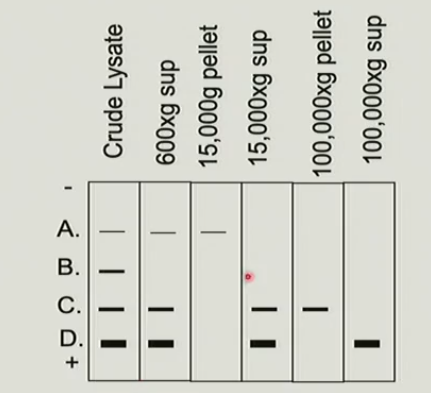
Lyse
Spin 600 g
Spin 15,000 g
Spin 100,000 g
Western to proteins A-D
Where in the cell does protein C reside in?
a. golgi
b. nucleus
c. cystosol
d. ER
e. mitochondria
Both A and D. This is because there is band for the 100,000g pellet. We know that in the 100,000g pellet we can fid the Golgi, ER, or the plasma membrane. So, it can be either both A and D. In the case that we need to differentiate between the golgi and ER we need to do density gradient centrifugation. But for the purpose of this question is both answer A and D!
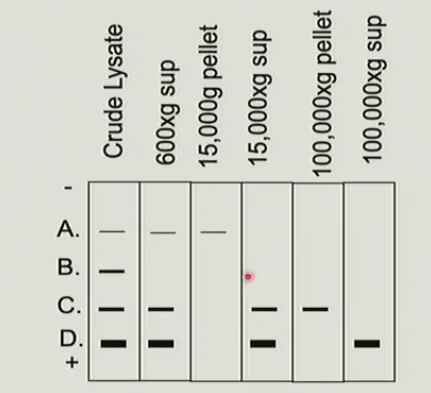
Lyse
Spin 600 g
Spin 15,000 g
Spin 100,000 g
Western to proteins A-D
Where in the cell does protein D reside in?
a. golgi
b. nucleus
c. cystosol
d. ER
e. mitochondria
C. cytosol. the answer is the cytosol because now the 100,000g sup is present and that is where the cytosol is present! Just a side tangent, protein A would be found in the mitochondria.
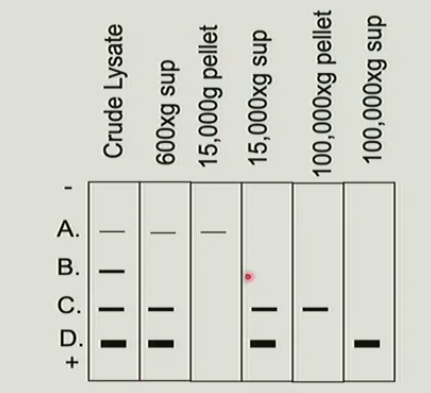
Lyse
Spin 600 g
Spin 15,000 g
Spin 100,000 g
Western to proteins A-D
Which is the largest protein?
a. A
b. B
c. C
d. D
a. A. the largest protein would be protein A because it is found on the tippy top of the gel. Showing that it is slower and therefore implying that it is bigger. Bigger proteins travel a smaller distance!
You have a mutant strain of bacteria that is cold sensitive. At 34 degrees Celsius it grows as fast as wild-type (22 hour doubling time). At 22 degrees Celsius its doubling time is 59 hours.
You’ve been told this mutation is in a gene that affects lipid dynamics.
You therefore should propose the following hypothesis: The mutation is in a gene that normally encodes a protein that ______.
a. synthesizes phosphoglycerides
b. desaturates fatty acids
c. saturates fatty acids
b. desaturates fatty acids. the mutation must be found in a gene that encodes a protein that desaturates the fatty acids. Normally, at colder temperatures, the membrane has a mechanism that increases the unsaturation of membranes in order to make it more fluid. But in the question, the mutated strain at colder temperatures has an increase in doubling time, implying that it is difficult for the membrane to grow at colder temperatues. This also implies that, there is something wrong in the desaturase. In turn, the membrane cannot form kinks to make it more fluid and will lead the membrane to become stiff and grow slower.
A lot of double negatives in cell bio but do not fret!
First, figure out the problem —> problem was that there was too much saturation
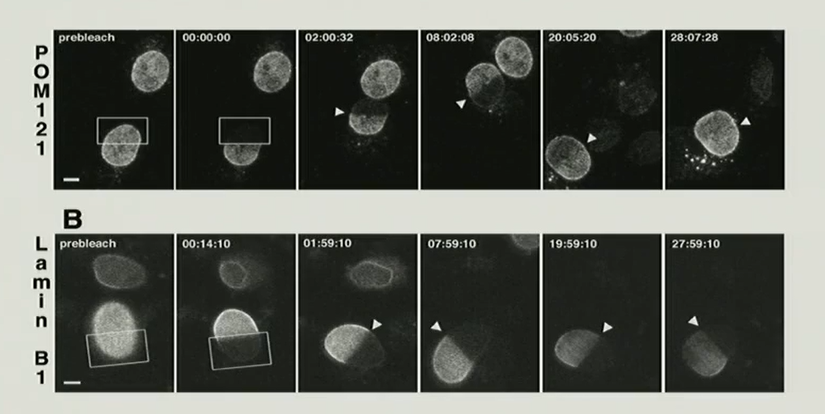
Below is a FRAP experiment. Which of the following is the best conclusion from this data?
a. both POM121 and lamin are equally destroyed by the laser.
b. It takes about 20 minutes to translate more POM121, but a longer time to translate more lamin
c. Lamin is more mobile in the membrane than POM121 is.
d. Lamin is less dynamic than POM121. Lamin doesn’t move in the membrane.
e. It would have been better to do this experiment using S35 pulse chase and differential centrifugation.
d. lamin is less dynamic than POM121. This is because pom121 appears to recover by the end of the experiment, implying that the recovery is fast and therefore the membrane protein has high mobility. However, lamin shows different behavior where it does not recover, showing that the protein is likely anchored to the membrane.
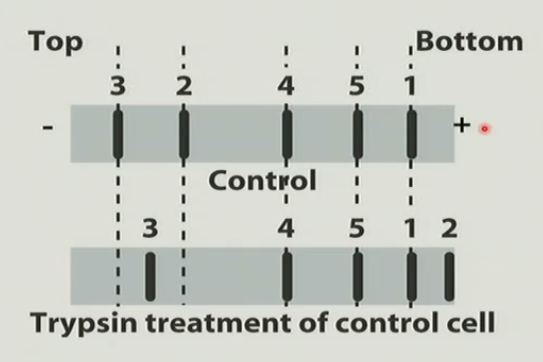
You compare untreated control cells (top lane) to cells treated with trypsin (bottom). After trypsin treatment you run the proteins out on an SDS-PAGE (the top (-) of the gel is to the left) and transfer them to a membrane. You are interested in 5 different proteins for which you have specific antibodies. You do westerns to identify the 5 proteins. What type of membrane protein is protein #2?
a. a TM protein with a large domain on the outside of the cell.
b. a TM protein with large domain inside the cell
c. a TM protein with equal domains both inside and outside the cell
d. a peripheral cytoplasmic protein
e. a peripheral extracellular protein
a. a TM protein with a large domain on the outside of the cell is the answer. This is because in the control group, protein 2 is at the top, implying that the protein is heavy. After being treated, protein 2 is way at the bottom, implying that the protein is way lighter. So, for it to travel down the blot it had to lose significant weight. Since trypsin digests proteins at the surface, it likely digested a large TM protein with a large domain at the surface.
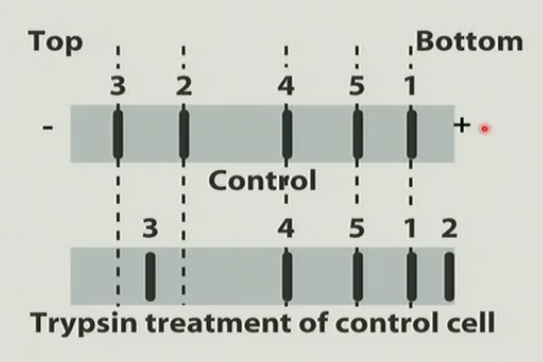
What type of membrane protein is protein #5?
a. a TM protein with a large domain on the outside
b. a TM protein with large domain inside the cell
c. a TM protein with domains inside and outside the cell
d. a peripheral cytoplasmic protein
e. a peripheral extracellular protein
d. a peripheral cytoplasmic protein. Protein 5 did not change at all, so it means that it is inside the cell (protected from the trypsin).