Research Methods I Midterm
 Call Kai
 Learn
Learn Practice Test
 Spaced Repetition
 Match
Match Flashcards
 Knowt Play
1/99

There's no tags or description
Looks like no tags are added yet.
Name | Mastery | Learn | Test | Matching | Spaced | Call with Kai | Chat |
|---|
No analytics yet
Send a link to your students to track their progress
100 Terms
Dictionary definition for research
scholarly or scientific investigation or inquiry
Long definition of research
multiple, systematic strategies to generate knowledge about human behavior, human experience, and human environments in which the thought and action processes of the researcher are clearly specified so that they are logical, understandable, confirmable, and useful
NIH 3-part definition
-patient-oriented
-epidemiologic
-outcomes research
patient-oriented research
Studies conducted with human subjects to improve the understanding of diseases and disorders
epidemiologic
observational studies focused on describing patterns of disease and disability and identifying preventative factors
outcomes research
Studies to determine the impact of research on population health and utilization of EBI
clinical research is essential to
inform clinical judgments, as well as the organization and economics of practice
fundamental goal of research
To develop scientific knowledge of a profession, the end product is data connecting intervention with outcomes, demonstrating the effectiveness and efficiency of our practice
How is research linked to theory
Research yields findings that lead to a theory and that examine and refine existing theory
Where is research needed?
-develop tests and assessments
-examine clinical decision making
-connect therapy to outcomes
-improve the process of therapy
-explore novel service delivery models
Barriers to research
Material
-money
-materials
-people
Organizational
-environment
-time
-support
Attitudinal
-mindset
-beliefs
-opinion
-history
-flexibility
Overcoming barriers to research
-requires a new mindset
-not like learning a new technique
-is a natural function of practice
common denominator in the process is the problem-solving approach
Basic research
bench or preclinical research, directed toward the acquisition of new knowledge; may or may not have a direct clinical application (animal)
Applied research
clinical research to advance the development of new diagnoses, drugs, therapies, and prevention strategies (typically where OT focuses)
Explanatory research
uses experimental designs to compare two or more conditions or interventions; assess efficacy and effectiveness (RCTs, PCTs, quasi-experimental, single-subject designs)
Exploratory research
examines a phenomenon of interest in populations or communities; can be used to establish associations. Assesses validity and reliability (cohort studies, case-control studies, correlational studies)
Descriptive research
attempts to describe a group of individuals on a set of varibales ot document their characteristics. Allows researchers to classify and understand the scope of the clinical or social phenomena (developmental, case reports, qualitative research)
Translational research
application of basic scientific findings to clinically relevant issues and simultaneously the generation of scientific questions based on clinical dilemmas, 'bench to bedside'
Lag time
10-25 years for a discovery to reach publication, the average is 17 years
Translation continuum
T0: basic science research (animal)
T1: Does it work- translation to humans (new methods of diagnosis, treatment, and prevention)
T2: Can it work under ideal conditions- translation to patients (controlled studies leading to effective care)
T3: Will it work in real-world conditions- translation to practice (delivery of recommended and timely care to the right patient)
T4: Is it worth it- translation to community (true benefit to society)
Efficacy
performance of an intervention under ideal and controlled conditions; randomized controlled trials
Effectiveness
performance of an intervention under natural, real-world conditions; pragmatic clinical trials
Outcomes research
An umbrella term to describe studies that focus on the impact of the results of health care practices and interventions
-address both clinical and population-based questions with the intent of improving the benefit of health care to individuals and communities
Implementation studies
-focuses on understanding the influence of the environment and resources on whether research findings are actually translated into practice
-ways to change behavior through education, training, team-based efforts, community engagement, or systematic infrastructure redesign
-address: clinical performance audits, use of patient or provider alerts to remind them of guidelines, patient education, and interventions
Steps of the research process
1. Identify the research question
2. Design the study
3. Implement the study
4. Analyze the data
5. Disseminate the findings
6. Close the loop
Research questions
Problem: Utilize professional literature to find gaps and conflicts in the literature
Question: importance and feasibility, population
Rationale: to guide research design and interpretation
-identify variables of interest
-conduct a review of the literature
-develop a hypothesis
What makes a good research question?
-Important: What is the potential impact on treatments
-ethical: conforms to ethical standards in terms of protection of human subjects and researcher integrity
-feasible: should be practical to execute for a successful project
What is measurement
-Investigators collect data from a sample to answer a research question
-the process of assigning numerals to observed people, objects, or events according to a set of rules for the purpose of understanding them objectively without ambiguity
-an approach to detecting and documenting relative conditions or events
-basis for making decisions or drawing conclusions
Why do we measure?
-make decisions based on criteria or standard performance
-draw comparisons to choose between courses of action
-evaluate responses to assess a patient's condition by documenting change or progress
-discriminate among individuals who present different profiles related to their condition and characteristics
-predict outcomes to draw conclusions about relationships and consider expected responses
Benefits of measurement
-increase understanding about a given variable via the expression of qualitative/ quantitative information
-summarize existing evidence, identify gaps, and map relevant theories
-ensure a systematic approach to source selection and synthesis
quantification
The first part of the measurement is to assign a number to the variables
variable
characteristic being measured that varies among the persons, objects, or events being studied
-can denote quantity or an attribute
methodology selection
-allow us to distinguish between groups or conditions as well as predict future outcomes
-Measurement is the quantification of an observation using a standard, whereas assessment includes the interpretation of the obtained measure
direct measurement
directly observed (height, ROM, etc.)
indirect measurement
constructs assorted traits chosen to represent an otherwise abstract phenomenon (intelligence, health, QoL, pain, fatigue, etc.)
-must be operationally defined in research
dichotomous variable
when a variable continues only two discrete levels (true/false, gender)
discrete variable
limited to whole units (numbers, nominal or ordinal)
continuous variable
can be any value along a continuum within a specified range (fractional of whole numbers, interval, or ratio), height (cm), time (sec)
nominal scales
-categories of objects or subjects are assigned different labels, the lowest scale or measurement
-cannot be converted to any other scales, but other scales can be converted to nominal
-ex. gender, race, type of occupation, political affiliation, hand dominance, favorite type of music
ordinal scales
ranked categories based on the relative magnitude of the characteristic
-differences are not consistent or quantifiable
-military rank, low-medium-high, manual muscle test, am-pac, berg, barthel, etc.
-use nonparametric statistics
interval scale
-values with known and equal distances, an arbitrarily assigned zero point (zero doesn't truly mean 0)
-illustrates numerical differences between scores, but not absolute magnitude
-can add or subtract means but cannot compute or compare ratios
-second-highest measurement scale
-ex. temperature, years on calendar, sea level, goni, elevation
ratio scale
-interval scale with absolute zero point (indicates complete absence)
-negative numbers are possible
-highest measurement scale
-can perform all mathematical and statistical processes
-ex. height, weight, percentiles, t scores, quotients, grades, blood pressure
scales of measurement rules
can go down in level but not up (ordinal to interval), researchers should use the highest level of measure available
non-parametric measures
nominal: frequency only mode
ordinal: frequency, median, and range
-averages don't have true mathematical significance
parametric measure
interval: addition and subtraction mean and variance
Ratio: all mathematical and statistical procedures are allowed
scale
An ordered system based on a series of questions or items, resulting in a score that represents the degree to which a respondent possesses a particular attribute, value, or characteristic
-ordered system based on a series of questions that provides an overal rating (attitudes, function, health, QoL, pain, exertion
literature
all scholarly products including original research articles, editorials, position papers, reviews and meta-analysis, books and dissertations, conference proceedings and abstracts, and website materials
-helps in formulating a research question and planning the study
literature search
systematic and organized from the already published data to identify a breadth of good-quality references on a specific topic
retrieving available information relevant to a topic is
Vital to both conducting research and being a consumer of research, and is a key step in performing good, authentic research
scientific journals
publications that contains original reports of scientific research and evaluated for scientific quality and correctness, usually specialized by discipline: audience - other researchers
-ex. AJOT, OTJR
-abstract, specific topic, peer-reviewed, academic journal
magazines
publications that include opinion piences, news, information on policy, and reports on a popular interest; readership- general public or professionals from a particular field
-ex. OT practice
-laymens terms, volume number, no abstract
government and professional websites
includes governmental agencies, nongovernmental organizations,
-ex. NIH, CDC, Red Cross, Doctors Without Borders
-CDC, not new research, sharing info, summarizing
Grey literature
anything not produced by a commercial publisher, including government documents, reports, fact sheets, practice guidelines, conference proceedings, and theses or dissertations
-poster session, no detailed methods
primary source
reported directly by the investigator
-original article, abstract
secondary source
a description or review of one or more studies presented by someone other than the original authors
-collecting information, health students, textbooks
Systematic reviews, meta-analyses, and clinical guidelines include a
critical analysis of published works that generate new knowledge
-secondary source, new knowledge, multiple sources reviewed
databases
an index of citations that is searchable by keywords, author, title, or journal
-most common databases in healthcare: Medline, CINAHL, and Cochrane for Systematic Reviews
PubMed
most used health science application, free, comprehensive, and readily available resource for biomedicine and health fields
MEDLINE
indexes more than 5,200 journal titles and over 24 million references in 40 languages
CINAHL
indexes references from nursing, biomedicine, health sciences, alternative/complementary medicine, consumer health, and 17 other disciplines
Cochrane Database of Systematic Reviews
contains citations of systematic reviews involving 37,000 contributors from 130 countries
Search engines
platforms that access one or more databases
-PubMed, OVID, EBSCO, Google Scholar
Successful searchers require
several iterations, revising keywords startefies, and using different databases
The search process can be guided by 4 overall questions
1. What am I looking for? (develop a PICO question)
2. Where can I find it? (making good predictions of where relevant information will be and using retrieved information to further define and articulate the search concept)
3. How do I access and retrieve it? (identify key words, search terms, generate search query, apply search syntax)
4. How well does it satisfy my information requirements, and what is the reliability of the information retrieved? (critical evaluation of information retrieved)
Too few articles
may need to remove some specificity from your topic
Too many citations
may need to be more specific in describing the population, the intervention, or the outcomes
limits and filters
can be used to refine a search
-ex. age groups, dates of publication
Sensitivity
The proportion of relevant articles identified by the search out of all relevant articles that exist on that topic
Specificity
proportion of relevant citations that the search is able to retrieve, or a measure of the ability of the search to exclude irrelevant articles
completing the search
-searched all relevant databases, using a variety of keywords and subject headings
-mined article bibliographies for their cited references
-looked in Google Scholar or Web of Science to see who has cited those articles
critical appraisal
The purpose is to determine the scientific merit of a research report and its applicability to clinical decision-making
Levels of Evidence: Quantitative Studies
Level 1: systematic reviews/meta-analyses
Level 2 of Evidence: Individual study with strong design
Level 3 of Evidence: Study with less rigorous design
Level 4 of Evidence: Case series
Level 5 of Evidence: Mechanistic reasoning
Grade up: strong effect size, strong design
Grade down: poor design, lack of consistency with other studies, small effect
Levels of Evidence - Qualitative Studies
1: generalizable studies
2: conceptual studies
3: descriptive studies
4: case studies
Appraisal Process
-first read the abstract to determine if the article addresses the clinical question
-should focus on the designs, the analysis, and the clarity of writing
Core Questions for Literature Appraisal
-Is the study valid? Is the research question clearly stated? What type of research is being done
-How was the study designed and implemented
-Are the results meaningful? What were the outcomes? How are the results interpreted
-Are the results relevant to my patient? Is clinical relevance discussed? Is the approach feasible in my setting? Is this approach worth the effort to incorporate into my treatment plan
-are applied for quantitative and qualitative studies
Critically Appraised Topic (CAT)
A brief summary of a search and critical appraisal of literature related ot a focused clinical question; evidence-based and patient-based tool
-useful to inform an aspect of patient care related to intervention, diagnosis, prognosis, or harm
-limitation: have a short shelf-life, often limited in scope, and include fewer references
5 steps in CAT process
-ask a question
-acquire relevant literature
-appraise the quality of the study
-apply findings to patient care
-assess the success of the clinical application
descriptive research
-observed approach that documents traits, behaviors, attitudes, and conditions of individuals, groups, and populations
-takes advantage of naturally occurring events or available information to generate new information through inductive processes
-exploratory elements
basic descriptive information
used to indicate norms, trends, needs, and circumstances that inform practice
-used to characterize subjects and other relevant circumstances that surround the research
univariate research
Data is collected on a single variable or a series of single variables and then characterized with descriptive statistics
-Characterize the sample or circumstances that make up any study
-Characterize a problem or phenomenon that is of interest to the fields
-document incidence and prevalence of health-related conditions
-establish norms to provide a basis for prescribing corrective intervention or predicting future performance
-document developmental phenomena: growth or change over time within selected segments of the population
-document case studies: in-depth descriptions of the experiences or behaviors of a particular individual or a series of individuals
correlational research
an examination of relationships between 2 or more variables
-can provide evidence that is consistent or inconsistent with causal assertions to inform the development of theoretical propositions
-can be useful first steps to understanding causal relationships and precursors ot ecperimental studies
-limitation: does not have an experimental control, possibly a variable, so there is no way to establish causality
developmental studies
describes developmental change and the sequencing of behaviors in people over time
Longitudinal Studies
-Collect data at prescribed intervals on the cohort to determine developmental changes over time
-studies patterns of change
cross-sectional research
-Collect data at one point in time on cohorts at different developmental stages
-describes differences in levels or various stages of life
-often seen with survey research and exploratory intervention studies
-sample often includes a wider range of subjects that allow for a variety of analyses
normative studies
-describes typical or standard values for characteristics of a particular population
-mean and standard deviation
-samples must be large, random, and representative of the population's heterogeneity
-important for determining need for intervention, developing treatment goals and protocols
case reports/studies
-in-depth description of a person's condition or response to treatment
-thorough analysis of a single situation
-want to end with a hypothesis that can be tested experimentally
-typically seen with unusual medical conditions
-inherent lack of control and limited generalizability
historical research
-critical review of events, documents, literature, and other sources of data to reconstruct the past in an effort to understand how past events occurred
-synthesizing data from the past
-can include primary and secondary sources
parameters
the measure of population characteristics
statistics
a systematic conversion of observation into numbers and then using those numbers to draw inferences about the world
descriptive statistics
used to characterize the shape, central tendency, and variability within a set of data, often with the intent to describe a sample or population
general goal of descriptive statistics
-organize
-summarize
-analyse
-group outcomes
frequency distribution
a table of rank ordered scores that shows the number of time each value occured, or its frequency
-refers to the total set of scores or measures
-often reported as n
population
-all possible measurements (N)
-measurements are called parameters
sampling distribution
-a subset of the population under study (n)
-measurements are called statistics
The most common ways to graph frequency distributions
histograms, line plots, and stem-and-leaf plots
-described by three characteristics: shape, central tendency, and variability
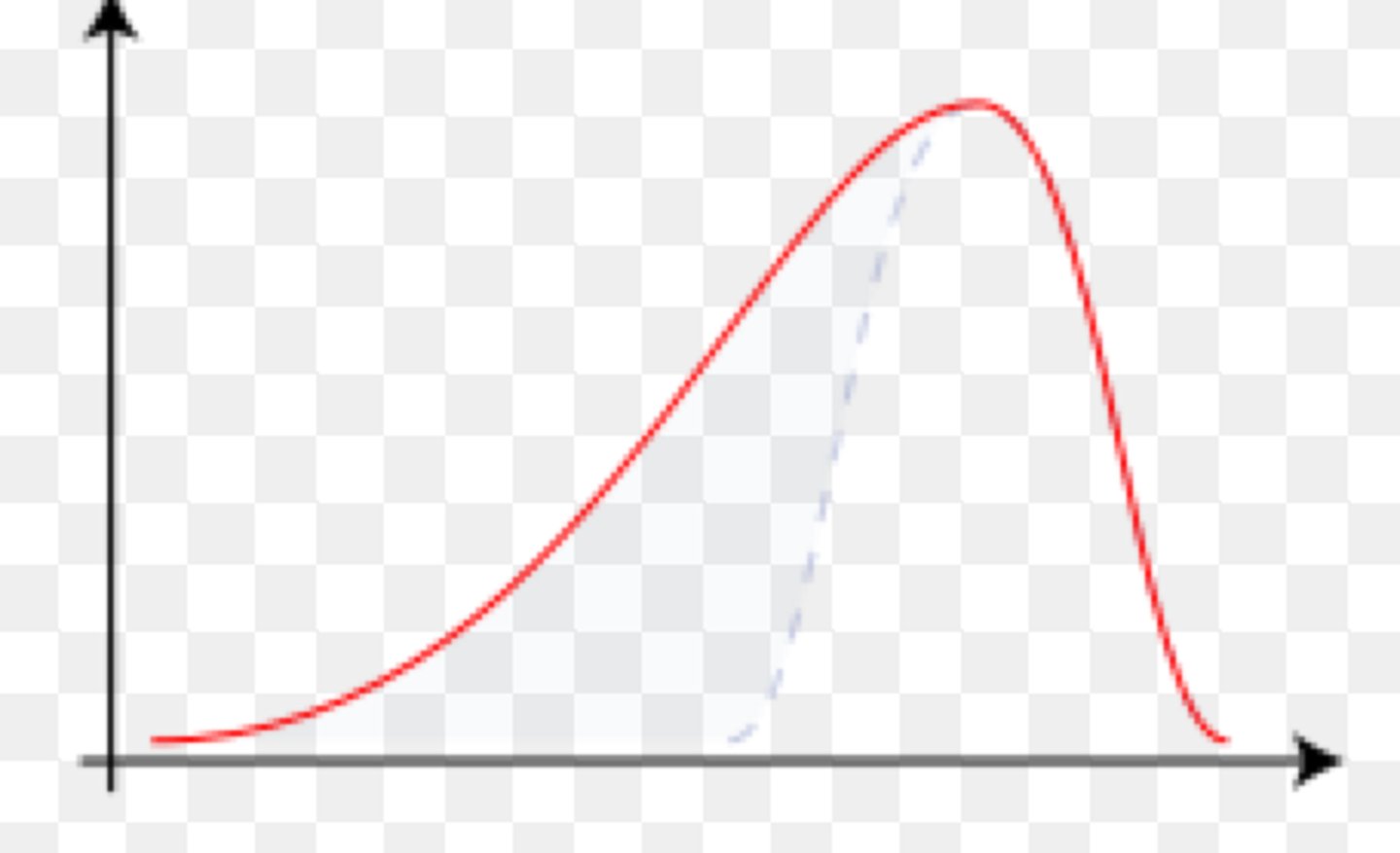
Negative skew
-most scores are positive
-more people die at old age than when they're young
-The mean is smaller than the median
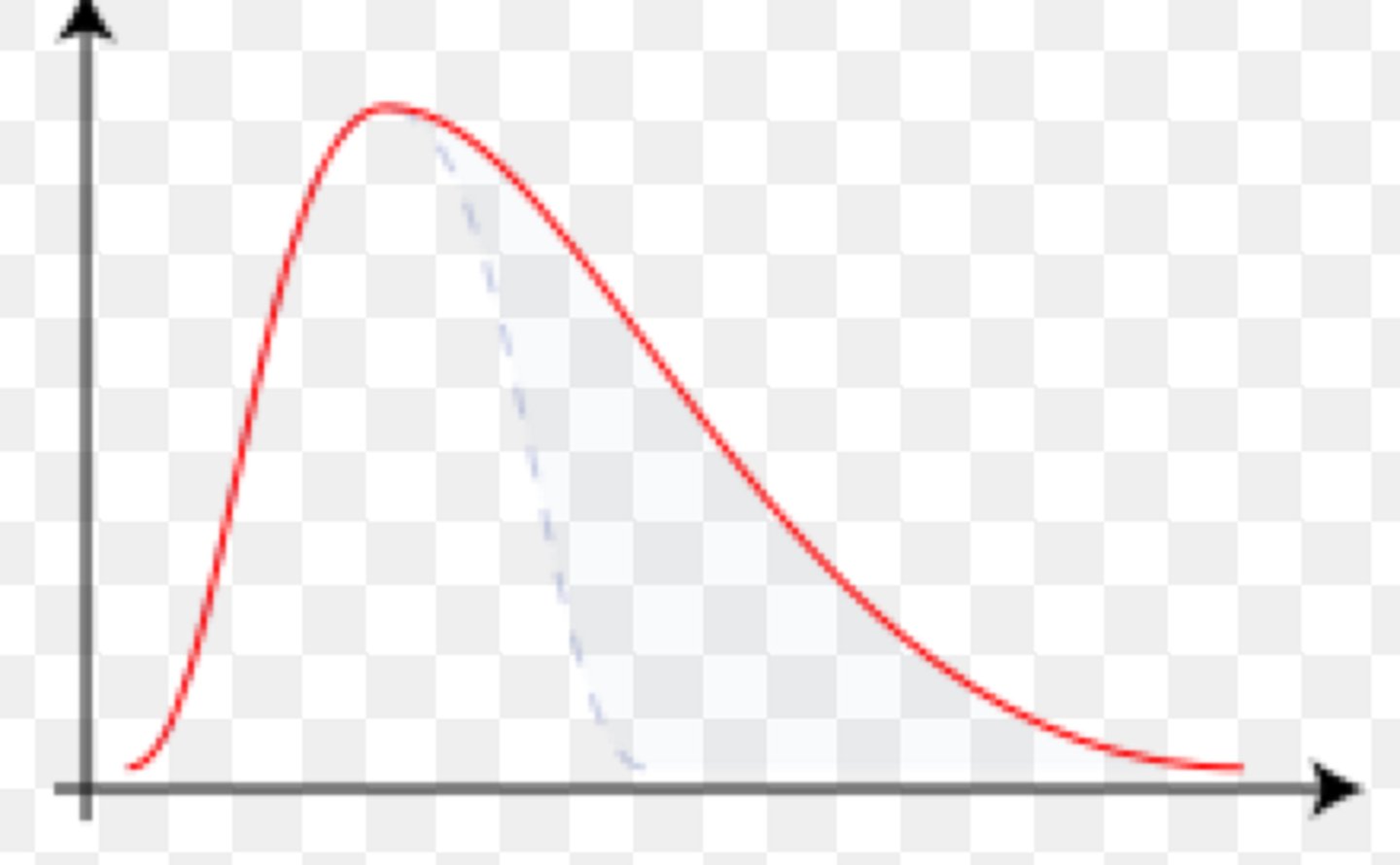
positive skew
-most are negative
-annual income In the US, the number of people at the high end is small, and the majority of people cluster around the low end
-The mean is larger than the median
mean
The sum of a set of scores divided by the number of scores
-used for numerical data and symmetric distributions
median
of a series of observations is that value above which there are as many scores as below it, dividing a rank order distribution into two equal halves
-unaffected by extreme scores
-useful for skewed distribution or ordinal scores
mode
the score that occurs most frequently in a distribution
-more than one score with the highest frequency = bimodal or multimodal
-most useful in the assessment of categorical data on nominal or ordinal scales
-limited application for continuous data