Ecology Lecture 11 Predation Herbivory
 Call Kai
 Learn
Learn Practice Test
 Spaced Repetition
 Match
Match Flashcards
 Knowt Play
1/33

There's no tags or description
Looks like no tags are added yet.
Name | Mastery | Learn | Test | Matching | Spaced | Call with Kai | Chat |
|---|
No analytics yet
Send a link to your students to track their progress
34 Terms
Predation
Predators obtain energy and nutrients by killing and eating prey
Some plants can consume animals to obtain nutrients an example is
The venus fly trap
Herbivores consume
producers such as plants and/or algae
Generalist:
Select and eat a wide variety of food items
Specialist:
Feeding upon a single species or a restricted range of closely related species
What are examples of specialist?
Ant eaters, pandas, koalas
Predators and herbivores can limit
the abundance (population size) of species
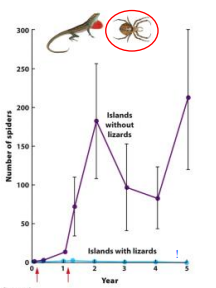
Explain what’s happening?
Spider densities on the Caribbean islands with and without lizards
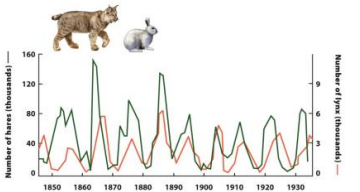
The synchrony of population cycles between predators and prey suggests that
these oscillations are the result of interactions between them
Decline of predators causes
Increase of prey
Increase of prey causes
More food for predators and causes an increase of predators
Decline of prey causes
lower survival and reproduction of the predator
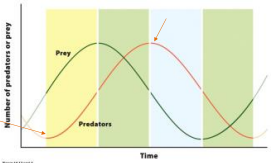
Predator population sizes
lags behind prey abundance
What other factors can cause fluctuations?
Resources, disease, and more
Active hunting strategies:
Predator spends most of the time moving around looking for prey
Ambush hunting strategies:
Wait for a potential prey to pass by
Behavior defenses:
Alarm calling, spatial avoidance, reduction of activity, and mobbing
Alarm calling:
Warning relatives by saying predators are approaching
Spatial avoidance:
Potential prey moves away from a predator
Reduction of activity:
Avoid being detected by predator by reducing movement
Mobbing:
Distraction of predator
Crypsis:
Camouflage that either allows an individual to match its environment or breaks up the outline of an individual to blend in better with the background
Chemical defenses:
Often more effective at deterring predators if the prey can convey the defense before an attack occurs
Warning coloration (aposematism):
Distastefulness evolves in association with very conspicuous colors and patterns
Batesian mimicry:
Palatable species evolve warning coloration that resembles unpalatable species
Mullerian mimicry:
Several unpalatable species evolve a similar pattern of warning coloration
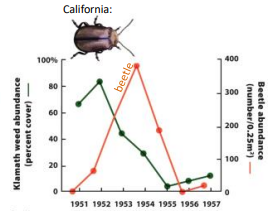
What is going on?
A beetle has eliminated 99% of the Klamath weed population in North America
Long-term fencing to prevent deer herbivory caused
much greater amount of plant growth in a Canadian national park
Removal of sea urchins from a rocky shore habitat caused
Biomass of different algae to increase
Pressure from herbivores allows
evolution of plant defenses (phenotypically plastic defenses induced by attack or fixed defenses
Structural defenses:
Sharp spines, “hairs”
Chemical defenses:
Sticky resins and latex compounds and alkaloids with a wide range of toxic effects
What is a parasitoid?
An organism whose larvae develop inside or on a single host feeding on it and eventually killing it
Are parasitoids predators or parasites?
Both could be considered