PCB3063 Exam 1 Dr. Cui
 Call Kai
 Learn
Learn Practice Test
 Spaced Repetition
 Match
Match Flashcards
 Knowt Play
1/149

There's no tags or description
Looks like no tags are added yet.
Name | Mastery | Learn | Test | Matching | Spaced | Call with Kai | Chat |
|---|
No analytics yet
Send a link to your students to track their progress
150 Terms
Genetics
Scientific study of heredity and variation
Traits are controlled by
genes
Gene
A segment of DNA that codes for a specific trait
DNA
deoxyribonucleic acid, carrier of genetic information
central dogma or molecular biology
DNA -> RNA -> Protein; some genes do not encode proteins such as rRNAs and tRNAs
Genes are carried on
chromosomes
Chromatin
an array of acidic and basic proteins into thin fibers
Chromosomes
condensed and coiled form of chromatin
The cytoplasm contains a
genome that results in female dominance
Pure-breeding
Individuals that are homozygous that will always produce the same offspring when crossed together
The chromosomal theory of inheritance states that
inherited traits are controlled by genes residing on chromosomes (Waltor, 1903)
each trait is controlled by
pair of genes
Genes are transmitted through
gametes
What is special about model organisms
easy to grow, have short life cycles, produce many offspring, and offer straightforward genetic analysis
Alternate form of a gene is called
allele
Mutations
a random error in gene replication that leads to a change
Genotype
genetic makeup of an organism
Phenotype
An organism's physical appearance, or visible traits.
Allele
Different forms of a gene
ABO blood groups
based on having an A, B, both or no antigens on red blood cells
A phenotype
AO or AA
B phenotype
BB, BO
O phenotype
OO genotype
AB phenotype
AB genotype
one unreplicated chromosome

one replicated chromosome
2 sister chromatids but one chromosome
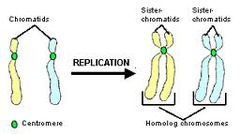
In this stage there is one DNA helix
G1 phase
Two DNA double helices are present in the
G2 phase
Interphase
Cell grows, performs its normal functions, and prepares for division; consists of G1, S, and G2 phases
Prometaphase
chromosomes are clearly double structures; centrioles reach the opposite poles; spindle fibers form
sister chromatids are held together by
cohesin
cohesion
multi subunit protein complex
cohesion is degraded by
separase
cohesion is protected by
shugoshin
Centrioles
Cell organelle that aids in cell division in animal cells only
centrioles function
organize DNA during cell division
Most organisms are
diploid
Diploid
2 sets of chromosomes (2n)
homologous chromosomes
chromosomes that carry the same sets of genes but might have different alleles
Centromere
Area where the chromatids of a chromosome are attached
sex chromosomes
homologous but do not carry the same genes
Haploid
an organism or cell having only one complete set of chromosomes
Polyploidy
condition in which an organism has extra sets of chromosomes
Mitosis
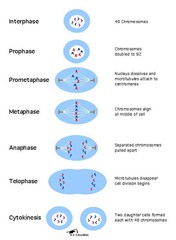
Mitosis produces
2 identical daughter cells
Karyotype
A display of the chromosome pairs of a cell arranged by size and shape.

chromosomes are recognized by
their centromere position
metacentric
centromere in middle

acrocentric
centromere close to end

telocentric
the centromere is at or very near the end of the chromosome

Mitosis is responsible for
growth, wound repair, asexual reproduction
Karyokinesis
division of the nucleus
Cytokinesis
division of the cytoplasm
S phase
DNA replication
G0 phase
A nondividing state occupied by cells that have left the cell cycle, sometimes reversibly.
cell cycle control kinases
promote the manufacture and activity of proteins required for DNA synthesis
Cyclins
proteins that regulate the timing of the cell cycle in eukaryotic cells
If the checkpoints fail to recognize and stop the errors, then cell division proceeds and a....... results
tumor
Practice Questions
At which stage of the cell cycle does DNA replication occurs?
A. Interphase
In what status the chromosome exist immediately after replication?
A. Extended and amorphous
Which of the following chromosome pairs are identical in adiploid cell?
A. sister chromatids
Meiosis
Creates 4 haploid gamete cells from a diploid cell and enhances genetic variation
meiosis 1
reproduction process that halves the # of chromosomes and results in diploid cells
Meiosis II
sister chromatids separate
synapsis
Pairing of homologous chromosomes
Recombination
shuffling the parental genetic alleles
Chiasma
site of crossing over
Tetrad
structure containing 4 chromatids that forms during meiosis
prophase 2
The duplicated chromosomes and spindle fibers reappear in each new cell.
metaphase 2
Chromosomes line up at the equator.
anaphase 2
sister chromatids separate and move to opposite poles
telophase 2
A nuclear membrane forms around the chromosomes in each of the 4 new cells.
special events in meiosis 1
- Homologous chromosomes pairs, forming tetrads
- Chromosome recombination (crossing over) occurs, shuffling the parental genetic materials
- Homologous chromosomes are separated into different daughter cells
special events in meosis 2
Sister chromatids are separated into different daughter cells
outcome of meiosis
chromosome number halved, parental genome shuffled, gamete of various genotypes are produced.
crossing over occurs during
meiosis 1 prophase 1 and produces independetly into gametes
Nondisjunction
Error in meiosis in which homologous chromosomes fail to separate.
[..] restores the diploid number
fertilization
allows multi-generation comparisons
seed storage
Mendel
had four postulates, two became laws, discovered the basis of diploid genetics
monohybrid cross
A cross between individuals that involves one pair of contrasting traits
P1 generation
parent generation
F1 generation
offspring of the P generation
F2 generation
offspring of the F1 generation
F2 generation results from
the selfing of f1
reciprical cross
a cross in which the phenotypes of the male and female are reversed compared with a prior cross
Mendel's first three postulates
1. Each trait is controlled by a pair of factors GENES
2. When 2 different factors for a trait are present in an individual one is DOMINANT and one is RECESSIVE
3. During gamete formation the paired factors SEGREGATE RANDOMLY
Homozygous
having two identical alleles for a trait
Heterozygous
having two different alleles for a trait
monohyprid cross ratios
phenotype 3:1
genotype 1:2:1
1st postulate: Unit factors in pairs
genetic characters are controlled by unit factors existing in pairs in individual organisms
2nd postulate: dominance/recessiveness
In the pair of unlike unit factors for a single characteristic in an individual, one unit factor is dominant and the other is recessive.
3rd postulate: Segregation (became Mendel's 1st law)
The paired unit factors segregate (separate) independently during gamete formation.
testcross
cross between an organism with an unknown genotype and an organism with a recessive phenotype
Spermatogenesis
production of sperm
Oogenesis
Egg production
dihybrid cross
A cross between individuals that have different alleles for the same gene; 2 factor cross
pehnotypic ratio for dihybrid cross
9:3:3:1
Mendel's fourth postulate (second law)
-during gamete formation, segregating pairs of unit factors assort independently of each other.
-all possible combinations of chromatids in the gametes will form with equal frequency