PCSD 313 Module VI & VII
 Call Kai
 Learn
Learn Practice Test
 Spaced Repetition
 Match
Match Flashcards
 Knowt Play
1/41

There's no tags or description
Looks like no tags are added yet.
Name | Mastery | Learn | Test | Matching | Spaced | Call with Kai | Chat |
|---|
No analytics yet
Send a link to your students to track their progress
42 Terms
central nervous system
brain and spinal cord
- brain: the body's computer
- spinal cord: pathway for messages sent from brain to body and vice-versa
peripheral nervous system
cranial nerves and spinal nerves
corpus callosum
the special band of fibers that joins the left and right hemispheres
central sulcus
separates the frontal and parietal lobes
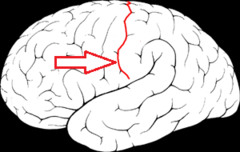
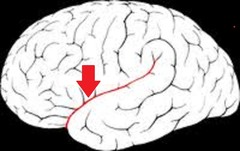
lateral sulcus
separates the temporal lobe from the frontal and parietal lobes
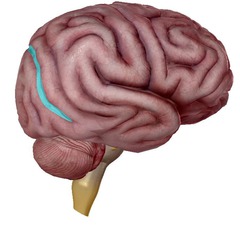
parieto-occipical sulcus
separates the occipital and parietal lobes
precentral sulcus
anterior to the central sulcus, houses primary motor area/cortex (controls voluntary movement of skeletal or voluntary muscle, contralaterally)
postcentral sulcus
posterior to the central sulcus, houses the primary somatosensory area/cortex
the cranium
what encases the brain (skull), made up of synarthrodial (not moveable) joints
primary areas
make you aware of a stimulus
association areas
allow you to interpret the stimulus
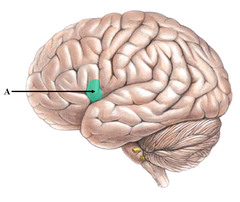
left frontal lobe
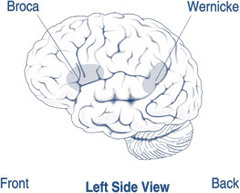
contains broca's area
broca's area
responsible for motor programming and planning for speech production (only plans and programs the message)
frontal lobes and executive function
higher-level cognitive functions that mediate language function & operate in the background (memory and attention, impulse control, planning and organization, ability to predict, mental/cognitive flexibility, problem solving)
what can damage to frontal lobes lead to?
personality changes, mood swings, lack impulse control, memory impairment, deficits in problem solving, etc)
left temporal lobe
contains wernicke's area and heschl's gyrus
wernicke's area
responsible for comprehension of spoken language and formulation of linguistic thought (thinks of the message you want to say/speak), is an association area (interprets what you heard)
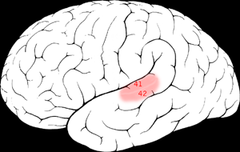
heschl's gyrus
makes you aware you heard something (primary auditory cortex)
other functions of the temporal lobes
memory (semantic and declarative), naming ability, reading, writing, word recognition, facial recognition, process sensory info, social cognition
functions of parietal lobes
math skills, spatial skills, supports memory, personality
what can damage to parietal lobes cause?
alter body image, produce left-side neglect, agnosia (inability to interpret sensation and recognize things)
occipital lobes
contain primary visual cortex (makes you aware that you have seen something) and visual association cortex (allows you to interpret what you see)
what can damage to occipital lobes do?
interfere with ability to process visual information, recognize phonemes and objects, integrate visual information, recognize color/shape/form, difficulty locating objects in an environment
brainstem
articulates with the spinal cord to control the flow of neural impulses between brain and body, responsible for life-sustaining functions, contains the medulla oblongata, pons, and midbrain
medulla oblongata
damage is imminently life threatening/ending, regulates ALL life-sustaining functions, houses nuclei for CNs IX, X, XI, and XII, responsible for many reflexes
pons
a bridge connecting the medulla oblongata and midbrain, transmits signals to/from other structures in brain, regulation of some sensations (hearing, taste, balance), most IMPORTANT function is regulation of respiration (pneumotaxic center), houses nuclei for CNs V, VI, VII, VIII
midbrain
relay center for visual, auditory, and motor system information, regulates autonomic functions, houses nuclei for CNs III & IV
cerebellum
responsible for smooth, graded, flowing, coordinated movements for speech production, maintains overall tone and truncal tone, important for balance, posture, coordination, regulates force and timing of movements
sensory CN
nerve is responsible for bringing sensory information TO the brain for processing
motor CN
nerve is responsible for sending OUT neural signal that tells a muscle to fire or contract
olfactory nerve (CN I)
SENSORY only for smell
optic nerve (CN II)
SENSORY only for vision, transmits info from eye to brain for processing (primary nerve of sight)
oculomotor nerve (CN III)
MOTOR only, goes through muscles that move the eyes and allows pupils to constrict
trochlear nerve (CN IV)
MOTOR only, aids in eye movement
trigeminal nerve (CN V)
SENSORY & MOTOR: mastication, swallowing, protection of ear from excessively loud noise, assists in soft palate elevation
abducens nerve (CN VI)
MOTOR only, abducts the eyes (away from midline)
facial nerve (CN VII)
SENSORY & MOTOR: muscles of facial expression, sensory for tongue and palate
auditory nerve (CN VIII)
SENSORY only, sense of hearing and for balance/equilibrium
glossopharyngeal nerve (CN IX)
SENSORY & MOTOR: assistant to vagus nerve, motor for deglutition (swallowing), sensory for larynx, pharynx, tongue, EAM
vagus nerve (CN X)
SENSORY & MOTOR: motor for layrynx, pharynx, velum &digestion, cardiovascular function, sensory for larynx, pharynx, tongue root, epiglottis, heard/abdominal large internal organs
accessory/spinal accessory nerve (CN XI)
MOTOR only, assistant to vagus nerve, also head turning, tilting, shoulder extension
hypoglossal nerve (XII)
MOTOR only for extrinsic and intrinsic muscles of the tongue