Memory and Cognition: Key Concepts and Research in Psychology
 Studied by 0 people
 Call Kai
 Learn
Learn Practice Test
 Spaced Repetition
 Match
Match Flashcards
 Knowt Play
1/196

There's no tags or description
Looks like no tags are added yet.
Name | Mastery | Learn | Test | Matching | Spaced |
|---|
No study sessions yet.
197 Terms
HM
An epilepsy patient who underwent radical surgery that affected his hippocampus and made him a pioneer in memory research.
dysnfunction
The behavior interferes with daily functioning (work, school, relationships)
what are the two stages in piaget’s stages of cognitive development where conservation is acquired?
preoperational stage doesn’t know conservation, only knows centration.
concrete operation stage knows conservation.
what age range did erik erikson believe was crucial to development?
12-18 years old is crucial for identity development.
what is the role of the central executive for real?
central executive directs phonological loop, episodic buffer, visual-spatial sketchpad, but it doesn’t have it’s own storage system.
what is reconsolidation?
The process that occurs when a stored memory is recalled and then restabilized in LTM.
what is the trust vs mistrust stage of erik erikson’s 8 psychosocial stages?
infants learn whether caregivers and the world are reliable and trustworthy based on the consistency of care they receive.
who came up with the idea of schema?
jean piaget
who created the cloth monkey experiment?
harry harlow
which piaget stage has cause and effect relationships?
In Piaget’s sensorimotor stage (birth–~2 years), infants learn about the world through actions and their consequences. This is where cause-and-effect relationships first emerge.
what is the ZPD?
the range of tasks a learner cannot do alone yet, but can do with guidance from a more knowledgeable other (teacher, parent, peer).
assimilation vs accomodation
Assimilation:
A child knows the schema “dog.”
They see a wolf and say, “That’s a dog.” 🐶
→ The child assimilates the wolf into the dog schema.
Accommodation:
The child learns wolves are different from dogs.
They modify their schema or create a new one (“wolf”).
Behaviorists
Ignored the mind, referring to it as a 'black box' and focused only on input and output.
Cognitive Revolution—and how did it analyze the brain?
A movement in the 1950s against behaviorism that used computers to mimic brain processes.
Encoding
The process of converting external stimuli into internal stimuli.
Storage
The process of keeping encoded information in your brain over time.
Ex:
You hear a phone number (encoding)
You keep it in your mind long enough to dial it (storage)
You dial the number (retrieval)
Consolidation
The process of turning short-term memories into long-term memories.
Retrieval
The process of bringing consolidated information (stored in LTM) back into conscious thought.
Free recall—retrieving info from LTM
Digging through the brain to recall information, similar to essay style. a type of retrieval from long-term memory
Cued recall—-retrieving info from LTM
Using hints to aid memory retrieval, like short answer questions.
Recognition—-retrieving info from LTM
Identifying previously learned information, similar to multiple-choice questions.
Savings—-retrieving info from LTM
Relearning information that has already been stored.
Ebbinghaus Forgetting Curve
Illustrates a drastic drop in retention followed by a plateau.
Ebbinghaus learned in regards to relearning and forgetting that..
relearning is faster than forgetting
Sensory Memory
Processes all incoming information—both visual and auditory, it only lasts milliseconds.
cons of sensory memory
- only last milliseconds
- low resolution
pros of sensory memory
- high capacity for stored memories
what was Sperling's partial-report procedure that shows sensory memory?
Sperling's experiment flashed a 3×4 grid of letters for a fraction of a second and tested whether people could recall all the letters or only a specific row cued by a tone (like high tone means 1st row).
He knew that iconic memory had a high capacity because when he played a tone (like high tone means 1st row) they knew the 1st row letters.
But when they were asked to recall all the letters, they could only do 2-3.
Sperling's results show that iconic memory can hold a lot of visual information, but only for a very brief moment before it disappears.
who is known for coining sensory memory?
atkinson and shiffin
Iconic Memory
Visual memory component of sensory memory.
Echoic Memory
Auditory memory component of sensory memory.
Baddeley and Hitch
Proposed that short-term memory is dynamic and can hold 7 +/- 2 items.
how long can short-term memory hold information vs sensory memory?
30 seconds vs milliseconds
Maintenance rehearsal
The process of repeating information to retain it in short-term memory.
cons of maintenance rehearsal
- passive process
- does not carry over to your long-term memory
central executive
the system that controls attention, directs mental resources, and decides how information is processed
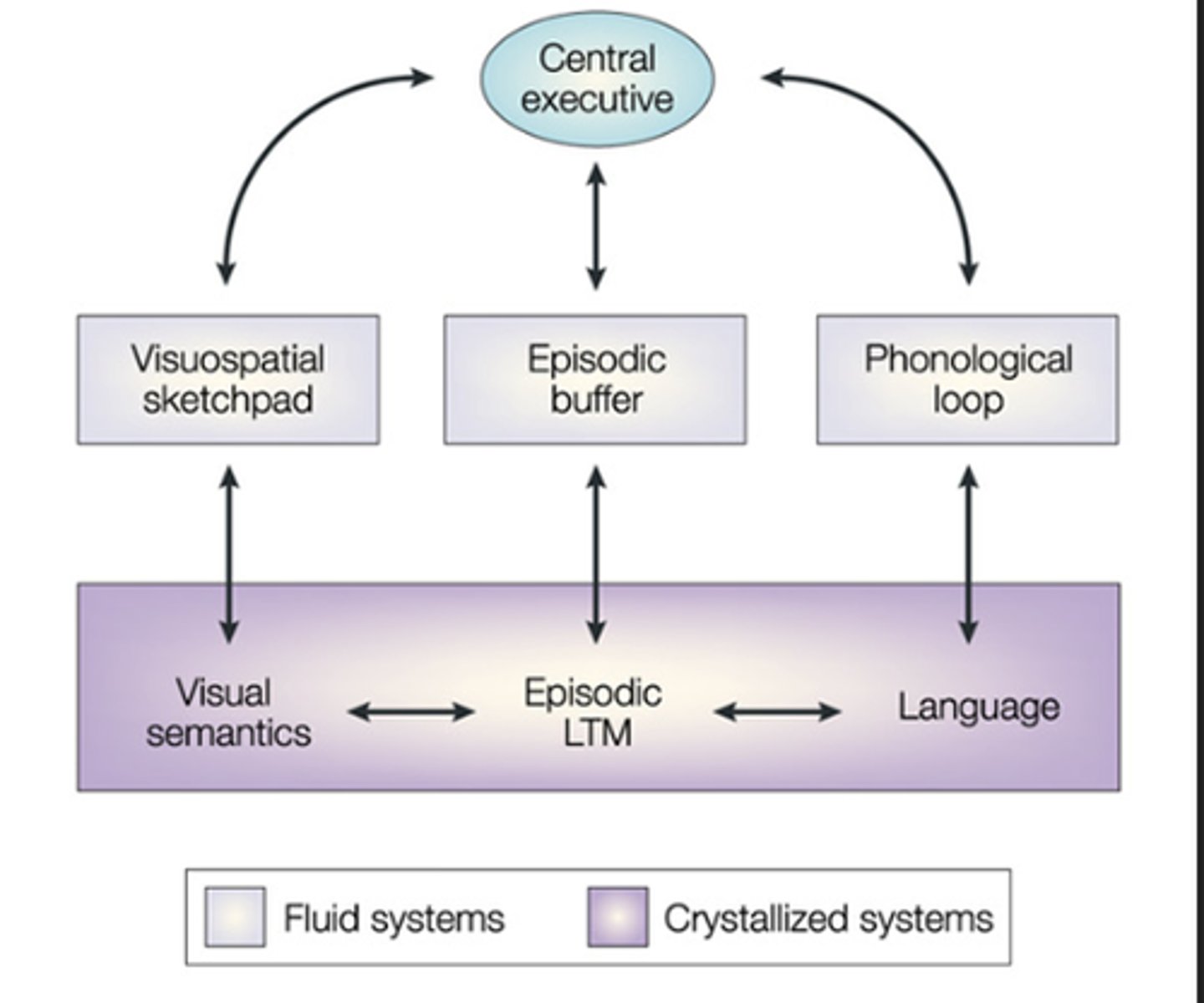
Episodic buffer
Acts as a temporary 'backup' store that integrates information from different sources.
example of episodic buffer in action
When you remember what you just read in a story — the words (verbal), the scene (visual), and how it made you feel (emotional/long-term memory) — the episodic buffer binds them all together into one mental "episode."
Phonological loop
The auditory component of working memory.
Visual spatial sketchpad
The visual component of working memory.
what is a synonym for short-term memory
working memory
Suppression
A conscious effort to push unwanted thoughts or memories out of awareness.
example of suppression against your phonological loop
Ex: If you're asked to memorize a list of words while repeating "the, the, the..." out loud, your memory for the words will be much worse — because your phonological loop is being "suppressed."
Chunking
Grouping items together so that they have meeting (like 1977 as a date)
Long-Term Memory
Unlimited storage stored for years, but you can still lose some info
how much pieces of info can LTM store?
unlimited!!!
equipotentiality
information organized and indexed over time because multiple areas of the brain can perform the same function.
encoding vs consolidation
encoding: It’s about getting information into your brain.
Consolidation: It’s about making the memory durable and long-lasting.
what is the process of retrieval?
Information stored in LTM is activated and brought back into working memory so you can consciously think about it.
what is hippocampus used for in regards to memory?
spatial memory
what is prefrontal cortex used for in terms of memory
working memory/decision making
what is temporal lobe used for in memory?
declarative memory
what is amygdala used for in memory?
fear-learning
what is cerebellum used for in memory?
motor action learning
Memory consolidation
The process of transferring short-term memories into long-term memories.
what are the four types of memory consolidation?
1. synaptic consolidation
2. cortical consolidation
3. serial-position effect
4. dunning-kruger effect
what is synaptic consolidation?
Synaptic consolidation is just long-term potentiation where changing of the neuron structure occurs that makes it easier to remember stuff
what is cortical consolidation
Cortical consolidation is where areas of the brain only in the cortical areas are strengthened, and over time the hippocampus is not needed. This is beneficial because it leads to stronger and larger memory.
Serial position effect
The tendency to remember the first (primacy effect) and last (recency effect) items in a list.
what type of memory is primacy effect?
LTM. The first items in a list are remembered well because you have more time to rehearse them, which allows them to be consolidated into long-term memory.
what type of memory is recency effect?
WM
Dunning-Kruger effect
The phenomenon where individuals overestimate their skills.
what are the two types of LTM?
explicit/declarative memory and implicit/non-declarative memory
Explicit memory
Consciously aware memories, including semantic and episodic memories.
semantic memory
memory of knowledge, concepts, theories.
Less prone to distortion
episodic memory
memory of events, more prone to distortion
what are the two types of episodic memory?
flashbulb memory and autobiographical memory
Flashbulb memory
A vivid memory of an emotionally significant event. occurs due to suprise, consequence, or emotional arousal
autobiographical memory
the memory for events and facts related to one's personal life story (ex: like being in a car crash)
Implicit memory
Memories below conscious awareness, including procedural memories and behavioral habits.
which two people developed the level of processing principles, and what is it?
Craig and Lockhart's theory that deeper processing leads to better memory retention.
what are the three levels of processing principles?
1. Superficial processing - rehearsal
2. Deeper processing - connections
Encodes semantically - you remember something based on the meaning of that word
Ex: rhymes/acoustics
3. Elaboration - meaningful processing
Processing info with meaning to you
Encoding specificity
The principle that memory is enhanced when conditions at encoding match those at retrieval. Ex: when you study underwater and then take the test underwater.
what is congruency?
This is called congruency: something is congruent when you study underwater and then take the test underwater.
Mood effect in encoding specificity
You remember things better when your mood at retrieval matches your mood at encoding.
Mnemonic devices
Techniques like acronyms and methods of loci used to enhance memory.
what is method of loci?
linking ideas to locations makes abstract information easier to recall.
Ex: shopping list in different areas of the house
Aphantasia
You cannot create mental images in your head, so method of Loci does not work
When you take breaks, how does it improve recall (number)
Taking breaks can improve recall by two times.
Illusion of Learning
You think you know it when you actually don't.
What is the Three-Word Association Study, and who created it?
Mantyla (1986) found that cued recall is better with personal associations.
Ex: the word is banana, the three-word association is yellow, yummy, curved
If you are cued by your own three word association, you have a better chance of recalling bananna than someone else's three word association
Transience
The state of forgetting caused by interference over time.
Proactive Interference
Difficulty learning new information due to prior knowledge.
Retroactive Interference
Difficulty recalling old information due to new learning.
Blocking
Temporary inability to remember something, exemplified by the tip of the tongue phenomenon.
Absetmindness
Caused by shallow encoding and fluctuating attention, not focused on the task at hand.
Amnesia
A deficit in long-term memory due to disease, brain injury, or psychological trauma.
child amnesia
Childhood (infantile) amnesia is the inability to recall memories from early childhood, usually before age 2-4, due to immature brain and cognitive development.
Anterograde Amnesia
Inability to form new long-term memories, often due to hippocampus damage.
who are the two famous people that have anterograde amnesia?
1. HM - An epilepsy patient who underwent radical surgery that affected his hippocampus and made him a pioneer in memory research.
2. Clive Waring
Retrograde Amnesia
Inability to retrieve long-term memories, often due to damage in the cortex in episodic memories.
who was the famous person that had retrograde amnesia?
clive waring
how are speech and memory correlated?
if it is hard for you to create speech, you have bad memory. this is why we dont remember everything when we were younger because we didn't know how to speak yet.
Memory Bias
a memory that is distorted—-lost details and false recollection
Cryptomnesia
A memory error where a forgotten memory is recalled as a new thought.
unconscious plagiarism
when an individual, unaware of the memory's source, presents the information as their own creation.
In other words, it’s the RESULT of cryptomnesia.
False Memory
A memory created that never occured, can be influenced by misinformation.
Ex:
1. say a bunch of words about sewing but not "needle"
2. Then give them a list of words different from what they said, one word in the list is "needle"
3. Ask them to say which words from this list were what they said
4. Most ppl say yes to "needle"
Attention
Limited by space, object, and time; can be disengaged and reengaged.
Voluntary Attention
Goal-directed attention requiring conscious effort.
Involuntary Attention
Automatic attention drawn to external stimuli.