Physics 3B Midterm
 Call Kai
 Learn
Learn Practice Test
 Spaced Repetition
 Match
Match Flashcards
 Knowt Play
1/45

There's no tags or description
Looks like no tags are added yet.
Name | Mastery | Learn | Test | Matching | Spaced | Call with Kai | Chat |
|---|
No analytics yet
Send a link to your students to track their progress
46 Terms
Chapter 9: Fluid Mechanics
Properties of fluids:
* What is a fluid?
* Name two fluids.
A fluid is a substance that can flow.
Liquids and gases are fluids as both substances can flow.
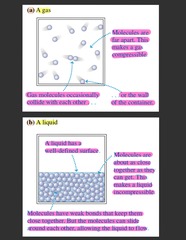
A gas: molecules are far apart. This makes a gas compressible. Gas molecules occasionally collide with each other, or the wall of the container.
A liquid: has a well-defined surface. Molecules are about as close together as they can get. This makes a liquid incompressible. Molecules have weak bonds that keep them close together. But molecules can slide around each other, allowing the liquid to flow.
Chapter 9: Fluid Mechanics
Properties of fluids:
* What is the density of a substance of uniform composition?
* What is the density of water at 4° C?
* Its mass (M) divided by its volume (V). That is: ρ = M/V
* The density of water at 4° C is 1000 kg/m³
Chapter 9: Fluid Mechanics
Properties of fluids:
* Compare density of liquids to density of gasses.
* Compare how liquids and gases fill their containers in our atmosphere vs. space. Understand why they differ.
* Liquids have a constant density. Gases have changing density (density of air on top of a mountain vs. density of air on ground at the bottom of the mountain).
* Liquids fill their containers, taking the shape of the container. Gases also fill their containers, taking the shape of the container. However, liquids can't fill their containers in space. Gases can. This is because, for liquids, filling their containers depends on the force of gravity.
Chapter 9: Fluid Mechanics
Pressure:
* What is average pressure (P)?
* What is the unit of pressure?
The average pressure (P) is the perpendicular component of the force (F) divided by the area (A) on which the force acts. -> P = F⊥/A
* The force exerted by a fluid on a submerged object at any point on the object is perpendicular to the surface of the object.
The unit of pressure: Pascal = Pa = 1 N/m²
Chapter 9: Fluid Mechanics
Pressure: Practice Problem
* Given the mass of air particles, and the area of the surface they're exerting a force on, find the pressure.
P = F/A
1. Using their mass, find their weight: weight = mg.
* The weight of the air particles is the force exerted on the surface they're acting on. By finding their weight, we found F.
* We have the area of the surface, so we can plug the numbers in to solve for pressure.
Chapter 9: Fluid Mechanics
Pressure:
* Compare force and pressure.
Force is a vector, but pressure is a scalar.
No direction is associated with pressure, but the direction of the force associated with the pressure is perpendicular to the surface on which the force acts.
Chapter 9: Fluid Mechanics
Variation of Pressure with Depth in a Liquid:
* When a fluid is at rest, what does this mean?
If a fluid is at rest, then all parts of the fluid are in static equilibrium.
Chapter 9: Fluid Mechanics
Variation of Pressure with Depth in a Liquid:
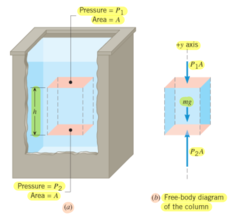
* Consider a liquid in static equilibrium (PIC): How is the pressure P1 related to the pressure P2?
- at different depths
- at the same depth
Consider a sample of liquid of cross-sectional area (A) and height (h) in static equilibrium. Then, the net ↑ force = 0.
----> P(deeper level) = P(upper level) + ρgh
The pressure increases as you go deeper in the liquid if it is in static equilibrium. Pressure is constant at the same depth if the liquid is in static equilibrium.
Chapter 9: Fluid Mechanics
Variation of Pressure with Depth in a Liquid:
* At sea level, what is the atmospheric pressure Po?
* How can you tell when you have atmospheric pressure in a problem?
At sea level, the atmospheric pressure Po is equal to 1.013 x 10⁵ Pa = 101 kPa = 14.7 psi = 1 atm
If you have an open container, the pressure on the fluid in the container from the air is the atmospheric pressure (Po).
Chapter 9: Fluid Mechanics
Variation of Pressure with Depth in a Liquid:
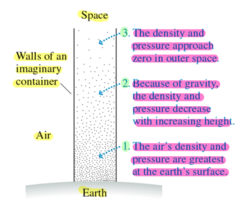
* Describe the density of air as it goes from Earth's surface -> space.
* Describe the pressure of air as it goes from Earth's surface -> space.
1. The air's density and pressure are greatest at the Earth's surface.
2. Because of gravity, the density and pressure decrease with increasing height.
3. The density and pressure approach zero in outer space.
Chapter 9: Fluid Mechanics
Variation of Pressure with Depth in a Liquid:
* Define Gauge Pressure.
* Compare Gauge Pressure and Absolute Pressure.
* Know how to calculate absolute pressure from gauge pressure.
* Should you use absolute pressure or gauge pressure in equations?
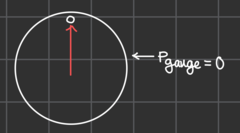
The difference between absolute pressure and atmospheric pressure is gauge pressure.
Gauge pressure = P - Po
Gauge pressure = Absolute pressure - Atmospheric pressure
Gauge pressure = P - 1 atm
Gauge pressure reads 1 atm lower than it should.
EX: If the absolute pressure = 1 atm...
gauge pressure will read: 1 atm - 1 atm = 0 atm.
Add an extra 1 atm to get absolute pressure from gauge pressure.
Always use absolute pressure to be safe, in equations that don't have pressure on both sides, the pressures won't cancel out and you will get the wrong answer.
Chapter 9: Fluid Mechanics
Variation of Pressure with Depth in a Liquid:
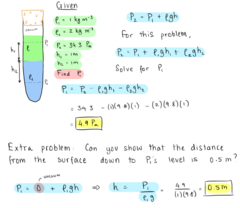
* Know how to calculate the pressure of liquids IN STATIC EQUILIBRIUM at different depths, when dealing with MULTIPLE DIFFERENT LIQUIDS.
* Just add more ρgh terms to represent the different liquids in the container.
Chapter 9: Fluid Mechanics
Variation of Pressure with Depth in a Liquid: PRACTICE PROBLEMS
* Two open cylinders have water in them. One has a radius of 10 m and the other has a radius of 20 m. At a depth of 50 cm from the surface, which cylinder has a higher pressure?
* Who's feet will hurt more: someone wearing heels or someone wearing regular shoes?
Since the equations for pressure don't depend on the area of the container (only the depth), both will have equal pressure.
The force however, will be different since P = F⊥/A. The one with the larger area will experience a larger force at that level. Force and area change accordingly since pressure is constant for this example.
Contrast this with a different problem. If a person wears regular shoes and later wears heels, their feet hurt more when they wear heels. The person's weight doesn't change (F⊥ is constant), so the difference in area (heels have a small area) causes the pressure to be LARGER when they wear heels. Pressure and area change accordingly since force is constant for this example.
Chapter 9: Fluid Mechanics
Pascal's Principle:
* Define Pascal's Principle.
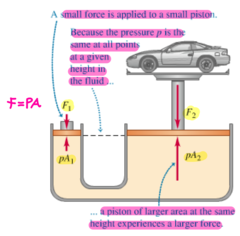
* Describe what is happening in a hydraulic press: When a small force is applied to a small piston, describe the force applied to a piston of larger area at the same height AKA if a small force F1 is applied to the left end, describe the force F2 applied to the right end when A2 >>>>> A1.
A change in pressure applied to an enclosed fluid is transmitted undiminished to every point of the fluid and to the walls of the container.
Hydraulic press: a small force is applied to a small piston. Because the pressure (P) is the same at all points at a given height in the fluid, a piston of larger area at the same height experiences a larger force.
-> A small force F1 applied to the left end results in a large force F2 applied to the right end if A2 >>>>> A1.
* F2 = (A2/A1)F1
Chapter 9: Fluid Mechanics
Pressure Measurements:
1. The open-tube manometer:
* Know what this instrument is used for.
* Know the equation for calculating pressure at different depths.
* Describe the pressure at two different points at the same depth.
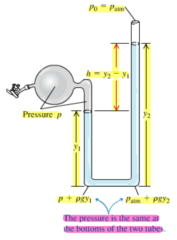
This apparatus is used to measure the pressure in an enclosed fluid. The governing equation is P = Po + ρgh, where (h) represents the vertical separation distance between the levels of the liquid in the two columns of the U-shaped tube.
* The pressure is the same at the bottoms of the two tubes.
Chapter 9: Fluid Mechanics
Pressure Measurements:
* When can you use Patm for Po?
You can only use Patm for Po when you're referring to the pressure of the atmosphere, (the pressure of the air above the ocean). DO NOT use Patm when you're referring to simply the pressure of air - this doesn't work when referring to the pressure of air in a tube.
Chapter 9: Fluid Mechanics
Pressure Measurements:
2. The Barometer:
* Know what this instrument is used for, and know how this works.
* Know relevant equations.
* When there is a vacuum in a certain area, what is the pressure in this area?
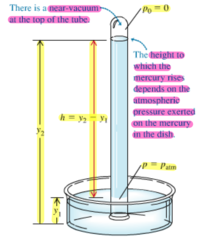
This apparatus is used to measure atmospheric pressure.
* There is a near-vacuum at the top of the tube (upper level) -> P(upper) = 0 atm
* The height to which the mercury rises depends on the atmospheric pressure exerted on the mercury in the dish.
* P(deeper) = P(upper) + ρgh -> P(deeper) = ρgh
* EX: For mercury, ρ = 13.6 x 10³ kg/m³, and atmospheric pressure at sea level is Po = 1.013 x 10⁵ Pa which corresponds to height (h) of 76 cm = 0.76 m = 760 mm = 29.92 inches of mercury.
*** Using this instrument, we can measure atmospheric pressure because it always makes the pressure of the upper level zero, due to acting like a vacuum at the upper level of the tube ***
EX: in problems using this instrument, P(upper) = 0, and P(deeper) = P(atm) = ρgh
Chapter 9: Fluid Mechanics
Buoyancy Forces and Archimedes's Principle:
* Know Archimedes's Principle.
- What is F(B) (not the equation, just what it is)?
- Know the direction of the net force, and why this is its direction.
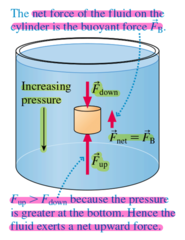
Archimedes's Principle: Any object completely or partially submerged in a fluid is buoyed upward by a force whose magnitude is equal to the weight of the fluid displaced by the object.
F(B) is the magnitude of the buoyant force acting on the submerged object, exerted by the entire surrounding fluid.
- The net force of the fluid on the submerged object is the buoyant force F(B).
F(up) > F(down) because the pressure is greater at the bottom of the object. Hence, the fluid exerts a net upward force.
Chapter 9: Fluid Mechanics
Buoyancy Forces and Archimedes's Principle:
* What is the equation(s) for F(B)?
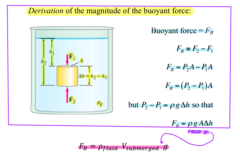
F(B) = ρ(fluid)V(submerged)g
F(B) = ρ(fluid)V(fluid displaced)g
F(B) = W(water displaced) -> F(B) = M(water disp.)g
* M = ρV
Chapter 9: Fluid Mechanics
Buoyancy Forces and Archimedes's Principle:
* When will an object sink?
* When will an object float?
* When will an object have neutral buoyancy?
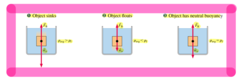
Object sinks: F(B) < Wo, ρ(avg,object) > ρ(fluid)
Object floats: F(B) > Wo, ρ(avg,object) < ρ(fluid)
Object has neutral buoyancy: F(B) = Wo, ρ(avg,object) = ρ(fluid)
Chapter 9: Fluid Mechanics
Fluids in Motion:
A fluid is flowing in a tube - how is the pressure related to the motion of the fluid? Know which equations to use.
A fluid is flowing in a tube (moving) - how is the pressure related to the motion of the fluid?
* Two equations for fluids in motion: Equation of continuity and Bernoulli's equation.
Chapter 9: Fluid Mechanics
Fluids in Motion:
* Define laminar flow.
* Know the continuity equation. Know what it results from.
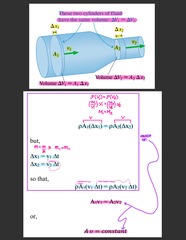
* Consider an incompressible fluid (liquid) flowing through a tube: if the diameter of the tube changes, then what happens to the speed of the fluid?
- Compare the volume of the A1 cylinder to the A2 cylinder, and know how to calculate their volumes.
- Compare the mass of liquid entering vs. leaving the tube.
* What does this tell you?
- Know the limitations of using the continuity equation.
Laminar flow: when each particle of the fluid follows a smooth path so that the paths of different particles never cross each other.
The continuity equation: A1v1 = A2v2, or Av = constant
The continuity equation results from conservation of mass in laminar flow.
* The two cylinders of liquid have the same volume:
∆V1 = ∆V2
* Volume ∆V1 = A1∆x1
* Volume ∆V2 = A2∆x2
If a fluid of mass ∆M1 enters the tube through A1 during a time interval ∆t, then an equal mass of fluid ∆M2 must leave the tube through A2 (conservation of mass in laminar flow).
- Mass of fluid entering = mass of fluid leaving
- ∆M1 = ∆M2
* Equation of continuity: the amount of liquid entering the tube = the amount of liquid leaving the tube; no holes are in the tube, there's no leaking (no fluid being lost).
☆☆☆ Only used in the case of liquids ☆☆☆
- Av = constant = volume/time
Chapter 9: Fluid Mechanics
Fluids in Motion:
* Know the equation for the volume flow rate.
* Know the units for the volume flow rate.
Volume flow rate (Q): Q = ∆V/∆t = Av
* Av has units of volume/time.
Chapter 9: Fluid Mechanics
Fluids in Motion:
Volume flow rate problem:
Let's say our lecture hall is flooding with water - there is water coming in from the back doors, and a door at the front is open.
- Door at the front (open): 2 l x 2 w
- Water is moving out of the open door at 3 m/s
Calculate the volume flow rate. How much water is leaving out the front door, every second?
How much water is leaving out the front door in 3 seconds?
Let's say our lecture hall is flooding with water - there is water coming in from the back doors, and a door at the front is open.
- Door at the front (open): 2 l x 2 w = 4 m² = A
- Water is moving out of the open door at 3 m/s
- Av = (4 m²)(3 m/s) = 12 m³/s
Meaning: every second, a volume of 12 m³ goes out the door, leaving the room.
In 3 seconds, 36 m³ goes out the door, leaving the room.
Now, let's say that outside the opened door, there's a swimming pool.
* Swimming pool: 1200 m³
How long would it take to fill the swimming pool with water? Remember - 12 m³ water is filling every second.
Chapter 9: Fluid Mechanics
Fluids in Motion:
If the diameter of the tube changes, then what happens to the speed of the fluid?
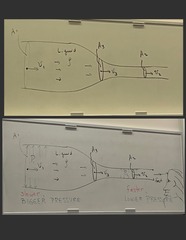
* In which of these locations is the liquid moving the fastest? A1, A2, A3? Rank them, and explain.
- An increasing speed causes the diameter to ____.
- Understand example.
* In which of these locations is there the highest pressure? Rank them, and explain.
In which of these locations is the liquid moving the fastest? A1, A2, A3?
Fastest: A2
Slower: A3
Slowest: A1
An increasing speed causes the diameter to decrease.
A1v1 = A2v2 = A3v3
EX -> Garden hose: you squish it to make water come out faster, so the water reaches farther.
In which of these locations is there the highest pressure?
Biggest P: A1
Lower P: A3
Lowest P: A2
P1: pressure at A1 (bigger)
P2: pressure at A2 (smaller)
Which pressure is larger? P1 is larger.
* Pressure is the unit of force that the liquid exerts on the area of the walls of the container.
Force is bigger at A1 -> pressure is bigger at A1.
* A1: the water is moving slower here, so more pressure is building up (bigger pressure).
* A2: the water is moving faster here, so there's less pressure on the walls of the container (lower pressure).
* A2: the pressure of the water leaving the container is bigger (hits someone harder), but the pressure of the water on the container, while it's in the container, is smaller.
- At A2, the pressure of the water is only bigger on what it hits, not on the container itself.
Chapter 9: Fluid Mechanics
Fluids in Motion:
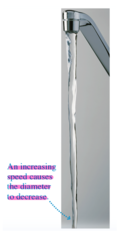
* How does speed affect diameter?
- An increasing speed causes the diameter to ___.
An increasing speed causes the diameter to decrease.
Chapter 9: Fluid Mechanics
Fluids in Motion:
* What about a gas? What happens to the speed of a gas when A ↓?
Gases
As A ↓, the speed of the gas ↑. Quantitatively, gases don't follow: Av = constant
but ... qualitatively, they do.
Chapter 9: Fluid Mechanics
Ideal Fluid Dynamics:
Bernoulli's Equation
* What does this equation apply to?
* What does this equation result from?
* Know the equation.
- How does the equation change if h1=h2?
* Understand applications of Bernoulli's principle.
- Faster moving liquid = ___ pressure exerted by the liquid.
* Know how to calculate lift force, and know what makes it larger/smaller.
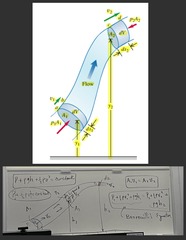
Bernoulli's Equation:
Applies to an ideal liquid with zero friction-like forces.
Results from conservation of energy. Applying the work-energy theorem to the laminar flow described below yields:
P₁ + (1/2)ρv₁² + ρgh₁ = P₂ + (1/2)ρv₂² + ρgh₂
OR
P + (1/2)ρv² + ρgh = constant
* If h1 = h2, then ... P + (1/2)ρv² = constant
Applications of Bernoulli's principle:
1. Blowing air over sheet of paper in front of your mouth.
2. Canvas top puffs upward in moving convertible cars.
3. Houses may explode during hurricanes or tornados.
4. Lift force on airplane wings:
- Lift force = (pressure difference) x (area of wing)
Lift is greater when the wing area is large or when the plane moves fast so that the pressure difference across the top and bottom of the wings is large.
As you hold a piece of paper, it bends.
* The pressure above the paper = the pressure below the paper ----------> cancel.
* The weight of the paper is the only force left.
* The faster air moves, the lower the pressure (blowing air on paper).
* While blowing air on paper, the paper lifts up, making itself flat.
A1v1 = A2v2
Chapter 9: Fluid Mechanics
Ideal Fluid Dynamics:
Magnus effect
* Understand the Magnus effect.
- Compare the motion of air relative to a non spinning ball vs. the motion of a spinning ball
- Motion of a spinning ball:
* Which side of the ball moves opposite to the airflow?
* Which side of the ball moves in the direction of the airflow?
- Describe the force generated when a spinning ball moves through air.
* A moving ball ____. So, when air moves past a spinning ball, what happens?
* In what direction does the resultant force point?
* Understand example given.
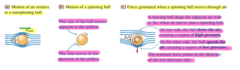
Magnus effect:
(a) motion of air relative to a nonspinning ball
(b) motion of a spinning ball
* This side (top) of the ball moves opposite to the airflow.
* This side (bottom) of the ball moves in the direction of the air flow.
(c) force generated when a spinning ball moves through air
* A moving ball drags the adjacent air with it. So, when air moves past a spinning ball:
- On one side, the ball slows the air, creating a region of high pressure.
- On the other side, the ball speeds the air, creating a region of low pressure.
The resultant force points in the direction of the low-pressure side.
Soccer field:
* A goalie kicks the ball - the ball starts spinning clockwise in the air, moving further away, the air moves faster -> less pressure is on the ball.
- Slower moving air = more pressure.
Chapter 9: Fluid Mechanics
Buoyancy Force: Liquid Under Static Equilibrium
* Know how to solve this kind of problem (QUIZ 1)
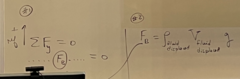
Static equilibrium -> the sum of the forces = 0.
* F(B) is one of the forces.
F(B) = ρ(fluid)V(submerged)g
F(B) = ρ(fluid)V(fluid displaced)g
F(B) = W(water displaced) -> F(B) = M(water disp.)g
* M = ρV
Chapter 9: Fluid Mechanics
Practice Problem:
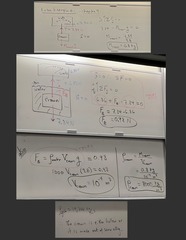
1. A bargain hunter purchases a "gold" crown at a flea market. After he gets home, he hangs the crown from a scale and finds its weight to be 7.84 N. He then weighs the crown while it is completely submerged in water of density 1000 kg/m³, and now the scale reads 6.86 N. Is the crown made of pure gold?
* The reading on the scale is the measure of F the scale is putting upwards on the crown.
The tension of the cord holding the crown = the number the scale reads.
* Crown is at rest, F(net) = 0.
* T = 7.84 N
* 7.84 N - Mg = 0
* 7.84 N = Mg
* 7.84 N/g = M
M(crown) = 7.84/9.8 = 0.8 kg
The reading on the scale when the crown is submerged in water is different. When the crown is submerged in water, its reading is 6.86 N, which is the force the string is putting on the crown.
* Weight = Mg = 7.84 N
* Crown is at rest, so F(net) = 0.
* The crown should be going down, this doesn't happen because F(B) pushes it up.
T + F(B) - Mg = 0
6.86 + F(B) - 7.84 = 0
7.84 - 6.86 = F(B) = 0.98 N
AKA
F(B) = ρ(water)V(crown)g = 0.98 N
(1000)(V)(9.8) = 0.98 -> 0.001 m³
ρ(crown) = M(crown)/V(crown) = 0.8 kg/0.001 m³ = 8000 kg/m³
ρ(gold) = 19,300 kg/m³, so the crown is either hollow or it is made out of some alloy.
Chapter 9: Fluid Mechanics
Practice Problem:
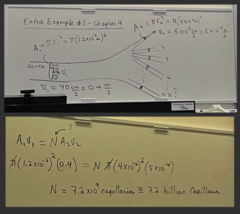
2. The approximate radius of the aorta is 1.2 cm, while that of a capillary is 4.0 µm. The approximate average blood flow speed is 40 cm/s in the aorta and 0.05 cm/s in the capillaries. If all the blood in the aorta eventually flows through the capillaries, estimate the number of capillaries in the human circulatory system. Here you may assume that the blood flow rate in the aorta must equal the blood flow rate in all capillaries.
* Blood entering = blood leaving
V(blood) from A1 in 1 s = (V(blood) from A2 in 1 s)(# capillaries)
A1v1 = A2v2 x (N)
* N = # capillaries
Chapter 9: Fluid Mechanics
Bermouidilli's Principle:
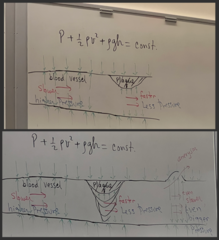
* Understand how Bermouidilli's Principle relates to blood flow in human blood vessels: blood clots vs. vessel expansion
P + (1/2)ρv² + ρgh = constant
* The flow of blood is horizontal.
* Let's say someone accumulates clots in the inner walls of their blood vessel.
- When blood goes through a narrow constriction (with clot), is it going faster or slower? FASTER.
- Moving faster = pressure is less at that point.
- Moving slower = pressure is greater at that point.
- As the blood is moving through, the pressure is the force of the blood on the walls of the vessel per unit area.
- The blood vessel has no vacuum - it has stuff pushing into it -> F is being exerted on the blood vessels' outer walls -> balance out.
- With narrower walls (clot), the F pushing on the wall from the outside isn't as strong at that point.
- Clot accumulating = blocks pathway completely.
* Blood vessel expands in certain area = blood is moving slower than in a normal vessel.
- Moving more slowly = bigger pressure
- The F exerted by the slower moving blood is bigger, so that region of the blood vessel expands even more, making the problem even worse -> blood vessel could rupture.
Chapter 12: Thermodynamics
Heat
Temperature and Thermal Equilibrium
* Define temperature.
* Define thermal equilibrium: when are two systems said to be in thermal equilibrium?
Temperature and Thermal Equilibrium
* Temperature is a measure of how hot or cold something is.
* Two systems are said to be in thermal equilibrium with one another if and only if the two systems have the same temperature.
- Temperature determines whether something is in equilibrium with something else.
Chapter 12: Thermodynamics
Heat
The Zeroth Law of Thermodynamics
* What is the Zeroth Law of Thermodynamics? (what does it state):
If objects A and B are separately in thermal equilibrium with a third object C, then objects A and B are ___.
* What are thermometers: what do they measure, and how?
* Know the difference between T(F), T(C) and T.
- Which is "absolute temperature"?
* Know the metric system's unit of temperature.
The Zeroth Law of Thermodynamics: if objects A and B are separately in thermal equilibrium with a third object C, then objects A and B are in thermal equilibrium with each other.
- EX: If a red marker is at the same temperature as a blue marker (thermal equilibrium), and the blue marker is in thermal equilibrium with a black marker, then the black marker is also in thermal equilibrium with the red marker.
Thermometers: instruments used to measure temperature, usually by the expansion or contraction of a liquid (such as mercury).
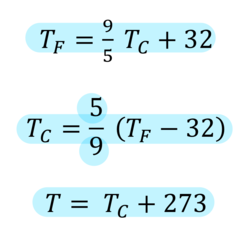
T(F) = Temperature in degrees Fahrenheit
T(C) = Temperature in degrees Celsius
T = "Absolute temperature" in Kelvin
- Metric system: unit of T = K.
↑↑↑↑↑↑↑↑↑↑↑↑↑↑↑↑↑↑↑↑↑↑↑↑↑↑↑↑↑↑↑↑↑↑↑↑↑
You'll need to make sure temperature is always converted to K (or equivalent) when using formulas.
Chapter 12: Thermodynamics
Heat
The Absolute Zero Temperature
* Define the "absolute zero temperature".
* Define the "zero-point energy".
* At what temperature does water freeze at 1 atm? Boil?
* Compare the Celsius and Kelvin scale.
* When using temperatures in equations, what is a good rule of thumb to follow?
* Define ∆T.
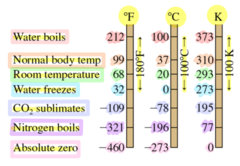
The "absolute zero temperature" is the temperature at which the system is in a state of minimum but finite atomic motion. The "zero-point energy" is the energy associated with this state of the system, i.e. with the motion of atoms at 0 kelvin.
☆☆☆ MEMORIZE WHAT TEMPERATURE WATER FREEZES AND BOILS AT, AT 1 ATM ☆☆☆
- It's easiest to memorize on the Celsius scale
-> (Boils @ 100, Freezes @ 0).
- Note: values in table are only true when P = 1 atm.
The change in temperature of the Celsius scale is the same as the change in temperature of the Kelvin scale, regardless of the position of the temperature.
---> ∆T(C) = ∆T(K)
* TIP: Always convert temperature to Kelvin when given a temperature in a problem.
If ∆T is in the problem, you can just use Celsius, if C is given, since ∆T(C) = ∆T(K). If no ∆T is in the problem, then convert the temperature to Kelvin.
∆T = T(hot) - T(cold)
*** T⁴ isn't ∆T⁴, just T! -> You must convert T to Kelvin -> If you just have T by itself, convert to Kelvin.
T⁴ - Ts⁴: must convert to Kelvin.
Chapter 12: Thermodynamics
Heat
The Three Phases of Matter
1. A solid is a ___ system that consists of ___ atoms connected by ___ molecular bonds. Solids are nearly ___, which tells us that the atoms in a solid are ___.
- Atoms ___.
2. A liquid is a system in which the molecules are ___ held together by ___ molecular bonds. The bonds are ___.
- Atoms are held ___ by ___ molecular bonds, but they can ___.
3. A gas is a system in which ___ until, on occasion, it ___. A gas is ___, telling us that there is ___.
- Atoms are ___ and ___ except for ____.
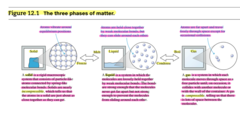
1. A solid is a rigid macroscopic system that consists of particle-like atoms connected by spring-like molecular bonds. Solids are nearly incompressible, which tells us that the atoms in a solid are just about as close together as they can get.
* Atoms vibrate around equilibrium positions.
2. A liquid is a system in which the molecules are loosely held together by weak molecular bonds. The bonds are strong enough that the molecules never get far apart but not strong enough to prevent the molecules from sliding around each other.
* Atoms are held close together by weak molecular bonds, but they can slide around each other.
3. A gas is a system in which each molecule moves through space as a free particle until, on occasion, it collides with another molecule or with the wall of the container. A gas is compressible, telling us that there is lots of space between the molecules.
* Atoms are far apart and travel freely through space except for occasional collisions.
Chapter 12: Thermodynamics
Heat
Heat & Heat Units
* Define Heat: the ___ energy being transferred, via ___, from a region of ___ to a region of ___.
* Define 1 calorie.
* 1 calorie = how many Joules?
* 1 diet Calorie = how many calories?
* How many Joules are required to raise the temperature of 1 kg of water by 1 °C?
Heat is the thermal energy being transferred, via particle collisions, from a region of high temperature to a region of lower temperature.
* Energy in transit from point to point (usually hot to cold).
* 1 calorie is defined as the energy needed to raise the temperature of 1 gram of water by 1 °C.
* 4186 Joules are required to raise the temperature of 1 kg of water by 1 °C.
- 1 calorie = 4.186 Joules
- 1 diet Calorie = 1000 calories
Chapter 12: Thermodynamics
Heat
Heat & Heat Units: Examples
* Let's say we have a metal rod with one end in fire and the other end in ice (one end is hot, one end is cold).
- Describe the atoms at the hot end of the rod.
- What starts happening to these atoms as the temperature continues to rise? What happens to the rod?
- Summarize what is happening here.
- Define heat energy.
* Understand example given.
EX (Conduction) -
Let's say we have a metal rod, with one end in fire and the other end in ice -> one end is hot, one end is cold.
* Hot end of rod: atoms aren't moving around, they're just dancing in the same space given to them (think of a crowded lecture hall, with students shoulder to shoulder in their seats. students are moving during the lecture, taking notes, but not leaving their seats). Molecules in the solid are in equilibrium positions, but vibrating in these equilibrium positions.
* Atoms start jiggling more rigorously with rising temperatures -> solid expands. This jiggling motion of agitation of these atoms leads to them agitating the atoms next to them -> domino effect.
SUMMARY: The fire on one end of the rod -> transfers energy of agitation from hot to cold -> this energy is heat energy.
EX: The Sun is hot - there's a vacuum between our Sun and the Earth. Heat isn't transferred to the Earth from convection nor conduction - it is transmitted by waves.
Chapter 12: Thermodynamics
Heat
Thermal Expansion of Solids and Liquids - Linear Expansion of Solids
* Know the equation for linear expansion OF SOLIDS.
- Know when this equation can be used.
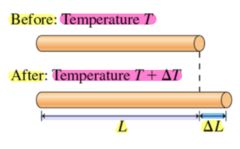
The length L₀ of a solid object (or thin liquid) changes by an amount ΔL when its temperature changes by an amount ΔT given by: ΔL = L₀αΔT (solids)
where...
α = thermal coefficient of linear expansion of the object.
For many materials, every linear dimension changes according to the formula above. Thus, L could represent the thickness of a rod, the side length of a square sheet, or the diameter of a hole.
* EX: ΔL = change in length of wire.
Chapter 12: Thermodynamics
Heat
Thermal Expansion of Solids and Liquids - Volume Expansion of Liquids and Solids
* Know the equation for volume expansion OF LIQUIDS AND SOLIDS
- How does β compare to α?
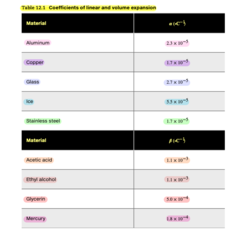
The volume V₀ of a solid object, or liquid, changes by an amount ΔV when its temperature changes by an amount ΔT given by: ΔV = V₀βΔT (liquids and solids)
where...
β = thermal coefficient of volume expansion of the solid or liquid
* Water ----heated----> grows in space = change in volume.
* β = 3x α
Chapter 12: Thermodynamics
Heat
Thermal Expansion
* Describe thermal expansion.
* Understand the idea of linear expansion.
* Let's say we have two markers - one marker is taller than the other:
- Two markers: some length, some temperature.
- Both of the markers have the same initial temperature, and we raise their temperatures by the same amount.
Will ΔL be the same, or different?
- SUMMARY: If our green marker is longer than our red marker, if the red marker increases by some amount, the green will ___ by a ___ amount. How much it ____ in length depends on ___.
- Which marker (green or red) undergoes the greater fractional change in length?
Thermal expansion: if you add heat energy -> atoms jiggle more vigorously -> atoms spread out -> grows in volume or length.
* α = different values of linear expansion for different elements.
* Let's say you have a rod - initial length (L₀), temp (T).
- You add heat to it -> rod expands.
- If you raise the temperature by 10 °C/K, of a rod with L₀, the rod gets longer. How much longer?
-> We've just experienced a change in the length of the rod as a result of the change in T.
* Let's say we have two markers - one marker is taller than the other:
- Two markers: some length, some temperature.
- Both of the markers have the same initial temperature, and we raise their temperatures by the same amount.
Will ΔL be the same, or different?
ΔL = L₀αΔT
L₀ is different between the markers -> the change in length of the bigger marker will be bigger.
* α is the same for both markers (same material), and both have the same ΔT.
* SUMMARY: if our green marker is longer than our red marker, if the red marker increases by some amount, the green will increase by a bigger amount. How much it increases in length, tho, depends on how long it was to start with.
EX: "Which marker (green or red) undergoes the greater fractional change in length?"
SAME: fractional change = ΔL/L₀ = αΔT
Chapter 12: Thermodynamics
Heat
Thermal Expansion of Solids and Liquids - Holes
* What happens to a hole in a piece of material when heated and cooled?
* When an object undergoes thermal expansion, what happens to any holes in the object?
- EX: Let's say you heat up your ring - does the hole get smaller or bigger?
* Understand example given.
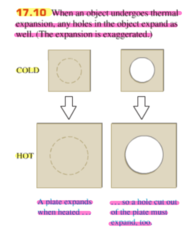
A hole in a piece of material expands when heated and contracts when cooled, just as if it were filled with the material that surrounds it.
* When an object undergoes thermal expansion, any holes in the object expand as well (the expansion is exaggerated).
- A plate expands when heated -> so a hole cut out of the plate must expand, too.
Chapter 12: Thermodynamics
Heat
Thermal Expansion of Solids and Liquids - Examples
* Expansion slots on bridges are needed to accommodate changes in ___ that result from ___ throughout the seasons.
* Running hot water on a jar lid -> ____. This is because the metal may be heated ___ by the hot water, or even if the jar is heated uniformly, metals ___ than glasses because ___.
* Understand examples.
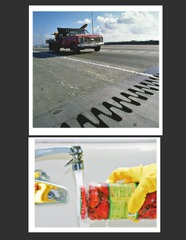
Expansion slots on bridges are needed to accommodate changes in length that result from thermal expansions and contractions throughout the seasons.
Running hot water on a jar lid loosens it. This is because the metal may be heated more directly by the hot water, or even if the jar is heated uniformly, metals expand more than glasses because
α(metal) > α(glass)
* Golden Gate Bridge: increases each summer by a meter.
* What happens if you pour a sidewalk in the winter time? What happens when the summer comes along? Slabs on concrete expand. If you don't allow for expansion, they can bunker.
* Bridges expand in sections, so they have expansion spots. When the slabs grow, they grow fitting like a puzzle, with each other, and in the winter, they move apart, leaving space between (PIC).
* Jar: If you're having a hard time opening a jar, run it under hot water -> expands because metal has a bigger alpha coefficient than glass, so you can open it.
Chapter 12: Thermodynamics
Heat
Thermal Expansion of Solids and Liquids - Water
* Water ___ as its temperature increases from 0°C to 4°C, and thus its ___ in this temperature range.
* Notice that above 4°C, water exhibits ___ with increasing temperature.
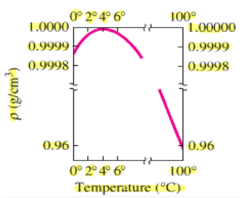
The anomalous behavior of water between 0°C and 4°C:
Water contracts as its temperature increases from 0°C to 4°C, and thus its density increases in this temperature range.
It is this weird behavior of water in this temperature range that explains why lakes freeze from the top down.
Notice that above 4°C, water exhibits the "expected" expansion with increasing temperature.
Chapter 12: Thermodynamics
Heat
Specific Heat (Solids and Liquids)