guide GC ethics + legal
 Call Kai
 Learn
Learn Practice Test
 Spaced Repetition
 Match
Match Flashcards
 Knowt Play
1/193

There's no tags or description
Looks like no tags are added yet.
Name | Mastery | Learn | Test | Matching | Spaced | Call with Kai | Chat |
|---|
No analytics yet
Send a link to your students to track their progress
194 Terms
Provider
The hospital, genetic testing labs, pharma, or outpatient clinics involved in healthcare delivery.
Payor
Public or private insurance entities responsible for paying health care costs.
Deductible
The amount that a health insurance plan enrollee must pay before the plan starts to pay for most covered items and services, usually reset every year.
Copay
A fixed dollar amount that enrollees must pay toward the cost of a medical item or service, commonly used for prescription drugs and physician visits.
Coinsurance
A fixed percentage of the allowed amount for a covered item or service that an enrollee must pay, which does not count toward the deductible.
Allowed amount
The most that an insurer will pay for a particular healthcare service; also known as the approved amount.
Capitated Payment
A payment method where providers receive a predictable, upfront, set amount of money to cover the predicted cost of services for a specific patient over a certain period.
Balance Billing
The remainder of the cost charged to the patient by a clinic after the payor has been billed, common when a provider is out-of-network.
Risk Adjustment
A system where health plans enrolling sicker individuals receive payments from plans enrolling healthier individuals to promote fair competition and prevent "cherry picking."
Back Billing
Billing a patient for additional charges long after the medical visit has been completed.
ICD-10
International Classification of Diseases; codes primarily used for diagnosis and public health surveillance of disease prevalence.
CPT Codes
Current Procedural Terminology; codes used for billing outpatient or inpatient procedures and visits.
HCPCS Level II Codes
Codes for products, supplies, and services not in CPT-4, including ambulance services, durable medical equipment, and prosthetics.
LOINC Codes
Codes used mainly for Laboratory tests that are NOT used for billing.
COBRA Plan
Provides health insurance coverage for up to 18 months after leaving a job, using the same plan from the prior employer.
GENETIC COUNSELOR SCOPE OF PRACTICE
(a) obtain and evaluate individual, family, and medical histories to determine genetic risk for genetic/medical conditions and diseases in a patient, his/ her offspring, and other family members;
(b) discuss the features, natural history, means of diagnosis, genetic and environmental factors, and management of risk for genetic/medical conditions and diseases;
(c) identify and coordinate genetic laboratory tests and other diagnostic studies as appropriate for the genetic assessment;
(d) integrate genetic laboratory test results and other diagnostic studies with personal and family medical history to assess and communicate risk factors for genetic/medical conditions and diseases;
(e) explain the clinical implications of genetic laboratory tests and other diagnostic studies and their results;
(f) evaluate the client’s or family’s responses to the condition or risk of recurrence and provide client- centered counseling and anticipatory guidance;
(g) identify and utilize community resources that provide medical, educational, financial, and psychosocial support and advocacy;
(h) provide written documentation of medical, genetic, and counseling information for families and health care professionals.
Explanation of Benefits (EOB)
A summary of the insurance company's coverage and the patient's financial responsibility after a claim has been processed.
Prior Authorization
Essentially: is the testing medically necessary?
provider obtains approval from the insurance company before performing a service to ensure it will be covered.
It does not provide a breakdown of charges or the patient's financial responsibility after services have been rendered.
letter of medical necessity
Done to ustify the need for a particular treatment or service, often used to support a prior authorization request. Provides clinical details, ICD-10 and CPT codes, and justification for why a specific test is necessary to change medical management.
It does not include billing information or insurance coverage details.
Claim form
Submitted by the healthcare provider to the insurance company to request payment for services provided. It is not sent to the patient and does not detail the insurance coverage or patient's financial responsibility.
Memory aid for insurance types: COBRA, Medicare, Medicaid, tricare, CHIP
COBRA provides health insurance
"COBRage" After you leave your job for up to 18 months 2
Health insurance marketplace plans are another option for the unemployed
MedicaRE is for REtirees ≥ 65 years old
medicARE = Age-Related Eligibility
MedicAID is for:
teens living Alone
Impoverished
Disabled a / Delivery (Pregnancy)
In Medi'PAID', covered services are paid for by insurance, and patients cannot be balanced billed ( → hospital may lose money).
TRicare is for TRoops (military) Q CHIP is for CHILdren (all states) & Pregnant women (select states)
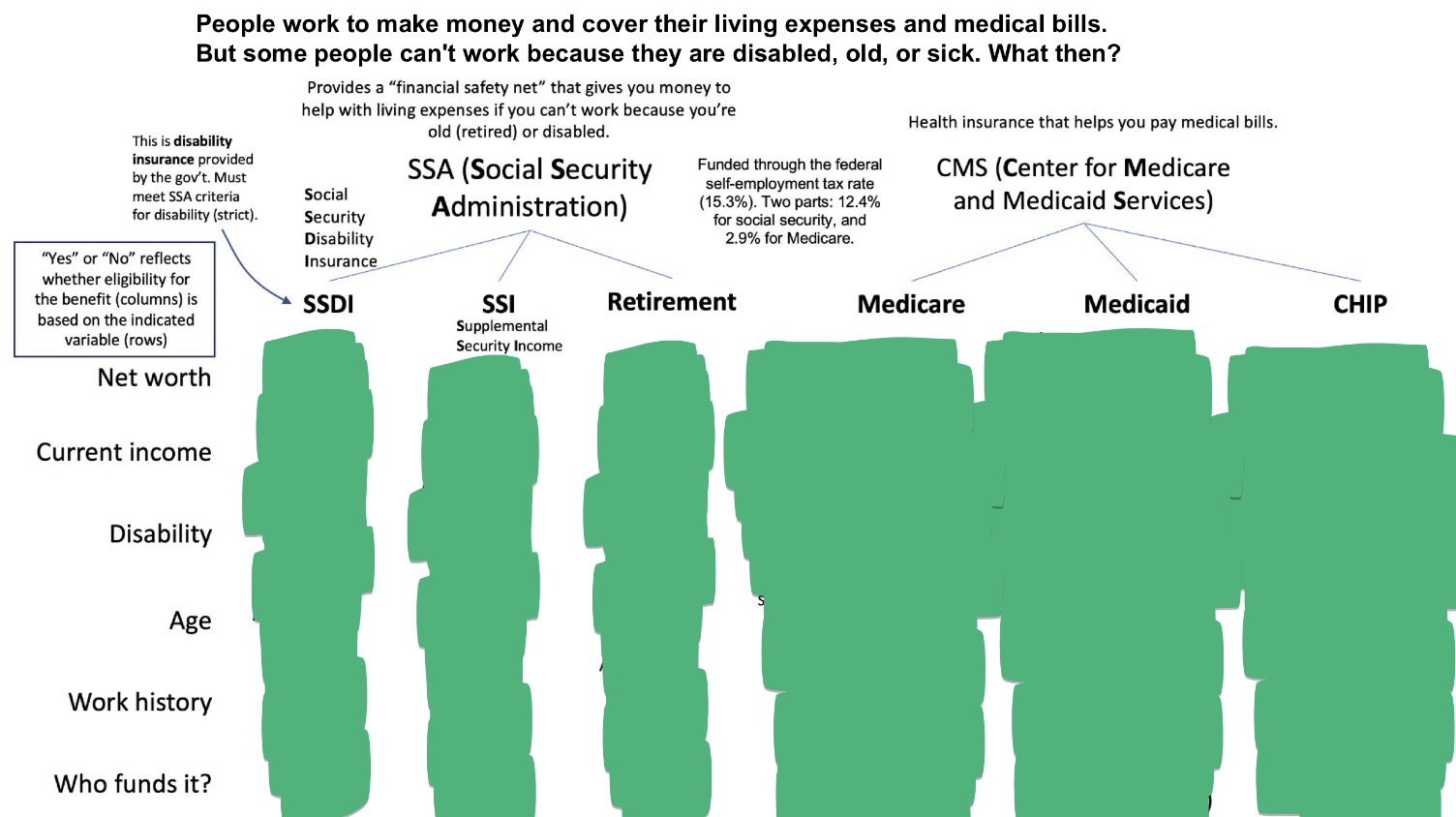
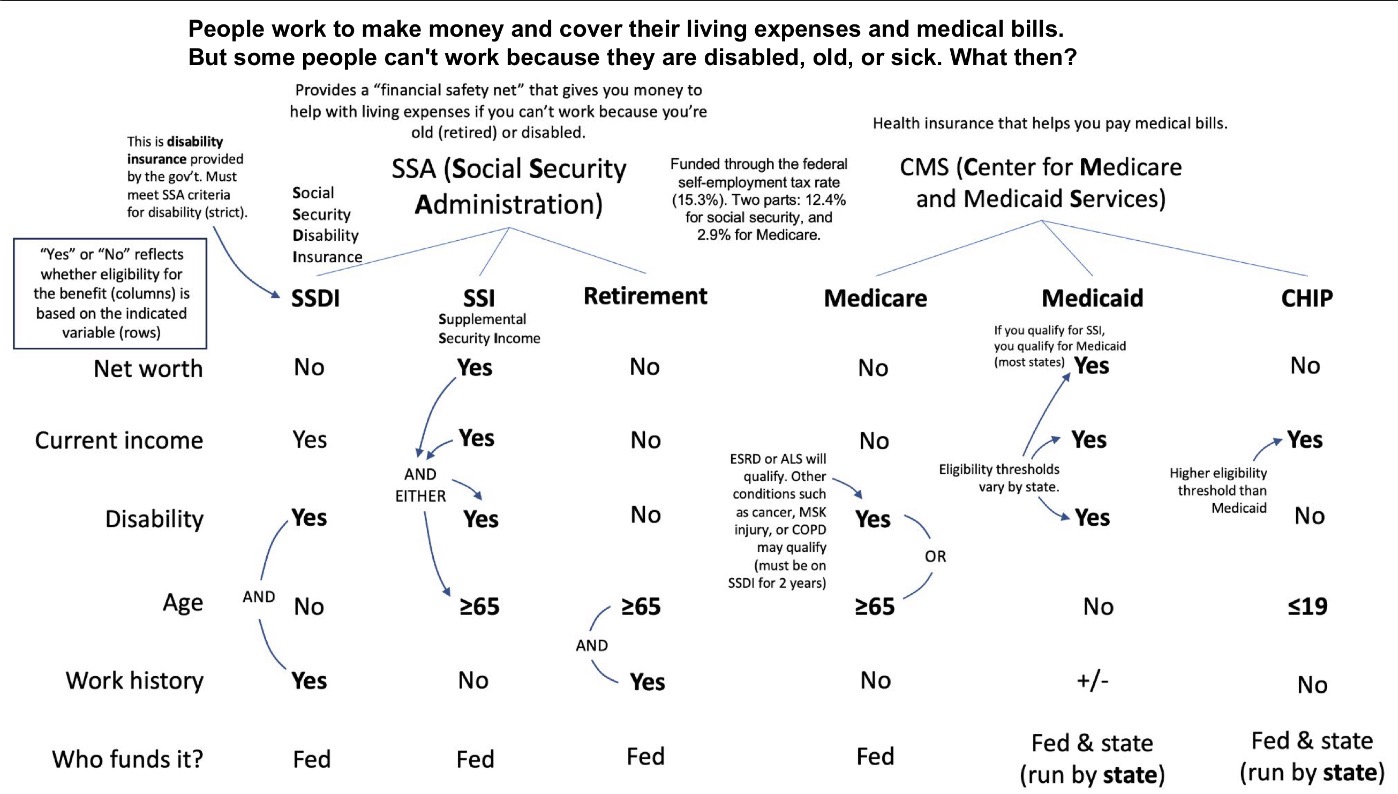
Disabilities that qualify a person for Medicare vs Medicaid
Medicare has a narrow set of criteria (defined by the Social Security Administration) regarding what constitutes a disability.
- Includes ALS and end-stage renal disease
- Must meet 2 sets of criteria:
Medical: unable to engage in “substantive” gainful activity due to disease or injury
Work: previously paid into Medicare system (via taxes)
- Applies across the U.S.
- Examples of conditions that could qualify for a disability include MSK/back injuries, congestive heart failure, COPD, multiple sclerosis
Medicaid definition is looser and varies.
Under what conditions does Medicare directly pay for GC services
Medicare with Parts A and B may cover genetic counseling when the procedure is undertaken as the result of a medical necessity in a skilled nursing facility or when counseling has been ordered by a Medicare-approved physician prior to starting a medication that may be covered under Part D.
Counseling may also be covered as part of a temporary stay at a skilled nursing facility or hospital under Medicare Part A.
Although genetic counseling may be covered by Medicare when ordered by a physician, genetic counselor services are not generally covered independently so can’t see them on their own. You will need to have the testing completed under your doctor’s orders.
Medicare-provider status is different than state licensure (ensures that only qualified individuals are practicing under the title of “Genetic Counselor”. May be required for some commercial insurances to reimburse for GC services.)
GCs are not recognized by Medicare as billing providers & can't receive direct reimbursements for services they provide.
GCs can receive indirect reimbursement for their services through Medicare when billed as incident to" those of a physician supervisor. The physician supervisor must have previously seen the patient, established a care plan, and must be present in the office suite or available via video chat.
What type of billing can be can be done for lab testing?
Institutional billing – the hospital or healthcare facility acts as the billing provider. Testing may be performed in house or sent to a 3rd party laboratory (eg GeneDx, Invitae).
Hospitals contract with laboratories for preferred pricing (incentive is to perform the test at the lowest cost) and are responsible for billing the patient’s insurance.
Non-institutional billing (laboratory billing) – the laboratory acts as the billing provider (will bill the patient’s insurance). Insurance may have in-network laboratories where testing can be performed.
Self pay (cash pay) – Patient pays the laboratory directly for the test. Lab may be associated with a hospital or a 3rd party (GeneDx, Invitae). No insurance involved. Can be offered if insurance denies coverage of testing.
Medicare Part A
Federal insurance for retirees age 65y+ covering hospital (inpatient) services, hospice, and home healthcare.
A looks like a house / hospital
Hospital (inpatient) services
Hospice
Home healthcare
Skilled nursing home (facility)
Medicare Part B
Federal insurance for retirees age 65y+ covering outpatient services where the patient pays 20% co-insurance and no prior authorizations are required.
B looks like two O's
Out patient physiuan services
Outpatient diagnostics
Outpatient surgery
Hospital Observation
Medicare Part C
Private health insurance companies providing Medicare benefits, such as Medicare Advantage Plans.
C is for Companies medicare advantage for private health insurance companies to provide medicare benefits
Medicare Part D
Drug coverage provided by private insurance companies through government contracts.
D is for Drugs
Prescription Drug coverage provided by private insurance companies with govt contracts
Medicaid
A state-specific program funded by state and federal governments for low-income individuals, families, and disabled or pregnant persons or postpartum, and emancipated minors.
Tricare
Health insurance for active-duty military, retirees, and their families.
CHIP
Children's Health Insurance Program; provides health coverage to uninsured children and some pregnant women in families with incomes too high for Medicaid but too low for private coverage.
Private coverage - fully insured vs self insured
Fully insured- when an employer purchases a health insurance plan from an insurance company, insurance company takes the risk. Groups are pooled→ risk is shared across groups and more risk can be assumed. Services come from selected carriers
Self-insured - employer or group assumes the financial risk, instead of purchasing a fully insured plan, benefits administered by 3rd party insurance company, may set limits to coverage.
Upcoding
An insurance fraud practice of billing for more than the actual services provided.
Unbundling
Using individual gene codes for panel billing instead of a single panel code to increase the rate of reimbursement.
Insurance Churning
When a person undergoes multiple changes in insurance coverage in a short period, often leading to discontinuity of care.
In what scenario is assent necessary for minors in order to proceed w testing, tx, etc?
Non-clinic so care scenarios (research), assent is NECESSARY. Age range is around 7y +. Patients <7y or w/ severe ID cannot provide assent.
In life-saving procedures or other scenarios like clinically indicated testing, consent from a parent (but ideally both) is needed, but assent is not. If parents divorced and joint legal custody then requires consent from both. Exception if the minor is emancipated, they can consent to further care.
Next of Kin Hierarchy
The ranked order for medical decision-making: Spouse, Adult Children, Parent, Adult Sibling, nearest living relative, then Close friends.
WIC
Women, Infants, and Children; federal grants for food and nutrition education for low-income pregnant/postpartum women and children up to age 5.
SNAP
Supplemental Nutrition Assistance Program; provides food benefits to low-income individuals via an Electronic Benefits Transfer (EBT) card.
Early Intervention
Services like speech and physical therapy for children ages 0−3 with developmental delays.
Respite Care
Short-term childcare or adult care services that offer temporary relief to primary caregivers.
Vocational Rehabilitation
A program designed to assist individuals with disabilities in preparing for, finding, and maintaining employment.
HIPAA Security Rule
Regulations applying specifically to Electronic PHI (e-PHI) utilizing administrative, physical, and technical safeguards such as role-based access.
Require records release to share PHI.
ONLY applies to the living! If deceased, can share w/ next of kin but hospitals may have different policies
Medical Negligence
A provider's failure to perform duties carefully, involving the "4 D's": Duty, Deviation from standard of care, Damages, and Direct Cause.
Medical Incompetence
A situation where a provider does not possess the specific skills required to perform a given task.
Therapeutic Misconception
When a research participant or investigator inaccurately attributes therapeutic intent to research procedures.
Common Rule
Protects human subjects in research.
Establishes IRBs, informed consent requirements, and assurances of compliance
Additional protections for vulnerable populations like children, prisoners, and neonates, and the
Teaching Role (Supervision)
A supervisor role where specific feedback is provided to help a novice student learn the appropriate way to handle a counseling situation.
Consultation Role (Supervision)
A supervisor role for advanced students who require advice on how to improve their pre-identified counseling approaches.
Counseling Role (Supervision)
A supervisor role that focuses on identifying and exploring the emotions felt by the student during a case.
Evaluation Role (Supervision)
A supervisor role focused on providing formal qualitative or quantitative feedback to the student.
Institutional Review Board (IRB)
A committee that reviews and approves research involving human subjects to ensure ethical standards are met.
Informed Consent
A process by which research participants are fully informed about the study's purpose, procedures, risks, and benefits before agreeing to participate.
Exempt Research
Studies that involve minimal risk to participants and meet specific criteria, exempting them from full IRB review. No sensitive topics or vulnerable populations. usually educational tests, surveys, deidentified data.
Expedited Review
A type of IRB review for research involving no more than minimal risk and for certain categories of research eligible for quicker review.
Usually looked at by one designated board member.
Continuing/Full board Review
More than minimal risk ex. clinical/drug trials
Periodic review of ongoing research studies by the IRB to ensure the safety and welfare of participants.
Recruitment Materials
Documents and advertisements used to enlist participants for research studies, requiring IRB approval prior to use.
Research Risk Assessment
Evaluation conducted by the IRB to identify potential risks to participants and ensure they are minimized.
Stages of grief
Denial
Anger
Bargaining
Acceptance
and Depression
Federalwide Assurance (FWA)
A commitment by an institution to comply with federal regulations regarding the protection of human subjects in research.
Individualized Education Program (IEP)
A written plan developed for a student with a disability that outlines the specific designed instruction/educational services and support the student will receive, tailored to their individual needs.
Section 504 Plan
A plan developed to ensure that a child with a disability has equal access to an education, outlining accommodations and modifications that enable their participation in the general education curriculum.
Student needs access
FAPE (Free Appropriate Public Education)
The legal requirement that students with disabilities are provided with an education that meets their unique needs at no cost to the family.
Least Restrictive Environment (LRE)
The requirement that students with disabilities are educated in the least restrictive setting appropriate to their needs, alongside their non-disabled peers to the maximum extent possible.
Due Process
A legal requirement that persons be given a fair and reasonable process when making decisions regarding special education services, including the right to dispute decisions through a formal process.
Confidentiality in Research
The ethical obligation to protect the privacy of research participants by keeping their data secure and not disclosing personal information without consent.
Beneficence in Research
The ethical principle that researchers should act in the best interest of the participants, maximizing potential benefits while minimizing harm.
patient-centered communication
Guide clinical practice through a bidirectional relationship between counselor and patient.
Tenets:
Patients are resilient
Patient emotions make a difference
Patient autonomy must be supported
Relationship between patient and counselor is integral to GC.
Genetic information is key, patient looking to enhance understanding.
Congruence
The match between the counselor's inner process and the response.
Empathy
The ability to accurately understand the client's experience as if it were your own and to communicate this understanding to the client.
Attending behaviors
Head nodding, smiling, and facing the patient.
Questioning
The act of asking questions to gather information.
Open questions
Invites broad responses.
Focused questioning
Guides response toward specific circumstances.
Close ended questioning
Asks for yes/no answers or for specific details; does not encourage elaboration.
Rephrasing
Restate your understanding of what the client has said.
Reflecting
Involves repeating the last phrase of a patient statement in the form of a question to encourage further exploration of the topic.
Redirecting
Technique used by the GC to manage the rate of information exchange to direct the introduction and flow of topics or to refocus the discussion.
Promoting Shared Language
Mirroring patients' language or communication style including word usage, speaking tempo, and the use of colloquial terms.
Silence
Shows respect for a patient story by pausing to take it in rather than rushing to comment.
People first language
"The child with cystic fibrosis" as opposed to "the cystic fibrosis child."
GeneReviews
Expert authored, peer reviewed summaries of genetic conditions including clinical features, diagnostic criteria, and more.
Online Mendelian Inheritance in Man (OMIM)
Comprehensive online database of genetic conditions, their patterns of inheritance, and a compendium of human genes.
Confronting
Trying to change the opinion of the person in charge.
Distancing
Going on as if nothing happened.
Self-controlling
Keeping feelings to oneself.
Seeking social support
Engaging in conversation in the hope of learning more.
Accepting responsibility
Criticizing oneself.
Escape-avoidance
Hoping for a miracle. ex. newly dx patient gets up and says they need to leave. Distraction is a form of escape.
Avoidance where individual does not enter the situation, like repeatedly cancels their results appointment.
Hoped a miracle would happen
Had fantasies or wishes about how things might turn out
Wished the situation would go away or be over w/
Magical thinking like carrying a lucky charm for good things to happen
Trying to distract oneself like drinking, eating, smoking, etc.
Plan
Identifying and following an action plan.
Positive reappraisal
Identifying existing or potential positive outcomes.
Self psychology
Psychological challenges that face us can be traced back to self-object experiences.
Self in Relation Theory
Development of self emerges from relational interaction with early caregivers and later with others in adult life.
Family System Theories: Strategic Approach
This approach finds its roots in the work of Milton H. Erickson and Jay Haley, using directive therapeutic interventions with families.
Family System Theories: Structural Approach
Focuses on family structure as the key organizing tenet of functionality and essential to the well-being of family members.
Family System Theories: Multigenerational Analysis
Interlocking concepts that include differentiation of the self, family dynamics, and emotions.
Family Systems-Illness Model
Provides a perspective on the interactive processes of psychosocial demand of the illness, family beliefs, and family functioning.