Ear Chapter
 Call Kai
 Learn
Learn Practice Test
 Spaced Repetition
 Match
Match Flashcards
 Knowt Play
1/33

There's no tags or description
Looks like no tags are added yet.
Name | Mastery | Learn | Test | Matching | Spaced | Call with Kai | Chat |
|---|
No analytics yet
Send a link to your students to track their progress
34 Terms
Define conductive hearing loss
Something blocks or impairs the passage of vibrations from getting to the inner ear
So there’s a blockage in the outer or middle ear (fluid, foreign objects, odee wax, allergies)
What are some conductive hearing loss sx?
sound best heard in affected ear (weber test)
muffled hearing
draining from ear
dizziness
pain/tendernes in ear
ear feels full or stuffy
sudden or steady loss of hearing
Define sensoineural hearing loss
damage located in inner ear
so there’s smth happening within the body
What are some sensoineural hearing loss sx?
sound best heard in normal ear (weber)
particular difficulty understanding kid + lady voices (presbycusis)
trouble hearing high pitched sounds ^^
trouble hearing when there’s background noise
Ear drainage (otorrhea) with pain and popping may indicate…?
Otitis media (middle ear infection) w/ tympanic membrane rupture
What is sudden sensorineural hearing loss? Why is it significant?
Rapid loss of hearing that occurs over hours to a few days
It’s considered a medical emergency
Pain when the pinna is moved may indicate..?
Otitis externa (swimmer’s ear/outer ear infection)
What’s the term for ear pain?
Otalgia
Why is tinnitus important to ask about?
It can indicate hypertension issues or use of ototoxic medications (antibiotics, aspirin, nsaids, furosemide, vancomycin)
What may vertigo indicate? What are the 2 main types?
Inner ear problem
1 - subjective vertigo: pt feels that they are spinning around
2 - objective vertigo: pt feels that the room is spinning around
What condition should you ask about when taking family hx?
Otosclerosis (ossicle fusion that reduces sound transmission)
What are some lifestyle/enviornmental factors to ask about?
work/living environment w/ loud noise
prolonged exposure to loud noises
q tip use
hearing protection use
swimming/water exposure
How is hearing loss defined in terms as dB
Inability to hear as well as normal hearing (>25 dB)
>40 dB is considered disabling hearing loss
What are the 4 main types of hearing loss?
1 - conductive (issue in outer to middle ear)
2 - sensorineural (issue in inner ear or auditory nerve)
3 - mixed (combo of ^^)
4 - auditory neuropathy spectrum disorder (sound enters normally but cannot properly interpret signals)
What are the 2 main causes of hearing loss?
1 - congenital (maternal infections, low birth weight, birth asphyxia)
2 - acquired (infections, ototoxic medications, aging, wax, loud noise exposure)
List the 4 main ototoxic meds class
1 - aminoglycoside antibiotics (vancomycin)
2 - chemotherapy drugs
3 - loop diuretics (furosemide)
4 - NSAIDs (aspirin, ibuprofen, naproxen)
What’s a specific pt teaching for older adults?
Have hearing checked periodically, especially after 50
What’s a specific pt teaching for new mothers?
Avoid feeding from bottle while infant is lying on back (fluid can get into ears)
Cone of light should be ____ in right ear and ____ in left ear
5:00 and 7:00
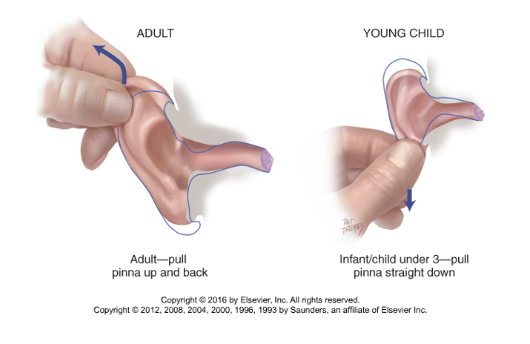
How do you inspect an ear on a child vs adult?
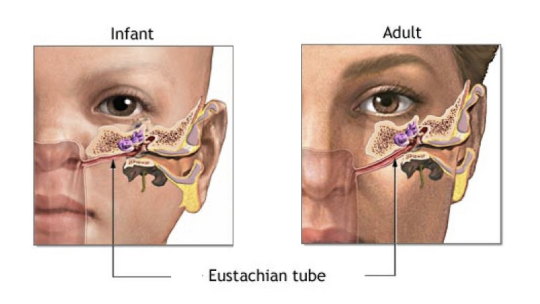
Child - pull ear down and back (b/c eustachian tube is horizontal)
Adult - pill ear up and back (b/c eustachian tube is angled)
Enlarged pre-auricular/post-auricular lymph nodes indicate …?
infection
Tophi (hard nodules on helix) indicate…?
gout
Ulcerated or bleeding nodules indicate…?
possible skin cancer
Redness, swelling, scaling, itching indicate…?
otitis externa
Why do kids get ear infections more than adults?
They have a horizontal and shorter eustachian tube, so their ears are less able to drain fluids
Why do we inspect the good ear first and then bad ear second?
Pt comfort
What are some abnormal findings when palpating the external ear (tragus/pinna/mastoid)
pain when moving auricle or pressing tragus (otitis externa or cyst)
tender mastoid process (mastoiditis)
tenderness behind ear (possible otitis media)
What is the weber test?
A test used when pt reports hearing loss in one hear.
It helps distinguish conductive vs sensorineural hearing loss in that ear.
How do you perform the weber test?
Strike a tuning fork and place it at the midline of the head or forehead. Then ask pt where the sound is heard best (right ear, left ear, or equally)
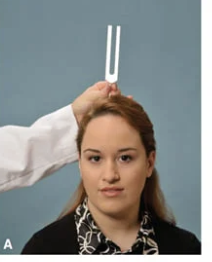
What are normal and abnormal weber test results?
Normal: sound heard equally in both ear (no lateralization)
Abnormal:
conductive (heard better in BAD EAR) - good ear is distracted by background noise and conducted ear, so poor ear gets most of the sound conducted by bone vibration
sensorineural (heard better in GOOD EAR) - limited perception of the sound due to nerve damage in bad ear makes sound seem louder in good ear
What is the rinne test?
A test used to help determine the type of hearing loss present by comparing air conduction and bone conduction
How do you perform the rinne test?
Strike a tuning fork and place the base of it on mastoid process to test bone conduction. Ask pt when sound is no longer heard.
Repeat steps but put tuning fork on external auditory canal instead to test air conduction
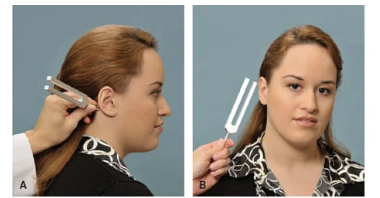
What are normal vs abnormal results of the rinne test?
Normal: AC > BC
Abnormal:
conductive: BC ≥ AC
sensorineural: AC > BC, but hearing is reduced in both ears
What are older adult considerations?
presbycusis normal after 50
otosclerosis occurs b/c auditory ossicles develop a spongy consistency, so you get conductive hearing loss
self image w/ hearing aid
coarse thicc hair at ear canal
tympanic membrane may look cloudy