Nutrition Exam 1
 Call Kai
 Learn
Learn Practice Test
 Spaced Repetition
 Match
Match Flashcards
 Knowt Play
1/241

There's no tags or description
Looks like no tags are added yet.
Name | Mastery | Learn | Test | Matching | Spaced | Call with Kai | Chat |
|---|
No analytics yet
Send a link to your students to track their progress
242 Terms
Chapter 3: How is food moved through the GI tract?
Moved by muscular contractions around the organs, including peristalsis and segmentation.
What is peristalsis and where does it begin?
Peristalsis is a wave of muscular contractions that pushes food forward, beginning in the esophagus.
What is the function of segmentation in the GI tract?
Segmentation moves liquid food (chyme) back and forth, breaking it down and mixing it with secretions for absorption.
Why are enzymes and water necessary for macronutrient digestion?
Macronutrients are too large to be absorbed, so enzymes and water break them into smaller monomers.
What happens during the enzymatic digestion process?
A substrate binds to an enzyme's active site, the bond is broken by hydrolysis, and products are released.
Where does mechanical digestion begin in the digestive system?
Begins in the mouth with chewing.
What is the role of amylase in saliva?
____ in saliva begins the breakdown of complex carbohydrates (starch) into maltose.
What is a bolus and how is it formed?
____ is liquified food formed in the mouth by chewing and mixing with saliva to ease swallowing.
What is the function of lingual lipase, and where is it secreted?
_____ is secreted in the mouth, but its specific function isn't detailed beyond secretion.
Do macronutrients get absorbed in the mouth?
No, though some micronutrients can be absorbed sublingually.
How are the five basic taste sensations perceived?
Via sensory nerves in taste buds, detecting sweet, sour, bitter, salty, and umami/savory.
How is flavor achieved in the mouth?
Through olfactory nerves, detecting sensations like grape, cinnamon, or garlic.
How does food move from the mouth to the stomach?
Moves from the mouth to the stomach via the pharynx and esophagus through peristalsis.
What controls the movement of food through the esophagus?
Two sphincter muscles, the upper and lower esophageal sphincters, control movement via parasympathetic vagus nerve stimulation.
What is the function of the lower esophageal sphincter (LES) during swallowing?
Relaxes to allow the bolus to enter the stomach after swallowing.
What happens to the LES after food enters the stomach?
The LES contracts to prevent stomach contents from returning to the esophagus.
How does mechanical digestion occur in the stomach?
Churns the bolus into liquified chyme using circular, longitudinal, and diagonal muscles for peristalsis and back-and-forth movement.
What is the role of the pyloric sphincter in the stomach?
Stays closed until the bolus is fully liquified into chyme.
What initiates chemical digestion in the stomach?
Begins with the hormone gastrin, released by stomach cells in response to the bolus.
What do gastric juices contain and what stimulates their release?
Contain water, mucus, pepsinogen, and hydrochloric acid, stimulated by gastrin.
What is the function of pepsin in the stomach?
An enzyme, breaks down large proteins in the stomach.
What are the functions of hydrochloric acid (HCl) in the stomach?
Breaks apart connective tissue, maintains a low pH for enzymatic action, and kills bacteria.
Are macronutrients absorbed in the stomach?
No, though some alcohol and micronutrients can be.
How does chyme move from the stomach into the duodenum?
Moves from the stomach into the duodenum via the pyloric sphincter.
How is chyme mixed and moved along the small intestine?
Peristalsis (longitudinal muscles) and segmentation (circular muscles) mix chyme with digestive juices and control its pace.
What nerve controls contractions along the small intestine?
The vagus nerve (CN10) controls contractions along the 10 feet of intestinal tissue.
What stimulates intestinal cells to secrete hormones in the small intestine?
Acidic chyme and the presence of fats stimulate intestinal cells to secrete hormones.
What is the role of secretin in the small intestine?
Acts on the pancreas to release enzymes (amylase, protease, nuclease, lipase) and sodium bicarbonate to lower pH.
What is the function of cholecystokinin (CCK)?
Acts on the gallbladder/liver to secrete bile, which emulsifies fats for digestion by pancreatic lipase.
What do incretin hormones like GLP-1 do?
GLP-1 from the lower small intestine signals the pancreas to produce insulin and reduces hunger feelings.
How do GLP-1 agonists work in obese/T2DM patients?
GLP-1 agonists mimic GLP-1 to reduce food intake and lower blood glucose levels.
What do epithelial cells in the crypts of the small intestine secrete?
Epithelial cells in the crypts secrete intestinal enzymes (e.g., lactase, maltase) and antimicrobial proteins.
What is the function of goblet cells on the villi?
Goblet cells on the villi secrete mucus.
What is the role of stem cells in the crypts of the small intestine?
Produce replacement cells for the villus, which is "turned over" quickly.
What features increase the surface area of the small intestine for nutrient absorption?
Its length, circular folds, villi, and microvilli increase its surface area by over 600 times.
What are circular folds in the small intestine?
Circular folds are heavy folds in the lining of the small intestine that increase surface area for nutrient absorption.
What are villi and what do they contain?
Thousands of fingerlike projections covering the circular folds, containing capillaries and a lacteal.
What is the function of capillaries and lacteals within each villus?
They pick up nutrients absorbed through enterocytes and transport them throughout the body.
What are microvilli, and what is their function?
Hair-like projections on enterocytes that form the brush border for nutrient absorption.
Where does absorption primarily occur in the small intestine?
Along the length of the villus, specifically in the jejunum and ileum.
How are water-soluble nutrients absorbed in the small intestine?
They are absorbed by intestinal cells and then into capillaries.
How are fat-soluble nutrients and larger fats absorbed?
They form clusters with special proteins, are absorbed into chylomicrons, and then into lymphatic lacteals.
What is passive diffusion?
Nutrients pass through the cell membrane without requiring a carrier protein or energy.
What is facilitated diffusion?
Nutrients are absorbed by a specific carrier protein to transport them across the cell membrane, but no energy is needed.
What is active transport?
It requires both a carrier protein and energy to move nutrients across the cell membrane against a concentration gradient.
What is endocytosis?
Whole molecules are engulfed by the cell membrane.
Does mechanical digestion occur in the large intestine?
No, but undigested material moves via peristalsis through the ileocecal valve.
What happens during chemical digestion in the large intestine?
Millions of microbes digest and metabolize fibers and remaining nutrients, producing water, gas, and nutrients.
What are prebiotics?
Substances that support the growth and activity of beneficial bacteria.
What are probiotics?
Live microbes that are beneficial to health.
What is absorbed in the large intestine?
Water, salts, and vitamins.
What is the role of the rectum and anus in the large intestine?
The rectum stores remaining waste, and the anus eliminates it via defecation through sphincters.
How are hormones involved in the regulation of the digestive system?
Released from GI tract cells in response to stimulation, traveling through the circulatory system to target organs.
What is the function of Ghrelin?
It is released from stomach cells and increases hunger.
What is the function of Gastrin?
It is released from stomach cells and stimulates secretions from the stomach and stomach motility.
What is the function of Secretin?
It is released from the small intestine and increases bicarbonate ions from the pancreas.
What is the function of CCK (Cholecystokinin)?
It is released from the small intestine and stimulates the secretion of enzymes from the pancreas and bile from the gallbladder.
What is the function of GIP (Gastric Inhibitory Peptide)?
It is released from the small intestine and increases secretions from the pancreas and small intestine while decreasing stomach motility.
What is the function of Peptide YY?
It is released from the small intestine and decreases hunger.
What is the role of the Vagus Nerve (CNX) in digestion?
It is involved in motility and secretion during digestion and brings sensory information from the GI tract.
What is the role of spinal nerves in digestion?
They are involved in reducing motility and secretion during stressful times.
What is the Enteric Nervous System?
Specific to the GI tract, consisting of the Myenteric and Submucosal plexuses.
What is the function of the Myenteric Plexus?
It is responsible for motor control (peristalsis) by influencing Interstitial Cells of Cajal.
What is the function of the Submucosal Plexus?
It innervates the submucosal layer and is responsible for the secretion of enzymes and mucus.
What hormone stimulates the release of gastric juices?
Gastrin.
What is the general flow of blood in the circulatory system?
Arteries carry blood away from the heart, to arterioles, then capillaries, venules, and veins return it to the heart.
What is the primary site of nutrient absorption and exchange in all body tissues?
Capillaries.
What is the role of the hepatic artery?
It brings freshly oxygenated blood from the lungs to the hepatocytes (liver cells).
What do the celiac and mesenteric arteries do?
They bring blood from the aorta to the capillaries of the digestive tract.
What is the hepatic portal vein's role in the liver?
Blood leaving digestive tract capillaries merges into it, branching into capillaries where hepatocytes detoxify the blood.
How does blood leave the liver and return to the heart?
The hepatic vein gathers blood in the liver and returns it to the heart via the inferior vena cava.
What nutrients are absorbed into the capillaries of the digestive tract?
Amino acids, glucose, and fructose.
What do lymphatic vessels in the abdomen absorb?
Amino acids from cells and interstitial fluids that leak from networks of lymph capillaries.
How are fat-soluble nutrients packaged and absorbed?
They are packaged into chylomicrons and absorbed into lacteals of the intestinal villi, not the portal vein.
Where do chylomicrons go after being absorbed into lacteals?
They are routed through lymph nodes, the thoracic duct, and into the blood circulation via the subclavian vein.
What happens when an adult mammal with lactose intolerance ingests milk?
Lactose is not digested in the small intestine and is fermented by bacteria in the large intestine.
What are the byproducts of lactose fermentation in the large intestine, and what do they cause?
Hydrogen gas, which irritates the large intestine lining, causing bloating, gas, and diarrhea.
Who was Virginia H. Holsinger?
A food chemist who helped create the lactase enzyme (Lactaid), the beano enzyme, and low-moisture mozzarella cheese.

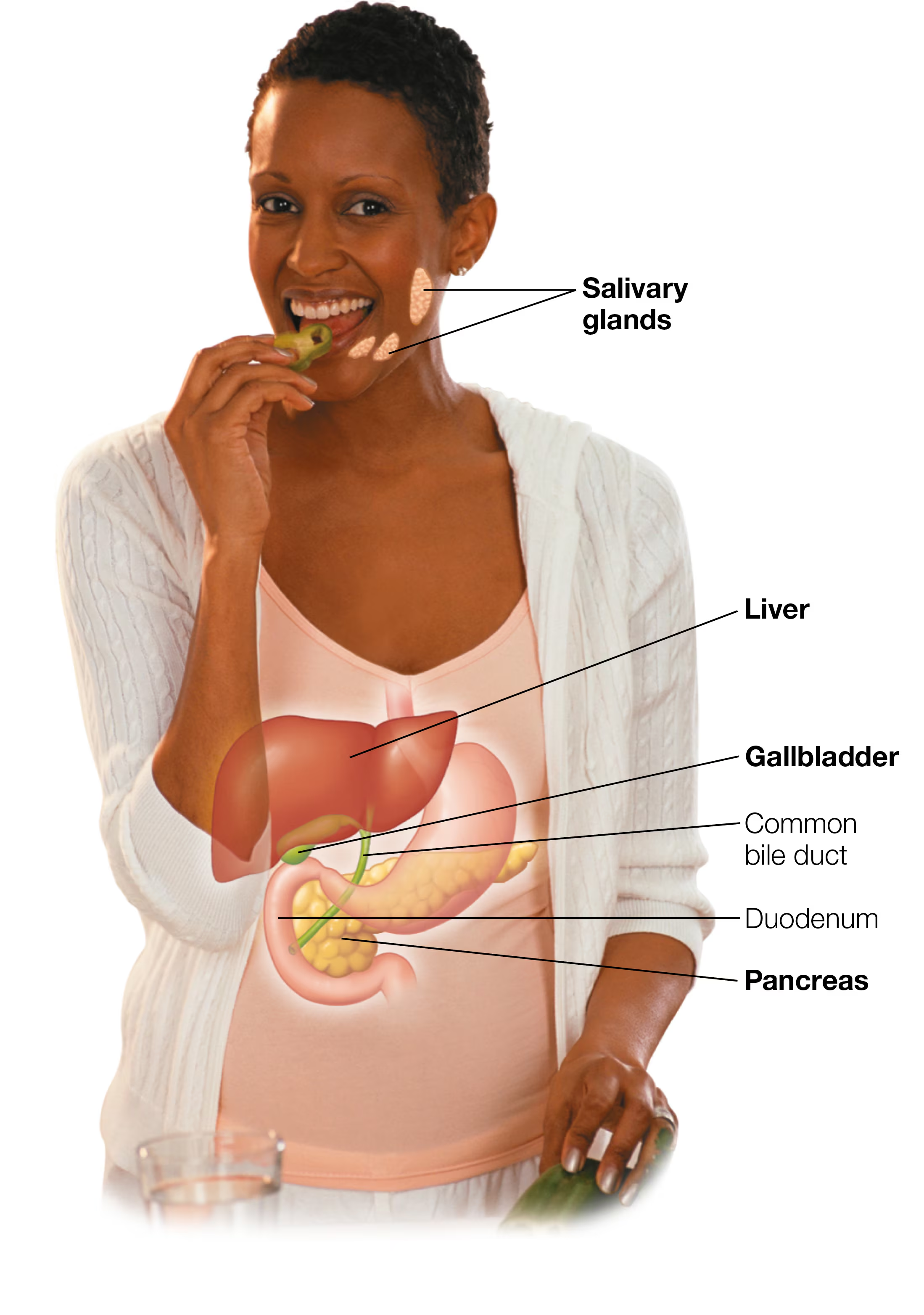
Identify the following structures on this diagram:

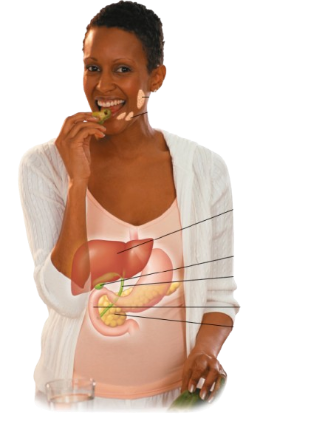
Identify the following structures on this diagram:
What is Irritable Bowel Syndrome (GI Syndrome)?
Recurring abdominal pain related to an abnormal immune response by the gut to oligosaccharides.
What dietary approach can help abate symptoms of Irritable Bowel Syndrome?
Diets low in FODMAPs (fermentable oligosaccharides, disaccharides, monosaccharides, and polyols).
What is Crohn's Disease?
Inflammation anywhere along the GI tract, affecting all layers of the small and large intestines.
What is Ulcerative Colitis?
Inflammation of the inner layer of the large intestine.
What causes Diverticulitis?
Weak pockets in the large intestine lining that entrap feces and become infected.
What is the origin of Colorectal Cancer tumors?
Epithelial cells due to a second chromosome mutation.
What are common screenings for Colorectal Cancer?
Colonoscopy and removal of polyps.
What is Celiac Disease?
An autoimmune disease causing inflammation of the small intestine in response to gluten.
How does gluten sensitivity differ from Celiac Disease?
Gluten sensitivity has similar symptoms but is not an autoimmune response.
What are non-celiac gluten sensitivity reactions?
Immune responses to foods that may or may not be caused by gluten or FODMAPs.
What are the five basic tastes detected by human taste buds?
Sweet, sour, salty, bitter, and umami.
What is the number one factor influencing food choices?
Taste and enjoyment.
How do genetic differences influence taste preferences?
They influence preferences for sweetness, saltiness, creaminess, and fat.
What impact does texture have on food acceptance?
Texture strongly affects acceptance, such as preferences for flaky crusts or crunchy apples.
How do smaller glasses influence beverage consumption?
lead to less beverage being consumed
How do cultural traditions influence food choices?
They shape staple foods, such as corn in Mexican cuisine or rice in Japanese cuisine.
What effect do visible food cues have on eating behavior?
They can trigger eating even without hunger.
How do larger plates influence food consumption?
Larger plates lead to more food being eaten.
What potential health risk is associated with eliminating food groups, such as all plant foods?
Eliminating food groups can cause nutrient deficiencies.
How does social media influence food choices?
It heavily influences food choices and spreads misinformation, often through influencers promoting fad diets.